
High cholesterol management
"dyslipidemia" AND "management" AND "guidelines"
LDL cholesterol management statin therapy cardiovascular risk diagram
![Summary : This flowchart summarizes patient management groups for cholesterol and cardiovascular risk, outlining key factors to consider and optional interventions for different patient populations.
flowchart:
# Nodes :
• "PATIENT MANAGEMENT GROUPS" (black rectangle, top center)
• "Secondary prevention" (green rounded rectangle, below left)
• "Primary prevention" (green rounded rectangle, below right)
• "Adults with clinical ASCVD" (green rounded rectangle, under Secondary prevention)
• "Adults with primary severe hypercholesterolemia (LDL-C ≥190 mg/dL [≥4.9 mmol/L])" (green rounded rectangle, center, under both prevention types)
• "Adults with diabetes" (green rounded rectangle, under Primary prevention)
• "Adults without diabetes" (green rounded rectangle, under Primary prevention)
• "FACTORS TO CONSIDER:" (purple rectangle, below all patient groups)
• "OPTIONAL INTERVENTIONS TO CONSIDER IN APPROPRIATE PATIENT GROUPS:" (orange rectangle, bottom)
# Connectors :
• Downward arrows from "PATIENT MANAGEMENT GROUPS" to "Secondary prevention" and "Primary prevention".
• Downward arrow from "Secondary prevention" to "Adults with clinical ASCVD".
• Downward arrows from "Primary prevention" to "Adults with diabetes" and "Adults without diabetes".
• "Adults with primary severe hypercholesterolemia" is connected to both prevention types.
• All four patient group nodes point downward to "FACTORS TO CONSIDER".
• "FACTORS TO CONSIDER" points downward to "OPTIONAL INTERVENTIONS TO CONSIDER IN APPROPRIATE PATIENT GROUPS".
# Layout :
• Hierarchical, top-down arrangement.
• Two main branches (Secondary and Primary prevention) with subgroups.
• Central node for severe hypercholesterolemia connects both branches.
• Factors and interventions listed in large rectangles below patient groups.
# Factors to Consider :
• Adherence to lifestyle modifications and evidence-based, guideline-recommended statin therapy.
• Patient on guideline-recommended statin therapy.
• Risk-enhancing factors.
• Control of other risk factors.
• Clinician-patient decision about potential benefits, harms, and preferences regarding nonstatin therapies.
• Percentage LDL-C reduction and absolute LDL-C or non-HDL-C level achieved.
• Monitoring response to lifestyle modifications, adherence, and therapy.
• Cost of therapy.
• Statin-associated side effects.
• Persistent hypertriglyceridemia.
# Optional Interventions :
• Referral to lipid specialist and registered dietitian/registered dietitian nutritionist.
• Ezetimibe.
• Bile acid sequestrants.
• PCSK9 mAbs (alirocumab and evolocumab).
• Bempedoic acid.
• Inclisiran.
• LDL apheresis (for familial hypercholesterolemia).
• Lomitapide (only in HoFH).
• Evincamab (only in HoFH).
# Analysis :
• The flowchart organizes patient management by prevention type and risk group, emphasizing a stepwise approach: first considering lifestyle and statin therapy, then evaluating additional risk factors and patient preferences, and finally listing optional interventions for those not achieving targets or with specific needs.
• The central placement of severe hypercholesterolemia highlights its importance across both prevention categories.
• The chart provides a comprehensive overview for clinicians to tailor therapy based on individual patient characteristics and response.](https://cdn.orris.care/cdss_images/GLGCA_2014663_1763373471887_6131bc5e-b3ec-448c-834d-1e7c2811cf5f.png)
Summary : This flowchart summarizes patient management groups for cholesterol and cardiovascular risk, outlining key factors to consider and optional interventions for different patient populations. flowchart: # Nodes : • "PATIENT MANAGEMENT GROUPS" (black rectangle, top center) • "Secondary prevention" (green rounded rectangle, below left) • "Primary prevention" (green rounded rectangle, below right) • "Adults with clinical ASCVD" (green rounded rectangle, under Secondary prevention) • "Adults with primary severe hypercholesterolemia (LDL-C ≥190 mg/dL [≥4.9 mmol/L])" (green rounded rectangle, center, under both prevention types) • "Adults with diabetes" (green rounded rectangle, under Primary prevention) • "Adults without diabetes" (green rounded rectangle, under Primary prevention) • "FACTORS TO CONSIDER:" (purple rectangle, below all patient groups) • "OPTIONAL INTERVENTIONS TO CONSIDER IN APPROPRIATE PATIENT GROUPS:" (orange rectangle, bottom) # Connectors : • Downward arrows from "PATIENT MANAGEMENT GROUPS" to "Secondary prevention" and "Primary prevention". • Downward arrow from "Secondary prevention" to "Adults with clinical ASCVD". • Downward arrows from "Primary prevention" to "Adults with diabetes" and "Adults without diabetes". • "Adults with primary severe hypercholesterolemia" is connected to both prevention types. • All four patient group nodes point downward to "FACTORS TO CONSIDER". • "FACTORS TO CONSIDER" points downward to "OPTIONAL INTERVENTIONS TO CONSIDER IN APPROPRIATE PATIENT GROUPS". # Layout : • Hierarchical, top-down arrangement. • Two main branches (Secondary and Primary prevention) with subgroups. • Central node for severe hypercholesterolemia connects both branches. • Factors and interventions listed in large rectangles below patient groups. # Factors to Consider : • Adherence to lifestyle modifications and evidence-based, guideline-recommended statin therapy. • Patient on guideline-recommended statin therapy. • Risk-enhancing factors. • Control of other risk factors. • Clinician-patient decision about potential benefits, harms, and preferences regarding nonstatin therapies. • Percentage LDL-C reduction and absolute LDL-C or non-HDL-C level achieved. • Monitoring response to lifestyle modifications, adherence, and therapy. • Cost of therapy. • Statin-associated side effects. • Persistent hypertriglyceridemia. # Optional Interventions : • Referral to lipid specialist and registered dietitian/registered dietitian nutritionist. • Ezetimibe. • Bile acid sequestrants. • PCSK9 mAbs (alirocumab and evolocumab). • Bempedoic acid. • Inclisiran. • LDL apheresis (for familial hypercholesterolemia). • Lomitapide (only in HoFH). • Evincamab (only in HoFH). # Analysis : • The flowchart organizes patient management by prevention type and risk group, emphasizing a stepwise approach: first considering lifestyle and statin therapy, then evaluating additional risk factors and patient preferences, and finally listing optional interventions for those not achieving targets or with specific needs. • The central placement of severe hypercholesterolemia highlights its importance across both prevention categories. • The chart provides a comprehensive overview for clinicians to tailor therapy based on individual patient characteristics and response.
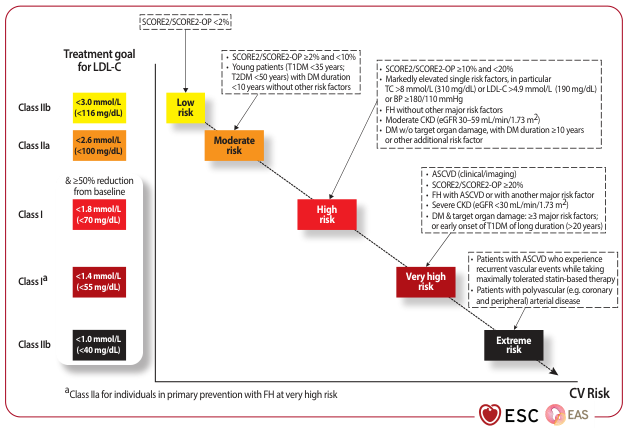
Summary : This figure presents the European Society of Cardiology (ESC) and European Atherosclerosis Society (EAS) guidelines for LDL-C (low-density lipoprotein cholesterol) treatment goals, stratified by cardiovascular (CV) risk categories. It visually links risk categories to specific LDL-C targets and provides criteria for classifying patients into low, moderate, high, very high, and extreme CV risk groups. flowchart: # Risk Categories and LDL-C Treatment Goals : • Low risk: SCORE2/SCORE2-OP <2%; LDL-C goal <3.0 mmol/L (<116 mg/dL), Class IIb. • Moderate risk: SCORE2/SCORE2-OP ≥2% and <10%; LDL-C goal <2.6 mmol/L (<100 mg/dL), Class IIa. • High risk: SCORE2/SCORE2-OP ≥10% and <20%, markedly elevated single risk factors, FH without other major risk factors, moderate CKD, DM without target organ damage but with long duration or other risk factors; LDL-C goal <1.8 mmol/L (<70 mg/dL) & ≥50% reduction from baseline, Class I. • Very high risk: ASCVD, SCORE2/SCORE2-OP ≥20%, FH with ASCVD or other major risk factor, severe CKD, DM with target organ damage or ≥3 major risk factors or early onset T1DM of long duration; LDL-C goal <1.4 mmol/L (<55 mg/dL), Class Ia (Class IIa for FH in primary prevention at very high risk). • Extreme risk: Patients with ASCVD who experience recurrent vascular events while on maximally tolerated statin-based therapy, patients with polyvascular disease; LDL-C goal <1.0 mmol/L (<40 mg/dL), Class IIb. # Node Details : • Each risk category is represented by a colored box: yellow (low), orange (moderate), red (high), dark red (very high), black (extreme). • Each box contains criteria for risk classification and corresponding LDL-C treatment goal. • LDL-C goals are listed in a vertical column on the left, color-coded to match risk categories. # Connectors and Layout : • Arrows connect risk categories to their respective LDL-C goals. • The flow is diagonal from top left (low risk) to bottom right (extreme risk), indicating increasing CV risk and stricter LDL-C targets. • Additional notes clarify special cases (e.g., young patients, FH, CKD, DM). # Design Encodings : • Color coding: yellow (low), orange (moderate), red (high), dark red (very high), black (extreme). • Boxed text for risk criteria and LDL-C goals. • Dotted and solid arrows indicate progression and relationships. • ESC and EAS logos at the bottom right. # Analysis : • The figure visually emphasizes the stepwise intensification of LDL-C targets as CV risk increases. • The most stringent LDL-C goals (<1.0 mmol/L) are reserved for patients at extreme risk, such as those with recurrent ASCVD events or polyvascular disease. • The diagram provides a clear decision-making pathway for clinicians to match patient risk profiles with appropriate LDL-C treatment goals, highlighting the importance of risk stratification in lipid management. • The color gradient reinforces the urgency and clinical priority associated with higher risk categories.
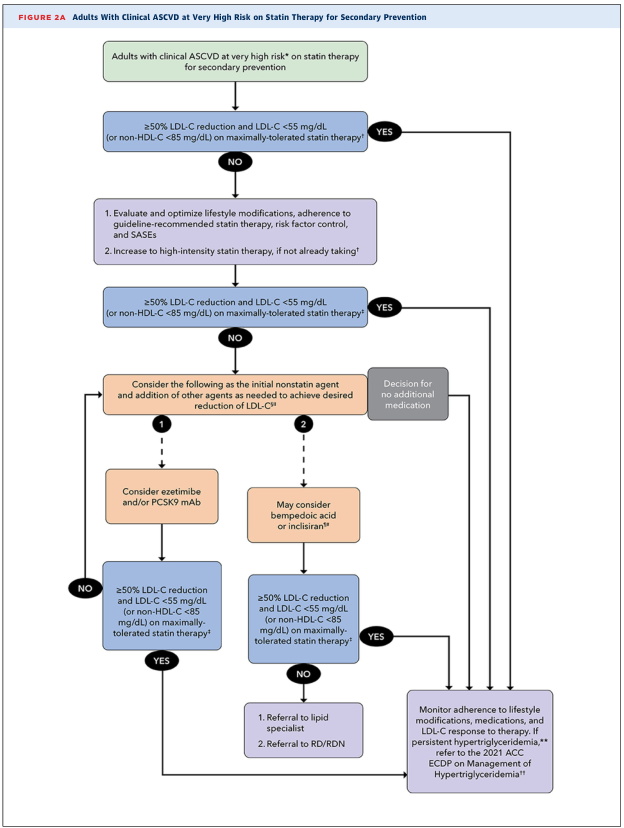
Summary : This flowchart outlines the stepwise management of adults with clinical ASCVD (atherosclerotic cardiovascular disease) at very high risk who are on statin therapy for secondary prevention, focusing on achieving LDL-C and non-HDL-C targets and escalation to nonstatin agents if goals are not met. flowchart: # Nodes : • Start (rounded rectangle): "Adults with clinical ASCVD at very high risk* on statin therapy for secondary prevention" • Decision (diamond): "≥50% LDL-C reduction and LDL-C <55 mg/dL (or non-HDL-C <85 mg/dL) on maximally-tolerated statin therapy‡" • If NO (rectangle): 1. "Evaluate and optimize lifestyle modifications, adherence to guideline-recommended statin therapy, risk factor control, and SASEs" 2. "Increase to high-intensity statin therapy, if not already taking†" • Decision (diamond): "≥50% LDL-C reduction and LDL-C <55 mg/dL (or non-HDL-C <85 mg/dL) on maximally-tolerated statin therapy‡" • If NO (rectangle): "Consider the following as the initial nonstatin agent and addition of other agents as needed to achieve desired reduction of LDL-C‡‡" • Branch 1 (rectangle): "Consider ezetimibe and/or PCSK9 mAb" • Branch 2 (rectangle): "May consider bempedoic acid or inclisiran§§" • Decision (diamond, both branches): "≥50% LDL-C reduction and LDL-C <55 mg/dL (or non-HDL-C <85 mg/dL) on maximally-tolerated statin therapy‡" • If NO (rectangle): 1. "Referral to lipid specialist" 2. "Referral to RD/RDN" • If YES (rectangle): "Monitor adherence to lifestyle modifications, medications, and LDL-C response to therapy. If persistent hypertriglyceridemia,** refer to the 2021 ACC ECDP on Management of Hypertriglyceridemia††" • Decision for no additional medication (gray rectangle) # Connectors : • Arrows flow top-down, with YES/NO branches at each decision diamond. • YES branches lead to monitoring or end nodes. • NO branches lead to further evaluation, escalation, or referral. • After nonstatin agent consideration, two parallel branches (ezetimibe/PCSK9 mAb and bempedoic acid/inclisiran) both lead to the same decision diamond. • All YES outcomes eventually merge into the monitoring node. • NO outcomes from the final decision diamonds lead to referral nodes. # Layout : • Vertical flow, starting from the top. • Decision diamonds split into YES (right) and NO (left or downward) branches. • Parallel branches for nonstatin agent options. • Final nodes merge into a single monitoring node. • Color coding: blue for statin therapy steps, orange for nonstatin agent options, gray for decision of no additional medication, purple for initial evaluation, and light blue for monitoring. # Analysis : • The flowchart provides a clear, stepwise escalation pathway for lipid management in very high-risk ASCVD patients on statin therapy. • It emphasizes repeated assessment of LDL-C/non-HDL-C targets, optimization of statin therapy, and addition of nonstatin agents if goals are not met. • Referral to specialists is recommended if targets remain unmet after all pharmacologic options. • The process is cyclical, with ongoing monitoring and adjustment based on response. • The chart visually prioritizes statin optimization before considering nonstatin agents, and highlights the importance of lifestyle and adherence throughout.
High Cholesterol (Dyslipidemia) Management
1. Why It Matters
2. Risk Stratification - The Starting Point
| CV Risk Category | LDL-C Target (ESC/EAS) |
|---|---|
| Low (SCORE2 <2%) | <3.0 mmol/L (<116 mg/dL) |
| Moderate (SCORE2 2-10%) | <2.6 mmol/L (<100 mg/dL) |
| High (SCORE2 10-20%) | <1.8 mmol/L (<70 mg/dL) + ≥50% reduction |
| Very high (ASCVD, SCORE2 ≥20%) | <1.4 mmol/L (<55 mg/dL) |
| Extreme (recurrent events on max statin) | <1.0 mmol/L (<40 mg/dL) |
- Apolipoprotein B (apoB)
- Lipoprotein(a) - Lp(a)
- High-sensitivity CRP (hs-CRP)
- Coronary artery calcium (CAC) score - recommended in men >40 and women >50 years
3. Lifestyle Modifications (Always First)
- Reduce saturated fat to <5-6% of total calories; eliminate trans fats
- Follow dietary patterns like the DASH diet, USDA Food Pattern, or AHA Diet
- Emphasize vegetables, fruits, whole grains, legumes, nuts, low-fat dairy, fish
- Limit red meats, sugar-sweetened beverages, and sweets
- 3-4 sessions per week, ~40 minutes each
- Moderate to vigorous aerobic activity
- Note: exercise has relatively modest direct LDL-C lowering but has significant independent cardiovascular benefit
4. Pharmacologic Therapy - Step-by-Step
Step 1: Statins (First-Line)
| Intensity | LDL-C Reduction | Drugs & Doses |
|---|---|---|
| High-intensity | ≥50% | Atorvastatin 40-80 mg; Rosuvastatin 20-40 mg |
| Moderate-intensity | 30-<50% | Atorvastatin 10-20 mg; Rosuvastatin 5-10 mg; Simvastatin 20-40 mg; Pravastatin 40-80 mg; Lovastatin 40 mg; Pitavastatin 2-4 mg |
| Low-intensity | <30% | Simvastatin 10 mg; Pravastatin 10-20 mg; Lovastatin 20 mg; Pitavastatin 1 mg |
- "Doubling the statin dose produces only ~6% further LDL-C reduction" (the "rule of 6")
- High-intensity statins are recommended for all patients with established ASCVD and for primary prevention at high cardiovascular risk (age 40-75)
- A powerful treatment effect is seen regardless of the pretreatment LDL-C level in patients with IHD - Harrison's 22E
- Myopathy / myalgia (most common reason for discontinuation)
- Rarely: rhabdomyolysis
- Modest increase in new-onset diabetes risk
- Transaminase elevation (rare)
Step 2: Ezetimibe (Add-On or Statin-Intolerant)
- Reduces LDL-C by ~18-20% as monotherapy; additive ~15-20% on top of statins
- Well tolerated with minimal side effects
- Evidence: The IMPROVE-IT trial showed ezetimibe added to simvastatin reduced cardiovascular events in ACS patients
- Also reduces triglycerides mildly (~9%)
Step 3: PCSK9 Inhibitors (Monoclonal Antibodies)
- Reduce LDL-C by 50-65% on top of maximally tolerated statin therapy
- Administered subcutaneously every 2-4 weeks
- Indicated for: very-high-risk ASCVD patients not at LDL-C goal on max statin + ezetimibe; familial hypercholesterolemia (especially HeFH and HoFH)
- Large outcomes trials (FOURIER, ODYSSEY OUTCOMES) confirmed reduction in MI and stroke
Step 4: Newer/Emerging Agents
| Drug | Mechanism | Notes |
|---|---|---|
| Bempedoic acid | Inhibits ATP citrate lyase (upstream of HMG-CoA reductase) | Reduces LDL ~18%; useful in statin-intolerant patients (works in liver, not muscle) |
| Inclisiran | siRNA that silences PCSK9 mRNA in hepatocytes | Twice-yearly injection; similar LDL lowering to PCSK9 mAbs |
| Evinacumab | Anti-ANGPTL3 antibody | Reserved for homozygous FH (HoFH) - works even without functional LDL receptors |
| Lomitapide | MTP inhibitor (reduces VLDL assembly) | HoFH only; hepatotoxicity risk |
| Bile acid sequestrants (cholestyramine, colesevelam) | Interrupt bile acid enterohepatic recirculation | Modest LDL lowering; contraindicated if TG >300 mg/dL (can worsen hypertriglyceridemia) |
5. Special Populations
Familial Hypercholesterolemia (FH)
- Autosomal dominant; universal screening recommended at age 8-11 with fasting lipid panel
- Moderate-intensity statin for children/adolescents with LDL >160 mg/dL after lifestyle trial
- High-intensity statin after age 20 if LDL >190 mg/dL
- Many FH patients require add-on ezetimibe + PCSK9 inhibitor to achieve targets
- HoFH may require LDL apheresis, lomitapide, or evinacumab
- Cascade screening: all first-degree relatives after index case identified (50% will have FH)
- Goldman-Cecil Medicine, pp.2283-2284
Hypertriglyceridemia
- TG >500 mg/dL: treat to reduce pancreatitis risk - first-line: fibrates or omega-3 fatty acids
- TG 150-500 mg/dL: focus on ASCVD risk reduction; statins remain first-line
- Fibrates (fenofibrate, gemfibrozil): reduce TG 30-50%; PPARα agonists - caution with statins (myopathy risk); can raise creatinine; increase gallstone risk
- Omega-3 fatty acids (icosapentaenoic acid / EPA, DHA): reduce TG 20-50% dose-dependently; REDUCE-IT trial showed icosapentaenoic acid (Vascepa) 4g/day reduced ASCVD events in statin-treated patients with elevated TG
- Niacin: reduces TG 5-38%; also raises HDL; limited use due to side effects (flushing, hepatotoxicity, worsening glycemia)
Diabetes
- High-intensity statin therapy is recommended for most diabetic patients aged 40-75
- GLP-1 receptor agonists (prescribed for diabetes/obesity) also reduce TG levels - Harrison's 22E
Chronic Kidney Disease / Post-Transplant
- Statins remain recommended; ezetimibe useful in post-transplant hyperlipidemia resistant to statins - Comprehensive Clinical Nephrology, 7th Ed.
6. Monitoring and Follow-Up
- Recheck fasting lipid panel 4-12 weeks after initiating or changing therapy
- Check CK and LFTs if symptomatic (myalgia, abdominal symptoms)
- Monitor for statin-associated side effects (SASEs) and adjust if needed - can switch statins, reduce dose, or try alternate-day dosing
- If persistent hypertriglyceridemia on statin, refer to the ACC expert consensus on hypertriglyceridemia management
- Refer to a lipid specialist if targets are not met after maximal combination therapy
7. Summary Stepwise Approach (Secondary Prevention - Very High Risk)
- Lifestyle + maximally tolerated high-intensity statin
- If LDL ≥55 mg/dL or <50% reduction: add ezetimibe
- If still not at goal: add PCSK9 inhibitor (alirocumab or evolocumab)
- Alternative nonstatin options: bempedoic acid or inclisiran
- Referral to lipid specialist if targets remain unmet
- Harrison's Principles of Internal Medicine, 22nd Ed. (2025), Chapter 419 - Disorders of Lipoprotein Metabolism
- Goldman-Cecil Medicine International Edition, Chapter 190 - Dyslipidemia / Familial Hypercholesterolemia
- Tietz Textbook of Laboratory Medicine, 7th Ed., Chapter 36 - Management of Hypercholesterolemia
- Goodman & Gilman's Pharmacological Basis of Therapeutics - Lipid-Lowering Drugs
- ESC/EAS Guidelines for the Management of Dyslipidemias (2019, updated 2021)
- ACC/AHA Guideline on the Management of Blood Cholesterol (2018/2022 update)