
hey tell me about lung cancer?
Reading File
Now let me search the medical library and PubMed in parallel for comprehensive lung cancer coverage.
Finding Sources
Searching PubMed
"lung cancer"[MeSH Terms] AND ("diagnosis" OR "treatment")
Searching the Web
lung cancer overview types diagnosis treatment 2025
Now let me read the key textbook sections from Murray & Nadel's Respiratory Medicine (the most authoritative source here) in parallel:
Reading File
Reading File
Searching Images
lung cancer types histology adenocarcinoma squamous cell small cell
Now let me get the main lung cancer dedicated chapters from the textbook:
Finding Sources
Finding Sources
Finding Sources
Finding Sources
Finding Sources
Finding Sources
Finding Sources
Finding Sources
I now have comprehensive information to write a thorough overview. Let me compile everything.
Lung Cancer
Lung cancer is the leading cause of cancer-related mortality worldwide and in the United States. In 2025, the 5-year relative survival rate remains around 27% — though this is improving with modern therapies.
Classification
Lung cancers are broadly divided into two major categories:
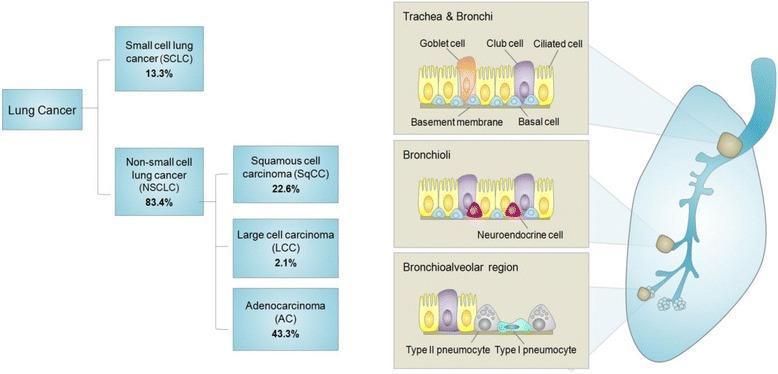
1. Non-Small Cell Lung Cancer (NSCLC) — ~83–85% of cases
The most common type, further subdivided by cell of origin:
| Subtype | Frequency | Location | Key Features |
|---|---|---|---|
| Adenocarcinoma | ~43% | Peripheral | Most common in women & never-smokers; EGFR/KRAS mutations |
| Squamous Cell Carcinoma | ~23% | Central (perihilar) | Strongly smoking-related; keratinization |
| Large Cell Carcinoma | ~2–3% | Anywhere | Diagnosis of exclusion |
2. Small Cell Lung Cancer (SCLC) — ~13–15% of cases
- Arises as a perihilar tumor from neuroendocrine cells
- In 95% of cases, presents as disseminated disease with mediastinal lymph node metastases (often more prominent than the primary)
- No curative role for surgery in most cases
- Highly sensitive to chemo/radiation initially, but relapses aggressively
Risk Factors
- Cigarette smoking — the dominant risk factor; accounts for ~85% of lung cancers. Squamous cell and small cell carcinomas are most strongly linked to smoking.
- Radon gas — second leading cause
- Occupational exposures — asbestos, arsenic, chromium, nickel
- Air pollution
- Genetic susceptibility — first-degree relatives have a 1.5× increased risk even after adjusting for smoking. Key susceptibility loci include CHRNA3/5, CYP2A6, BRCA2, CHEK2, TERT/TERC
- COPD and pulmonary fibrosis — independent risk factors
- Lung transplantation — reported lung cancer frequency post single-lung transplant is as high as 6.9%, arising predominantly in the native lung of recipients with underlying COPD/fibrosis and prior smoking history
Clinical Presentation
Lung cancer may be discovered incidentally on imaging, during screening, or via symptoms:
| Symptom | Frequency in Patients |
|---|---|
| Cough | 45–75% |
| Weight loss | 8–68% |
| Dyspnea | 37–58% |
| Hemoptysis | 27–57% |
| Chest pain | 27–49% |
| Hoarseness | 2–18% |
Red flag signs on examination include: lymphadenopathy >1 cm, superior vena cava syndrome, hepatomegaly, hoarseness, focal neurologic signs, and bone tenderness.
Paraneoplastic syndromes are especially common with SCLC: SIADH, Cushing syndrome, Lambert-Eaton myasthenic syndrome.
Pancoast tumors (superior sulcus): cause Horner syndrome (ptosis, miosis, anhidrosis) and shoulder/arm pain from involvement of the brachial plexus.
Diagnosis & Staging
Imaging:
- Chest X-ray: initial evaluation, but limited for small/early cancers (tumors may be visible retrospectively on prior films)
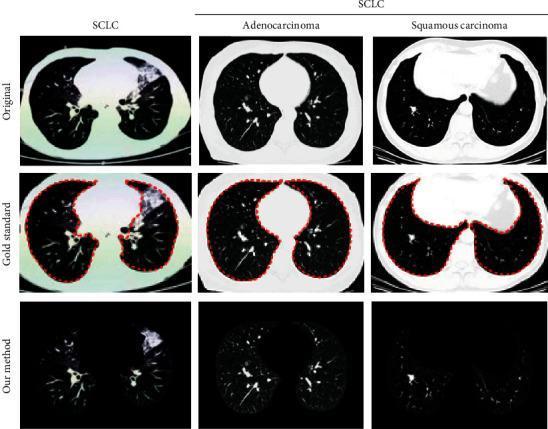
- CT chest (with contrast): superior for nodule characterization, mediastinal involvement
- PET-CT: metabolic staging, detecting occult metastases
- MRI brain: for brain metastases
Tissue diagnosis:
- Bronchoscopy ± endobronchial ultrasound (EBUS) for central/mediastinal lesions
- CT-guided biopsy for peripheral lesions
- SCLC: cytology alone is 60–90% sensitive, >95% specific
Staging (TNM system, AJCC 8th ed.):
- Stage I–II: localized, potentially resectable
- Stage III: locally advanced (mediastinal involvement)
- Stage IV: metastatic (most common presentation, especially SCLC)
SCLC uses a simplified staging:
- Limited stage (LS-SCLC): confined to one hemithorax — concurrent chemo-radiation
- Extensive stage (ES-SCLC): beyond one hemithorax — systemic chemotherapy ± immunotherapy
Molecular Profiling (NSCLC)
Molecular testing is mandatory for all advanced NSCLC. Key actionable drivers:
| Mutation | Frequency | Targeted Drug |
|---|---|---|
| EGFR | 10–15% (Western), ~50% (Asian) | Osimertinib (3rd-gen TKI) |
| ALK rearrangement | ~5% | Alectinib, brigatinib, lorlatinib |
| KRAS G12C | ~13% | Soterasib, adagrasib |
| ROS1 rearrangement | ~2% | Crizotinib, entrectinib |
| BRAF V600E | ~2–3% | Dabrafenib + trametinib |
| MET exon 14 skip | ~3% | Capmatinib, tepotinib |
| RET fusion | ~1–2% | Selpercatinib |
PD-L1 expression guides immunotherapy selection.
Treatment Summary
NSCLC
| Stage | Primary Treatment |
|---|---|
| Early (I–II) | Surgical resection (lobectomy); stereotactic body radiotherapy (SBRT) if inoperable |
| Stage III (unresectable) | Concurrent chemoradiation → durvalumab (immunotherapy) maintenance |
| Stage IV — driver mutation | Targeted oral TKI (e.g., osimertinib for EGFR+) |
| Stage IV — no driver, PD-L1 ≥50% | Pembrolizumab monotherapy |
| Stage IV — no driver, PD-L1 <50% | Chemotherapy + pembrolizumab |
Neoadjuvant immunotherapy (e.g., nivolumab + chemo before surgery) is now approved for resectable NSCLC — patients with pathologic complete response show a ~90% reduction in mortality risk.
Adjuvant osimertinib is approved post-resection for EGFR-mutant NSCLC.
SCLC
- Limited stage: Concurrent cisplatin/etoposide + thoracic radiotherapy → prophylactic cranial irradiation (PCI)
- Extensive stage: Carboplatin/etoposide + atezolizumab or durvalumab (immunotherapy)
- Second-line: Lurbinectedin ± atezolizumab (2025 data show ~3-month OS improvement)
Screening
Low-dose CT (LDCT) annually is recommended for high-risk individuals:
- Age 50–80, ≥20 pack-year smoking history, current or former smoker (quit within 15 years)
- Reduces lung cancer mortality by ~20% (NLST trial) to ~24% (NELSON trial)
Prognosis
| Stage | Approximate 5-Year Survival |
|---|---|
| Stage IA | ~90% |
| Stage IIB | ~50% |
| Stage IIIA | ~25% |
| Stage IV | ~6–10% (improving with targeted therapy) |
| SCLC (extensive) | <5% |
Survival is rapidly improving for patients with driver mutations — EGFR+ patients on osimertinib have median OS >38 months.
Sources: Murray & Nadel's Textbook of Respiratory Medicine, 2-Vol. (9780323655873); Harrison's Principles of Internal Medicine (9781260473940); NCI NSCLC Treatment PDQ; 2025 NSCLC Management Update, PMC
This is a shared conversation. Sign in to Orris to start your own chat.