
HMP pathway 15 marks long answer mbbs
Reading File
The HMP (Hexose Monophosphate) pathway, also called the Pentose Phosphate Pathway, is a major alternate glucose oxidation route producing NADPH and ribose-5-phosphate. Let me pull the full textbook content now.
Searching sources...
Finding Sources
Finding Sources
Reading File
Reading File
Reading File
Reading File
Reading File
Reading File
Reading File
Reading File
Reading File
I now have comprehensive content from two authoritative biochemistry textbooks (Lippincott's and Basic Medical Biochemistry). Let me also fetch the key pathway diagram.
Loading Image
I now have all the content needed for a complete 15-mark MBBS long answer. Here is the full structured answer:
Hexose Monophosphate (HMP) Pathway / Pentose Phosphate Pathway
Introduction
The hexose monophosphate (HMP) pathway - also called the pentose phosphate pathway or HMP shunt - is an alternative route for the oxidation of glucose 6-phosphate that operates in the cytosol of cells. Unlike glycolysis, it does not produce ATP and does not involve pyruvate. Its two cardinal products are:
- NADPH - the main cellular reductant for anabolic and detoxification reactions
- Ribose 5-phosphate - for nucleotide and nucleic acid biosynthesis
The pathway is active in all tissues that synthesize nucleotides and nucleic acids, and is especially prominent in the liver, lactating mammary glands, adipose tissue, adrenal cortex, gonads, and red blood cells.
Location
All reactions occur in the cytosol. No mitochondrial involvement.
Two Phases of the Pathway
The HMP pathway consists of two distinct phases:
| Phase | Reactions | Reversibility |
|---|---|---|
| Oxidative | Glucose 6-P → Ribulose 5-P + 2 NADPH + CO2 | Irreversible |
| Non-oxidative | Interconversion of pentose sugars → fructose 6-P + glyceraldehyde 3-P | Reversible |
Phase 1: Irreversible Oxidative Reactions
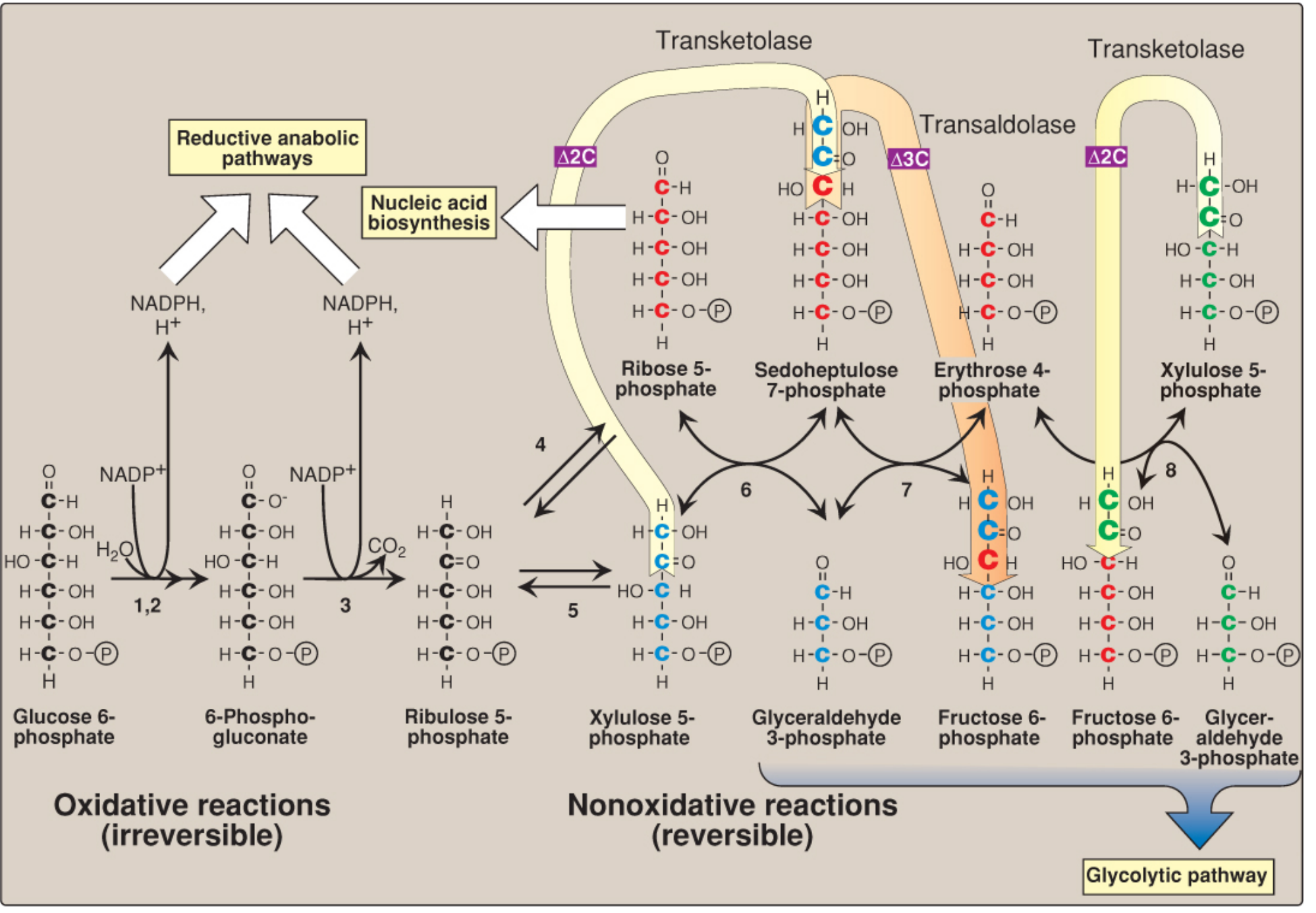
Step 1 - Glucose 6-phosphate dehydrogenase (G6PD) reaction:
- Glucose 6-phosphate + NADP+ → 6-Phosphogluconolactone + NADPH + H+
- Enzyme: G6PD (glucose 6-phosphate dehydrogenase)
- This is the committed, rate-limiting, and regulated step
- G6PD is competitively inhibited by NADPH (product inhibition)
- When NADPH/NADP+ ratio falls, G6PD activity increases - the pathway is "demand-driven"
- Insulin upregulates G6PD gene expression
Step 2 - Hydrolysis of the lactone:
- 6-Phosphogluconolactone + H2O → 6-Phosphogluconate
- Enzyme: 6-Phosphogluconolactone hydrolase (lactonase)
- Spontaneous but accelerated by this enzyme
Step 3 - Oxidative decarboxylation:
- 6-Phosphogluconate + NADP+ → Ribulose 5-phosphate + CO2 + NADPH + H+
- Enzyme: 6-Phosphogluconate dehydrogenase
- Carbon 1 of glucose is released as CO2
- A second molecule of NADPH is produced
- Product is a 5-carbon ketose - ribulose 5-phosphate
Net result of oxidative phase (per molecule of glucose 6-phosphate):
Glucose 6-P + 2 NADP+ → Ribulose 5-P + 2 NADPH + 2H+ + CO2
Phase 2: Reversible Non-Oxidative Reactions
Ribulose 5-phosphate can be channeled in two directions depending on cellular needs:
A. Isomerization to Ribose 5-phosphate (if nucleotide synthesis is needed)
- Ribulose 5-P → Ribose 5-P
- Enzyme: Ribose 5-phosphate isomerase
- Ribose 5-P is used for synthesis of ATP, NAD+, FAD, CoA, and nucleic acids
B. Epimerization to Xylulose 5-phosphate
- Ribulose 5-P → Xylulose 5-P
- Enzyme: Phosphopentose epimerase
If NADPH demand > ribose demand - the ribulose 5-phosphates are converted back to glycolytic intermediates by the following interconversions:
Transketolase reaction (first):
- Xylulose 5-P (5C) + Ribose 5-P (5C) → Sedoheptulose 7-P (7C) + Glyceraldehyde 3-P (3C)
- Transfers a 2-carbon unit from ketose to aldose
- Coenzyme: Thiamine pyrophosphate (TPP) - clinically important
- This reaction is used to test thiamine status (transketolase activity assay)
Transaldolase reaction:
- Sedoheptulose 7-P (7C) + Glyceraldehyde 3-P (3C) → Erythrose 4-P (4C) + Fructose 6-P (6C)
- Transfers a 3-carbon unit from ketose to aldose
- Uses an active lysine residue (Schiff base mechanism) - no cofactor needed
Transketolase reaction (second):
- Xylulose 5-P (5C) + Erythrose 4-P (4C) → Fructose 6-P (6C) + Glyceraldehyde 3-P (3C)
- Again requires TPP
The net result: 3 ribulose 5-P (15C) → 2 fructose 6-P (12C) + 1 glyceraldehyde 3-P (3C)
These products re-enter glycolysis.
Overall Balanced Equation
When 3 molecules of glucose 6-phosphate enter the combined oxidative + non-oxidative pathway:
3 Glucose 6-P + 6 NADP+ → 6 NADPH + 6H+ + 3 CO2 + 2 Fructose 6-P + 1 Glyceraldehyde 3-P
Regulation
| Regulator | Effect on G6PD |
|---|---|
| NADPH (high ratio) | Inhibits G6PD - shuts down pathway |
| NADP+ (low NADPH/NADP+) | Activates G6PD - increases flux |
| Insulin | Upregulates G6PD gene expression |
The pathway is entirely driven by the cell's need for NADPH, not for ATP.
Functions / Significance of Products
1. NADPH
NADPH is the major reducing coenzyme produced by this pathway. Its key roles:
| Function | Tissue |
|---|---|
| Fatty acid biosynthesis (FAS enzyme) | Liver, adipose, lactating breast |
| Cholesterol/steroid synthesis | Liver, adrenal cortex, gonads |
| Glutathione reductase - reduces GSH (antioxidant defense) | All cells, especially RBCs |
| NADPH oxidase - respiratory burst (O2- production for killing bacteria) | Neutrophils, macrophages |
| Cytochrome P450 monooxygenase system - drug detoxification | Liver |
| Nitric oxide synthase (NOS) - NO synthesis | Endothelium, macrophages |
| Vitamin D activation | Liver, kidney |
| Reduction of H2O2 via glutathione peroxidase | RBCs |
Note: NADPH/NADP+ ratio in cytosol is ~0.1 (high NADPH), favoring reductive biosynthesis - opposite of the NAD+/NADH ratio (~1000) which favors oxidation.
2. Ribose 5-phosphate
Used for synthesis of:
- Purines and pyrimidine nucleotides (RNA, DNA)
- ATP, NAD+, FAD, CoA, PRPP
G6PD Deficiency - Clinical Importance
Inheritance: X-linked recessive - predominantly affects males
Pathophysiology: G6PD is the only source of NADPH in RBCs (which lack mitochondria). Deficient G6PD → low NADPH → glutathione remains oxidized (G-S-S-G) → H2O2 accumulates → oxidative damage to hemoglobin (Heinz bodies) and RBC membrane → hemolytic anemia
Triggers of hemolytic crisis:
- Oxidant drugs (primaquine, dapsone, rasburicase, nitrofurantoin, some sulfonamides)
- Fava beans (favism) - contain oxidant isouramil
- Severe infections (generate free radicals)
Features:
- Hemolytic anemia + jaundice episodically
- Heinz bodies on peripheral smear (denatured hemoglobin)
- Bite cells (splenic removal of Heinz body inclusions)
- Neonatal jaundice (prolonged)
- Malaria-protective advantage in heterozygous females (geographic distribution in malaria belt)
Important: Degree of anemia depends on amount of residual enzyme activity. Older RBCs have less G6PD than young RBCs - they are more susceptible.
Tissues where HMP Pathway is Most Active
| Tissue | Reason |
|---|---|
| Liver | Fatty acid and cholesterol synthesis (need NADPH) |
| Lactating mammary gland | Fatty acid synthesis |
| Adipose tissue | Fatty acid synthesis |
| Adrenal cortex, gonads | Steroid hormone synthesis |
| Red blood cells | NADPH to maintain reduced glutathione |
| Neutrophils/macrophages | NADPH oxidase - respiratory burst |
| Corneal epithelium, lens | Protection from oxidative damage |
Comparison with Glycolysis
| Feature | Glycolysis | HMP Pathway |
|---|---|---|
| ATP production | Yes (net 2 ATP) | None |
| NADH production | Yes | None |
| NADPH production | None | Yes (2 per G6P) |
| CO2 release | No | Yes (C1 of glucose) |
| Location | Cytosol | Cytosol |
| Reversibility | Mostly irreversible | Phase 2 reversible |
| Key enzyme | PFK-1 | G6PD |
| Product | Pyruvate | Ribose 5-P, NADPH |
Thiamine (B1) Deficiency and the HMP Pathway
Transketolase requires thiamine pyrophosphate (TPP) as a coenzyme. Thiamine deficiency (beriberi, Wernicke's encephalopathy) impairs the non-oxidative phase. Erythrocyte transketolase activity is used as a sensitive assay for thiamine status.
Summary
The HMP pathway is a metabolic shunt that:
- Oxidizes glucose 6-P to generate 2 NADPH and ribose 5-phosphate (oxidative, irreversible phase)
- Interconverts pentose sugars back to glycolytic intermediates via transketolase and transaldolase (non-oxidative, reversible phase)
- Is regulated entirely by the NADPH/NADP+ ratio via G6PD
- Does not generate ATP or CO2 in large quantities (only 1 CO2 per glucose)
- Is clinically relevant through G6PD deficiency causing drug- or infection-induced hemolytic anemia
Sources: Lippincott Illustrated Reviews: Biochemistry, 8th ed., Chapter 13; Basic Medical Biochemistry: A Clinical Approach, 6th ed., Chapter 27
HMP pathway 15 marks
Your credits are exhausted. You can purchase a top-up or subscribe to a plan to continue using Orris. If you're already subscribed, your daily credits will reset tomorrow.
This is a shared conversation. Sign in to Orris to start your own chat.