
Erectile dysfunction
Reading File
Erectile dysfunction (ED) is defined as the persistent inability to attain or maintain a penile erection sufficient for satisfactory sexual performance. It is one of the most common male sexual disorders, affecting an estimated 150 million men worldwide.
Searching sources...
Finding Sources
Searching PubMed
"erectile dysfunction"[MeSH Terms] AND treatment
Reading File
Reading File
Reading File
Finding Sources
Finding Sources
Reading File
Reading File
Reading File
Reading File
Reading File
Loading Image
Loading Image
Here is a comprehensive overview of erectile dysfunction drawn from Harrison's Principles of Internal Medicine (22nd ed.), Goldman-Cecil Medicine, and the Family Medicine Textbook.
Erectile Dysfunction (ED)
Definition
Erectile dysfunction is defined as a man's persistent inability to attain and/or maintain penile erection sufficient for satisfactory sexual performance. - Goldman-Cecil Medicine, p. 2542
Epidemiology
- In the Massachusetts Male Aging Study (MMAS), 52% of men aged 40-70 reported some degree of ED; complete ED occurred in 10%, moderate in 25%, and minimal in 17%.
- Incidence of moderate or severe ED more than doubled between ages 40 and 70.
- ~10-15% of all adult American men are affected.
- Higher rates in: type 2 diabetes mellitus, post-radical prostatectomy, cardiovascular disease, obesity, benign prostatic hyperplasia (BPH), hypertension, and lower spinal cord injury.
- ED represents a "sentinel symptom" for occult cardiovascular and peripheral vascular disease - the degree of ED correlates with severity of cardiovascular disease. - Harrison's, p. 3199
Pathophysiology
ED arises from three basic mechanisms:
- Failure to initiate - psychogenic, endocrinologic, or neurogenic causes
- Failure to fill - arteriogenic (inadequate arterial inflow)
- Failure to store - veno-occlusive dysfunction (venous leak)
These categories often overlap; multiple factors contribute simultaneously.
The NO/cGMP Pathway (molecular basis)
Parasympathetic stimulation triggers nonadrenergic, noncholinergic (NANC) fibers and endothelial nitric oxide synthase (eNOS), raising nitric oxide (NO) in cavernosal smooth muscle. NO activates guanylyl cyclase → raises cyclic GMP → lowers intracellular Ca²⁺ → smooth-muscle relaxation → increased blood filling of lacunar sinusoids → erection. PDE-5 normally degrades cGMP, terminating erection.
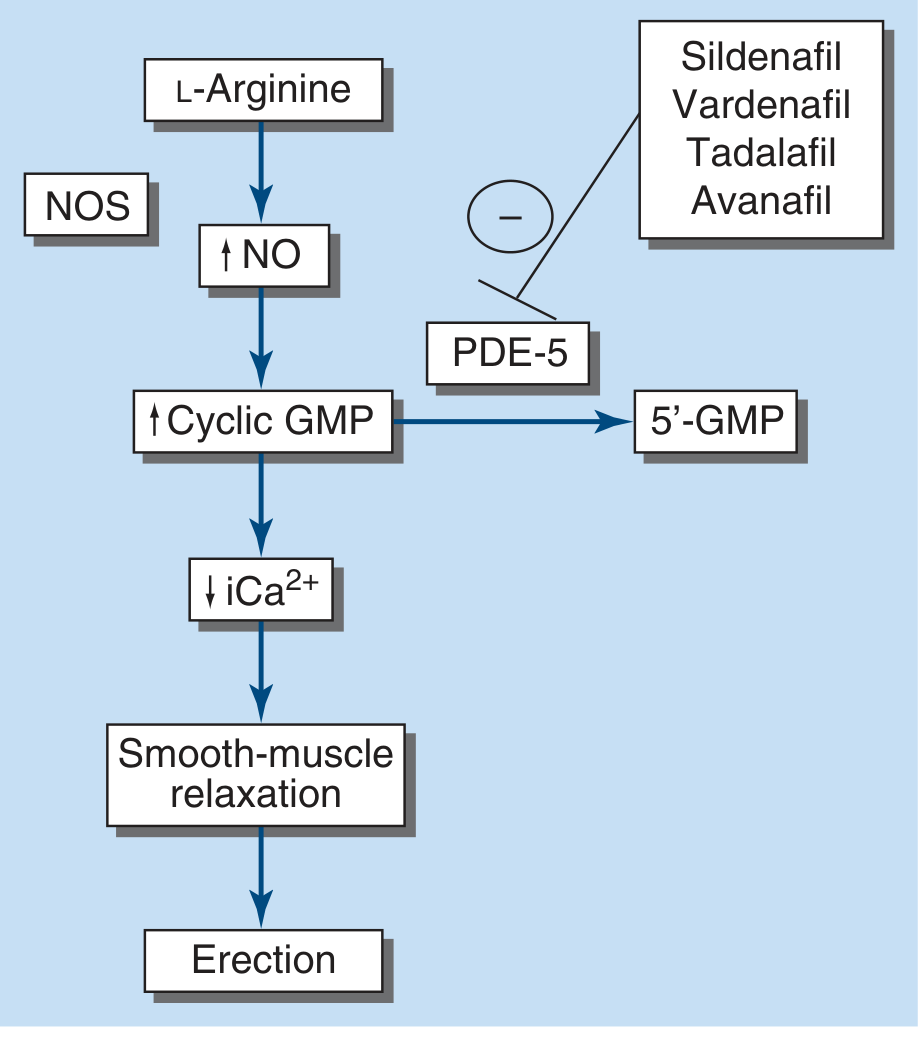
Detumescence is mediated by norepinephrine (sympathetic), endothelin, and Rho kinase activation, increasing venous outflow. - Harrison's, p. 3199
Causes by Category
| Category | Examples |
|---|---|
| Vasculogenic (most common organic cause) | Atherosclerosis, hypertension, hyperlipidemia, diabetes-related endothelial dysfunction |
| Neurogenic | Spinal cord injury, radical prostatectomy, pelvic surgery, diabetic neuropathy |
| Endocrine | Hypogonadism (low testosterone), hyperprolactinemia, thyroid disease |
| Psychogenic | Anxiety, depression, relationship stress, performance anxiety |
| Drug-induced | See table below |
| Aging/Systemic | Impaired penile vasodilatory capacity from endothelial dysfunction |
Drugs Commonly Associated with ED
| Drug Class | Examples |
|---|---|
| Antidepressants | SSRIs, tricyclics, MAOIs |
| Antihypertensives | Beta-blockers, verapamil, clonidine |
| Cardiac drugs | Amiodarone, digoxin |
| Diuretics | Thiazides, spironolactone |
| H2 blockers | Cimetidine, ranitidine |
| Hormonal agents | Corticosteroids, antiandrogens, LHRH agonists/antagonists, 5α-reductase inhibitors (finasteride, dutasteride) |
Medications play a role in up to 25% of ED cases. - Goldman-Cecil Medicine, p. 2543
Diagnosis
- History: Detailed medical and sexual history; use validated tools such as the Sexual Health Inventory for Men (SHIM); assess libido, substance use, partner relationship.
- Physical examination: Genitourinary, cardiovascular, endocrine, and neurologic systems; prostate examination.
- Laboratory tests:
- Morning serum testosterone
- Fasting glucose or HbA1c
- Lipid panel
- PSA (if indicated)
- Prolactin and LH/FSH (only if hypogonadism suspected)
- Urinalysis, renal function, CBC
- Specific vascular/neurophysiologic tests are rarely required. - Goldman-Cecil Medicine, p. 2543
Treatment
The first goal is to identify and treat any reversible cause. Lifestyle modification (weight loss, exercise, smoking cessation, alcohol reduction) can meaningfully improve erectile function, particularly in obese men.
Treatment Algorithm
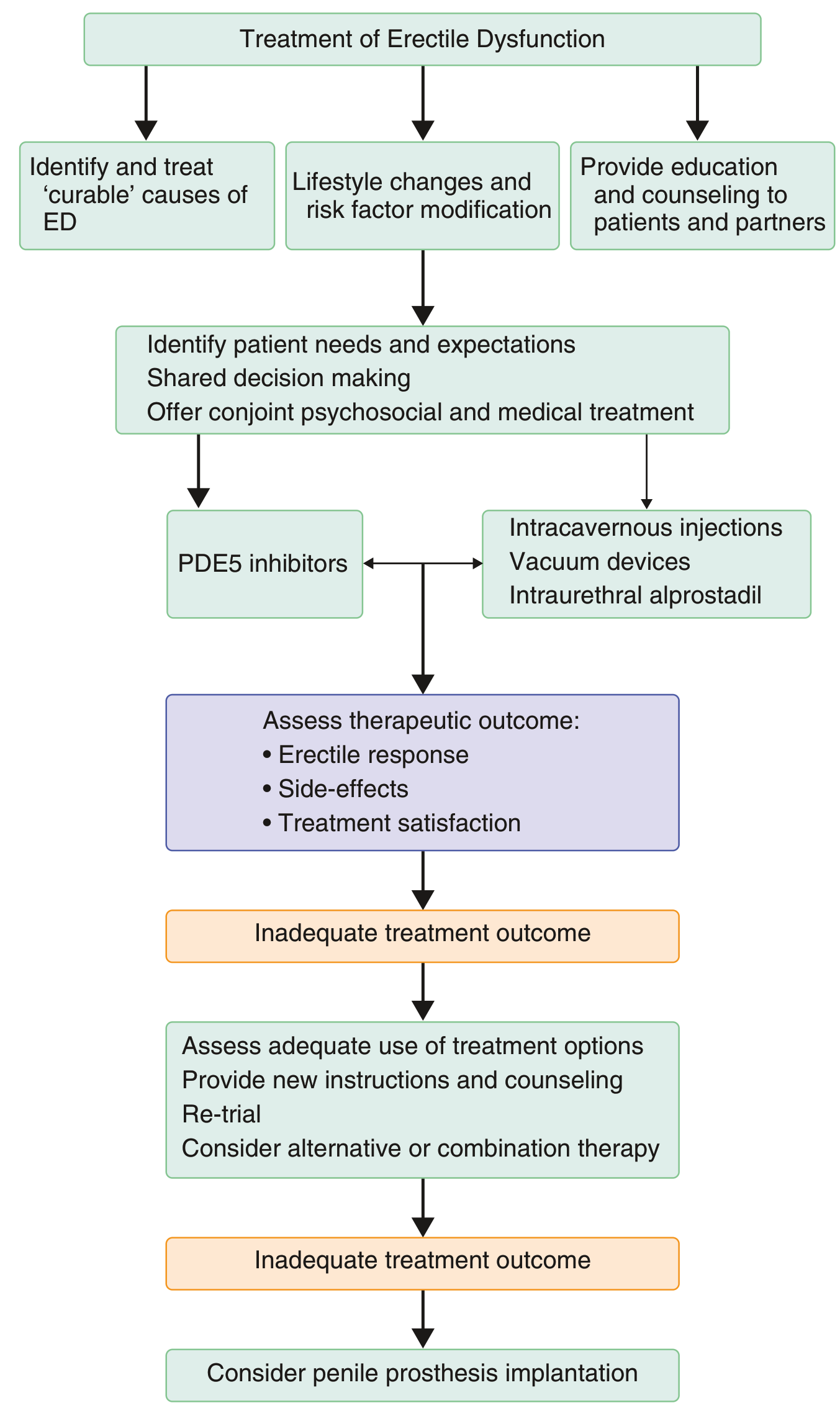
First-Line: PDE-5 Inhibitors
These are the drugs of first choice for most men with ED. They work by blocking PDE-5 and preventing breakdown of cGMP, thereby sustaining smooth-muscle relaxation.
| Drug | Starting Dose | Duration of Action | Notes |
|---|---|---|---|
| Sildenafil | 50 mg (range 25-100 mg) | ~4 hours | Take 20-60 min before intercourse |
| Vardenafil | 5-20 mg | 4-6 hours | Similar efficacy to sildenafil |
| Tadalafil | 10 or 20 mg (on-demand); 2.5-5 mg (daily) | Up to 36 hours | Daily dosing preferred if intercourse >2×/week |
| Avanafil | 50-200 mg | ~6 hours | Faster onset |
- Effective in approximately 60% of men.
- Lower response rates in diabetes, spinal cord injury, post-prostatectomy.
- CONTRAINDICATED with nitrates (risk of severe hypotension due to cGMP accumulation).
- Caution with alpha-blockers (orthostatic hypotension risk).
Second-Line: Intracavernosal / Intraurethral
- Intracavernosal injection: Prostaglandin E1 (alprostadil), alone or combined with papaverine and/or phentolamine. Injected with 27-30 gauge needle into the cavernosal space. Side effects: pain, cavernosal fibrosis.
- Intraurethral alprostadil (MUSE): 125-1000 µg suppository; effective in 30-66% of cases.
- Vacuum erection devices: Non-pharmacologic option suitable for men who cannot tolerate medications.
Hormonal Therapy
- If serum testosterone is <275 ng/dL with symptoms of deficiency: testosterone replacement (gel, injections) can improve sexual function.
- Adding testosterone to sildenafil in partial responders does not provide additional benefit.
Psychosexual Counseling
- Beneficial when psychogenic factors are prominent or when treatments fail; may be combined with medical therapy.
Third-Line: Penile Prostheses
- Surgical implantation of semi-rigid (malleable) or inflatable devices.
- Reserved for men who fail all other therapies or prefer a permanent solution.
- Inflatable devices have ~10-20% mechanical failure rate at 10 years.
- Long-term patient and partner satisfaction is excellent with proper selection.
Special Populations
- Post-radical prostatectomy: PDE-5 inhibitors (on-demand dosing) aid sexual recovery. Recovery is gradual - 38% potent at 3 months, 86% at 18 months in nerve-sparing cases. - Campbell-Walsh-Wein Urology, p. 1955
- Diabetes: Higher ED prevalence; slightly reduced response to PDE-5 inhibitors; GLP-1 agonists (e.g., dulaglutide) may reduce incidence.
- SSRI-induced ED: Switch to bupropion, add a PDE-5 inhibitor, or consider a drug holiday.
- Cardiovascular disease: ED itself is a risk marker; assess cardiac risk. PDE-5 inhibitors do not cause ischemia and did not increase cardiovascular events in randomized trials, but are contraindicated with nitrates.
Key Takeaways
- ED is multifactorial - organic and psychogenic causes almost always coexist.
- It is a cardiovascular risk marker - always assess for underlying cardiometabolic disease.
- PDE-5 inhibitors are first-line; work best when the NO pathway is at least partially intact.
- Lifestyle modification alone can significantly improve ED in obese men.
- Management should involve the patient's partner and address psychosocial factors alongside medical treatment.
Sources: Harrison's Principles of Internal Medicine 22E, p. 3199-3201 | Goldman-Cecil Medicine, p. 2542-2544 | Textbook of Family Medicine 9E, p. 1193-1194
This is a shared conversation. Sign in to Orris to start your own chat.