
Ebola symptoms
Ebola virus disease symptoms clinical presentation 2024
Ebola virus disease symptoms clinical signs hemorrhagic fever
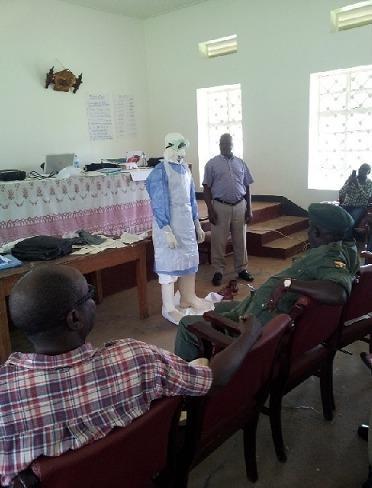
This clinical photograph captures a Personal Protective Equipment (PPE) demonstration during a medical training session focused on Viral Hemorrhagic Fever (VHF) preparedness, specifically for Ebola Virus Disease (EVD). A participant is shown wearing a complete, multi-layered PPE ensemble which includes a white head hood, protective goggles, a light blue long-sleeved isolation gown, a white fluid-resistant apron, white gloves, and high-top white boot covers. The training takes place in a classroom setting with other participants and instructors visible, emphasizing the 'donning and doffing' protocol necessary for infection prevention and control (IPC). The visual illustrates standard barrier nursing precautions and high-level protection required for managing highly infectious pathogens in healthcare or border surveillance contexts. Key educational concepts include contact and droplet precautions, biocontainment procedures, and the role of multi-disciplinary teams in epidemic response.
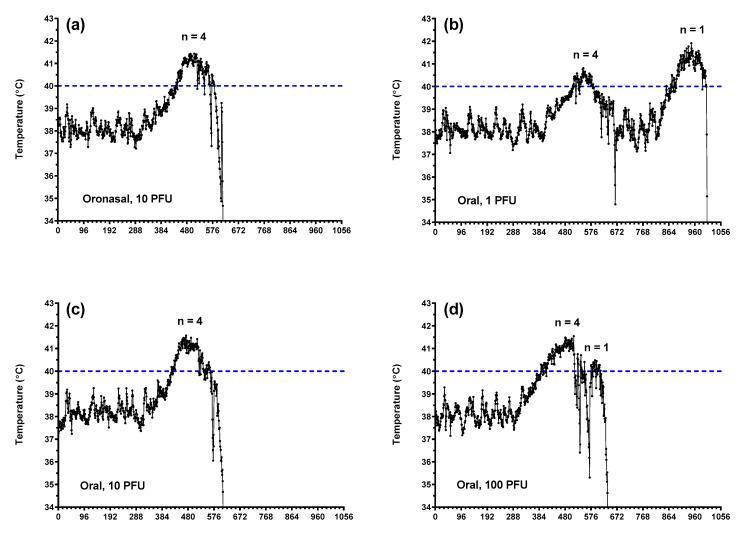
This set of line graphs illustrates core body temperature alterations in a ferret model of Ebola virus (EBOV) disease across different inoculation routes and doses. The graphs (a-d) plot temperature in degrees Celsius (°C) against time (every tick representing 4 hours). Subfigure (a) shows the oronasal route (10 PFU), while (b-d) show the oral route at 1, 10, and 100 PFU doses, respectively. A horizontal dashed line at 40°C indicates the threshold for fever. Common to most groups is an initial baseline fluctuation (37°C–39°C), followed by a progressive febrile response exceeding 41°C. Notably, higher doses (10 and 100 PFU) exhibit more rapid progression to peak fever, while the 1 PFU oral group displays a delayed or biphasic temperature profile. All lethal cases culminate in a sharp terminal decline (hypothermia), with temperatures dropping below 35°C, representing clinical deterioration and the near-terminal phase of the hemorrhagic fever syndrome.
An infographic-style photograph illustrating the concept of a global health crisis, specifically focusing on Ebola Virus Disease (EVD). The image features a white sheet of paper resting on a dark surface, with the word 'EBOLA' written centrally in bold, crimson-red lettering. The medium used for the text has a fluid, slightly irregular texture resembling blood or liquid pigment, suggesting the visceral nature of the hemorrhagic fever. To the top right of the paper sits a small, transparent glass globe on a gold-toned pedestal, symbolizing the international impact and geographic spread of infectious disease outbreaks. This visual serves as an educational representation of global health security, emerging infectious diseases, and the public health response to viral pathogens with epidemic potential. It is suitable for discussions regarding epidemiology, international disease surveillance, and the sociological impact of high-consequence pathogens.
Ebola Virus Disease (EVD) - Symptoms & Clinical Presentation
Background
Phase 1 - Early "Dry" Symptoms (Days 1-5)
- Fever (present in ~95% of patients) - often sudden onset with chills/rigors
- Severe headache (50-74%)
- Profound fatigue/asthenia (85-95%)
- Muscle and joint pain - myalgias, arthralgias (50-79%)
- Sore throat - inflamed, swollen throat; patients describe a painful lump sensation
- Loss of appetite (anorexia, ~45%)
- Lower back pain
Phase 2 - Later "Wet" Symptoms (Days 4-10)
- Nausea and vomiting (68-73%)
- Severe diarrhea (85%) - leads to dangerous fluid and electrolyte loss
- Abdominal pain (~65%)
- Maculopapular rash - erythematous, appears around day 5-7, most visible on the trunk; eventually desquamates
- Conjunctivitis / bilateral eye injection (~45%)
- Dysphagia / odynophagia (difficulty or pain on swallowing, ~57%)
Phase 3 - Hemorrhagic Manifestations (Days 5-10+)
- Spontaneous bleeding from mucous membranes, gums, nose, vagina
- Ecchymosis and petechiae (skin bruising and pinpoint bleeding)
- Blood in vomit and feces
- Bleeding at IV/needle puncture sites
- Occurs in roughly 40-50% of patients - WHO fact sheet
Systemic Complications
- Hypovolemic shock - from massive GI fluid losses
- Metabolic derangements: hyponatremia, hypokalemia, hypocalcemia
- Acute kidney and liver failure (transaminitis, elevated creatinine)
- Neurological effects: confusion, irritability, aggression, seizures
- Multiorgan failure - terminal stage
- Chest pain, shortness of breath, hiccups
Laboratory Findings
| Finding | Details |
|---|---|
| Thrombocytopenia | Low platelets, contributes to bleeding |
| Anemia | Especially in hemorrhagic cases |
| Coagulopathy | Clotting factor dysfunction |
| Elevated liver enzymes | Transaminitis |
| Elevated creatinine | Renal involvement |
| Hypocalcemia / Hypokalemia | From GI losses |
| Leukocytosis | Early elevated WBC |
Long-Term Complications in Survivors
- Memory loss, hearing problems, pain/tingling in extremities
- Inflammation of the heart (pericarditis) or testicles (orchitis)
- Hair loss, dry mouth, depression, anxiety, PTSD
- Changes in menstruation, impotence
Differential Diagnosis to Consider
Key Transmission Facts
- Spread by direct contact with blood, saliva, vomit, feces, semen of a symptomatic patient
- Not airborne under normal conditions
- Patients are contagious only once symptomatic
- Transmission risk persists in semen for months after recovery