
Explain this and management
Reading File
Reading File
Now let me extract the PDF content and search the medical library in parallel.
Running Command
cd /home/daytona/workspace/attachments/f3cb3c7c-5835-4289-82e9-e11849af5629/ && python3 -c " import pdfplumber with pdfplumber.open('FAYIS P MRI C SPINE.pdf') as pdf: for i, page in enumerate(pdf.pages): print(f'--- PAGE {i+1} ---') print(page.extract_text()) "
Finding Sources
Good - I have the full MRI report. Now let me pull the relevant textbook sections and search for management in parallel.
Reading File
Finding Sources
Finding Sources
Reading File
Reading File
Reading File
Let me get the treatment section from Adams & Victor:
Reading File
Reading File
I now have all the information needed to provide a thorough explanation. Let me also fetch the MRI image from the textbook for visual context.
Loading Image
I now have everything needed for a comprehensive explanation. Here is the full breakdown:
MRI Cervical Spine Report - Fayis P (42M) - Explained
Patient Summary
42-year-old male with 3 months of neck numbness radiating to the left shoulder - a classic presentation of cervical radiculopathy from degenerative disc disease.
What the Report Found - Finding by Finding
1. Multilevel Cervical Spondylosis (All Levels)
"Disc desiccation... multilevel degenerative disc disease. Osteophyte formation at multiple levels."
- Disc desiccation = the intervertebral discs have lost their water content and become dry and shrunken. Normal discs appear bright white on T2 MRI; desiccated discs appear dark.
- Spondylosis is the umbrella term for age-related degenerative changes: disc height loss + desiccation + osteophyte (bone spur) formation.
- Finding this at ALL cervical levels at age 42 indicates moderately advanced degeneration for his age.
- Osteophytes form as the body's attempt to stabilize the damaged disc space, but they can encroach on the spinal canal and nerve root exit foramina.
2. C3-C4: Left Neural Foraminal Narrowing + Left C4 Nerve Root Abutment ⚠️ (Most Clinically Significant)
"Posterior disc-osteophyte complex with left posterolateral disc bulge... left neural foraminal narrowing with preforaminal abutment of the exiting left C4 nerve root."
This is the primary cause of his symptoms (left shoulder numbness):
- A disc-osteophyte complex = a combination of bulging disc + bony spur that acts as a hard ridge pressing on neural structures.
- Left posterolateral bulge = the disc is bulging toward the left side and backward, where the nerve roots exit the spinal canal through the neural foramen.
- Neural foraminal narrowing = the bony tunnel through which the C4 nerve root exits is now narrowed, compressing or irritating the nerve.
- Preforaminal abutment = the nerve root is being touched/pressed just before it enters the foramen - this causes the radiating numbness down the left shoulder/arm in the C4 dermatomal distribution.
- C4 nerve root distribution: innervates the top of the shoulder, upper trapezius, and periscapular area - perfectly matching his symptom of numbness radiating to the left shoulder.
- Importantly: no central canal compromise at this level - the spinal cord itself is safe here.
3. C5-C6: Ventral Thecal Sac Indentation ⚠️ (Second Significant Level)
"Broad-based posterior disc bulge resulting in ventral thecal sac indentation. Canal diameter 11.0 mm."
- A broad-based posterior disc bulge means the disc is bulging centrally backward, pressing against the front (ventral aspect) of the thecal sac - the dural tube containing the spinal cord and CSF.
- Thecal sac indentation = the CSF buffer around the cord is being dented, but the cord itself shows no signal abnormality - meaning no myelopathy (spinal cord injury) yet.
- Canal diameter of 11.0 mm is at the low end of normal (normal >12 mm; relative stenosis 10-12 mm; absolute stenosis <10 mm) - so this is borderline but not yet critically stenotic.
- This level is worth monitoring because a further disc herniation or neck flexion could push it into cord compromise.
4. Spinal Canal Diameters
All measured levels (C3-T2) range from 10.6 - 12.3 mm, all reported "within normal limits":
| Level | Diameter | Significance |
|---|---|---|
| C3-C4 | 12.3 mm | Normal |
| C4-C5 | 11.0 mm | Low-normal |
| C5-C6 | 11.0 mm | Low-normal + thecal indentation |
| C6-C7 | 10.6 mm | Lowest - narrowest canal |
| C7-T1 | 11.4 mm | Near-normal |
The cord itself is normal in caliber and signal throughout - this is reassuring and means no myelopathy has developed yet.
5. D1 Vertebral Body Hemangioma (Incidental)
"Focal area of T1 and T2 hyperintensity with characteristic trabecular pattern... benign incidental finding."
- Vertebral hemangiomas are benign vascular tumors within the vertebral body, very common (found in ~10-12% of the population).
- The "trabecular pattern" (coarse vertical striations on imaging) is their hallmark appearance.
- No cortical expansion or extraosseous extension = completely benign, no treatment needed.
- This was found incidentally on the whole-spine screening sequences and has no bearing on his symptoms.
6. Cervical Cord - Normal
The cord shows normal caliber and signal intensity throughout - this is the most important reassuring finding. There is no myelopathy (spinal cord dysfunction from compression) at this time.
For reference, here is what a more severe case of cervical spondylosis with cord compression looks like on T2 MRI:
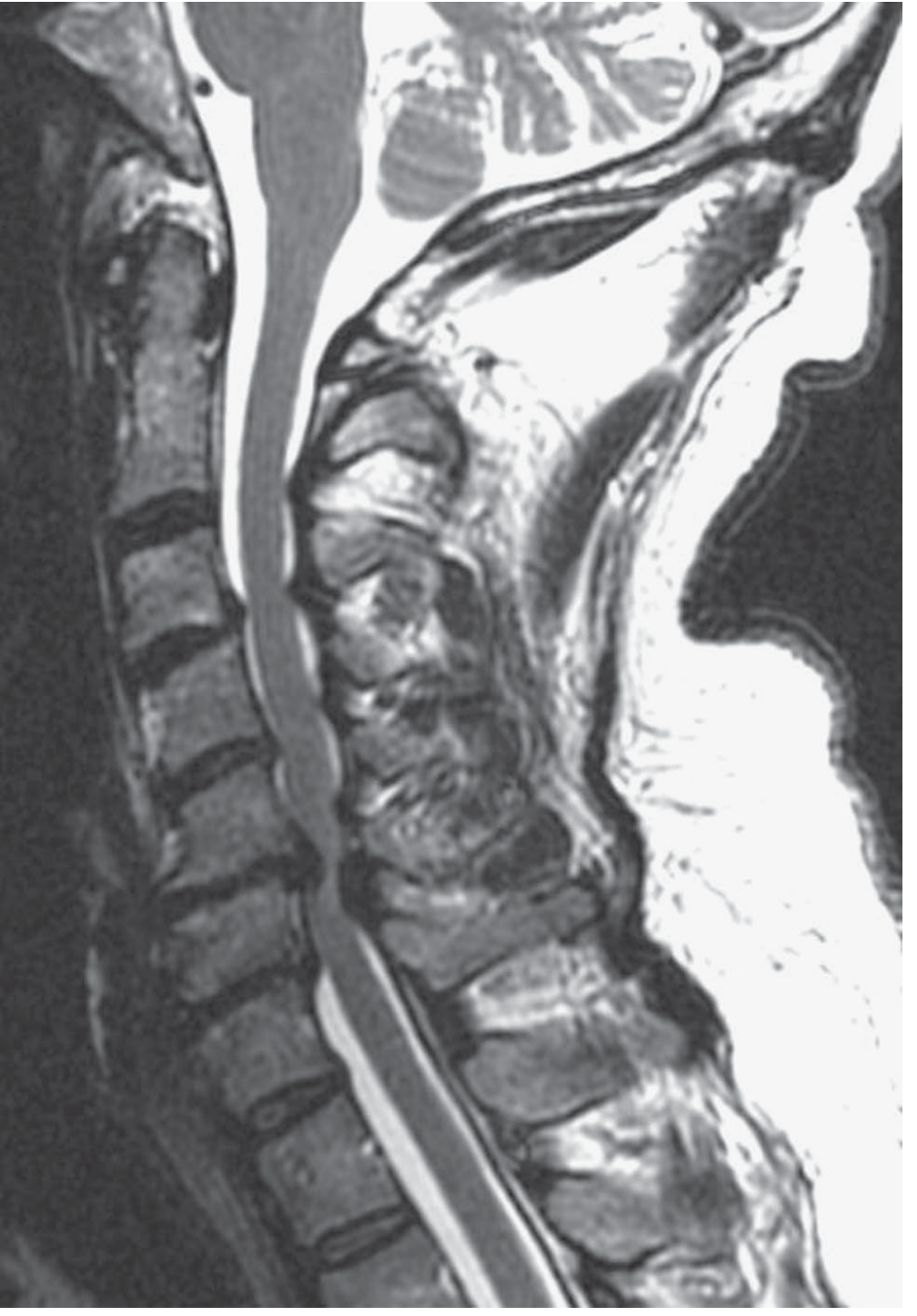
Clinical Interpretation
Fayis has cervical radiculopathy at C3-C4 (left C4 nerve root involvement) causing his 3-month history of left shoulder numbness. He does NOT currently have myelopathy (cord involvement). The C5-C6 level is a secondary concern for future monitoring.
C4 radiculopathy symptoms typically include:
- Numbness/tingling in the neck and top of shoulder
- Pain radiating from neck to shoulder/upper trapezius
- Possible deltoid or diaphragm weakness (if severe)
- Reduced biceps reflex (if C4-5 involved)
Management
Conservative Management (First Line - Appropriate for This Patient)
Since Fayis has no myelopathy, no progressive motor deficit, and no cord signal change, conservative treatment is the starting point:
-
NSAIDs (e.g., ibuprofen, naproxen) - first-line for pain and inflammation; no RCT data specific to neck, but widely used by analogy with cervical radiculopathy evidence.
-
Analgesics (acetaminophen/paracetamol) - adjunct for pain relief.
-
Muscle relaxants - for associated cervical muscle spasm (e.g., cyclobenzaprine, methocarbamol).
-
Soft cervical collar - limits anteroposterior neck movement, reduces nerve root irritation. Adams & Victor note it "may be sufficient to reduce discomfort in the neck and arms." Should not be worn 24/7 (leads to muscle atrophy).
-
Supervised physiotherapy - gentle stretching, cervical traction, posture correction, strengthening of deep cervical flexors. Avoid activities that provoke symptoms.
-
Epidural/foraminal steroid injection - if oral therapy fails, targeted fluoroscopy-guided injection can reduce radicular inflammation. (Note: higher complication risk in the neck vs. lumbar spine - vertebral artery dissection and cord injury are rare but reported.)
-
Activity modification - avoid prolonged neck flexion (e.g., looking down at phone), heavy lifting, overhead work.
Indications for Surgery
Per Harrison's Principles of Internal Medicine (22nd ed.) and Adams & Victor, surgical intervention is considered when:
- Progressive motor deficit due to nerve root compression (not yet present in Fayis)
- Functionally limiting pain that fails to respond to 6-8 weeks of conservative management
- Spinal cord compression with myelopathy (not currently present)
- Sphincter disturbance - urgent indication
Surgical Options (If Needed)
| Approach | Indication |
|---|---|
| ACDF (Anterior Cervical Discectomy and Fusion) | 1-2 level disease; better results, less risk |
| Posterior laminectomy | Multi-level canal stenosis |
| Laminoplasty | Multi-level disease, preserves motion |
Adams & Victor note: "When only one or two interspaces are the site of osteophytic compression, their removal by an anterior approach (ACDF) has apparently given better results and carries less risk." The C3-C4 level fits this description.
Follow-up Plan
- Clinical reassessment at 6-8 weeks
- Monitor for red flags: upper limb weakness, hand clumsiness, gait disturbance, bladder/bowel symptoms (these indicate myelopathy and require urgent reassessment)
- Repeat MRI if symptoms worsen or new neurological signs appear
- The C5-C6 thecal sac indentation with borderline canal diameter (11.0 mm) warrants periodic monitoring even if asymptomatic
Summary in Plain Language
Fayis has wear-and-tear changes throughout his neck discs with two significant levels:
- C3-C4: A disc bulge + bone spur is pressing on the left C4 nerve root, directly explaining his left shoulder numbness.
- C5-C6: A central disc bulge is indenting the spinal cord's protective lining but NOT the cord itself - a "watch and wait" finding.
The spinal cord itself is completely healthy on this scan. Start with conservative treatment (physiotherapy, anti-inflammatories, collar). Surgery is reserved for failure of conservative management, worsening motor weakness, or if cord compression develops.
Sources: Adams and Victor's Principles of Neurology, 12th Ed., p. 1270 (Cervical Spondylosis with Myelopathy); Harrison's Principles of Internal Medicine, 22nd Ed., p. 176 (Neck Pain with Radiculopathy)
This is a shared conversation. Sign in to Orris to start your own chat.