
Posturography for 10 marks long question
Reading File
Finding Sources
Finding Sources
Reading File
Reading File
Reading File
Reading File
Loading Image
Now I have solid material from three textbooks. Let me write up the full 10-mark answer.
Finding Sources
I have enough material now. Here is the full answer.
Posturography
Definition
Posturography is a group of techniques used to record and quantify postural activity - the sway or force exerted by the body while maintaining upright stance. It objectively evaluates the integration of the three sensory systems responsible for balance - vestibular, visual, and somatosensory (proprioceptive) inputs - and the motor output required to maintain equilibrium (Scott-Brown's Otorhinolaryngology, Vol 2).
Strictly, posturography is any method of recording postural activity, though sway/force platforms are the most convenient and widely used. These platforms do not directly measure body sway but foot torque (Nm), expressed as movement of the centre of foot pressure (cm).
Types
1. Static posturography
The patient stands quietly on a fixed platform with eyes open or eyes closed. No perturbation is applied.
2. Dynamic posturography
Balance perturbations or conflicting stimuli are added - a moving platform, moving visual surround, or muscle vibration - to stress the postural system. When computer-controlled, this is called Computerized Dynamic Posturography (CDP), the commercial prototype being the "Equitest" system developed from Nashner's work.
Physiological basis
Nashner described that during small perturbations, the body behaves as an inverted pendulum pivoting at the ankle, with muscle activation proceeding distal-to-proximal (tibialis anterior, soleus first) - the "ankle strategy." With larger perturbations or a narrow base of support, activation shifts to proximal muscles (abdominals, paraspinals, quadriceps, hamstrings) around the hip - the "hip strategy."
Components of CDP (three standard tests)
A. Sensory Organization Test (SOT)
Evaluates anteroposterior body sway under six conditions that selectively eliminate or bias visual, somatosensory, and vestibular input:
| Condition | Support surface | Visual surround |
|---|---|---|
| 1 | Fixed | Fixed (eyes open) |
| 2 | Fixed | Eyes closed |
| 3 | Fixed | Sway-referenced |
| 4 | Sway-referenced | Fixed |
| 5 | Sway-referenced | Eyes closed |
| 6 | Sway-referenced | Sway-referenced |
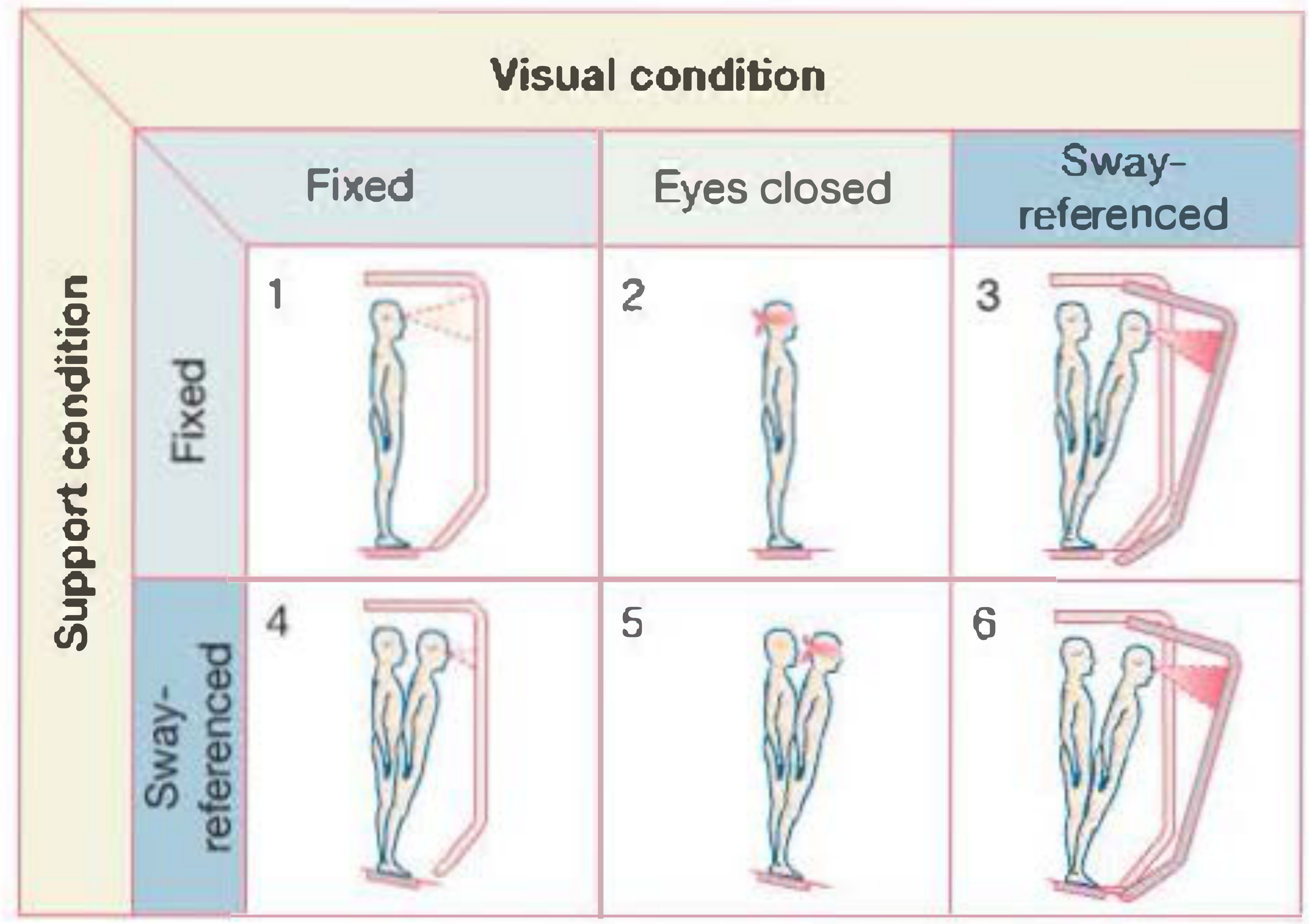
"Sway-referenced" means the platform or visual screen moves in tandem with the patient's centre of gravity, so the corresponding sensory input becomes unreliable. Condition 6 (eyes open, both surface and vision sway-referenced) creates a true sensory conflict: vision reports no movement while vestibular and proprioceptive receptors report that movement is occurring.
An equilibrium score is generated for each condition (0-100%): 100% = no sway, 0% = sway to the limit of stability before falling. Interpretation:
- Poor score on eyes-closed/stable surface -> loss of proprioceptive function
- Poor score on eyes-open/sway-referenced surface -> loss of visual contribution
- Poor score on eyes-closed/sway-referenced surface -> vestibular dysfunction
- Better performance eyes-closed than with sway-referenced (conflicting) vision -> difficulty resolving visual conflict, seen in visually-dependent or "space and motion discomfort" patients
B. Motor Control Test (MCT)
Assesses the patient's ability to make rapid, automatic postural corrections in response to sudden horizontal (forward/backward) translations of the platform of increasing magnitude - tests the intact reflex/motor pathway rather than sensory organization.
C. Adaptation Test (ADT)
The platform rotates abruptly "toes-up" or "toes-down"; the test measures the force generated and the rate at which the patient adapts (habituates) responses to repeated unexpected rotations.
Clinical findings
- Acute unilateral peripheral vestibular lesion (e.g., vestibular neuritis): patient tends to fall towards the side of the lesion on eye closure, i.e., in the direction of the slow phase of nystagmus.
- Compensated vestibular lesions: static posturography (eyes open/closed on fixed platform) is usually normal; abnormalities emerge only on CDP conditions with sway-referenced support and/or vision - i.e., when proprioceptive and visual cues are simultaneously degraded, unmasking the vestibular deficit.
- Correlates well with the Dizziness Handicap Inventory (DHI) and is useful for tailoring vestibular rehabilitation programmes to a patient's specific sensory deficit profile, and for monitoring compensation/recovery.
- Also useful in non-vestibular causes of imbalance such as spinal cord lesions, Parkinson's disease, and in medicolegal/psychogenic ("functional") unsteadiness, where scores are inconsistent or paradoxically better under harder conditions.
Inexpensive clinical alternative - "Foam and Dome" test
Since the value of CDP largely comes from destabilizing the support surface and visual surround, a low-cost bedside equivalent has been developed: the patient stands on rubber foam (degrades proprioceptive accuracy) while wearing optically reversing goggles or a "Chinese lamp" dome over the head (degrades visual accuracy). This is called the "Clinical Test of Sensory Integration and Balance" and correlates well with formal CDP findings.
Limitations / clinical usefulness
- Posturography (whether static or CDP) is not diagnostic of a specific lesion site or aetiology - an abnormal result only shows that postural control is disturbed, not why.
- Comparative studies show the caloric test correlates better with a history of vertigo, whereas CDP can be abnormal even with normal caloric responses - this may reflect genuine detection of non-vestibular contributors to imbalance, or false positives.
- A Therapeutics and Technology Assessment report and multiple reviews concluded there is ongoing debate about its usefulness for day-to-day management of individual patients, even though it has clearly advanced understanding of how postural control systems work and how they are impaired in various patient groups.
- Best used as an adjunctive, functional/quantitative measure - particularly to guide and monitor vestibular rehabilitation and to document functional impairment (e.g., for compensation/legal purposes) - rather than as a stand-alone diagnostic test.
Summary
| Feature | Detail |
|---|---|
| Purpose | Quantify postural sway / balance control |
| Types | Static, Dynamic (CDP) |
| Key tests | SOT, MCT, ADT |
| Systems evaluated | Vestibular, visual, somatosensory |
| Main use | Vestibular rehab planning, functional assessment, compensation documentation |
| Limitation | Not lesion/site specific; limited diagnostic value alone |
Sources: Scott-Brown's Otorhinolaryngology Head & Neck Surgery Vol 2, p. 846-848; Shambaugh Surgery of the Ear, p. 150-151; K J Lee's Essential Otolaryngology, Ch. 16; Cummings Otolaryngology Head and Neck Surgery.
Note: A quick check of recent systematic reviews/meta-analyses (last 2 years) on posturography did not surface findings that contradict these textbook fundamentals - the debate over its stand-alone diagnostic value versus adjunctive/rehabilitation role remains the current consensus.
This is a shared conversation. Sign in to Orris to start your own chat.