
PCOS
Reading File
Searching sources...
Finding Sources
Searching PubMed
"polycystic ovary syndrome"[MeSH Terms] AND management
Finding Sources
Finding Sources
Good - I found PCOS content in multiple textbooks. Let me read the key sections in parallel.
Reading File
Reading File
Loading Image
Reading File
Reading File
I now have comprehensive content to write an authoritative, complete answer on PCOS. Let me compile it.
Polycystic Ovary Syndrome (PCOS)
Definition
PCOS is a heterogeneous endocrine disorder defined by the Rotterdam criteria - any 2 of 3 of the following, after exclusion of other causes:
- Oligo-ovulation or anovulation
- Hyperandrogenism (clinical or biochemical)
- Polycystic ovaries on ultrasound
Other biochemical features (not required for diagnosis) include elevated LH, decreased FSH, and LH/FSH ratio >3.
- Goldman-Cecil Medicine, p. 2560; Berek & Novak's Gynecology
Epidemiology
- Affects 6-12% of women of reproductive age - the most common endocrine abnormality in this group
- No obvious geographic or ethnic predilection
-
50% of affected women develop type 2 diabetes by age 40
- Obesity contributes significantly; rising obesity prevalence is increasing PCOS prevalence
Pathophysiology
The core mechanisms involve a self-perpetuating hormonal loop:
| Mechanism | Detail |
|---|---|
| Insulin resistance | Present across all racial/ethnic groups; compensatory hyperinsulinemia is the hallmark |
| Inappropriate gonadotropin secretion | Hypothalamic-pituitary axis is intact but deranged; elevated LH with relatively low/constant FSH |
| Androgen excess | Elevated testosterone (mildly), DHEAS; implicated CYP17 and CYP19 genetic alterations |
| Anovulation | Insulin-like growth factors within the ovary disrupt folliculogenesis |
| Extraglandular estrogen | Peripheral conversion of androgens to estrogen maintains persistent estrogen stimulation |
- Goldman-Cecil Medicine, p. 2560
Clinical Manifestations
Classic presentation (but highly variable):
- Menstrual irregularity - oligomenorrhea, amenorrhea, or irregular/profuse bleeding
- Hirsutism - most common androgen-excess sign
- Acne, androgenic alopecia
- Obesity - though normal-weight PCOS exists
- Symptoms typically begin at puberty and worsen with time, but may improve near menopause
A subset presents with marked obesity, anovulation, mild glucose intolerance, hyperinsulinemia, and acanthosis nigricans (HAIR-AN syndrome).
Diagnosis
Step 1 - Exclusion of other causes:
- Cushing syndrome
- Congenital adrenal hyperplasia (non-classical)
- Virilizing adrenal or ovarian tumors
- Hyper/hypothyroidism
- Hyperprolactinemia
Step 2 - Confirm Rotterdam criteria (2 of 3 features present)
Lab workup:
- Total and free testosterone, DHEAS
- LH/FSH ratio (elevated >3 supports PCOS, but not required)
- Fasting glucose and insulin, HbA1c
- Lipid panel
- TSH, prolactin (to exclude)
- Pelvic ultrasound (≥12 follicles 2-9 mm in either ovary, or increased ovarian volume >10 mL)
Diagnostic Flowchart and Ancillary Studies
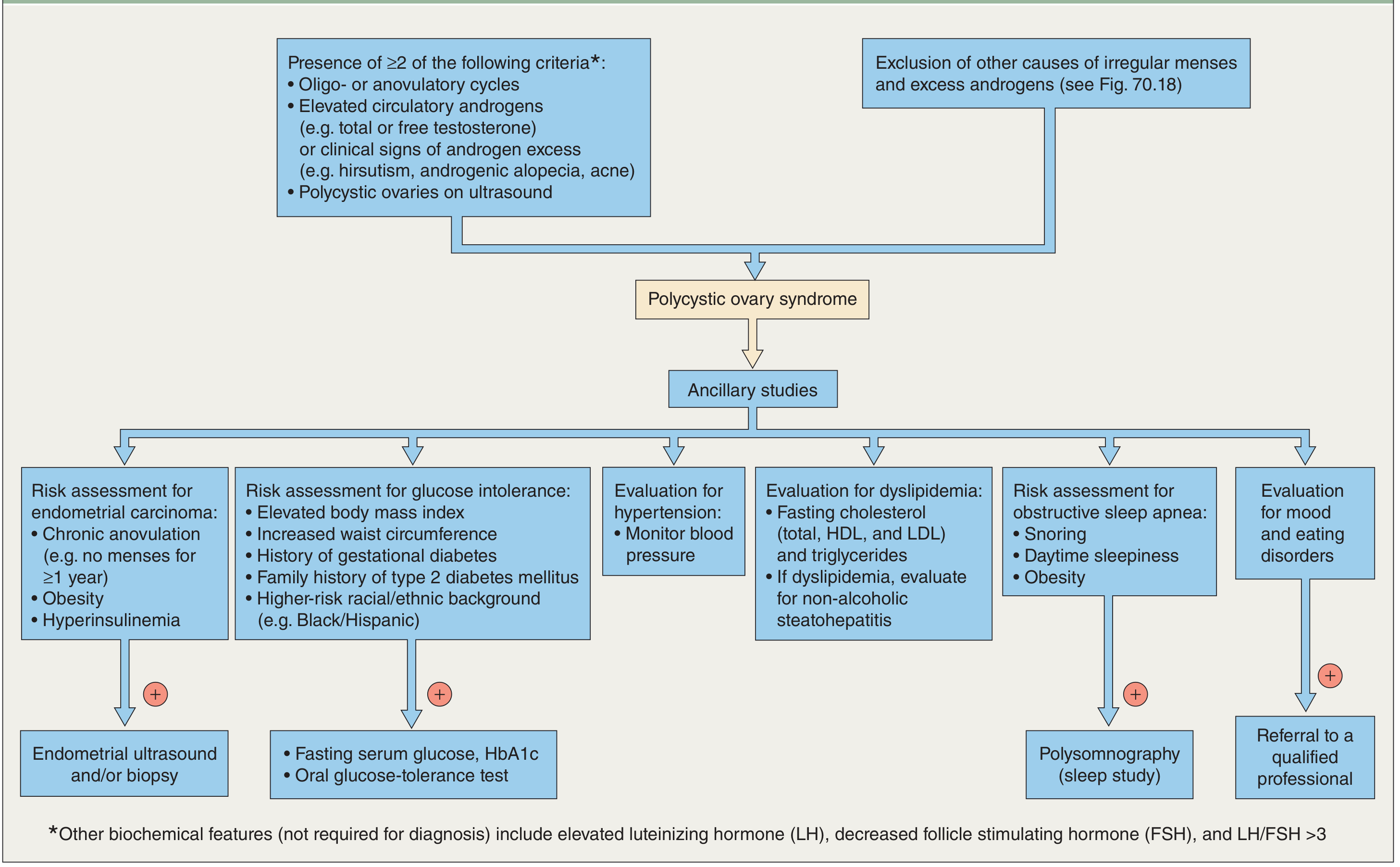
Dermatology 2-Volume Set 5e - PCOS evaluation pathway
Long-Term Risks
| System | Risk |
|---|---|
| Metabolic | Type 2 diabetes, metabolic syndrome, dyslipidemia |
| Cardiovascular | Hypertension, increased CVD risk |
| Endometrial | Endometrial hyperplasia and carcinoma (unopposed estrogen) |
| Hepatic | Non-alcoholic steatohepatitis |
| Respiratory | Obstructive sleep apnea |
| Psychiatric | Depression (35-40%), anxiety, eating disorders |
Management
Treatment is goal-directed and individualized.
1. Lifestyle Modification (First-line for all)
- Weight loss of 5-7% over 6 months can significantly reduce free testosterone, restore ovulation in >75% of women, and improve insulin sensitivity
- Exercise targeting large muscle groups (e.g., thighs) reduces insulin resistance
- A 2025 systematic review (PMID 39861440) confirms lifestyle interventions improve reproductive and metabolic outcomes
2. Not Desiring Pregnancy
Goal: Menstrual regulation, anti-androgen effect, endometrial protection
| Agent | Mechanism | Notes |
|---|---|---|
| Combined OCP | Suppresses LH → reduces ovarian androgens; increases SHBG; inhibits 5α-reductase in skin | First-line; prefer low-androgenic progestins (drospirenone, norgestimate, desogestrel) |
| Medroxyprogesterone acetate | Suppresses GnRH → decreases gonadotropins; reduces hair growth in up to 95% | Oral 20-40 mg/day or IM 150 mg every 6-12 weeks |
| Spironolactone | Antiandrogen; androgen receptor blocker | 50-200 mg/day; requires contraception (teratogenic) |
| Finasteride | 5α-reductase inhibitor | Blocks DHT formation |
| GnRH agonists | Suppress ovarian androgens to castrate levels; add-back estrogen prevents bone loss | Used in refractory cases |
| Metformin | Reduces hepatic gluconeogenesis, improves insulin sensitivity, lowers androgens | 1500-2000 mg/day; restores ovulation in 60-70% |
3. Desiring Pregnancy (Ovulation Induction)
| Agent | Dose | Notes |
|---|---|---|
| Letrozole | 5 mg days 3-7 | Preferred first-line (superior to clomiphene in PCOS) |
| Clomiphene citrate | 50 mg days 3-7 | Alternative; ~75-80% conception rate with either agent |
| Metformin | 500-2000 mg/day | Less effective than letrozole/clomiphene alone, but may be combined |
| Gonadotropins + hCG | Specialist-directed | Second-line |
| Laparoscopic ovarian drilling | Electrocautery or laser | Last resort; risk of ovarian adhesions |
- Goldman-Cecil Medicine, p. 2560; Berek & Novak's Gynecology, p. 1934-1936
4. Emerging / Recent Evidence
- GLP-1 receptor agonists (e.g., semaglutide, liraglutide): A 2024 meta-analysis (PMID 39178623) showed GLP-1 agonists significantly promote weight loss and hormonal regulation in PCOS women with obesity
- Probiotics/synbiotics: A 2024 systematic review (PMID 39599701) found benefits in managing insulin resistance and hormonal imbalance
Mental Health
-
Depression prevalence: 35-40% in PCOS vs. ~10.7% in controls (after adjusting for BMI)
-
Anxiety and eating disorders are also common
-
Screen using PHQ-2 at every visit
-
Lifestyle management improves quality of life and depression scores
-
Refer to qualified mental health professional when indicated
-
Berek & Novak's Gynecology, p. 1934
Summary Table
| Feature | Detail |
|---|---|
| Prevalence | 6-12% of reproductive-age women |
| Diagnosis | Rotterdam criteria: 2/3 features |
| Core defect | Insulin resistance + hyperinsulinemia |
| Key hormones | ↑LH, ↑androgens, ↓/normal FSH, ↓SHBG |
| First-line treatment | Lifestyle (weight loss, exercise) |
| Pharmacotherapy (no pregnancy desired) | OCP + metformin ± antiandrogens |
| Pharmacotherapy (pregnancy desired) | Letrozole > clomiphene > metformin |
| Key long-term risks | T2DM, endometrial cancer, CVD, depression |
This is a shared conversation. Sign in to Orris to start your own chat.