
Ticks miges cyclops indetail from spm in the form images
Reading File
Now let me search the SPM (Social & Preventive Medicine) textbook for ticks, midges, and cyclops content with images.
Finding Sources
Finding Sources
Finding Sources
Park's SPM has ticks and cyclops. Let me also search for midges in Park's and then read all the relevant sections.
Finding Sources
Reading File
Excellent! I can see ticks content with images. Now let me read more to get the complete ticks content, mites content, and cyclops content.
Reading File
Reading File
I have cyclops data. Now let me read the mites section (which the user likely meant by "miges") and get more ticks content, plus fetch all images.
Reading File
Reading File
Now let me get the mites section content (which was truncated) and fetch all images in parallel.
Reading File
Loading Image
Loading Image
Loading Image
Now let me fetch the mite life cycle image and itch mite image in parallel, and also get the remaining itch mite description:
Loading Image
Reading File
Now let me fetch the itch mite image:
Loading Image
I now have all the images and content. Let me compile the full detailed response from Park's SPM.
Ticks, Mites (Chiggers), and Cyclops - Park's SPM
Source: Park's Textbook of Preventive and Social Medicine
TICKS AND MITES (Acarina)
Ticks and mites form one of the largest and most important orders (Acarina) of the phylum Arthropoda. They are ectoparasites of vertebrate animals and all suck blood.
TICKS
Ticks are of two kinds: hard ticks (Ixodidae) and soft ticks (Argasidae).
Morphology:
- Oval body, not distinctly separated into head, thorax, and abdomen
- Four pairs of legs; no antennae
- Hard ticks: covered dorsally by a chitinous shield called the scutum (covers entire back in males; only anterior portion in females)
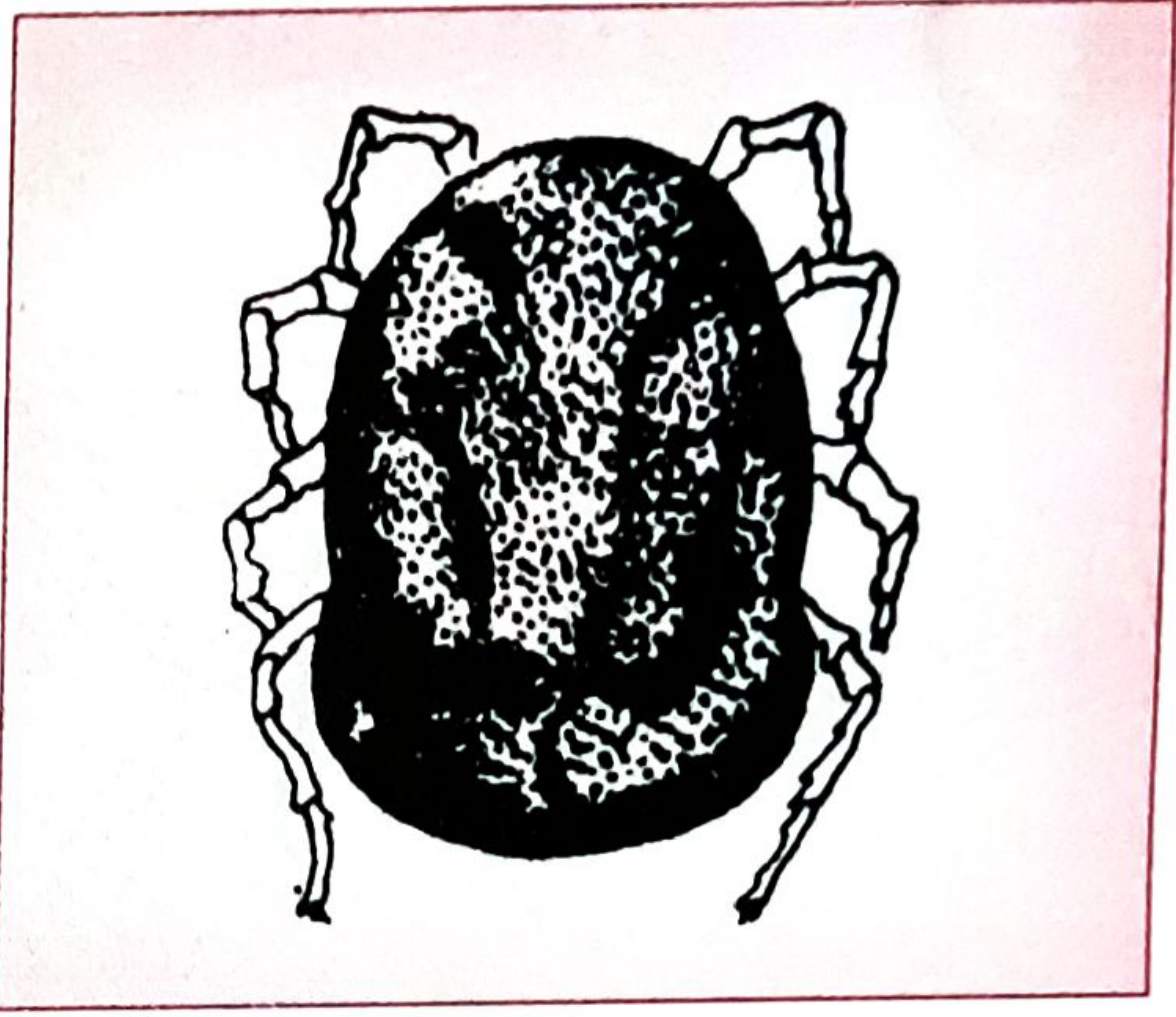
- Soft ticks: scutum absent; head lies ventrally and is invisible from above
- Males are generally smaller than females
Habits:
- Hard ticks: feed both day and night; cannot stand starvation; always found on hosts
- Soft ticks: feed at night; can withstand starvation for several months; hide in cracks and crevices during daytime
Common hard ticks in India: Dermacentor, Haemaphysalis, Hyalomma, Rhipicephalus, Boophilus
Important soft tick: Ornithodorus moubata (transmits relapsing fever)
Fig. 12 - Hard Tick
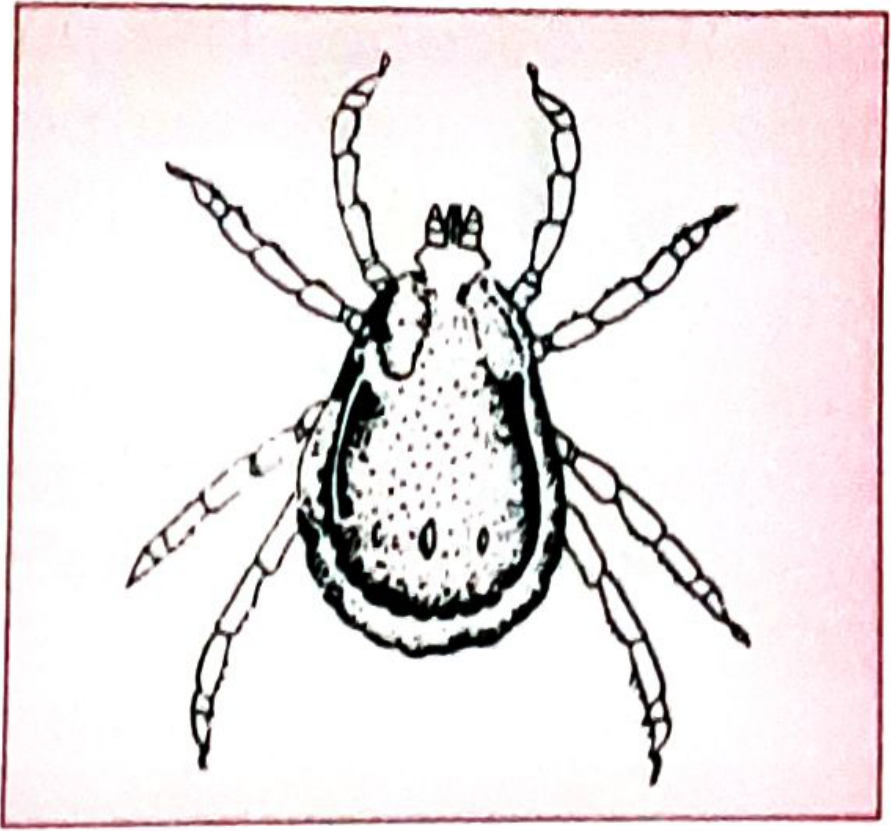
Fig. 13 - Soft Tick
Life History of Ticks (4 Stages)
| Stage | Details |
|---|---|
| Egg | Hard ticks: hundreds-thousands at one time (then female dies). Soft ticks: batches of 20-100 over long period. Hatch in 1-3 weeks. |
| Larva | 3 pairs of legs. Waits on grass/herbage for host. After blood meal, drops off and moults to nymph. Lasts 3-13 days. |
| Nymph | 4 pairs of legs, no genital pore. Blood suckers. Soft ticks have 5 nymphal stages. |
| Adult | Hard ticks: egg to adult ~2 months. Soft ticks: 9-10 months. Adults live 1 year or more. |
Public Health Importance
Hard ticks transmit:
- (a) Tick typhus (Rocky Mountain Spotted Fever)
- (b) Viral encephalitis (e.g., Russian Spring-Summer Encephalitis)
- (c) Viral fevers (e.g., Colorado Tick Fever)
- (d) Viral haemorrhagic fevers (e.g., KFD in India)
- (e) Tularaemia
- (f) Tick paralysis
- (g) Human babesiosis
Soft ticks transmit:
- (a) Q fever
- (b) Relapsing fever
- (c) KFD
The tick attaches by burrowing its rostrum into the skin to suck blood, while secreting saliva containing a neurotoxin. Disease is transmitted trans-stadially (larva and nymph can also transmit) and by transovarian transmission through successive generations.
Comparison: Hard vs Soft Ticks
| Feature | Hard Ticks (Ixodidae) | Soft Ticks (Argasidae) |
|---|---|---|
| Scutum | Covers entire back (male); small anterior portion (female) | Absent |
| Head | Anterior end | Ventral; not seen from above |
| Spiracles | Behind IV coxa | Between III and IV coxa |
| Eggs | Hundreds/thousands at one sitting | Batches of 20-100 over long period |
| Nymphal stages | One | Five |
| Habits | Cannot stand starvation; feed night and day | Can stand starvation for a year or more |
| Diseases | Tick typhus, viral encephalitis, haemorrhagic fever, tularaemia, tick paralysis, babesiosis | Relapsing fever |
| Key species | Dermacentor andersoni, Haemaphysalis spinigera | Ornithodorus moubata |
MITES (Chiggers)
Mites resemble ticks - 4 pairs of legs, body not well demarcated into head, thorax and abdomen. Two mites of public health importance:
- Trombiculid mite (chigger mite)
- Itch mite (Acarus scabiei / Sarcoptes scabiei)
TROMBICULID MITES
Spider-like arthropods. Important species: Leptotrombidium deliense and L. akamushi - vectors of scrub typhus in Asia and South Pacific.
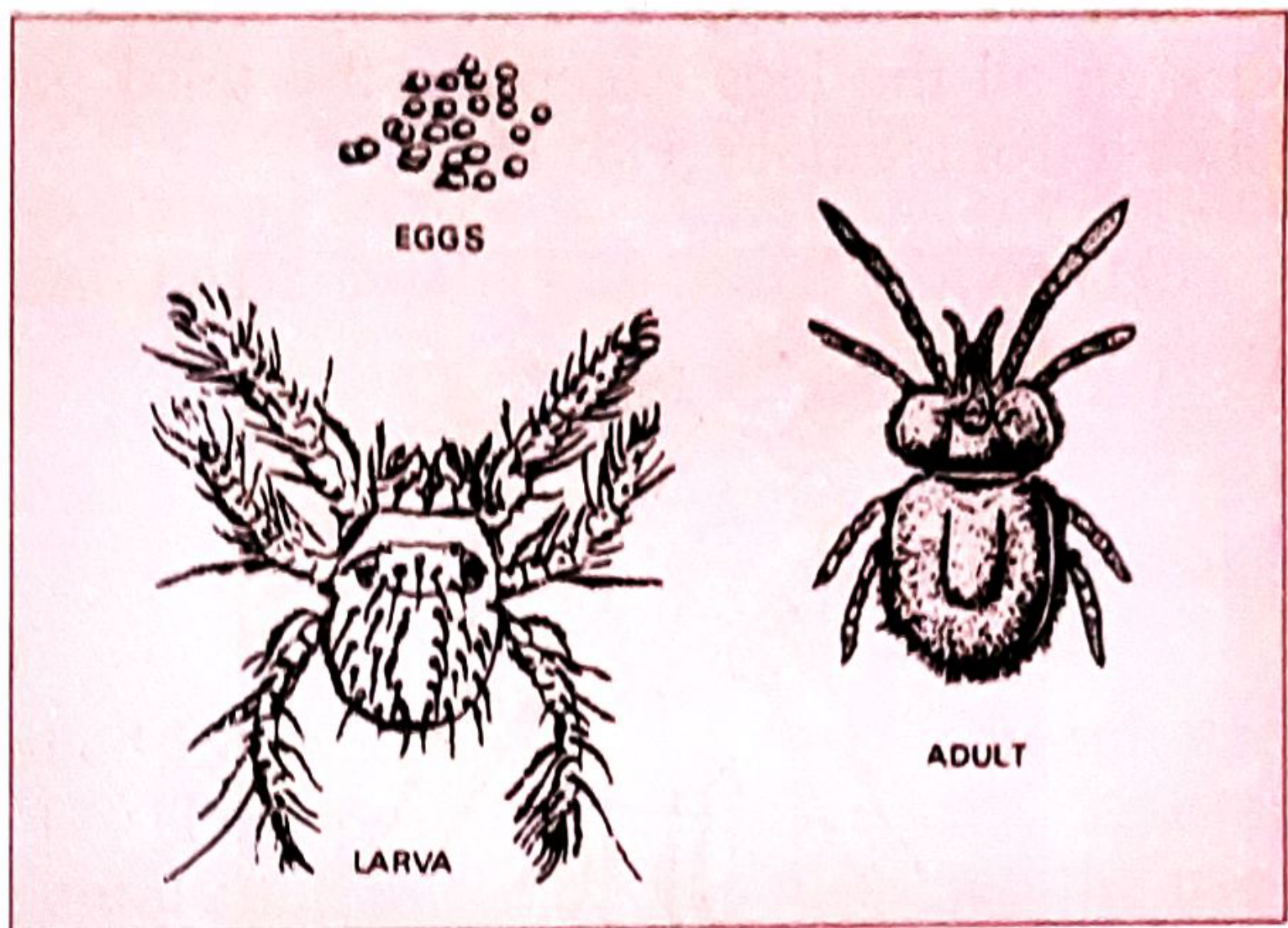
Life Cycle of Mite (4 Stages)
| Stage | Details |
|---|---|
| Egg | Laid singly; hatch in ~1 week |
| Larva | Very small, pale orange, 3 pairs of legs. Attacks vertebrate hosts (rodents/man). After blood meal drops to ground; lasts 1-2 weeks |
| Nymph | Brick-red, 4 pairs of legs; lives on vegetable juices; lasts 1-3 weeks |
| Adult | Male lives in soil; 4 pairs of legs (first pair largest); lives ~6 months |
Fig. 14 - Life Cycle of a Mite (Eggs, Larva, Adult)
ITCH MITE (Sarcoptes scabiei)
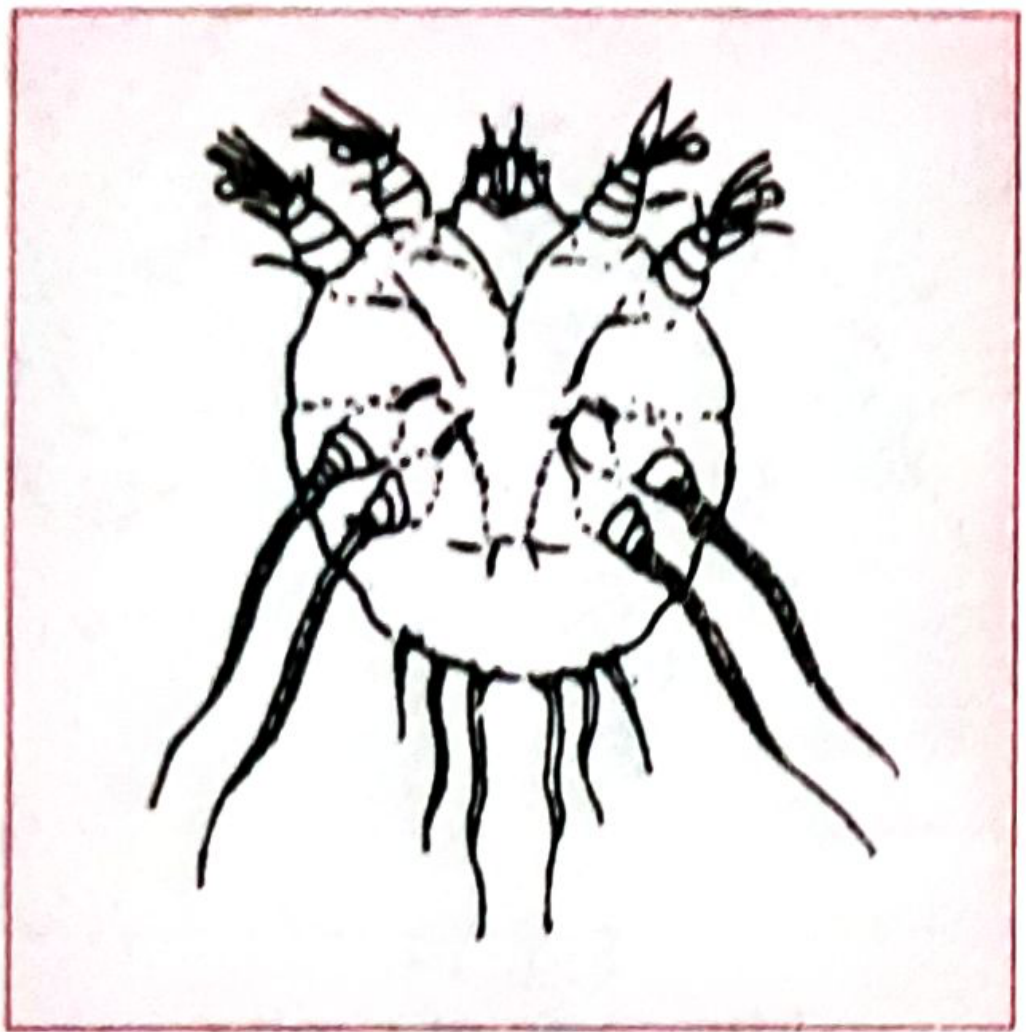
- Just visible to the naked eye; measures 0.4 mm
- Body shaped like a tortoise - rounded above, flattened below
- No demarcation into cephalothorax or abdomen
- Body surface has folds and short bristles
- Two pairs of legs in front, two pairs behind
- Front legs: end in long tubular suckers
- Hind legs: end in long bristles
- Males have suckers on all legs except 3rd pair (distinguishes from female)
The female burrows into the epidermis causing scabies (itch).
Fig. 15 - Itch Mite (Sarcoptes scabiei)
Life history of itch mite:
- Egg: Female lays up to 30 eggs (2-3/day) within burrows in stratum corneum; hatch in 3-4 days
- Larva: Three-legged; leave burrows, bore into hair follicles; mature in ~3 days
- Nymph: Develop into adults in 6-8 days
- Adult: Full life cycle egg to adult = 10-15 days; adults live 1-2 months
Scabies - Mode of spread: (1) Close contact - sleeping in same bed, children playing, nursing infested persons; (2) Contaminated clothes and bed linen.
Sites of lesion: Hands and wrists (63%), extensor aspect of elbows (10.9%), axillae, buttocks, lower abdomen, feet and ankles, palms (in infants), breasts (women), genitals (men).
Control of ticks and mites:
- Insecticidal: DDT, chlordane, dieldrin, lindane, malathion (1-2 lbs/acre)
- Environmental: Fill cracks/crevices; reduce wild rodent hosts
- Personal protection: Protective clothing with insect repellents (indalone, DEET, benzyl benzoate); regular self-examination in tick-infested areas
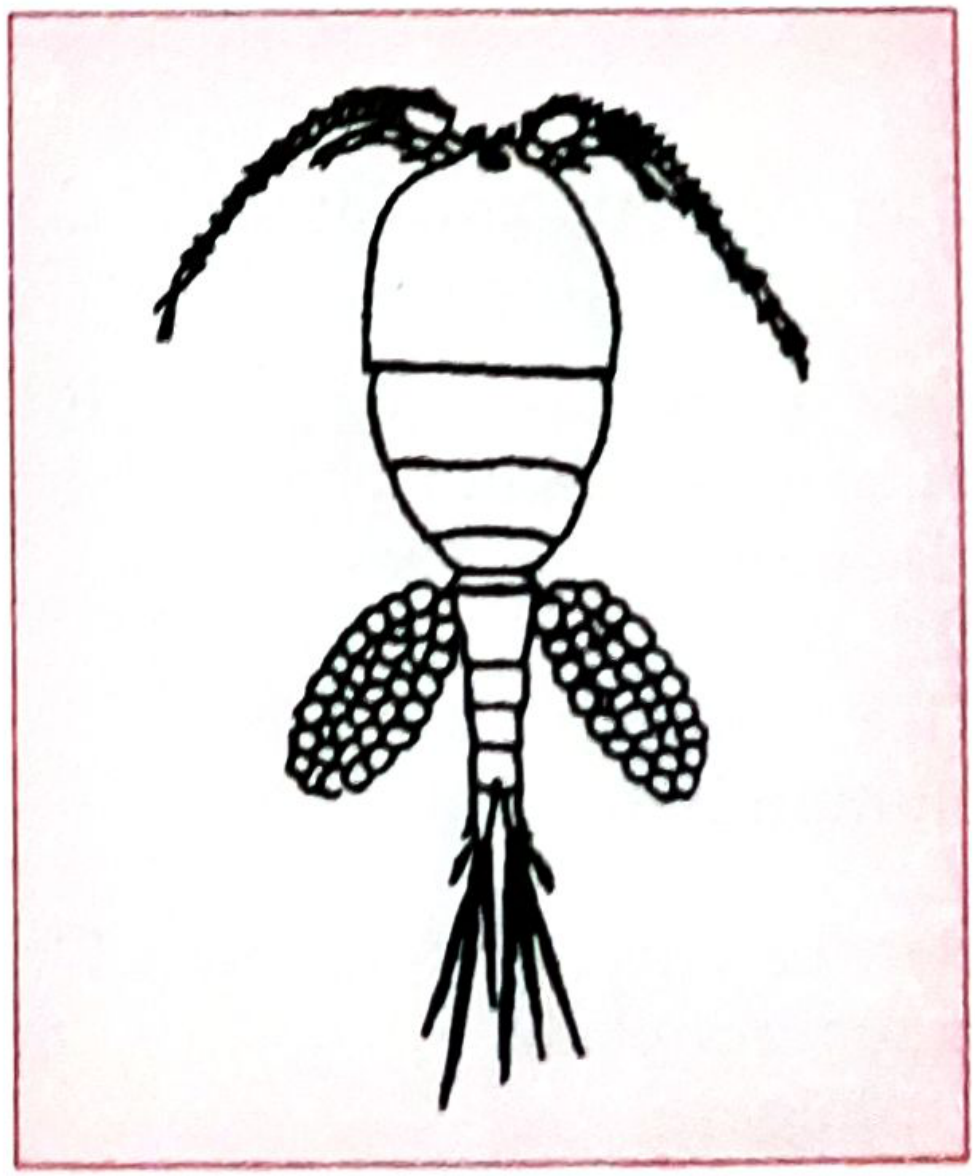
CYCLOPS (Water Flea)
Cyclops is a crustacean present in most collections of fresh water.
Morphology:
- Tiny arthropod, not more than 1 mm in length
- Just visible to the trained eye
- Pear-shaped, semi-transparent body
- Forked tail (furca)
- 2 pairs of antennae
- 5 pairs of legs
- One small pigmented eye (hence "Cyclops")
- Swims with characteristic jerky movements
- Average life: ~3 months
Fig. 16 - Cyclops
Public Health Importance
-
Dracunculiasis (Guinea-worm disease): Cyclops is the intermediate host. Man acquires infestation by drinking water containing infected cyclops harboring the larvae of Dracunculus medinensis.
-
Fish tapeworm (Diphyllobothrium latum): Cyclops also acts as one of the intermediate hosts (rare in India).
Control of Cyclops
| Method | Details |
|---|---|
| Physical - Straining | Straining water through fine cloth removes cyclops |
| Physical - Boiling | Killed at 60°C; useful for individual prophylaxis |
| Chemical - Chlorine | 5 ppm destroys cyclops and guinea-worm larvae (excess must be dechlorinated) |
| Chemical - Lime | 4 g per gallon of water |
| Chemical - Abate (OMS-786) | Organophosphorus insecticide; 1 mg/litre effective |
| Biological | Barbel fish and gambusia fish feed on cyclops (used successfully in Karnataka) |
| Permanent solution | Piped water supply or tube wells; abolition of step wells |
Source: Park's Textbook of Preventive and Social Medicine, Chapter on Arthropods of Public Health Importance (pp. 882-885)
This is a shared conversation. Sign in to Orris to start your own chat.