
Gustillo Anderson classification and management
Reading File
Finding Sources
Finding Sources
Searching PubMed
"open fracture" AND "Gustilo" AND classification management
Good results from Rockwood & Green, Miller's, Bailey & Love, and Sabiston. Now reading the main content sections in parallel.
Reading File
Reading File
Reading File
Now let me read the detailed management section from Rockwood & Green and the Miller's section:
Reading File
Reading File
Searching Images
Gustilo Anderson open fracture classification types
Now let me read more of the Rockwood & Green section on open fractures (the classification detail and OTA classification):
Reading File
Let me now find the specific Gustilo-Anderson classification section in Rockwood & Green:
Reading File
Let me search specifically for the Gustilo-Anderson classification detail within Rockwood & Green block 16 (where it's described for open fractures):
Finding Sources
Finding Sources
Reading File
Reading File
Reading File
I now have comprehensive information. Let me read the management section from Sabiston to get the complete treatment protocol including wound closure timing, fixation, etc.:
Reading File
I now have comprehensive data from multiple authoritative textbooks. Let me compile the full answer.
Loading Image
Loading Image
I have all the information needed. Here is the comprehensive answer:
Gustilo–Anderson Classification of Open Fractures
The Gustilo–Anderson (G-A) classification is the most widely used system for open fractures. It evaluates three variables: wound size, degree of contamination, and extent of soft tissue injury. True classification can only be finalised intraoperatively (after debridement), not at initial presentation — the type may upgrade with further debridement. There is considerable interobserver variability (42–94% agreement).
Classification
| Type | Wound | Soft Tissue | Fracture Pattern | Mechanism |
|---|---|---|---|---|
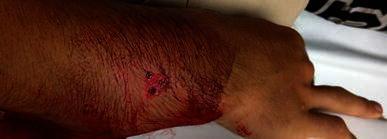
| I | < 1 cm, clean | Minimal muscle contusion; no periosteal stripping | Simple transverse/oblique | Low energy; usually "inside-out" (bone pierces skin) |
| II | 1–10 cm | Moderate damage; flaps/avulsion without extensive crush; little periosteal stripping | Simple transverse/short oblique, minimal comminution | Moderate energy |
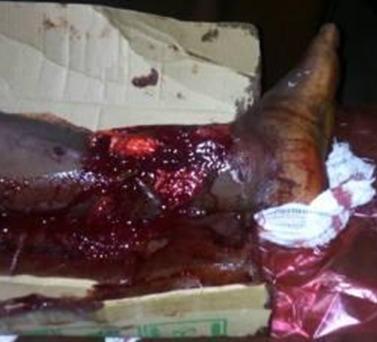
| IIIA | > 10 cm (or any size with heavy contamination) | Extensive laceration; periosteal stripping present but adequate soft tissue cover remains after debridement | Segmental fracture, comminution | High energy: gunshot, farm/barnyard, shotgun |
| IIIB | Same as IIIA | Extensive periosteal stripping + bone exposure — inadequate coverage; flap required | Comminuted/segmental | High energy + contamination |
| IIIC | Any size | Any extent of soft tissue injury | Any pattern | Vascular injury requiring repair — regardless of wound size |
Key memory point: The distinction between IIIA, IIIB, and IIIC depends on soft tissue cover adequacy and vascular status, NOT wound size alone.
Clinical Example — Type I (inside-out puncture wound)
Clinical Example — Type III (massive soft tissue disruption)
Infection Risk by Grade
| Grade | Infection Rate |
|---|---|
| Type I | 0–2% |
| Type II | 2–10% |
| Type IIIA | ~10–25% |
| Type IIIB | ~10–50% |
| Type IIIC | Highest (+ amputation risk) |
In practice, clinicians often dichotomise into IIIB/IIIC vs. all others, as infection rates for Types I, II, and IIIA are similar, while IIIB/IIIC require soft tissue coverage and carry substantially higher morbidity.
Management
1. Emergency / Initial
- ATLS primary survey — manage life-threatening injuries first
- Wound: bedside irrigation of gross contamination, loose sterile dressing, splint; avoid repeated inspection in the ED to minimise contamination
- Fracture reduction and splinting
- Mark NPO; arrange theatre
2. Antibiotics (Most Important Intervention)
Antibiotics must be started within 1 hour of injury (some protocols push prehospital administration for severe injuries). Delay beyond 3 hours significantly increases infection risk.
| Grade | Agent | Duration |
|---|---|---|
| Type I & II | Cefazolin (1st-gen cephalosporin) | 24 h after primary closure; 24 h after each subsequent procedure |
| Type III | Cefazolin + aminoglycoside (gentamicin/tobramycin) | 48 h from presentation; 24 h after each subsequent procedure |
| Soil/farm contamination | + Penicillin G (anaerobic/clostridial cover) | Single dose or extended per severity |
| Freshwater contamination | Fluoroquinolone (ciprofloxacin/levofloxacin) or 3rd/4th-gen cephalosporin | — |
| Saltwater contamination | Doxycycline + ceftazidime (Vibrio coverage) | — |
| True penicillin allergy | Clindamycin ± vancomycin (if high community MRSA rate) | — |
Aminoglycoside caveat: Dose-dependent nephrotoxicity and ototoxicity have led some institutions to omit aminoglycosides — use is declining. Check local protocols.
3. Tetanus Prophylaxis
| Patient Status | Tetanus-Prone Wound | Non-tetanus-Prone Wound |
|---|---|---|
| Unknown / < 3 doses | Toxoid + Human Tetanus Immunoglobulin (TIG) | Toxoid only |
| Fully immunised, last booster > 5 years | Toxoid booster | Not required |
Tetanus-prone wound: > 6 hours old, > 1 cm deep, devitalised tissue, gross contamination.
4. Debridement and Irrigation
- Perform within 6–24 hours of injury
- Thorough excision of all devitalised muscle, bone, and contaminated tissue
- Pulsed lavage irrigation (normal saline); low-pressure irrigation is as effective as high-pressure and avoids driving bacteria deeper into tissue
- Counter-incisions to improve wound access reduce flap rates (especially medial ankle)
- Repeat debridement every 48–72 hours if needed until wound is clean
- Antibiotic bead pouch (methylmethacrylate + tobramycin ± vancomycin): useful for highly contaminated wounds as local antibiotic delivery
5. Fracture Stabilisation
- Reduces further soft tissue damage and facilitates wound management
- Options:
- External fixator — preferred for heavily contaminated/unstable wounds, temporary stabilisation before definitive fixation
- Intramedullary nail — suitable for Type I–IIIA fractures once adequately debrided (widely used for tibial shaft fractures)
- Plate fixation (ORIF) — selected cases, requires good soft tissue coverage
- Spanning external fixator — periarticular open fractures
6. Wound Coverage
| Timeframe | Significance |
|---|---|
| Primary closure (same sitting) | Only if wound can be closed without tension after debridement (Type I/II) |
| < 7 days | Goal for definitive soft tissue coverage |
| > 7 days | Significantly increased infection risk |
Tibia coverage by zone (rule of thumb):
- Proximal third → Gastrocnemius muscle flap
- Middle third → Soleus muscle flap
- Distal third → Fasciocutaneous flap or free-tissue transfer (microvascular)
Negative pressure wound therapy (VAC): useful adjunct between debridements but is NOT a substitute for definitive coverage.
7. Vascular Injury (Type IIIC)
- Requires urgent vascular surgery consultation
- Temporary vascular shunt → skeletal stabilisation → definitive vascular repair (preferred sequence)
- Warm ischaemia time: revascularisation should be complete within 6 hours to avoid irreversible muscle necrosis
- Amputation rates for IIIC historically up to 50%; early multidisciplinary approach improves limb salvage
8. Compartment Syndrome Monitoring
All high-energy open fractures (especially tibia) require serial compartment assessments. Paradoxically, the open wound may decompress one compartment but not others. Fasciotomy threshold: compartment pressure > 30 mmHg, or within 30 mmHg of diastolic blood pressure.
Limitations of G-A Classification
- Designed originally for open tibia fractures only — validity for other bones is extrapolated
- Poor interobserver reliability (42–94%)
- Final grade can only be assigned intraoperatively, not at presentation
- Treatment-based rather than anatomy-based (type of wound closure defines IIIB)
OTA Open Fracture Classification (OTA-OFC)
Developed to address these shortcomings. Grades five independent factors:
- Skin (laceration size/complexity)
- Muscle (degree of loss)
- Arterial injury
- Contamination
- Bone loss
The OTA-OFC is more precise and better predicts outcomes than G-A, but its complexity has limited widespread adoption. The G-A system remains the standard in clinical practice.
Sources: Rockwood and Green's Fractures in Adults, 10th ed. (2025); Miller's Review of Orthopaedics, 9th ed.; Sabiston Textbook of Surgery; Bailey and Love's Short Practice of Surgery, 28th ed.
Development dysplasia of hip diagnosis and treatment
Reading File
Finding Sources
Finding Sources
Searching PubMed
"developmental dysplasia of the hip"[MeSH Terms] AND treatment
Excellent — multiple textbook sources found. Now reading the richest sources in parallel:
Reading File
Reading File
Reading File
Good data coming in. Now reading the continuation of Bailey & Love and Miller's sections, plus the Grainger radiology section and the Miller's treatment section:
Reading File
Reading File
Reading File
Now reading the treatment sections from Bailey & Love and Miller's continuation:
Reading File
Reading File
Reading File
Reading File
Searching Images
developmental dysplasia of hip DDH Pavlik harness ultrasound Graf classification
Excellent — comprehensive data collected. Let me fetch the most informative images:
Loading Image
Loading Image
Loading Image
Loading Image
I now have comprehensive, well-illustrated information. Let me also fetch the Hilgenreiner/Perkin's line X-ray and the blocks-to-reduction diagram:
Loading Image
Loading Image
I now have all the data needed for a comprehensive, illustrated answer. Let me compile it.
Developmental Dysplasia of the Hip (DDH)
DDH describes a spectrum of hip instability ranging from a shallow (dysplastic) acetabulum that may sublux, to a fully dislocated hip that is irreducible. The key underlying problem is failure of normal concentric development between the femoral head and the acetabulum.
Spectrum of Disease
| Grade | Description |
|---|---|
| Dysplasia | Shallow acetabulum; femoral head in joint but inadequately covered |
| Subluxation | Femoral head partially displaced, within the labrum |
| Dislocation (reducible) | Ortolani positive — dislocated but reducible |
| Dislocation (irreducible) | Ortolani negative — dislocated and cannot be reduced |
| Teratologic | Dislocated in utero, irreducible at birth; associated with arthrogryposis, Larsen syndrome, trisomy 21 |
Incidence & Risk Factors
- Neonatal instability: ~20 per 1,000 live births; true dislocation ~2 per 1,000
- Many hips stabilise spontaneously within the first 2–3 weeks
Risk factors (in decreasing importance):
- Breech presentation (especially extended breech) — 30–50× increased risk
- Female sex — 4–5× more common; oestrogen-related peripartum ligamentous laxity
- Positive family history — ≥20% incidence with affected first-degree relative
- Firstborn child — tight primigravid uterus, left occipito-anterior position → 67% left hip
- Oligohydramnios — restricts fetal movement
- Swaddling with hips in extension — postnatal risk factor
Associations: torticollis (20%), metatarsus adductus (10%); no association with clubfoot.
Diagnosis
Clinical Examination — Neonate
The critical question at neonatal examination:
Is the hip dislocated? If so, is it reducible (Ortolani +) or irreducible? If not dislocated, is it dislocatable (Barlow +)?
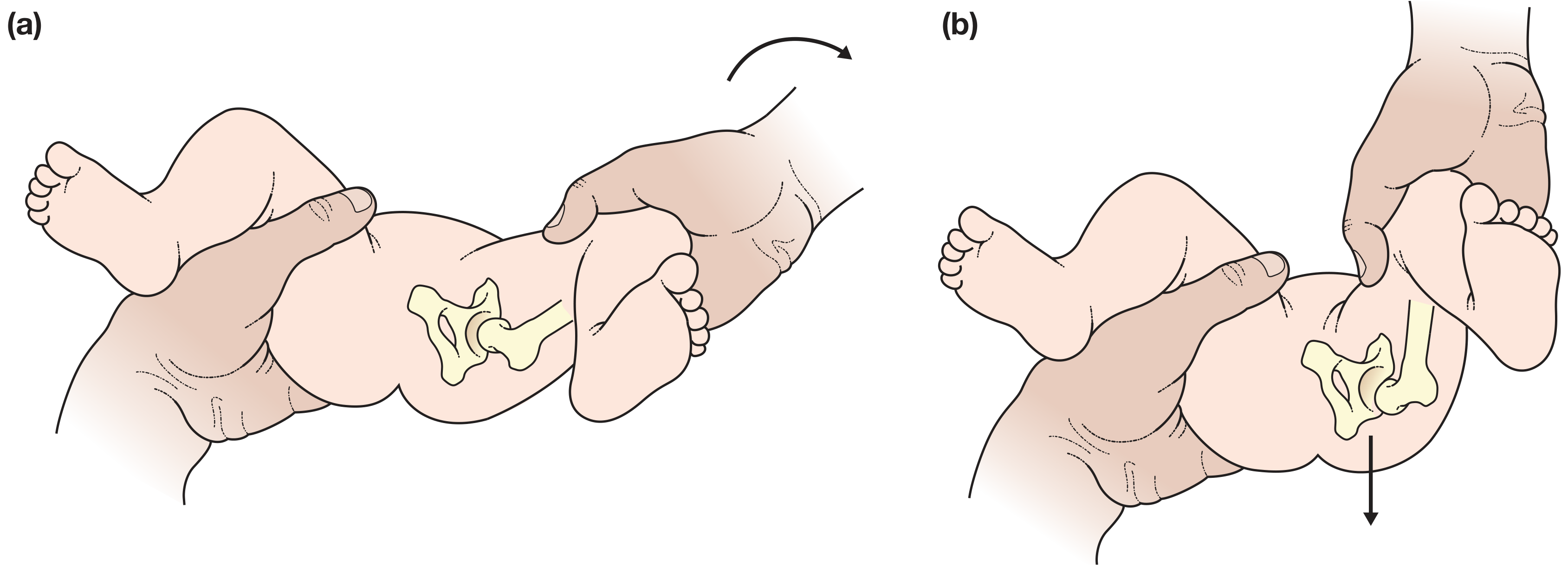
Ortolani test: Hip at 90° flexion → gentle abduction + elevation of greater trochanter → clunk of reduction = positive (dislocated but reducible)
Barlow test: Hip at 90° flexion → adduction + posterior pressure on knee → clunk of dislocation = positive (reduced but dislocatable)
Bilateral dislocation may be missed — abduction is symmetrically limited and may appear normal in low-tone infants.
Clinical Examination — Older Infant/Child
| Sign | Age | Finding |
|---|---|---|
| Limited hip abduction | > 3 months | < 60° abduction on affected side |
| Galeazzi sign | Any | Apparent femoral shortening — knees at unequal heights with hips & knees at 90° |
| Asymmetric thigh/gluteal folds | Infant | Less reliable |
| Trendelenburg gait | Toddler | Contralateral pelvis drops when standing on affected leg |
| Limping / tip-toe gait | Child | Affected leg appears short |
| Lumbar lordosis + waddling gait | Bilateral | |
| Exercise-related groin/knee pain | Adolescent |
Investigations
1. Ultrasound (< 4–6 months)
Modality of choice in the neonatal period, since the femoral head is cartilaginous and not visible on X-ray until 4–6 months.
Performed at 4–6 weeks of age (coronal view, lateral decubitus position):
Graf Classification (α angle on coronal US):
| Graf Type | α angle | Interpretation | Action |
|---|---|---|---|
| I | ≥ 60° | Normal, mature | None |
| IIa | 50–59° | Immature (< 3 months) | Follow-up |
| IIb | 50–59° | Delayed ossification (> 3 months) | Treatment |
| IIc | 43–49° | Critical zone — borderline | Treatment |
| III | < 43° | Subluxed; cartilaginous roof displaced | Treatment |
| IV | — | Dislocated | Treatment |
Normal: α > 60°; femoral head bisected by the iliac line; Morin index (femoral head coverage) > 50%.
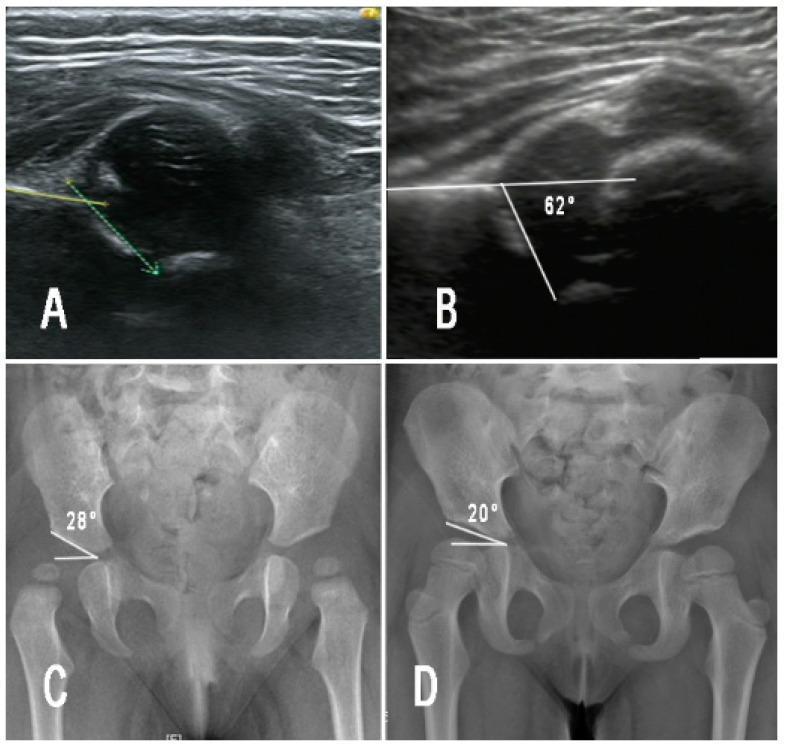
Selective US screening is recommended for:
- Breech presentation
- Positive family history
- Abnormal clinical examination
2. Plain Radiograph (≥ 4–5 months)
Used once the femoral ossific nucleus begins to appear (normally 4–6 months; often delayed in DDH).
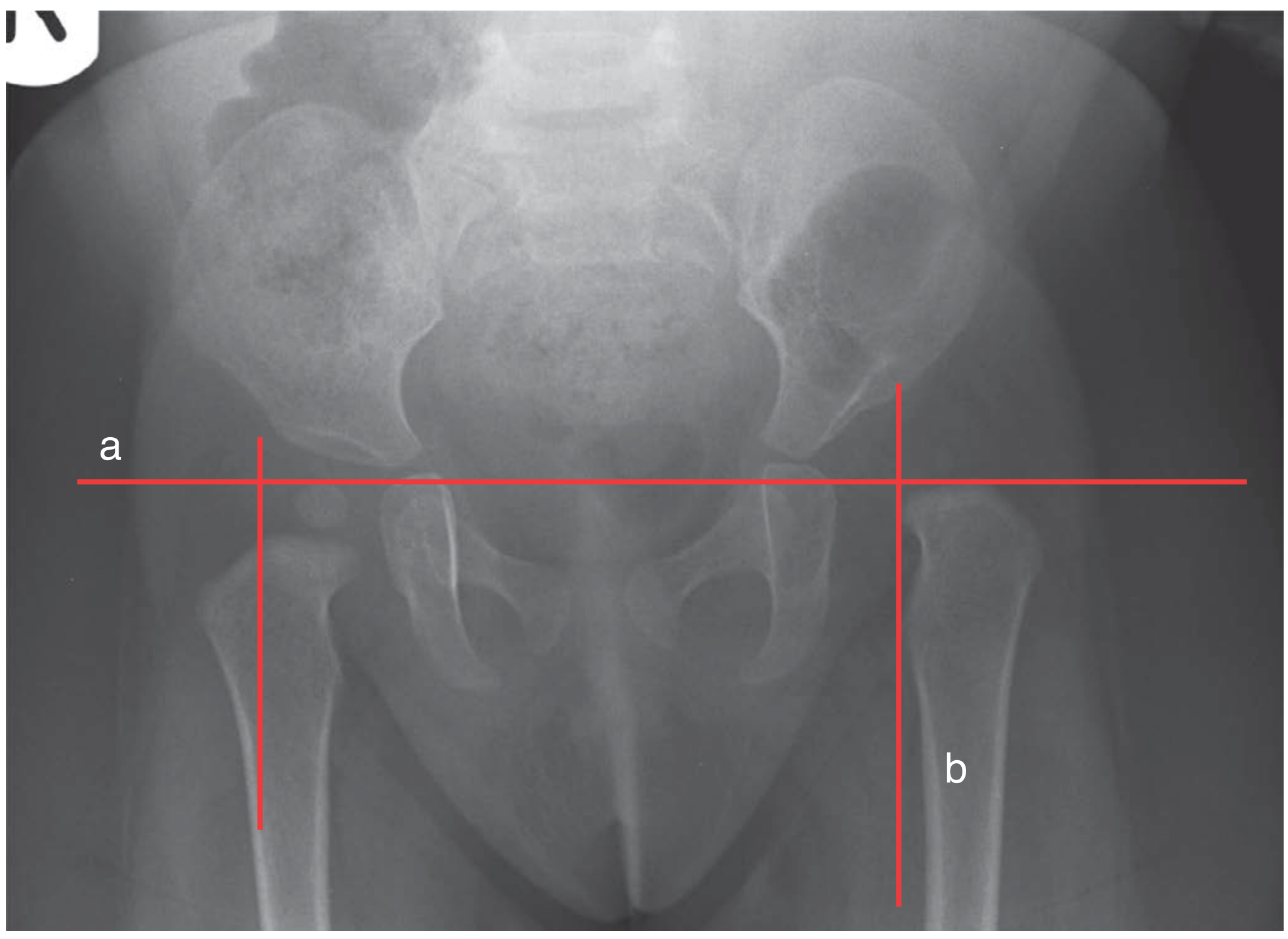
Key radiographic lines and measurements:
| Line / Measurement | Description | Normal |
|---|---|---|
| Hilgenreiner's line | Horizontal line through both triradiate cartilages (Y-cartilages) | Reference line |
| Perkin's line | Vertical line through lateral acetabular edge, perpendicular to Hilgenreiner's | Ossific nucleus should be medial |
| Shenton's line | Smooth arc from femoral neck to superior pubic ramus | Disrupted in dislocation/subluxation |
| Acetabular index (AI) | Angle between Hilgenreiner's line and roof of acetabulum | Normal: < 25–30° (decreases with age) |
| Centre-edge (Wiberg) angle | In older children — lateral femoral head coverage | Normal > 25° |
3. Arthrography
Used intraoperatively to:
- Confirm concentric reduction before casting
- Identify blocks to reduction (the "thorn sign" indicates normal labral position)
- Assess medial dye pool width (> 8 mm suggests inadequate reduction)
4. CT / MRI
- Post-reduction confirmation of concentric reduction in the spica cast
- MRI preferred (no radiation) for post-reduction assessment
- CT used where MRI unavailable
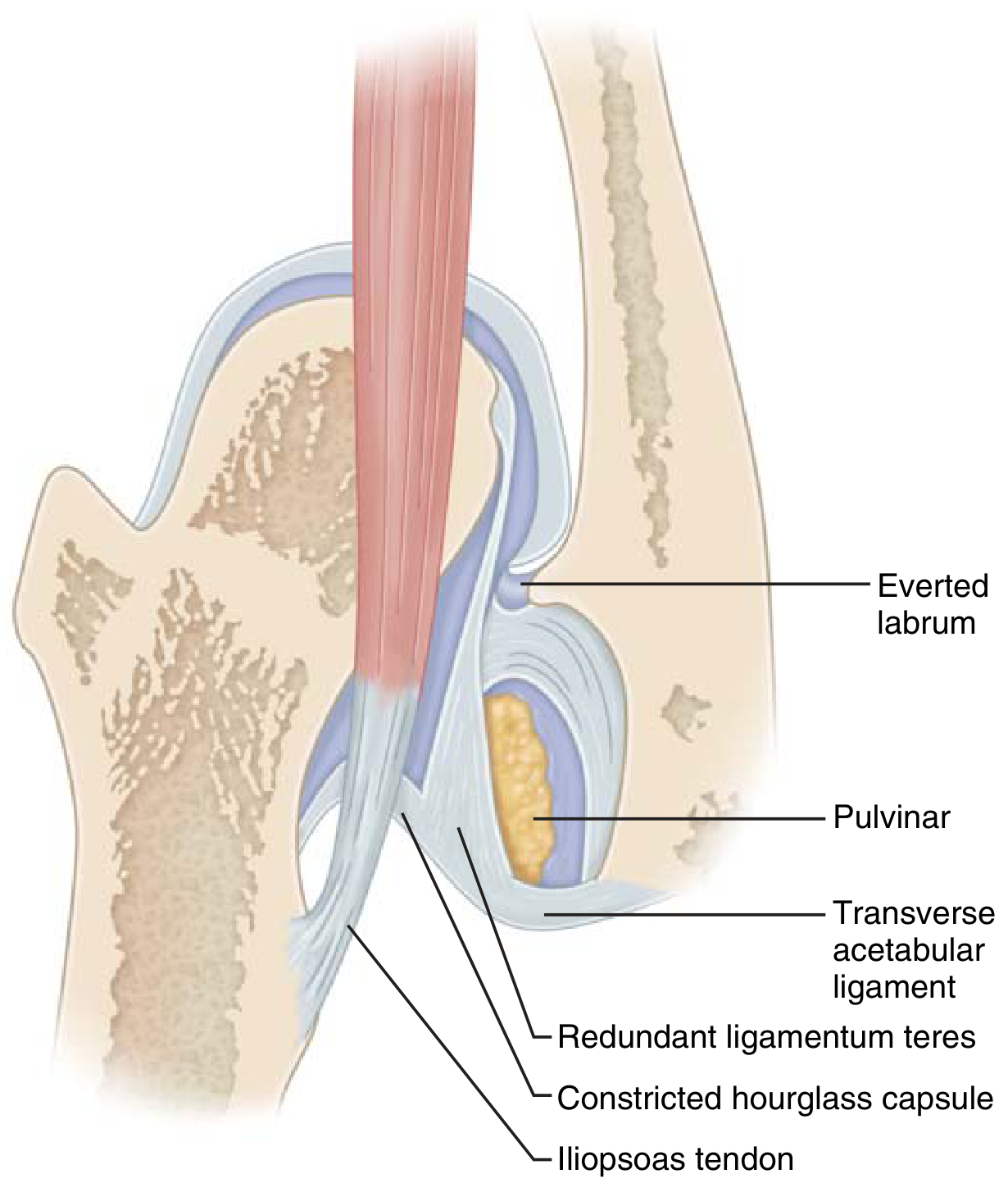
Blocks to Concentric Reduction
When a hip cannot be reduced, the following structures are implicated:
Treatment
The overarching goal is stable concentric reduction of the femoral head within the acetabulum, achieved as early as possible to allow normal acetabular development — while avoiding avascular necrosis (AVN) of the femoral head, the most feared complication.
Age 0–6 Months: Pavlik Harness
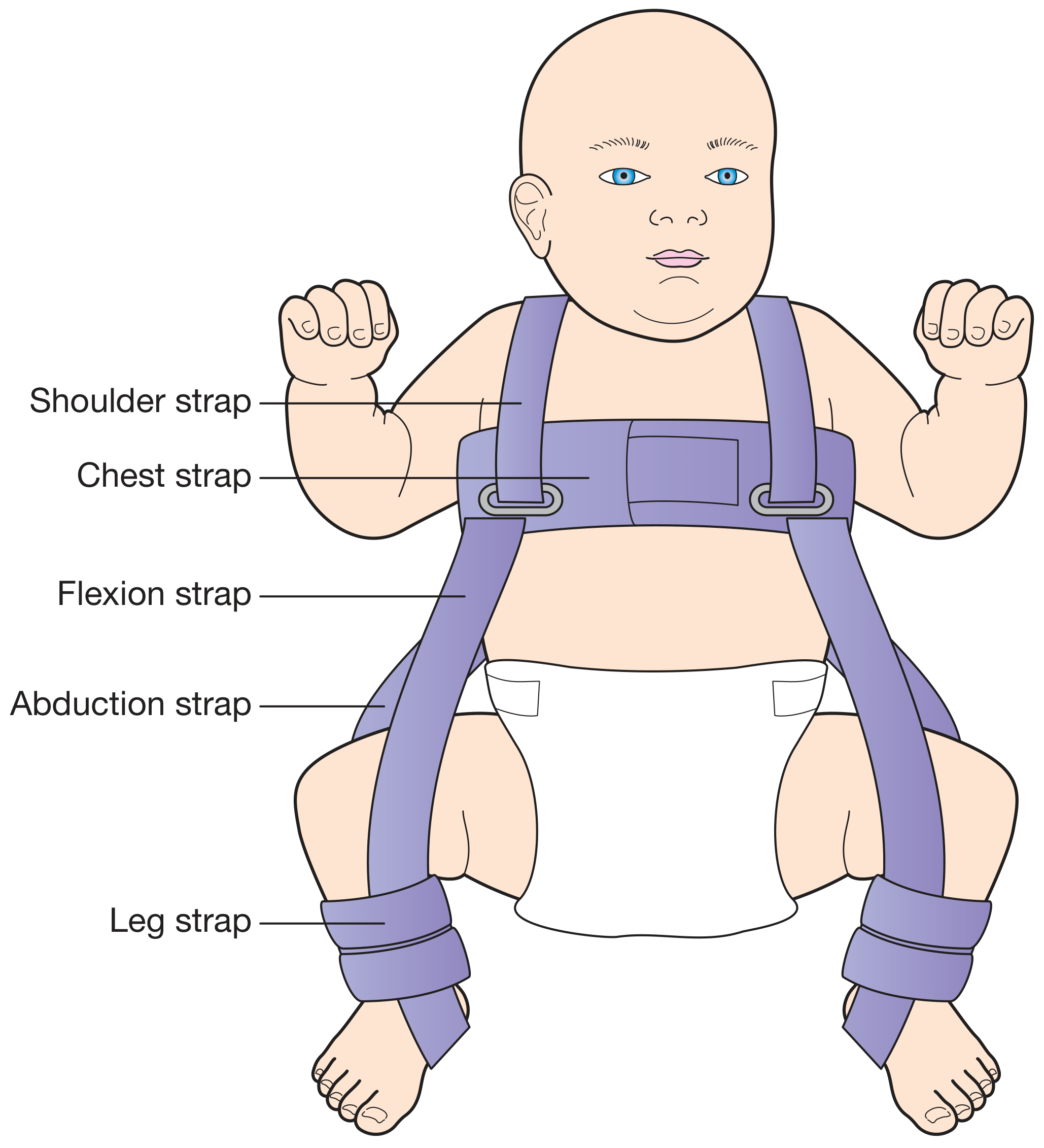
- First-line treatment for all Ortolani-positive and Barlow-positive hips (reducible and dislocatable)
- Maintains hips in the "human position" — ~100° of flexion, mild abduction (Salter position)
- Worn 23 hours/day for at least 6 weeks after reduction achieved, then part-time (nights/naps) for a further 6–8 weeks
- Reduction confirmed by ultrasound after fitting; repeat US to monitor
Safe zone (Ramsey zone): Between maximum adduction before redislocation and maximum abduction before AVN risk. A narrow safe zone (< 40°) is an indication for adductor tenotomy.
Complications of Pavlik harness:
- AVN — from excessive abduction (compresses posterosuperior retinacular branch of medial femoral circumflex artery)
- Femoral nerve palsy — from excessive flexion (transient)
- "Pavlik disease" — if reduction is not achieved within 3 weeks, continued harness use causes erosion of the pelvis superior to the acetabulum, making subsequent closed reduction more difficult → discontinue at 3 weeks if not reduced
Risk factors for harness failure:
- Age > 7 weeks at initiation
- Bilateral dislocations
- Absent Ortolani sign (irreducible hip)
- Teratologic dislocation (absolute contraindication)
Age 6–18 Months: Closed Reduction + Spica Cast
For hips failing Pavlik harness treatment, or presenting in this age group.
Procedure (under general anaesthetic):
- Examination under anaesthetic
- Hip arthrography — assess reduction and blocks
- Adductor ± psoas tenotomy if tight
- Closed reduction — gentle traction + flexion + abduction
- Hip spica cast in the stable zone of abduction (hips ≥ 90° flexion)
- Post-reduction CT or MRI to confirm concentric reduction
If closed reduction fails or only achieved in extreme position → proceed to open reduction.
Age 6–18 Months (failed closed) / Age ≥ 18 Months: Open Reduction
Approach:
- Medial approach (Ferguson/Ludloff): 6–24 months; allows direct access to medial obstacles; does not permit simultaneous capsulorrhaphy
- Anterior (Smith-Petersen) approach: preferred from 9–12 months onwards; allows capsulorrhaphy; lower risk to medial femoral circumflex artery than medial approach at older ages
Structures released at open reduction:
- Adductor longus tenotomy
- Iliopsoas release
- Pulvinar excision
- Transverse acetabular ligament division
- Labrum repositioning
- Capsulorrhaphy (tightening of capsule) to maintain reduction
Femoral shortening osteotomy: Added for children > 18 months to reduce excessive pressure on reduction (reduces AVN risk).
Pelvic Osteotomies (for residual acetabular dysplasia)
| Osteotomy | Age | Mechanism |
|---|---|---|
| Salter | 18 months–6 years | Single innominate osteotomy; redirects acetabulum anterolaterally; requires open triradiate cartilage |
| Pemberton | 18 months–8 years | Incomplete pericapsular osteotomy; reduces acetabular volume; good for large femoral heads |
| Dega | Similar to Pemberton | Posterior hinge; useful in neuromuscular DDH |
| Triple osteotomy (Steel/Tönnis) | Older children, skeletal near-maturity | Three cuts (ilium, ischium, pubis); triradiate cartilage must be closed or near-closed |
| Periacetabular (Ganz/PAO) | Adolescent/adult; closed triradiate | Redirects entire acetabulum; best for reducible dysplastic hips; preserves posterior column |
| Chiari | Salvage | Medial displacement osteotomy; non-anatomic; used for irreducible dysplasia |
| Shelf/augmentation | Salvage | Extends acetabular roof with bone graft |
Surgery is contraindicated in children > 6–8 years with bilateral dislocations and > 8–10 years with unilateral — the pseudoacetabulum provides sufficient function and correction risks more harm than benefit.
Summary Treatment Algorithm
Birth → Neonatal exam (Ortolani / Barlow)
│
├─ Unstable / dislocated → Observe 2–3 weeks (many resolve spontaneously)
│        Still abnormal at 4–6 weeks → Ultrasound + Pavlik harness
│
├─ 0–6 months → Pavlik harness (23 h/day x 6–8 weeks)
│        Reduced → Continue until US/XR normal
│        Not reduced in 3 weeks → Stop harness → EUA + closed reduction + spica
│
├─ 6–18 months → EUA + arthrogram + closed reduction + spica cast
│        Failure → Open reduction (medial or anterior approach) ± adductor tenotomy
│
├─ 18 months–3 years → Open reduction + femoral shortening + possible pelvic osteotomy
│
├─ 3–8 years → Open reduction + pelvic osteotomy (Salter/Pemberton/Dega)
│
├─ Older child / adolescent → Triple/PAO osteotomy ± femoral osteotomy
│
└─ Adult → PAO (if reducible), Chiari/shelf (salvage), or THA when arthritic
Complications
| Complication | Cause | Comments |
|---|---|---|
| Avascular necrosis (AVN) | Excessive abduction, forced reduction, medial approach | Most feared; graded I–V; can lead to permanent deformity and early OA |
| Redislocation | Inadequate capsulorrhaphy or reduction | Requires repeat intervention |
| Residual acetabular dysplasia | Incomplete treatment response | May need pelvic osteotomy |
| Femoral nerve palsy | Excessive flexion in Pavlik harness | Transient; resolves on harness adjustment |
| Leg length discrepancy | AVN or growth disturbance | — |
| Early osteoarthritis | Untreated or poorly treated DDH | Leads to THA in adult life |
| "Pavlik disease" | Continued harness when not reducing | Acetabular erosion; complicates later reduction |
Sources: Miller's Review of Orthopaedics, 9th ed.; Bailey and Love's Short Practice of Surgery, 28th ed.; Schwartz's Principles of Surgery, 11th ed.; Grainger & Allison's Diagnostic Radiology
This is a shared conversation. Sign in to Orris to start your own chat.