
PCSK9 inhibitors
I'll start with a quick overview while I pull from the medical library for a thorough answer.
Quick answer: PCSK9 inhibitors are a class of lipid-lowering drugs that block proprotein convertase subtilisin/kexin type 9 (PCSK9), a protein that degrades LDL receptors on hepatocytes. By inhibiting PCSK9, more LDL receptors remain on the liver surface, clearing more LDL-C from the blood. The approved agents (evolocumab, alirocumab) are monoclonal antibodies given subcutaneously, and inclisiran is a small interfering RNA. They reduce LDL-C by ~50-60% on top of statins and have demonstrated cardiovascular outcome benefits in major trials (FOURIER, ODYSSEY OUTCOMES).
Searching sources...
Reading File
Now let me search the library and PubMed in parallel for comprehensive coverage.
Finding Sources
Searching PubMed
"PCSK9 inhibitors" AND cardiovascular outcomes
Searching the Web
PCSK9 inhibitors 2025 2026 new approvals inclisiran updates
Good results. Now let me pull the core content from the key textbook sections in parallel.
Reading File
Reading File
Reading File
There's a diagram in Goodman & Gilman's - let me fetch that image, and also read more content from Goodman & Gilman and Washington Manual for clinical use and adverse effects data.
Loading Image
Reading File
Reading File
I now have rich data from four major textbooks plus recent PubMed evidence. Let me compile the full response.
PCSK9 Inhibitors
Mechanism of Action
PCSK9 (proprotein convertase subtilisin/kexin type 9) is a hepatic serine protease that binds to LDL receptors on the hepatocyte surface and escorts them to the lysosome for degradation. This reduces the number of LDL receptors available to clear LDL-C from circulation. PCSK9 inhibitors prevent this receptor destruction, allowing LDL receptors to recycle back to the cell surface and continuously remove LDL particles from the blood.
The diagram below illustrates this process:
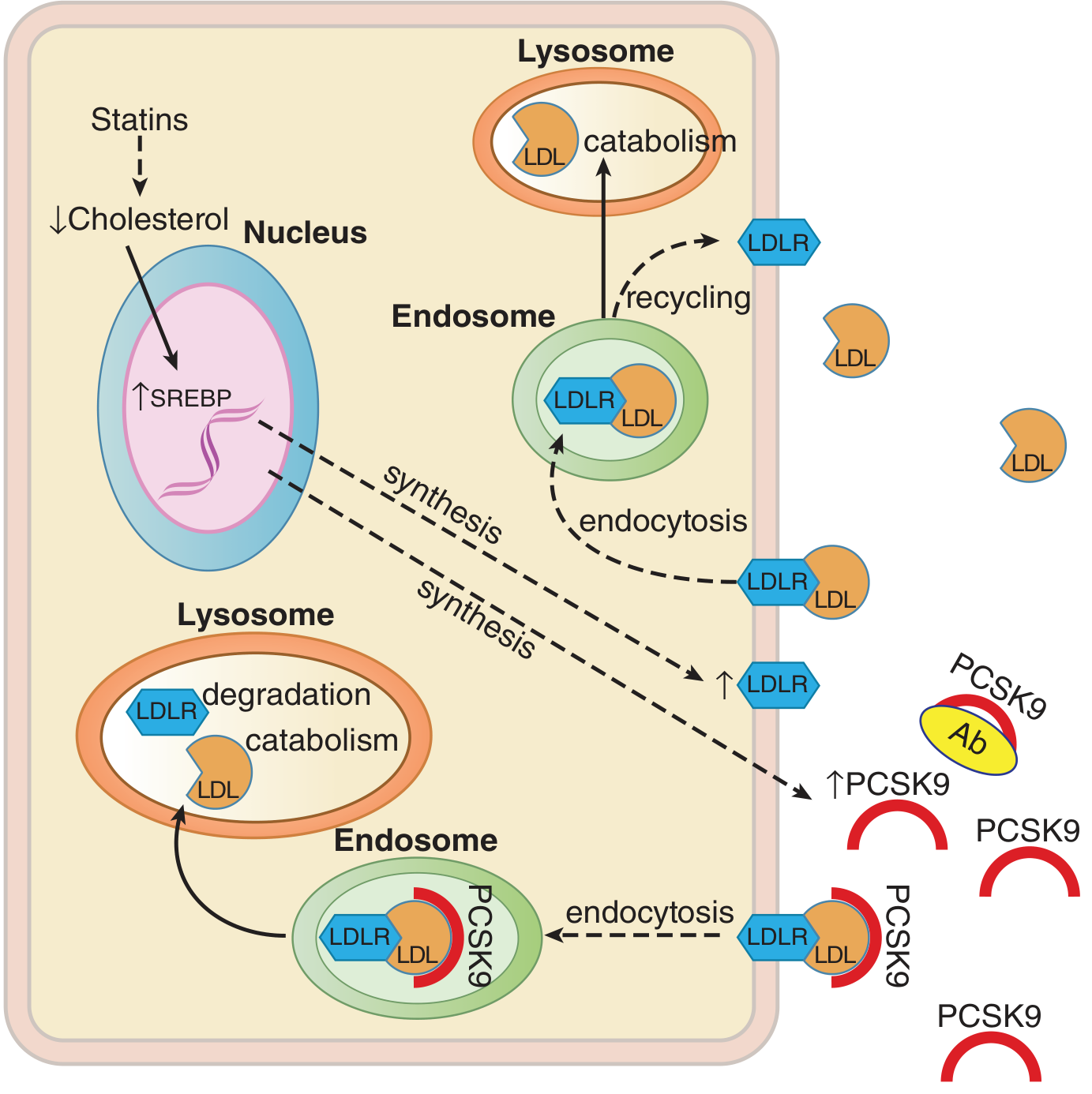
Figure: Top pathway = normal LDLR recycling. Bottom pathway = PCSK9 hijacks the LDLR-LDL complex into the lysosome for degradation. Antibody (Ab) blocks PCSK9 from binding the receptor; inclisiran blocks PCSK9 synthesis upstream.
The rationale for this target came from the observation that loss-of-function PCSK9 mutations result in very low LDL-C levels with no apparent morbidity, and conversely, gain-of-function mutations cause familial hypercholesterolaemia (FH). - Katzung's Basic & Clinical Pharmacology, 16th Ed.; Thompson & Thompson Genetics and Genomics in Medicine
Approved Agents
1. Monoclonal Antibodies (mAbs)
| Drug | Brand | Dose | Frequency |
|---|---|---|---|
| Evolocumab | Repatha | 140 mg SC | Every 2 weeks |
| 420 mg SC | Monthly | ||
| Alirocumab | Praluent | 75-150 mg SC | Every 2 weeks |
| 300 mg SC | Monthly |
Both are fully humanized monoclonal antibodies that bind free circulating PCSK9 and prevent it from interacting with the LDL receptor. - Goodman & Gilman's Pharmacological Basis of Therapeutics
2. siRNA (Small Interfering RNA)
| Drug | Brand | Dose | Frequency |
|---|---|---|---|
| Inclisiran | Leqvio | 284 mg SC | Initial, then 3 months, then every 6 months |
Inclisiran targets PCSK9 mRNA in hepatocytes, blocking PCSK9 protein synthesis rather than neutralizing the protein once secreted. A single dose reduces LDL-C within 14 days and keeps it reduced for ~6 months. It reduced serum PCSK9 levels by ~75% at 4 months. - Goodman & Gilman's; Katzung's
2025 Update: In July 2025, the FDA approved a label update for inclisiran (Leqvio) enabling its use as first-line monotherapy with diet and exercise for adults with hypercholesterolaemia, no longer requiring it to be add-on to statin therapy only.
Lipid Effects
| Parameter | Change |
|---|---|
| LDL-C | ↓ 45-70% (mAbs); ↓ 40-50% (inclisiran) |
| Non-HDL-C | Fairly similar reduction |
| Triglycerides | Modest reduction |
| Apo B-100 | Reduced |
| Lp(a) | ↓ 25-30% |
| HDL-C | Mild increase |
Each 39 mg/dL reduction in LDL-C is associated with a 22% reduction in cardiovascular events (when baseline LDL ≥120 mg/dL). - Goldman-Cecil Medicine
Clinical Trial Evidence
FOURIER Trial (Evolocumab)
- Population: Patients with established ASCVD on moderate-to-high intensity statin therapy
- Result: Evolocumab reduced ASCVD events by ~20% over 2.2 years on top of statin therapy
- LDL-C reduced to median ~30 mg/dL
ODYSSEY OUTCOMES Trial (Alirocumab)
- Population: Patients with recent acute coronary syndrome (ACS) on high/moderate intensity statin therapy
- Result: Significantly reduced ischemic events, all-cause mortality, and MI
- Most benefit was in patients with baseline LDL ≥100 mg/dL
-
- Washington Manual of Medical Therapeutics
A 2024 network meta-analysis (PMID 39521985) confirmed that PCSK9 mAbs and inclisiran outperform statin+ezetimibe for LDL-C lowering in hyperlipidemia. A 2025 meta-analysis across 23 RCTs (PMID 40841123) specifically in familial hypercholesterolaemia showed robust efficacy and safety in both adults and children.
Indications (Guideline-Based)
Per the 2018 AHA/ACC cholesterol guidelines:
| Risk Tier | LDL Threshold | Indication |
|---|---|---|
| Extreme high risk (>40% 10-yr ASCVD) | ≥ 70 mg/dL | Consider PCSK9 inhibitor |
| Very high risk (30-39% 10-yr ASCVD) | ≥ 100 mg/dL | Consider PCSK9 inhibitor |
| High risk (20-29% 10-yr ASCVD) | ≥ 130 mg/dL | Consider PCSK9 inhibitor |
Guidelines generally recommend PCSK9 inhibitors as secondary prevention in ASCVD, or primary prevention in FH, when LDL-C remains >70 mg/dL despite maximally tolerated statin + ezetimibe therapy. - Goldman-Cecil Medicine
Specific approved indications:
- Established ASCVD (to reduce MI, stroke, unstable angina requiring hospitalization)
- Heterozygous familial hypercholesterolaemia (HeFH) - as adjunct or monotherapy
- Homozygous familial hypercholesterolaemia (HoFH) - in combination with other LDL-lowering drugs
- Hypercholesterolaemia (inclisiran now also as monotherapy, 2025)
Pharmacokinetics
- Route: Subcutaneous injection only (for mAbs and inclisiran)
- Half-life (mAbs): ~11-20 days; PCSK9 inhibition lasts 2-3 weeks
- LDL monitoring: Check 4-8 weeks after initiation or dose change
- Inclisiran duration: Single dose produces LDL reduction lasting ~6 months
- Renal/hepatic impairment: No dose adjustment needed for mild-moderate impairment
- Storage: mAbs require refrigeration; inclisiran can be stored at room temperature
Adverse Effects
- Injection site reactions: Most common (<5%); mild and transient
- Hypersensitivity reactions: Rare with mAbs
- Upper respiratory / flu-like symptoms: Reported
- Inclisiran-specific: Injection site reactions (8.2% vs 1.8% placebo); bronchitis (4.3% vs 2.7% placebo)
- Drug interactions: None identified for evolocumab or alirocumab
- Safety at very low LDL: Well tolerated over 3 years even when LDL drops below 25 mg/dL - Goldman-Cecil Medicine
Contraindications:
- Pregnancy (placental transfer expected)
- Lactation (breast milk presence unknown, not recommended)
Statin Interaction / Complementary Mechanism
PCSK9 inhibitors are complementary to statins, not antagonistic. Statins reduce intracellular cholesterol, which activates SREBP (sterol regulatory element-binding protein), which upregulates both LDLR and PCSK9 gene expression. This statin-induced rise in PCSK9 blunts the full LDL-lowering effect of statins. PCSK9 inhibitors counteract this rebound, making the combination more effective than either alone. - Goodman & Gilman's (Figure 37-5)
Emerging Developments (2025-2026)
- Inclisiran monotherapy approval (July 2025): First-line use without requiring concomitant statin
- Enlicitide (LIPFENDRA): First oral PCSK9 inhibitor, FDA-approved July 2026 - a daily pill rather than injection
- Lerochol: A newer PCSK9 inhibitor with simplified administration (FDA approved December 2026 per early reports, though this is beyond verified data and should be confirmed)
Summary Comparison
| Feature | Evolocumab | Alirocumab | Inclisiran |
|---|---|---|---|
| Class | mAb | mAb | siRNA |
| Target | PCSK9 protein | PCSK9 protein | PCSK9 mRNA |
| LDL-C reduction | 50-70% | 45-65% | 40-50% |
| Dosing frequency | Q2 weeks or monthly | Q2 weeks or monthly | Every 6 months |
| Key trial | FOURIER | ODYSSEY OUTCOMES | ORION program |
| CV outcomes data | Yes | Yes | Pending (ORION-4) |
This is a shared conversation. Sign in to Orris to start your own chat.