
Krebbs diease
Reading File
The user likely means the Krebs cycle (also called the citric acid cycle or TCA cycle) - a fundamental biochemical pathway. Let me search the medical library for comprehensive coverage.
Searching sources...
Finding Sources
Finding Sources
Searching the Web
Krebs cycle citric acid cycle overview biochemistry
Found a great source in Guyton and Hall. Let me read it now.
Reading File
Finding Sources
I have excellent content from Guyton & Hall. Let me also fetch the cycle diagram image and read a bit more from the text.
Loading Image
Reading File
I have comprehensive information from Guyton & Hall with the diagram. Here is a full, well-structured answer:
The Krebs Cycle (Citric Acid Cycle / TCA Cycle)
You likely mean the Krebs cycle - named after Sir Hans Krebs who discovered it. It is also called the citric acid cycle or tricarboxylic acid (TCA) cycle.
What Is It?
The Krebs cycle is a sequence of chemical reactions that takes place in the matrix of mitochondria. It forms the central hub of aerobic cellular energy metabolism. Its main job is to break down the acetyl portion of acetyl-CoA into carbon dioxide and hydrogen atoms, capturing their energy for ATP production.
(Guyton and Hall Textbook of Medical Physiology)
Where Does It Fit in Metabolism?
Glucose is first broken down by glycolysis (in the cytoplasm) into pyruvate. Pyruvate then enters the mitochondria and is converted into acetyl-CoA (a 2-carbon molecule). Acetyl-CoA then feeds into the Krebs cycle.
Inputs per cycle turn (from one acetyl-CoA):
- Acetyl-CoA (2 carbons)
- Oxaloacetate (4 carbons, the starter molecule)
- Water (H₂O) added at multiple steps
The 8 Steps - Intermediates
Here is the sequence of compounds formed in the cycle:
| Step | Compound | Carbon # | Key Event |
|---|---|---|---|
| 1 | Citric acid | C6 | Acetyl-CoA + oxaloacetate → citrate (CoA released) |
| 2 | cis-Aconitic acid | C6 | Dehydration |
| 3 | Isocitric acid | C6 | Rehydration (isomerization) |
| 4 | Oxalosuccinic acid | C6 | Oxidation - releases 2H to NAD+ |
| 5 | α-Ketoglutaric acid | C5 | Decarboxylation - releases CO₂ |
| 6 | Succinic acid | C4 | Oxidative decarboxylation - releases CO₂ + 2H + ATP |
| 7 | Fumaric acid | C4 | Oxidation - releases 2H (to FADH₂) |
| 8 | Malic acid | C4 | Hydration |
| → | Oxaloacetate | C4 | Oxidation - releases 2H; cycle restarts |
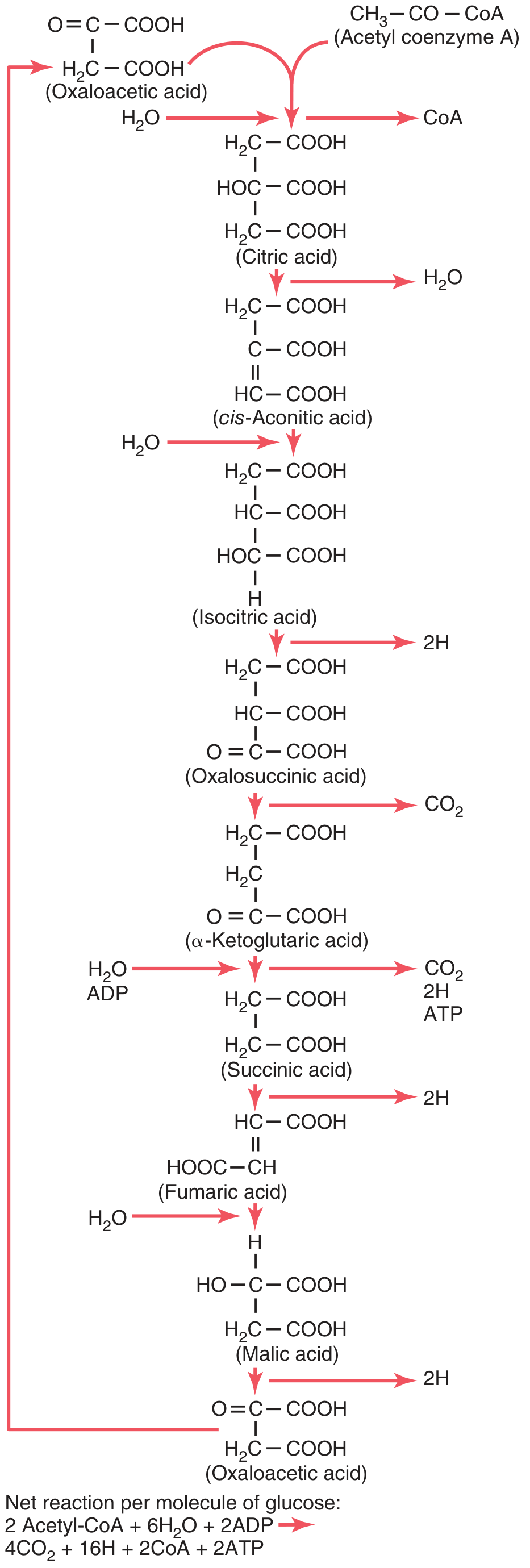
Figure: Chemical reactions of the citric acid cycle, showing release of CO₂ and hydrogen atoms. (Guyton and Hall)
Products Per Turn (1 Acetyl-CoA)
| Product | Amount | Significance |
|---|---|---|
| CO₂ | 2 molecules | Waste gas, exhaled |
| NADH | 3 molecules | Enters electron transport chain |
| FADH₂ | 1 molecule | Enters electron transport chain |
| ATP (or GTP) | 1 molecule | Direct energy |
Net reaction per glucose molecule (2 turns of the cycle):
2 Acetyl-CoA + 6H₂O + 2ADP → 4CO₂ + 16H + 2CoA + 2ATP
Energy Yield - Why It Matters
The Krebs cycle itself makes only 2 ATP per glucose - a small amount. Its real significance is that it produces NADH and FADH₂, which carry hydrogen atoms to the electron transport chain (oxidative phosphorylation). That process generates the bulk (~90%) of the ~30-32 total ATP from glucose metabolism.
The 24 hydrogen atoms released per glucose are captured:
- 20 H combine with NAD+ → NADH (via dehydrogenases) - then fed into oxidative phosphorylation
- 4 H go directly from dehydrogenase to FADH₂ (succinic → fumaric step) → also into the electron transport chain
Key Enzymes & Regulators
- Citrate synthase (step 1) - regulated by ATP and NADH (feedback inhibition)
- Isocitrate dehydrogenase (step 4) - key rate-limiting enzyme; stimulated by ADP, inhibited by ATP/NADH
- α-Ketoglutarate dehydrogenase (step 5) - inhibited by succinyl-CoA and NADH
- Succinate dehydrogenase (step 7) - the only membrane-bound enzyme; inhibited by malonate (a classic competitive inhibitor used in biochemistry experiments)
Clinical Relevance
| Condition | Connection to Krebs Cycle |
|---|---|
| Thiamine (B1) deficiency | Impairs pyruvate dehydrogenase and α-ketoglutarate dehydrogenase → lactic acidosis, Wernicke's encephalopathy |
| Mitochondrial disorders | Mutations in cycle enzymes reduce ATP production, causing myopathy, encephalopathy |
| Cancer (Warburg effect) | Tumor cells prefer glycolysis over the Krebs cycle even in oxygen, producing lactate |
| Succinate dehydrogenase mutations | Associated with paragangliomas and pheochromocytomas |
| Fumarate hydratase mutations | Associated with hereditary leiomyomatosis and renal cell cancer |
Summary
The Krebs cycle is where the cell fully oxidizes the 2-carbon acetyl group from acetyl-CoA, regenerating oxaloacetate to keep the cycle spinning. It acts as a hub connecting carbohydrate, fat, and protein metabolism - all three eventually feed acetyl-CoA into this pathway. Its main output is not ATP directly, but the high-energy electron carriers NADH and FADH₂ that power the bulk of aerobic ATP synthesis.
Source: Guyton and Hall Textbook of Medical Physiology; Mulholland and Greenfield's Surgery - Scientific Principles and Practice, 7e; Basic Medical Biochemistry, 6e
I am asking krebbs disease
I want to make sure I find the right condition for you. "Krebs disease" isn't a widely recognized single medical term - it could refer to a few different things.
Asking for Preferences
Which 'Krebs disease' are you referring to?
This is a shared conversation. Sign in to Orris to start your own chat.