
Hipec
Reading File
HIPEC (Hyperthermic Intraperitoneal Chemotherapy) is a surgical procedure used to treat peritoneal surface malignancies. After cytoreductive surgery (CRS) removes all visible tumor, heated chemotherapy (typically 41-43°C) is circulated directly into the peritoneal cavity for 60-90 minutes. The heat enhances drug penetration and cytotoxicity while limiting systemic exposure.
Searching sources...
Finding Sources
Searching PubMed
HIPEC cytoreductive surgery peritoneal carcinomatosis
Finding Sources
Searching PubMed
HIPEC ovarian cancer colorectal peritoneal metastases survival
Reading File
Reading File
Reading File
Reading File
Now I have comprehensive textbook content. Let me compile the full answer.
HIPEC (Hyperthermic Intraperitoneal Chemotherapy)
Definition
HIPEC is the delivery of heated chemotherapy directly into the peritoneal cavity at the time of surgery, typically following cytoreductive surgery (CRS). It is the cornerstone treatment for peritoneal surface malignancies (PSM). - Fischer's Mastery of Surgery, 8th ed., p. 1013-1014
Rationale
The peritoneal cavity represents a natural barrier that limits systemic absorption, allowing high local drug concentrations with reduced systemic toxicity. Heat (41-43°C) enhances drug cytotoxicity and tissue penetration. HIPEC is administered using a heating perfusion apparatus that circulates the heated chemotherapy solution via an open or closed technique for a defined duration. - Fischer's Mastery of Surgery, p. 1014
Indications (Established and Investigational)
| Tumor Type | Evidence Level |
|---|---|
| Pseudomyxoma peritonei | Strong - reference treatment |
| Peritoneal mesothelioma | Strong - reference treatment |
| Ovarian cancer (recurrent/initially unresectable) | Strong option |
| Colorectal peritoneal metastases | Established |
| Gastric cancer with peritoneal metastases | Investigational / selective |
CRS + HIPEC is "today the reference treatment for pseudomyxoma peritonei and peritoneal mesothelioma, a strong option for treatment of initially nonresectable ovarian cancer." - Fischer's Mastery of Surgery, p. 1014
Peritoneal Cancer Index (PCI)
Before HIPEC, tumor burden is quantified using the PCI score (0-39), dividing the abdomen and small bowel into 13 regions (sites 0-12), each scored 0-3. PCI is the main prognostic factor and directs treatment sequencing. A high PCI in colorectal or gastric cancer is associated with no survival benefit from CRS/HIPEC. - Fischer's Mastery of Surgery, p. 1006
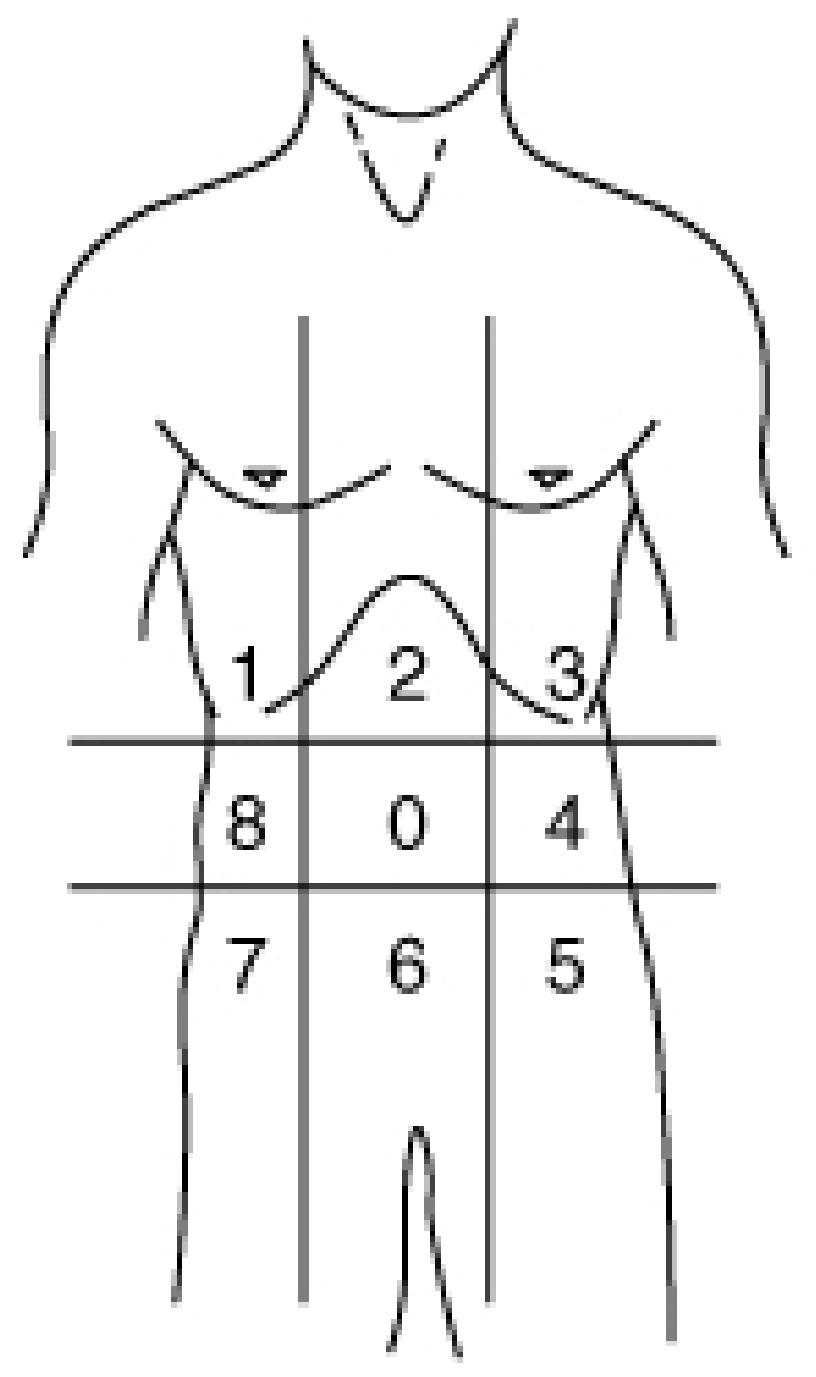
Commonly Used Drugs by Indication
| Indication | HIPEC Drug |
|---|---|
| Ovarian | Cisplatin |
| Colorectal | Mitomycin-C / Oxaliplatin |
| Pseudomyxoma peritonei | Mitomycin-C / Oxaliplatin |
| Peritoneal mesothelioma | Cisplatin / Mitomycin-C |
| Gastric | Mitomycin-C / Oxaliplatin / Cisplatin |
Other less commonly used agents include Paclitaxel, Gemcitabine, and Melphalan. - Fischer's Mastery of Surgery, Table 33.2
Cytoreductive Surgery (CRS)
CRS precedes HIPEC and involves all necessary procedures to achieve complete peritoneal resection: multivisceral resections, omentectomy, and peritonectomy (Sugarbaker technique). Leaving behind any residual disease has severe prognostic consequences. CRS + HIPEC must be performed by trained surgeons in specialized centers. - Fischer's Mastery of Surgery, p. 1013
The goal is CC-0 resection (complete cytoreduction - no visible residual tumor).
Contraindications
- Extensive extraperitoneal (systemic) metastases
- Unresectable disease
- Poor performance status or inability to tolerate major surgery
- Previous anaphylactic reaction to the chemotherapy agent
- Severe renal or hepatic impairment
- Myelosuppression
- Severe myocardial insufficiency, recent MI, or arrhythmias
All patients must be evaluated by a specialized multidisciplinary tumor board. - Fischer's Mastery of Surgery, p. 1011
Preoperative Optimization
Given the invasiveness of CRS + HIPEC, prehabilitation is important:
- Nutritional optimization (immunomodulatory supplements, enteral/parenteral nutrition in malnourished patients)
- Respiratory physiotherapy
- Hematologic optimization (preoperative systemic chemotherapy often causes bone marrow suppression)
- Psycho-oncological support
Outcomes (Recent Evidence)
- CRS + HIPEC is associated with significantly improved progression-free and overall survival vs. palliative chemotherapy alone for peritoneal carcinomatosis [Grainger & Allison's Diagnostic Radiology].
- A 2024 systematic review and cost-effectiveness analysis (PMID: 39254852) evaluated HIPEC + CRS across tumor types including ovarian, colorectal, and gastric cancers.
- A 2025 worldwide systematic review of national HIPEC guidelines (PMID: 40413333) analyzed recommendations from multiple countries, reflecting growing international consensus on indications and techniques.
- For repeat CRS + HIPEC in colorectal peritoneal metastases, a 2024 systematic review (PMID: 38627808) found it is feasible in selected patients with acceptable morbidity.
PIPAC - Emerging Alternative
PIPAC (Pressurized Intraperitoneal Aerosol Chemotherapy) is a minimally invasive alternative for unresectable peritoneal disease - laparoscopic delivery of aerosolized chemotherapy under pressure. It does not attempt curative cytoreduction but allows repeated treatment, PCI assessment, and biopsies. Uses the same drug classes as HIPEC (e.g., oxaliplatin for colorectal, cisplatin + doxorubicin for ovarian). - Fischer's Mastery of Surgery, p. 1014
Summary
CRS + HIPEC represents a multimodal locoregional treatment strategy that can offer long-term survival or cure in carefully selected patients with peritoneal surface malignancies. Patient selection (especially PCI), surgical expertise, center volume, and complete cytoreduction (CC-0) are the key determinants of outcome.
Epigenetic shirt notes
Reading File
Short notes on epigenetics - covering mechanisms, types, and clinical relevance. Searching the library now.
Searching sources...
Finding Sources
Finding Sources
Reading File
Reading File
Reading File
Finding Sources
Reading File
Reading File
Reading File
Finding Sources
Reading File
Reading File
I now have rich, comprehensive content. Here are the short notes on epigenetics.
Epigenetics - Short Notes
Definition
Epigenetics is the study of modifications to DNA or DNA packaging that are transmissible to daughter cells without changes to the DNA sequence itself. These changes regulate gene expression by altering chromatin structure and DNA accessibility. - Thompson & Thompson Genetics, 9th ed.
Conrad Waddington (1940s) originally defined it as "the branch of biology which studies the causal interactions between genes and their products, which bring the phenotype into being."
Central dogma of epigenetics: Epigenetic patterning reflects the relationship between genetic variation and the environment - representing a regulatory stratum above the genome.
Chromatin Structure - The Basis
- DNA is wound around histone octamers (2× H2A, 2× H2B, 2× H3, 2× H4), forming nucleosomes
- ~147 bp of DNA wraps around each nucleosome
- Chromatin exists as:
- Euchromatin - loosely packed, transcriptionally active
- Heterochromatin - tightly packed, transcriptionally silent
The entire collection of epigenetic marks in a cell = the epigenome (unique to each cell type). - Rheumatology, Elsevier 2022
Mechanisms of Epigenetic Regulation
1. DNA Methylation
- Addition of a methyl group (-CH₃) to the 5' carbon of cytosine in CpG dinucleotides (cytosine-guanine pairs), creating 5-methylcytosine (5mC)
- Controlled by DNA methyltransferases (DNMTs)
- DNMT1 - maintenance methyltransferase (copies methylation patterns after replication)
- DNMT3A, DNMT3B - de novo methyltransferases
- Hypermethylation of promoters → gene silencing
- Hypomethylation → gene activation
- Removed by TET enzymes (stepwise demethylation)
Key term: CpG island - clusters of CpG sites in gene promoters; normally unmethylated = gene active
2. Histone Modifications (Post-translational modifications, PTMs)
Histone tails are modified at specific amino acids. Notation: H3K9ac = acetylation of lysine-9 on histone H3.
| Modification | Effect on Transcription |
|---|---|
| Acetylation (via HATs) | Opens chromatin → activation |
| Deacetylation (via HDACs) | Closes chromatin → repression |
| H3K4 methylation (me2/me3) | Activation |
| H3K9 methylation | Repression |
| H3K27 methylation | Repression |
| Phosphorylation | Context-dependent |
| Sumoylation | Generally repressive |
3. Non-coding RNAs
- microRNAs (miRNAs) - short (~22 nt), post-transcriptional gene silencing by mRNA degradation or translational repression
- Long non-coding RNAs (lncRNAs) - affect both DNA methylation and histone modifications; also influence transcription machinery directly
- Four key epigenetic marks: histone acetylation, histone methylation, DNA methylation, miRNAs - The Developing Human, Clinically Oriented Embryology
4. Genomic Imprinting
- Certain genes are differentially expressed based on parent of origin
- Occurs via epigenetic silencing of one parental allele
- Maternal imprinting = maternal allele silenced (paternal expressed)
- Paternal imprinting = paternal allele silenced (maternal expressed)
- Classic examples:
- Prader-Willi syndrome - loss of paternal 15q11-q13 expression
- Angelman syndrome - loss of maternal 15q11-q13 expression
- Beckwith-Wiedemann syndrome - imprinting defect at 11p15
- Russell-Silver syndrome - imprinting defect (growth restriction)
5. X-Chromosome Inactivation (Lyonization)
- One X chromosome is randomly inactivated in each female somatic cell → forms Barr body
- Mediated by the lncRNA XIST
- Creates mosaicism in heterozygous females
Epigenetic Regulators: Writers, Erasers, Readers
| Role | Function | Examples |
|---|---|---|
| Writers | Add epigenetic marks | DNMTs, histone acetyltransferases (HATs), histone methyltransferases (HMTs) |
| Erasers | Remove epigenetic marks | HDACs (deacetylases), histone demethylases, TET enzymes |
| Readers | Bind specific marks | Bromodomain proteins (acetyl-lysine readers), chromodomain proteins |
| Remodelers | Alter nucleosome position/conformation | SWI/SNF complex |
DNA and histone modifications function interdependently - methylated DNA regions typically exclude H3K4me2/me3 (activating marks). - Thompson & Thompson Genetics
Epigenetics and Cancer
Cancer cells show characteristic epigenetic dysregulation:
- Global DNA hypomethylation - chromosomal instability, activation of oncogenes
- Focal promoter hypermethylation - silencing of tumor suppressor genes (e.g., RB1, p16/CDKN2A, MLH1, BRCA1)
- Mutations in chromatin modifier genes (e.g., DNMT3A in AML, EZH2 in lymphomas, NSD1)
Cancer cells are not just genetically altered - epigenetic changes can be selected during tumor progression and contribute to drug resistance. - Robbins & Kumar Basic Pathology
Diagnostic use of DNA methylation: The methylation profile of a tumor preserves the cell-type-of-origin signature, enabling identification of the primary site in cancers of unknown primary (CUP). - Thompson & Thompson Genetics
Epigenetic Therapies
| Drug | Target | Mechanism | Indication |
|---|---|---|---|
| Azacitidine | DNMT | Hypomethylation (re-expresses silenced genes) | MDS, AML |
| Decitabine | DNMT | Hypomethylation | MDS, AML |
| Vorinostat | HDAC | Histone deacetylase inhibitor → open chromatin | CTCL |
| Romidepsin | HDAC | HDAC inhibitor | CTCL |
DNA methyltransferase inhibitors also have an immune-based mechanism - current trials are testing epigenetic therapy + immunotherapy combinations. - Goldman-Cecil Medicine
Epigenetics in Development
- Epigenetic marks are established during embryogenesis, undergo global reprogramming in gametes and early embryo
- Assisted Reproductive Technologies (ART) - increased risk of imprinting disorders (Beckwith-Wiedemann, Russell-Silver, Angelman, Prader-Willi) likely due to in vitro manipulation during critical reprogramming windows
Mendelian Disorders of the Epigenetic Machinery
Pathogenic variants in epigenetic regulators cause neurodevelopmental syndromes. The two most common features: intellectual disability + growth dysregulation.
| Gene | Syndrome | Notes |
|---|---|---|
| DNMT3A (writer) | Tatton-Brown-Rahman syndrome | Overgrowth, ID; same variants cause AML somatically |
| DNMT1 | HSAN1E, ADCA-DN | Adult-onset neurologic disorders |
| CREBBP (HAT writer) | Rubinstein-Taybi syndrome | HDAC inhibitors show benefit in mouse models |
| KMT2D (HMT writer) | Kabuki syndrome | HDAC inhibitors restore open chromatin |
| EZH2 (HMT writer) | Weaver syndrome | Increased cancer risk |
| NSD1 (HMT writer) | Sotos syndrome | Overgrowth, increased cancer risk |
Key Terms Quick Reference
| Term | Meaning |
|---|---|
| CpG site | Cytosine-Guanine dinucleotide; methylation target |
| DMR | Differentially Methylated Region |
| Epigenome | Complete set of epigenetic marks in a cell |
| Epituation | Disease-related change in DNA methylation at an imprinted locus |
| EWAS | Epigenome-Wide Association Study |
| 5mC | 5-methylcytosine |
Sources: Thompson & Thompson Genetics and Genomics in Medicine, 9th ed. | Robbins & Kumar Basic Pathology | Goldman-Cecil Medicine | Rheumatology (Elsevier, 2022) | The Developing Human, Clinically Oriented Embryology
This is a shared conversation. Sign in to Orris to start your own chat.