
Attachment, relations, nerve supply and action of the deltoid muscle
Reading File
Now I'll search the medical library for deltoid muscle anatomy.
Finding Sources
Finding Sources
Reading File
Reading File
Excellent detail from both sources. Let me now fetch the key anatomy images and read the Miller's orthopaedics section for any additional clinical detail.
Loading Image
Loading Image
Loading Image
I now have comprehensive, well-illustrated information from two authoritative sources. Here is the complete answer:
Deltoid Muscle
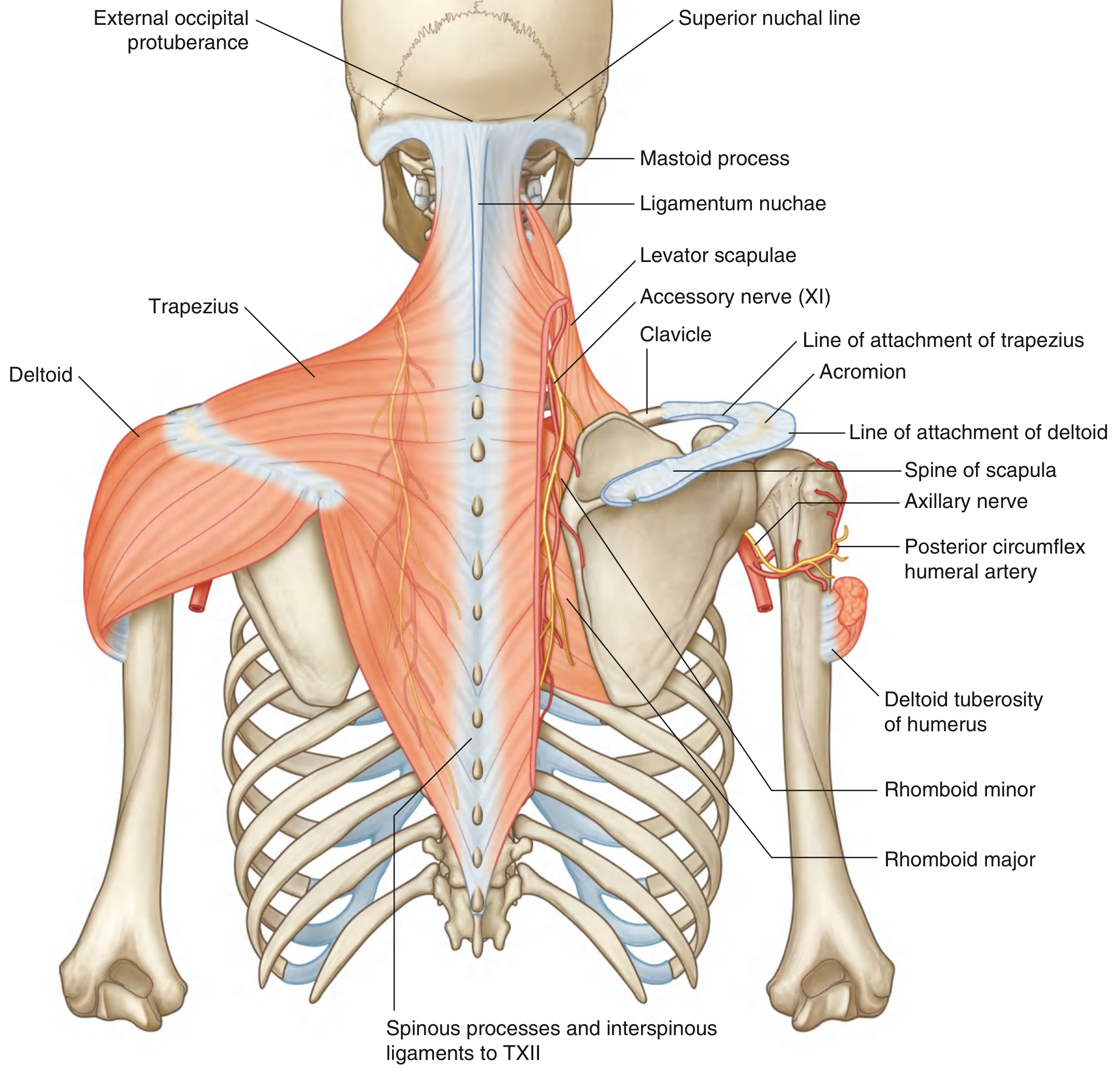
The deltoid is a large, triangular muscle that caps the shoulder. Its base is attached superiorly along the clavicle and scapula, and its apex points inferiorly to the humerus - forming a shape that is essentially a mirror image of the trapezius insertion above it.
Attachments
Origin (proximal / base of triangle)
The deltoid originates along a continuous U-shaped line from three parts:
| Part | Origin |
|---|---|
| Clavicular (anterior) | Lateral third of the clavicle |
| Acromial (middle) | Lateral border of the acromion |
| Spinal (posterior) | Spine of the scapula (entire lower lip) |
Insertion (distal / apex of triangle)
- Deltoid tuberosity on the lateral surface of the shaft of the humerus (approximately at its midpoint)
Nerve Supply
- Axillary nerve (C5, C6) - a branch of the posterior cord of the brachial plexus
- The axillary nerve, together with the posterior circumflex humeral artery and vein, enters the deep surface of the deltoid by passing posteriorly around the surgical neck of the humerus (through the quadrangular space)
Clinical note: Fractures of the surgical neck of the humerus or anterior shoulder dislocations can injure the axillary nerve, resulting in weakness of abduction and loss of sensation over the "regimental badge" area of the lateral arm.
Actions
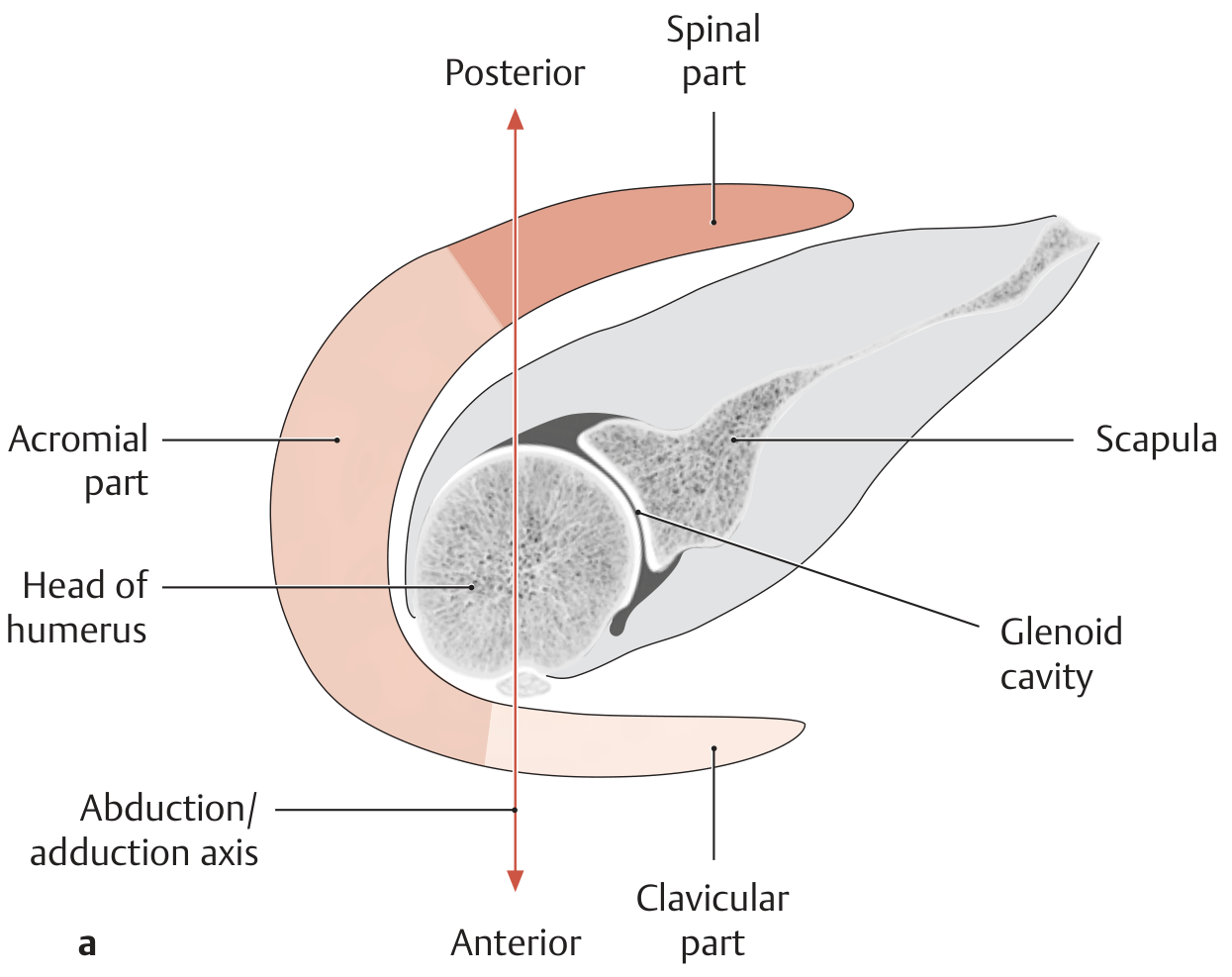
The deltoid's actions vary by part, and depend on the angle of arm abduction:
| Part | Primary Actions |
|---|---|
| Clavicular (anterior) | Flexion, internal rotation, adduction of the arm |
| Acromial (middle) | Abduction (the prime mover, 0-90°) |
| Spinal (posterior) | Extension, external rotation, adduction of the arm |
Variable actions with degree of abduction
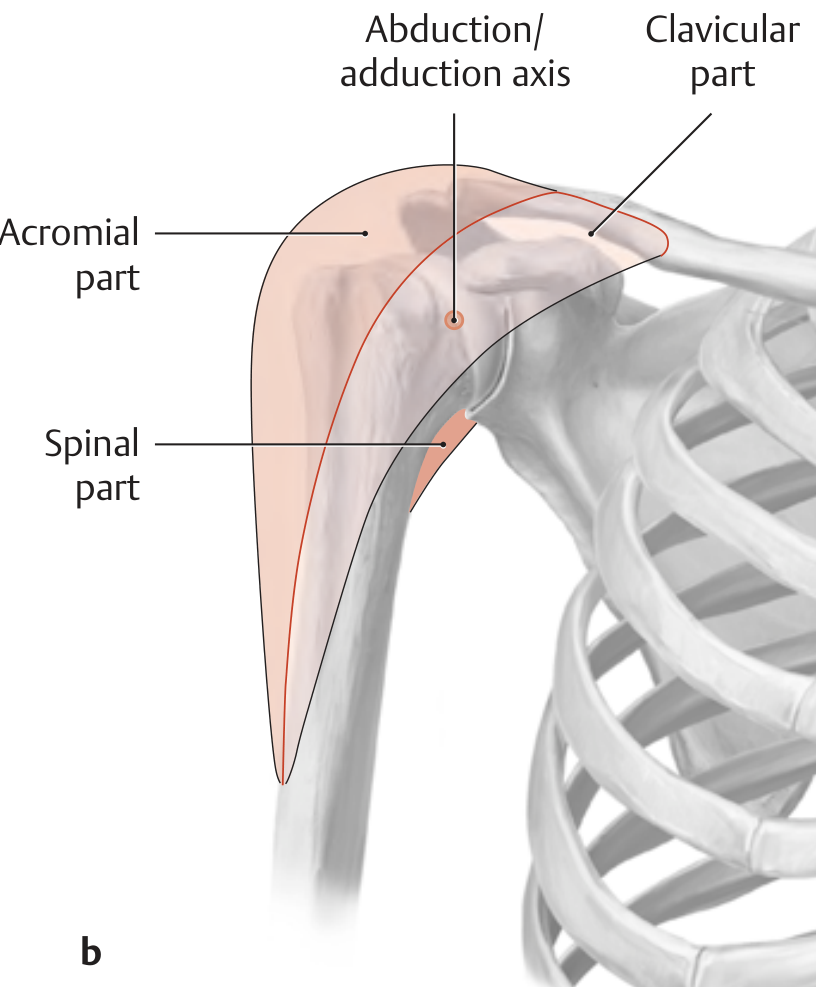
An important concept is that the clavicular and spinal parts change their role depending on arm position:
- Below 60° of abduction: The clavicular and spinal parts act as antagonists to the acromial part - they are adductors and resist abduction.
- Above 60° of abduction: As the arm passes the abduction/adduction axis, the clavicular and spinal parts flip their role and become synergistic abductors, assisting the acromial part.
Summary Table
| Feature | Detail |
|---|---|
| Origin | Lateral 1/3 clavicle, acromion, spine of scapula |
| Insertion | Deltoid tuberosity of humerus |
| Nerve | Axillary nerve (C5, C6) - posterior cord of brachial plexus |
| Blood supply | Posterior circumflex humeral artery |
| Main action | Abduction of the arm (acromial part) |
| Other actions | Flexion & medial rotation (clavicular part); Extension & lateral rotation (spinal part) |
Sources: Gray's Anatomy for Students (9780323934237); THIEME Atlas of Anatomy - General Anatomy and Musculoskeletal System (9781626237186)
Give me relations
Finding Sources
Finding Sources
Finding Sources
Finding Sources
Reading File
Finding Sources
Finding Sources
Finding Sources
Reading File
Reading File
Loading Image
Loading Image
Here are the full relations of the deltoid muscle, organized systematically:
Relations of the Deltoid Muscle
Superficial (Outer) Surface
- Covered by skin and superficial fascia
- The platysma extends onto the upper part of the muscle
- The supraclavicular nerves (C3, C4) supply the skin over the upper part of the deltoid
Deep Surface
The deep surface is separated from underlying structures by the subdeltoid (subacromial) bursa, which lies between the deltoid/acromion above and the rotator cuff tendons/joint capsule below. The deep surface overlies:
| Structure | Location |
|---|---|
| Glenohumeral joint capsule | Central deep surface |
| Rotator cuff muscles (supraspinatus, infraspinatus, teres minor) | Directly deep |
| Subacromial/subdeltoid bursa | Intervening between deltoid and rotator cuff |
| Biceps brachii (long head tendon) | Deep, anteriorly |
| Coracobrachialis | Deep, anteromedially |
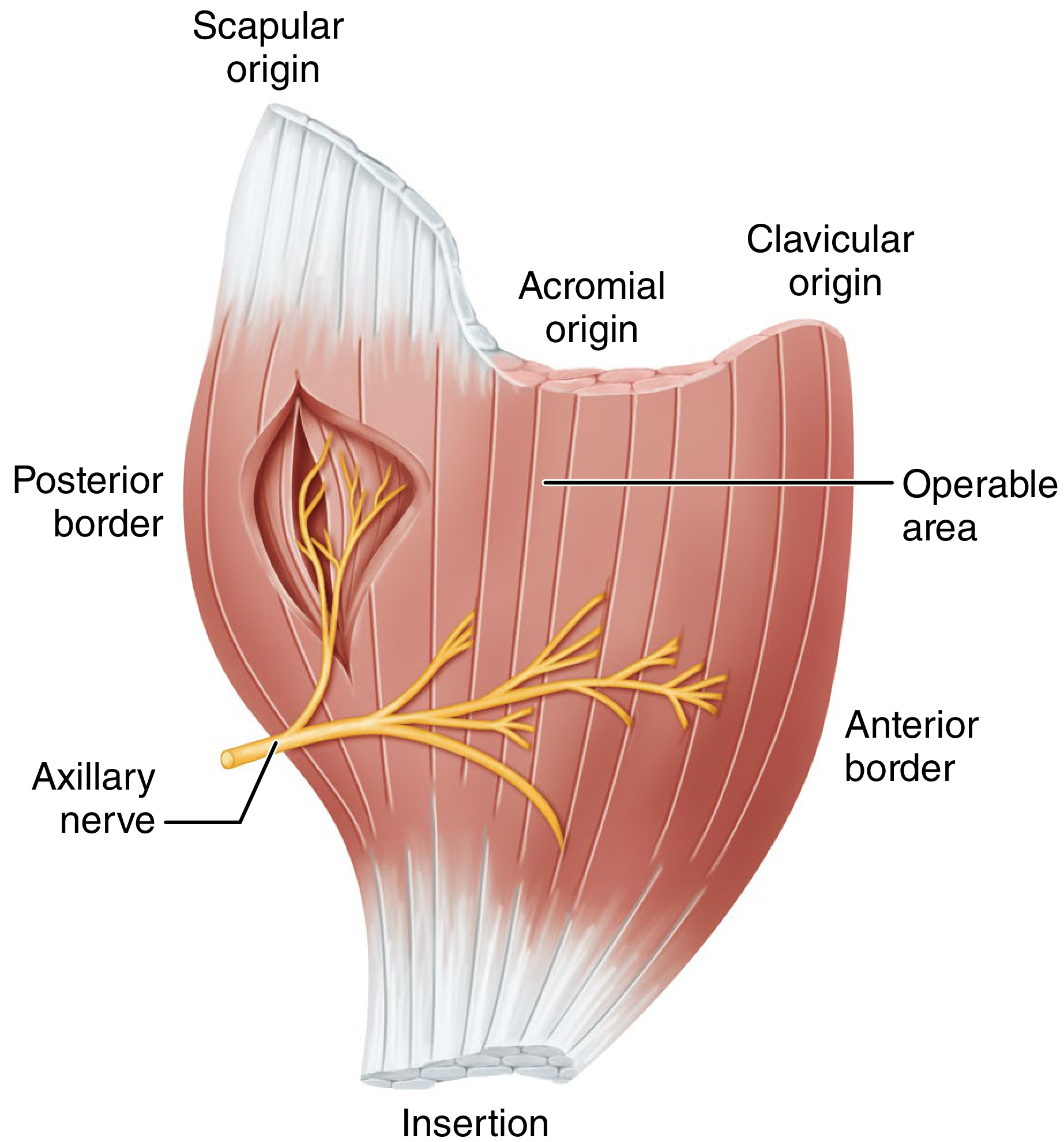
| Axillary nerve + posterior circumflex humeral vessels | Course transversely ~5 cm below the origin, on the deep surface, entering from the quadrangular space posteriorly |
Anterior Border
- Separated from pectoralis major by the deltopectoral groove (interval)
- In this groove runs the cephalic vein (ascending to drain into the axillary vein at the infraclavicular fossa after piercing the clavipectoral fascia) and the deltoid branch of the thoracoacromial artery
- This interval is the key surgical approach to the shoulder (deltopectoral approach)
Posterior Border
- Overlaps the long head of triceps brachii posteriorly
- Related to teres major and teres minor posteroinferiorly
Superior / Bony Relations
- Overlies the acromion and acromioclavicular joint superiorly
- The trapezius inserts on the same bony line (clavicle, acromion, spine of scapula) immediately medial to the deltoid origin - the two muscles mirror each other
Neurovascular Content Within / On Deep Surface
- Axillary nerve - enters deep surface posterolaterally after passing through the quadrangular space; courses transversely approximately 5 cm distal to the acromial origin before branching into the muscle
- Posterior circumflex humeral artery and vein - accompany the axillary nerve
Clinical note: When splitting the deltoid for a lateral surgical approach, incisions must not extend more than 5 cm below the acromion to avoid damaging the axillary nerve branches on the deep surface.
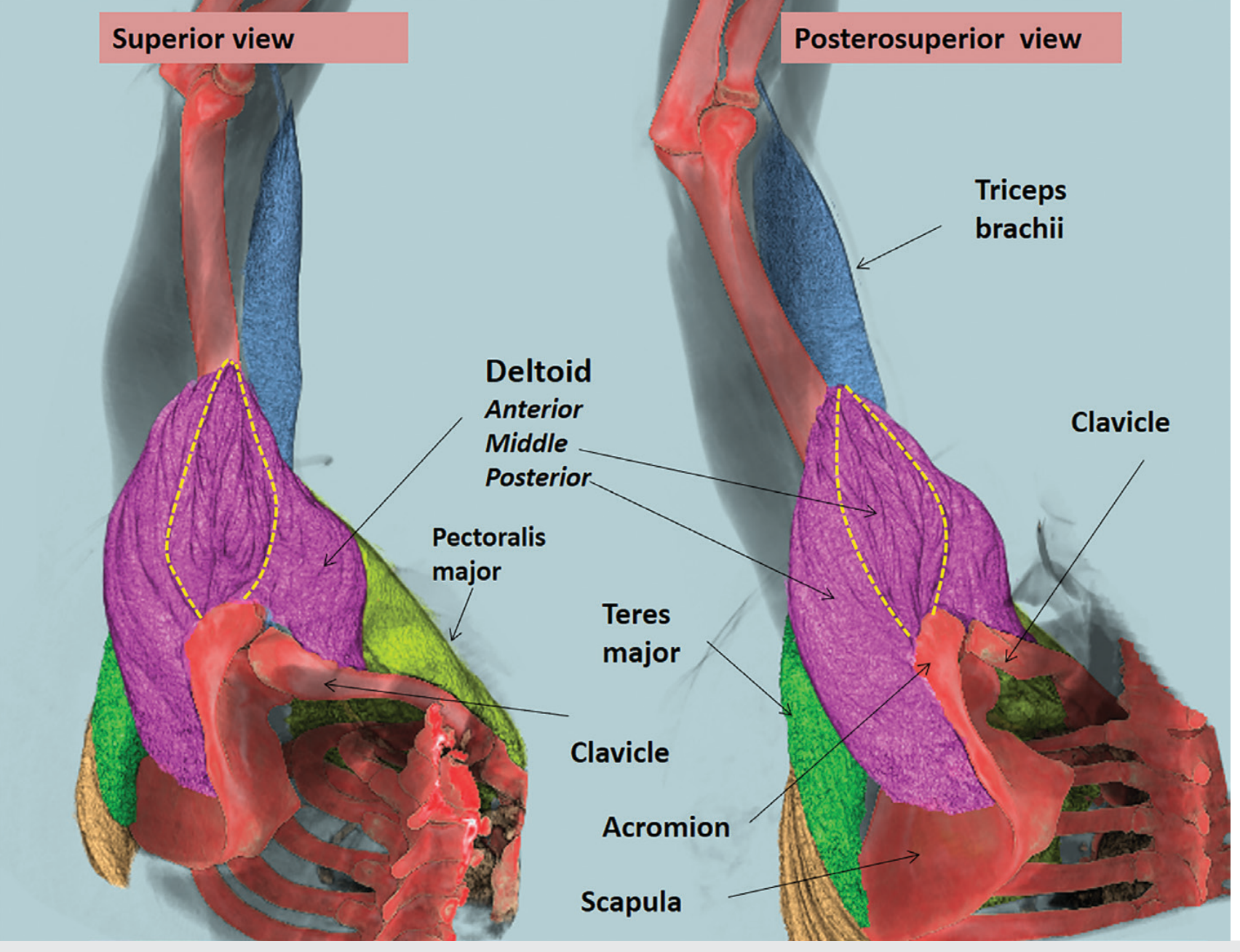
Sources: Campbell's Operative Orthopaedics 15th Ed (9780443117633); Imaging Anatomy Atlas Vol. 3 (9781626239845); Gray's Anatomy for Students (9780323934237); THIEME Atlas of Anatomy (9781626237186)
Make it short and easily understand
Relations of the Deltoid Muscle
Superficial (Outside)
- Skin and superficial fascia
- Supraclavicular nerves over the skin
Deep Surface (Underneath)
- Subdeltoid bursa (a cushion separating it from below)
- Rotator cuff (supraspinatus, infraspinatus, teres minor)
- Shoulder joint capsule
- Axillary nerve + posterior circumflex humeral vessels — run across the deep surface about 5 cm below the acromion
Anterior Border
- Meets pectoralis major at the deltopectoral groove, which contains:
- Cephalic vein (drains upward into axillary vein)
- Deltoid branch of thoracoacromial artery
Posterior Border
- Overlaps long head of triceps
- Related to teres major and teres minor
Above (Superior)
- Overlies the acromion and acromioclavicular joint
- Trapezius inserts just medial to it — the two muscles mirror each other
⚠️ Key clinical point: Never split the deltoid more than 5 cm below the acromion — the axillary nerve runs there and will be damaged.
This is a shared conversation. Sign in to Orris to start your own chat.