
120/90 emergency management
I'll check the medical library skill first as required for this medical query.
Searching sources...
Reading File
Now let me search the medical library and PubMed in parallel for hypertensive emergency management.
Finding Sources
Finding Sources
Searching PubMed
"hypertensive emergency" AND management
Now let me read the key textbook sections in parallel:
Reading File
Reading File
Reading File
Let me get the detailed drug table and treatment section from Rosen's EM:
Reading File
Reading File
I now have comprehensive information to compile a thorough answer. Let me also fetch the clinical algorithm image from Goldman-Cecil:
Loading Image
Excellent - I have all the data I need. Here is the full, evidence-based emergency management guide:
Hypertensive Emergency: Emergency Management
Note: BP of 120/90 mm Hg alone is not a hypertensive emergency by numeric criteria. A hypertensive emergency is defined by acute target organ damage (TOD) in the setting of severely elevated BP (typically ≥180/120 mm Hg). The clinical context - not the number alone - determines management. The framework below covers hypertensive emergencies comprehensively.
1. Definition and Classification
| Category | BP Level | Target Organ Damage? | Action |
|---|---|---|---|
| Hypertensive Emergency | Usually ≥180/120 mmHg | YES - acute TOD | ICU admit, IV agents, immediate intervention |
| Hypertensive Urgency | ≥180/120 mmHg | No acute TOD | Oral agents, outpatient follow-up 3-10 days |
| Severe/Uncontrolled HTN | Elevated, no TOD | No | Refill/up-titrate meds, follow-up arranged |
A true hypertensive emergency requires both markedly elevated BP and evidence of acute end-organ injury. Elevated numbers alone are not sufficient.
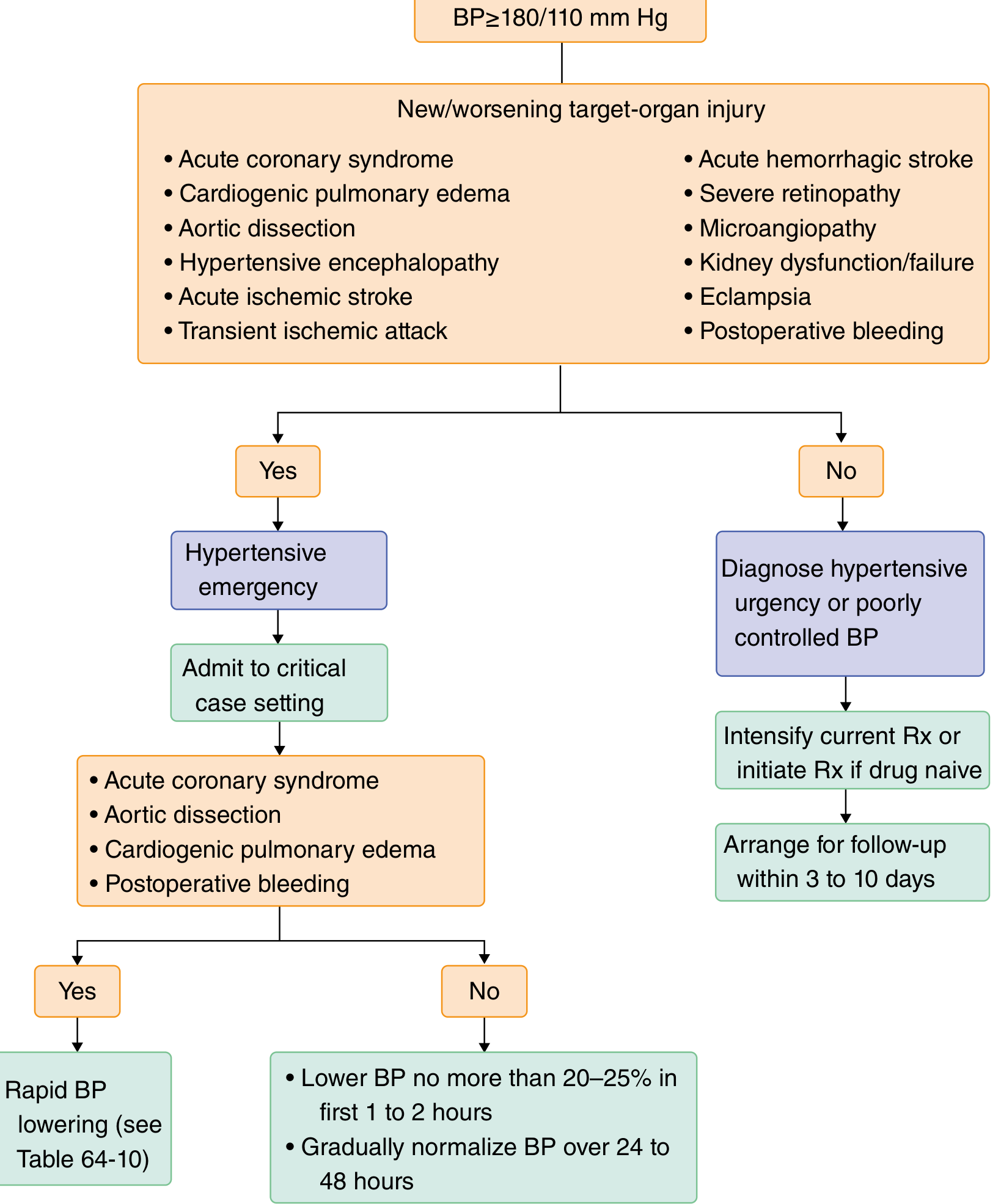
2. Clinical Algorithm
3. Hypertensive Emergency: Target Organ Damage Presentations
Acute TOD to assess for:
- Neurological: Hypertensive encephalopathy, acute ischemic stroke, hemorrhagic stroke, PRES (posterior reversible encephalopathy syndrome)
- Cardiovascular: Acute coronary syndrome (ACS), acute cardiogenic pulmonary edema, aortic dissection
- Renal: Acute kidney injury, microangiopathic hemolytic anemia
- Obstetric: Severe preeclampsia, eclampsia, HELLP syndrome
- Ophthalmologic: Grade 3-4 retinopathy (hemorrhages, exudates, papilledema)
4. Initial Stabilization
- Admit to ICU / critical care setting - continuous arterial BP monitoring required
- IV access - large-bore peripheral or central
- 12-lead ECG - rule out ACS, LVH
- Labs: BMP (Cr, K+), CBC, troponin, LFTs, urinalysis with sediment, coagulation studies
- Imaging: CXR (pulmonary edema, aortic knob), CT head (stroke, hemorrhage), CT aorta if dissection suspected
5. Blood Pressure Reduction Goals
The general rule (for most emergencies excluding the special cases below):
| Timeframe | Target |
|---|---|
| First 1 hour | Reduce MAP by no more than 20-25% |
| Next 2-6 hours | Reduce to 160/100 mmHg |
| 24-48 hours | Gradually normalize to normal range |
Why the 20-25% rule? Chronic hypertension shifts the cerebral autoregulation curve rightward. Rapid overcorrection risks cerebral hypoperfusion, coronary, and renal ischemia. - Rosen's Emergency Medicine, p. 2522
6. Condition-Specific Targets and Preferred Agents
(Based on Goldman-Cecil Medicine Table 64-2 and Tintinalli's Table 57-4)
| Clinical Presentation | BP Target | First-Line | Alternative |
|---|---|---|---|
| Malignant HTN / renal failure | MAP -20 to -25% over several hours | Labetalol or Nicardipine | Nitroprusside |
| Hypertensive encephalopathy | MAP -20 to -25% immediately | Labetalol or Nicardipine | Nitroprusside |
| Acute ischemic stroke (no thrombolysis, SBP >220 or DBP >120) | MAP -15% over 1 hour | Labetalol or Nicardipine | Nitroprusside |
| Acute ischemic stroke (thrombolysis candidate, SBP >185 or DBP >110) | SBP <185/DBP <110 within 1 hour | Labetalol or Nicardipine | Nitroprusside |
| Hemorrhagic stroke (SBP >180) | SBP 130-180 mmHg immediately | Labetalol or Nicardipine | Urapidil |
| Acute coronary syndrome | SBP <140 mmHg immediately | Nitroglycerin or Labetalol | Urapidil |
| Cardiogenic pulmonary edema | SBP <140 mmHg immediately | Nitroprusside or Nitroglycerin + loop diuretic | Urapidil + loop diuretic |
| Aortic dissection | SBP <120 + HR <60 within 1 hour | Esmolol PLUS Nitroprusside/Nitroglycerin/Nicardipine | Labetalol or Metoprolol |
| Eclampsia / severe preeclampsia / HELLP | SBP <160, DBP <105 immediately | MgSO4 + Labetalol or Nicardipine | - |
| Sympathetic crisis / pheochromocytoma | MAP -20 to -25% | Phentolamine (alpha-blocker) | Nitroprusside |
Important: Beta-blockers alone are contraindicated in catecholamine excess (pheochromocytoma, cocaine toxicity) - they cause unopposed alpha-mediated vasoconstriction and can paradoxically worsen hypertension.
7. IV Antihypertensive Drug Guide
| Drug | Mechanism | Onset | Dosing | Key Indication |
|---|---|---|---|---|
| Labetalol | Alpha+beta blocker | 2-5 min | 20 mg IV bolus, repeat 40-80 mg q10min (max 300 mg); or 0.5-2 mg/min infusion | Most hypertensive emergencies, pregnancy |
| Nicardipine | CCB (dihydropyridine) | 1-5 min | 5-15 mg/hr IV infusion | Stroke, encephalopathy, ACS |
| Nitroglycerin | Venous > arterial dilator | 1-2 min | 5-100 mcg/min infusion | ACS, pulmonary edema |
| Nitroprusside | Arterial + venous dilator | Seconds | 0.3-10 mcg/kg/min (caution: cyanide toxicity at high doses/prolonged use) | Severe HTN, aortic dissection (with beta-blocker) |
| Esmolol | Short-acting beta-blocker | <1 min | 500 mcg/kg load, then 50-200 mcg/kg/min | Aortic dissection (with vasodilator) |
| Clevidipine | Rapid-acting CCB | 1-4 min | 1-2 mg/hr, titrate up to 32 mg/hr | Any emergency, arterial titration |
| Phentolamine | Alpha-blocker | 1-2 min | 5-15 mg IV bolus | Pheochromocytoma, cocaine crisis |
| Magnesium sulfate | Seizure prophylaxis + mild vasodilation | Minutes | 4-6 g IV load over 15-20 min, then 1-2 g/hr | Eclampsia/preeclampsia |
8. Special Populations
Aortic Dissection
Goal: SBP <120 mmHg + HR <60 within 1 hour. Always give beta-blocker first to prevent reflex tachycardia, then add vasodilator. Pain control with opioids reduces sympathetic drive. - Tintinalli's Emergency Medicine, p. 2501
Pulmonary Edema
Vasodilators (nitrates) are the mainstay - reduce afterload and venous capacitance. Use diuretics cautiously and avoid nesiritide + loop diuretics together (worsens renal function). - Tintinalli's EM, p. 2510
Preeclampsia/Eclampsia
MgSO4 is the anticonvulsant of choice (not an antihypertensive). Do not use ACE inhibitors or ARBs (teratogenic). Delivery is the definitive treatment. The 2023 meta-analysis comparing nifedipine vs labetalol in pregnancy (PMID 37487762) found both to be effective with similar maternal/neonatal outcomes.
Hypertensive Encephalopathy vs Stroke
These must be distinguished before treatment. Aggressive BP reduction in ischemic stroke (without thrombolysis indication) is harmful - a permissive hypertension strategy is used unless SBP >220 or DBP >120.
9. What NOT to Do
- Do NOT use sublingual nifedipine - unpredictable, precipitous drop causes stroke and MI
- Do NOT reduce BP too rapidly - overshooting causes cerebral/coronary/renal ischemia
- Do NOT start long-term oral antihypertensives de novo in the ED for asymptomatic elevated BP
- Do NOT give beta-blockers alone in cocaine/catecholamine toxicity
- Do NOT use nitroprusside for long periods (cyanide toxicity) or in renal failure (thiocyanate accumulation)
10. Disposition
- True hypertensive emergency: ICU admission mandatory for continuous monitoring
- Hypertensive urgency (no TOD): Can be managed with oral agents; arrange follow-up within 3-10 days
- Asymptomatic elevated BP in ED: Refill/up-titrate known antihypertensives; arrange outpatient follow-up; do not initiate new therapy
Sources:
- Rosen's Emergency Medicine: Concepts and Clinical Practice - Hypertensive Emergency chapter
- Tintinalli's Emergency Medicine: A Comprehensive Study Guide - Chapter 57, Treatment section
- Goldman-Cecil Medicine, International Edition - Table 64-2, Algorithm 4.5
- Recent evidence: Siddiqi et al., JAHA 2023 (PMID 37421281) - systematic review/meta-analysis on clinical outcomes in hypertensive emergency confirms high morbidity with acute heart failure and stroke as dominant presentations; Wilson et al., Ann Intern Med 2024 (PMID 38560900) - systematic review of inpatient BP management guidelines
This is a shared conversation. Sign in to Orris to start your own chat.