
Solitary fibrous tumour of bone
Reading File
Now let me search the library and PubMed in parallel for solitary fibrous tumour of bone.
Finding Sources
Finding Sources
Searching PubMed
"solitary fibrous tumor" AND bone
The library has minimal direct coverage. Let me search more broadly and fetch the most relevant PubMed abstracts in parallel.
Finding Sources
Finding Sources
Reading Article
PMID: 39120790
Reading Article
PMID: 38136399
Reading Article
PMID: 35767018
Let me read the neurology textbook section on HPC/SFT and the respiratory medicine section, plus search for more specific content on SFT of bone.
Reading File
Finding Sources
Searching PubMed
"solitary fibrous tumor" AND bone AND primary
Excellent - found the Robbins pathology section on SFT. Let me now read that and the case report on primary intraosseous SFT in parallel.
Reading File
Reading Article
PMID: 36305024
Finding Sources
Let me get the full Murray & Nadel SFT section and also search for WHO 2020 classification of SFT of bone specifically.
Reading File
Searching the Web
solitary fibrous tumor primary bone intraosseous WHO 2020 classification clinical features treatment
Finding Sources
Good - I now have enough material. Let me also fetch the Springer pictorial review and the StatPearls page for additional detail on primary intraosseous SFT specifically.
Reading Web Page
https://www.ncbi.nlm.nih.gov/books/NBK585038
I now have comprehensive information to write a thorough answer on solitary fibrous tumour of bone. Let me also fetch the SFT gross pathology image from Robbins.
Loading Image
I now have comprehensive information to write a detailed answer. Here is the full synthesis:
Solitary Fibrous Tumour of Bone
Overview and Classification
Solitary fibrous tumour (SFT) is a rare fibroblastic mesenchymal neoplasm that was first described in the pleura but is now recognised across virtually every anatomical site. Primary intraosseous (bone) SFT is exceptionally rare - one of the rarest localisations even within the already uncommon SFT family. Only a handful of well-documented cases appear in the literature, most involving flat and short bones, with long bone involvement (e.g. femur, humerus) being exceedingly uncommon.
Under the 2020 WHO Classification of Soft Tissue and Bone Tumours, extrameningeal SFT (including bone) is classified as a fibroblastic neoplasm of intermediate (rarely metastasising) to malignant behaviour, reflecting its capacity for local recurrence and rare distant spread. This edition merged SFT and hemangiopericytoma (HPC) into a single entity and discouraged the older "typical/atypical" designations due to overlap with aggressive lesions.
- Robbins & Cotran Pathologic Basis of Disease - p. 258
Molecular Pathogenesis
The defining molecular event in all SFTs - regardless of site - is a cryptic inversion of chromosome 12q13, generating a NAB2::STAT6 fusion gene. This fusion:
- Transforms NAB2 (a transcriptional repressor) into a transcriptional activator
- Drives overexpression of EGR1 (early growth response 1)
- Is considered virtually pathognomonic for SFT
Multiple fusion variants exist; NAB2ex4-STAT6ex2 and NAB2ex6-STAT6ex16/17 are the most frequent. Additional mutations in TP53 and TERT promoter correlate with malignant behaviour, higher grade, recurrence, and metastasis.
- Robbins & Cotran Pathologic Basis of Disease - p. 258
- Ren et al., Cancer Metastasis Rev 2024 (PMID 39120790)
Clinical Features
Demographics: SFT of bone affects adults across a wide age range (reported cases from 20s to 70s); no strong sex predilection has been established given the rarity.
Presentation:
- Localised bone pain, often insidious in onset
- Pain may radiate if there is neural compression (especially in spinal lesions)
- Pathological fracture can be the presenting event (as in the reported femoral intertrochanteric case)
- Spinal SFTs may present with neurological deficits
Sites: Predilection for spinal involvement; long bones are exceedingly rare. Flat and short bones are more frequently reported in case series.
- Coppola et al., Pathologica 2022 (PMID 36305024)
Imaging
Plain Radiograph / CT
- Lytic intramedullary lesion with a narrow, non-sclerotic transition zone
- Potential cortical breakthrough in aggressive lesions
- Imaging is non-specific and cannot distinguish SFT from other intermediate/aggressive bone neoplasms (Ewing sarcoma, lymphoma, metastasis)
- Calcification is rare
MRI
-
T1-WI: Intermediate signal intensity
-
T2-WI: Heterogeneous signal - areas of low signal (collagen/fibrosis), intermediate signal (cellular foci), and high signal (myxoid areas)
-
Streaks of low T1 and T2 signal are characteristic, reflecting fibrous and collagenous components
-
Post-gadolinium: Intense, often heterogeneous enhancement; multiple peripheral vessels at the tumour periphery are characteristic of SFT at all sites
-
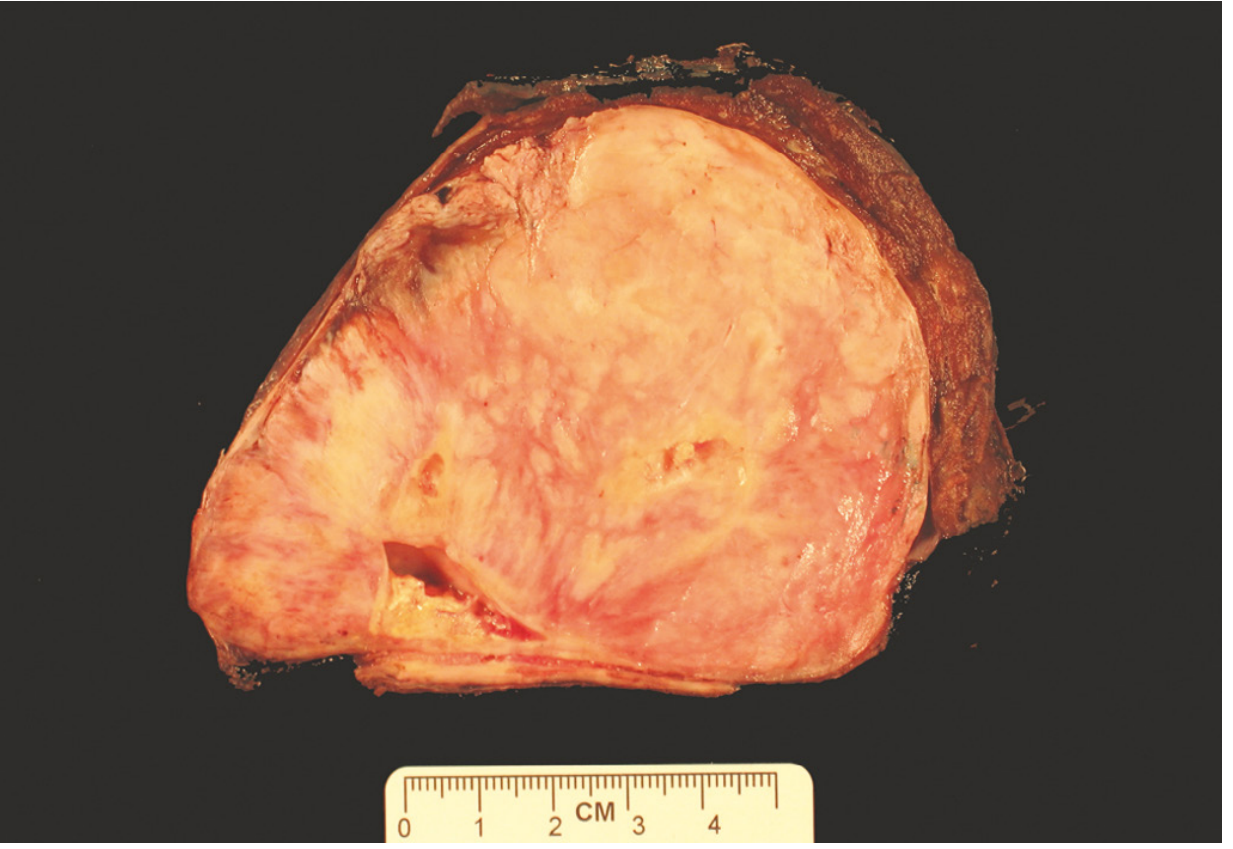
Gross Pathology
SFT has a solid, whorled cut surface with dense fibrous tissue. Occasional cysts filled with viscid fluid may be present. Malignant variants show necrosis and haemorrhage.
Histopathology
Microscopy:
- Spindle to oval cells with patternless architecture (alternating hypercellular and hypocellular zones)
- Cells surrounded by stromal collagen and characteristic staghorn/branching ("hemangiopericytoma-like") vascular pattern
- Whorls of reticulin and collagen among interspersed fibroblast-like spindle cells
Features of malignancy:
- Increased mitotic activity (>4/10 HPF)
- Significant nuclear pleomorphism
- Necrosis
- Tumour size >10 cm
- Infiltrative growth pattern
In dedifferentiated SFT, CD34 and STAT6 expression can be lost, making diagnosis more difficult.
- Robbins & Cotran Pathologic Basis of Disease - p. 263-270
Immunohistochemistry
| Marker | SFT | Notes |
|---|---|---|
| CD34 | Positive (cytoplasmic) | Most characteristic; lost in dedifferentiated SFT |
| STAT6 | Nuclear positive | Most sensitive and specific IHC marker |
| Vimentin | Positive | Non-specific |
| bcl-2 | Positive | |
| CD99 | Variable | |
| Keratin | Negative | Helps exclude mesothelioma |
| Factor XIIIa | Variable |
Nuclear STAT6 expression is the key diagnostic IHC finding and helps distinguish SFT from histological mimics including synovial sarcoma, solitary fibrous meningioma, and malignant mesothelioma (the latter has opposite phenotype: keratin positive, CD34/STAT6 negative).
- Fishman's Pulmonary Diseases and Disorders - p. 2144
- Janik et al., Cancers 2023 (PMID 38136399)
Differential Diagnosis
Primary intraosseous SFT is easily misdiagnosed due to non-specific imaging and histological overlap with:
- Ewing sarcoma (initial misdiagnosis in reported cases; small round blue cell morphology)
- Lymphoma of bone
- Metastatic carcinoma
- Giant cell tumour of bone
- Haemangioendothelioma / angiosarcoma
- Synovial sarcoma (monophasic)
- Phosphaturic mesenchymal tumour (overlap with hemangiopericytoma pattern)
- Desmoid fibromatosis
The combination of nuclear STAT6 IHC + NAB2-STAT6 molecular testing is now the gold standard for definitive diagnosis.
Risk Stratification
Several validated risk stratification models (Demicco, Pasquali/FNCLCC-based) use:
- Patient age (>55 years = higher risk)
- Tumour size (>10 cm = higher risk)
- Mitotic index (>4 per 10 HPF)
- Necrosis (presence = higher risk)
About 15-20% of SFTs are malignant; even histologically bland tumours can metastasise after many years, emphasising the need for long-term follow-up.
Treatment
Surgery
Wide en-bloc resection with negative margins is the mainstay for localised disease - both for SFT of bone and soft tissue. For bone SFT, this may require:
- Curettage with adjuvants for contained lesions
- En-bloc resection with reconstruction (endoprosthesis, allograft) for more aggressive lesions
Radiation Therapy
- Adjuvant radiotherapy (48-60 Gy fractionated) reduces local recurrence rates
- Recommended for margin-positive resections or high-risk tumours
- Definitive radiotherapy is a promising modality for unresectable disease
Systemic Therapy (Advanced/Metastatic Disease)
- No established standard for metastatic SFT of bone specifically
- Anthracycline-based chemotherapy (doxorubicin ± ifosfamide) is applicable as first-line
- Antiangiogenic agents (pazopanib, sunitinib, sorafenib) have shown activity post-first-line and are preferred over cytotoxics in most expert centres given the tumour's high vascularity
- Other agents under investigation: imatinib, axitinib, eribulin, figitumumab
Metastatic Spread
SFTs spread haematogenously, most commonly to:
- Lungs
- Bone (from intracranial SFT, this is a known late site)
- Liver
Lymphatic spread is rare.
- Bradley & Daroff's Neurology in Clinical Practice - p. 1603-1605
- Janik et al., Cancers 2023 (PMID 38136399)
Prognosis
- Intraosseous SFT behaves similarly to soft tissue SFT at equivalent histological grade
- Up to 90% of high-grade/intracranial SFTs recur locally or systemically within 9 years
- Median survival after first recurrence is 4-5 years with aggressive management
- Long-term surveillance is mandatory given the propensity for very late recurrence (>10 years)
- Complete surgical resection remains the single most important prognostic factor
Key Points Summary
| Feature | Detail |
|---|---|
| Entity | Rare fibroblastic mesenchymal neoplasm |
| Bone incidence | Extremely rare; predilection for spine and flat bones |
| Driver alteration | NAB2::STAT6 fusion (chr 12q13 inversion) |
| IHC hallmark | Nuclear STAT6 + CD34 |
| WHO 2020 grade | Intermediate (rarely metastasising) or malignant |
| Imaging | Lytic lesion; low T2 fibrous streaks on MRI; avid enhancement |
| Treatment | Wide resection ± RT; antiangiogenics for advanced disease |
| Pitfall | Easy misdiagnosis as Ewing sarcoma; late recurrence possible |
Recent literature note: A 2021 single-institution retrospective review (Bianchi et al., Cancers 2021;13:2470) specifically characterised the clinical, histological, and molecular features of SFT of bone, confirming NAB2-STAT6 fusion in all cases and highlighting the diagnostic challenges and long-term metastatic risk. A 2020 report (Jia et al., Skeletal Radiol 49:1865-1871) documented lung metastases developing on long-term follow-up, reinforcing the need for sustained surveillance.
This is a shared conversation. Sign in to Orris to start your own chat.