
sympthatic and paRASympthatic
Reading File
Now let me search the library for comprehensive content on the sympathetic and parasympathetic nervous systems.
Finding Sources
Finding Sources
Excellent results. Let me now read the most relevant sections in parallel.
Reading File
Reading File
Reading File
Now let me read the detailed comparison table and effects on organs from Costanzo, plus fetch the key diagrams:
Reading File
Loading Image
Loading Image
Now let me read the organ-by-organ effects table and the sympathetic system section:
Reading File
Reading File
Now let me get the organ-effects comparison table (Table 2.3) and the parasympathetic diagram:
Reading File
Loading Image
Now let me get the detailed organ effects table (Table 2.3):
Reading File
I have rich, comprehensive content. Now I'll compile the full answer.
Sympathetic and Parasympathetic Nervous Systems
The sympathetic and parasympathetic divisions make up the two major divisions of the autonomic nervous system (ANS), which controls involuntary functions such as heart rate, digestion, glandular secretion, and smooth muscle tone.
Overview Diagram
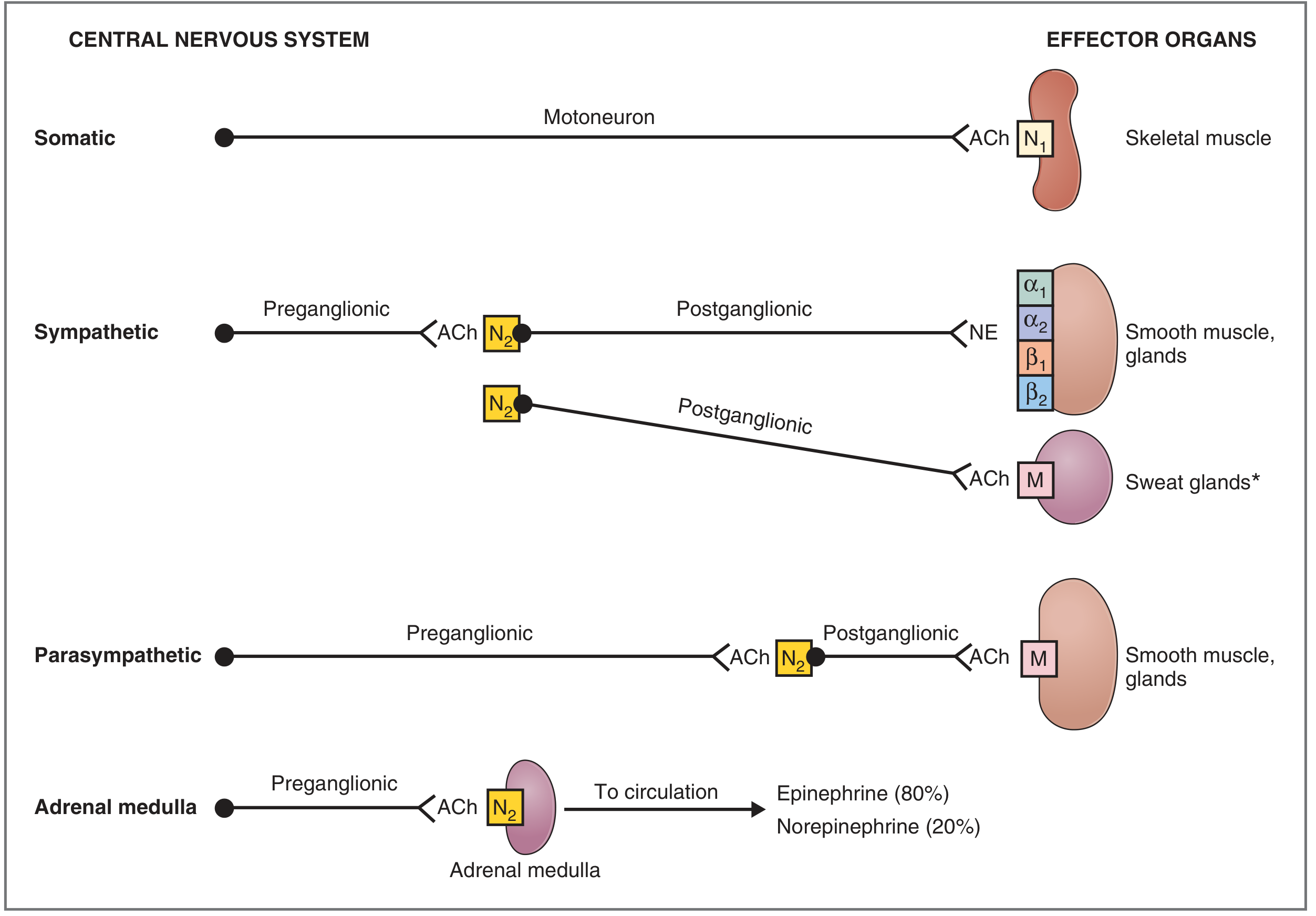
Organization of the ANS showing preganglionic and postganglionic neurons, neurotransmitters (ACh/NE), and receptor types. - Costanzo Physiology 7th Ed., Fig. 2.1
1. Key Anatomical Comparison
| Feature | Sympathetic | Parasympathetic |
|---|---|---|
| Origin (preganglionic neurons) | Thoracolumbar spinal cord (T1-L3) | Craniosacral: CN III, VII, IX, X; sacral cord S2-S4 |
| Ganglion location | Paravertebral & prevertebral (near CNS) | Near or inside effector organs |
| Preganglionic axon length | Short | Long |
| Postganglionic axon length | Long | Short |
| Neurotransmitter in ganglion | ACh (nicotinic N2 receptor) | ACh (nicotinic N2 receptor) |
| Neurotransmitter at effector | Norepinephrine (NE) - except sweat glands | Acetylcholine (ACh) |
| Receptor at effector | α1, α2, β1, β2 adrenoreceptors | Muscarinic receptors |
| Effector tissues | Smooth muscle, cardiac muscle, glands | Smooth muscle, cardiac muscle, glands |
- Costanzo Physiology 7th Ed., Table 2.1
2. Functional Overview
Sympathetic - "Fight or Flight"
The overall function is to mobilize the body for activity. When activated during stress, the sympathetic system drives:
- Increased heart rate and blood pressure
- Increased blood flow to active muscles
- Elevated blood glucose and metabolic rate
- Increased mental alertness
- Bronchodilation (more air into lungs)
- Pupil dilation (mydriasis)
Parasympathetic - "Rest and Digest"
The overall function is restorative, to conserve energy. It dominates during calm conditions to drive:
- Decreased heart rate
- Stimulation of digestion (increased GI motility, gland secretion)
- Bronchoconstriction
- Pupil constriction (miosis) and accommodation (near vision)
- Stimulation of urination and sexual arousal (erection)
3. Anatomy Diagram
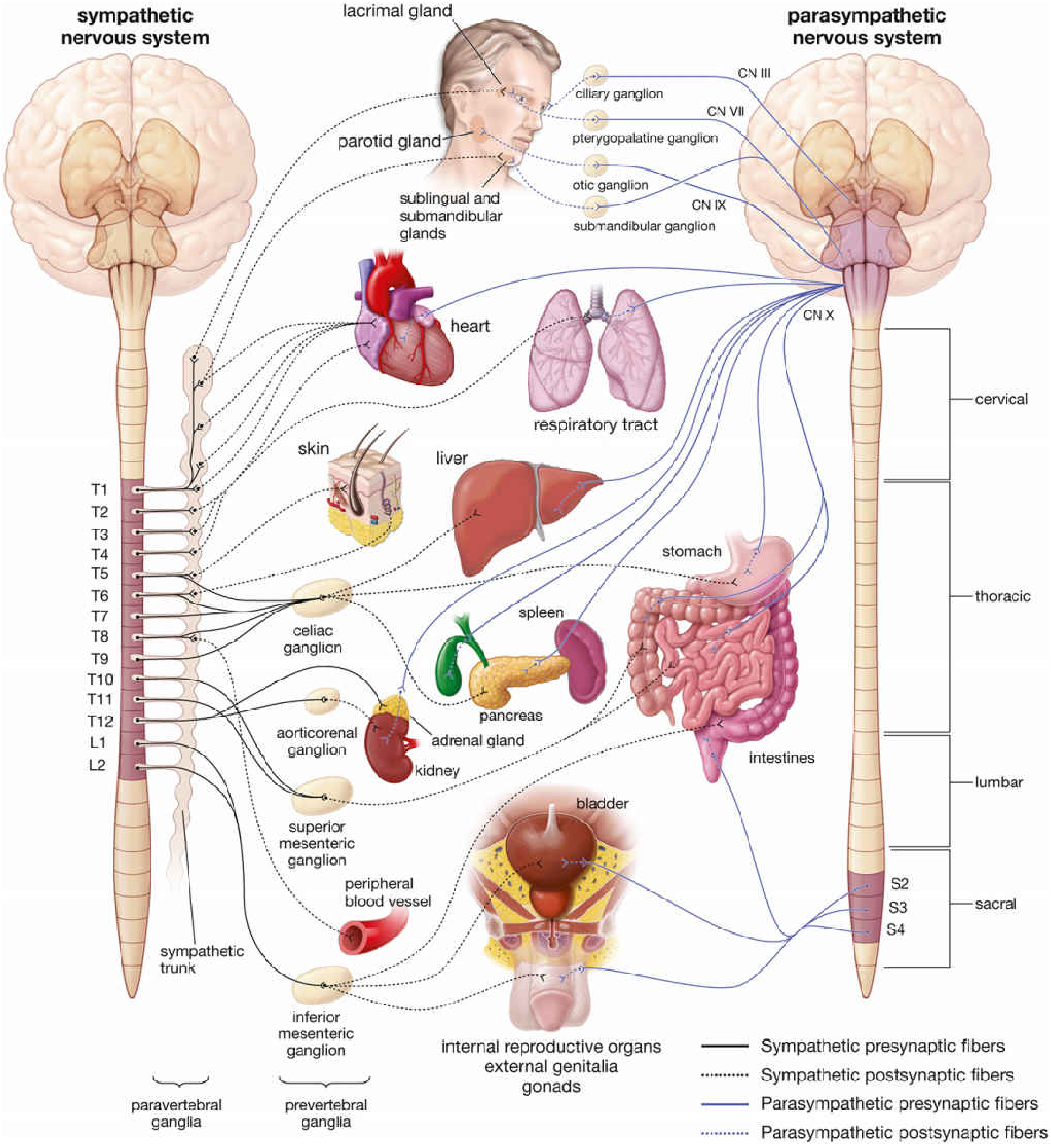
Full anatomical distribution of both divisions showing spinal cord origin, ganglia, and organ targets. - Histology A Text and Atlas, Fig. 12.29
4. Parasympathetic Cranial Nerve Pathways
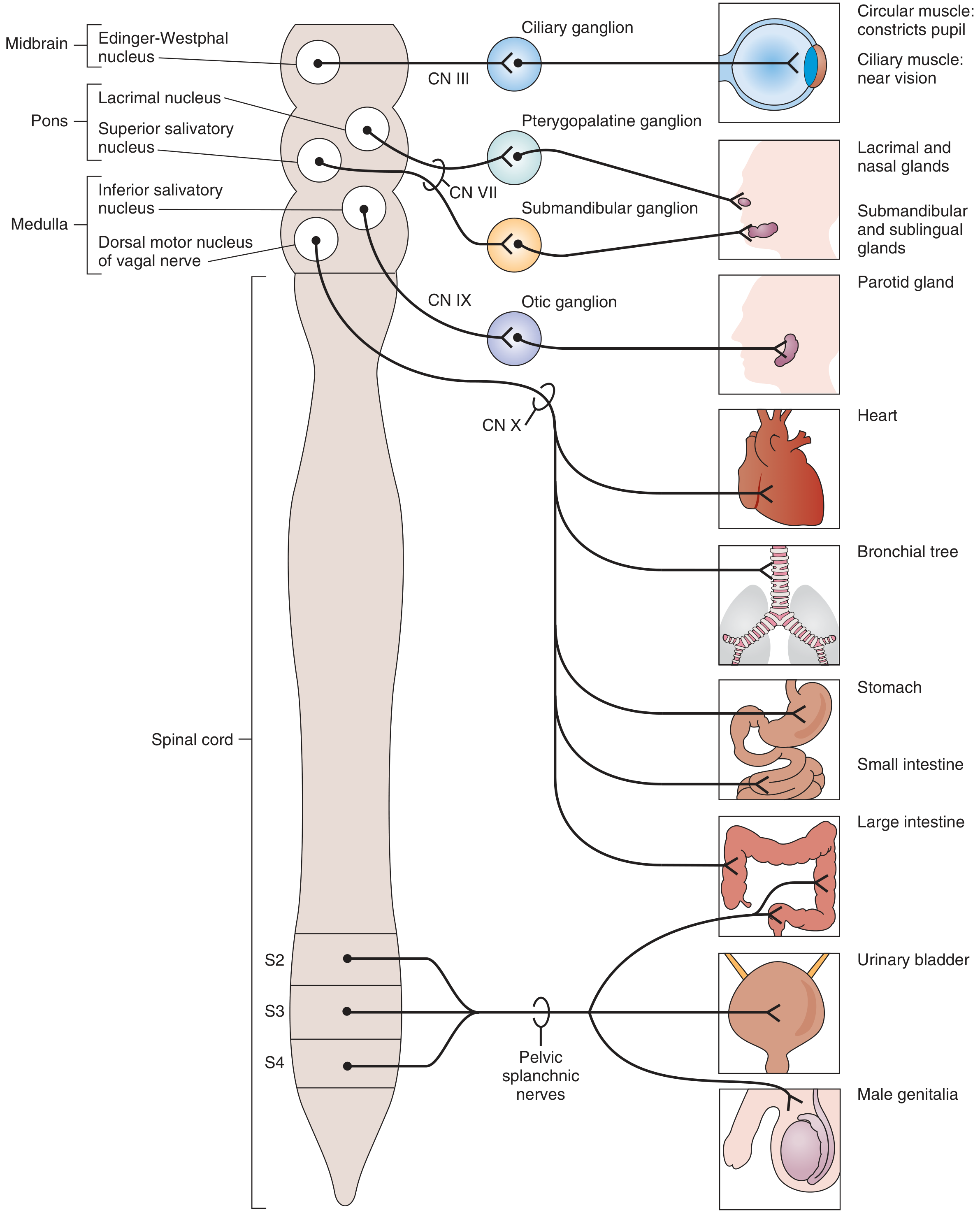
Parasympathetic preganglionic neurons originate in the brainstem nuclei and sacral cord. - Costanzo Physiology 7th Ed., Fig. 2.3
The four cranial nerves carrying parasympathetic fibers:
| CN | Nucleus | Ganglion | Target |
|---|---|---|---|
| CN III | Edinger-Westphal nucleus (midbrain) | Ciliary ganglion | Pupil constriction, ciliary muscle (near focus) |
| CN VII | Lacrimal & superior salivatory nuclei (pons) | Pterygopalatine & submandibular ganglia | Lacrimal, nasal, sublingual & submandibular glands |
| CN IX | Inferior salivatory nucleus (medulla) | Otic ganglion | Parotid gland |
| CN X (Vagus) | Dorsal motor nucleus (medulla) | Terminal ganglia in organs | Heart, lungs, stomach, small intestine, large intestine (to splenic flexure) |
Pelvic splanchnic nerves (S2-S4) innervate the descending colon, rectum, bladder, and genitalia.
5. Effects on Specific Organ Systems
| Organ | Sympathetic Action (Receptor) | Parasympathetic Action (Receptor) |
|---|---|---|
| SA node (heart rate) | Increases (β1) | Decreases (M) |
| AV conduction velocity | Increases (β1) | Decreases (M) |
| Ventricular contractility | Increases (β1) | Minimal effect |
| Bronchioles | Dilates (β2) | Constricts (M) |
| GI tract wall (motility) | Decreases/relaxes (β2) | Increases/contracts (M) |
| GI sphincters | Contracts (α1) | Relaxes (M) |
| Pupil (iris) | Dilates - radial muscle (α1) | Constricts - circular muscle (M) |
| Ciliary muscle (lens) | Relaxation for far vision (β2) | Contraction for near vision (M) |
| Bladder detrusor | Relaxes - filling (β2) | Contracts - emptying (M) |
| Bladder internal sphincter | Contracts - filling (α1) | Relaxes - emptying (M) |
| Blood vessels (skin/viscera) | Constricts (α1) | None |
| Sweat glands | Increases secretion (M)* | None |
| Salivary glands | Thick, scant secretion (α1) | Watery, copious secretion (M) |
| Liver | Glycogenolysis (β2) | None |
| Adrenal medulla | Secretes epinephrine/NE | None |
| Male genitalia | Ejaculation (α1) | Erection (M) |
| Pilomotor muscle (skin) | Contracts - goosebumps (α1) | None |
*Sweat glands are a notable exception - they have sympathetic innervation but release ACh (cholinergic), acting on muscarinic receptors.
- Costanzo Physiology 7th Ed., Table 2.3
6. Neurotransmitter Details
All preganglionic neurons (both sympathetic and parasympathetic) release ACh onto nicotinic (N2) receptors at the ganglion.
For postganglionic neurons:
- Sympathetic postganglionic neurons release norepinephrine (NE) - except sweat glands (cholinergic)
- Parasympathetic postganglionic neurons release ACh onto muscarinic receptors
The adrenal medulla is a modified sympathetic ganglion - preganglionic fibers directly stimulate chromaffin cells to secrete epinephrine (80%) and NE (20%) into the bloodstream.
7. Reciprocal and Synergistic Control
Most organs receive dual innervation that works reciprocally:
- Heart rate: sympathetic increases, parasympathetic decreases
- Bladder: sympathetic fills, parasympathetic empties
- Pupil: sympathetic dilates, parasympathetic constricts
Some organs have only sympathetic innervation: sweat glands, vascular smooth muscle, pilomotor muscles, liver, adipose tissue, and kidney.
The two divisions also work synergistically - for example, in the male sexual response: parasympathetic drives erection, sympathetic drives ejaculation.
- Costanzo Physiology 7th Ed., pp. 54-65
This is a shared conversation. Sign in to Orris to start your own chat.