

IMG-20260718-WA0000.jpg
What's this clinical diagnosis
analyse_media
Reading File
Now let me search the medical library for flat warts and related conditions to provide a thorough clinical answer.
Finding Sources
Finding Sources
Reading File
Reading File
Loading Image
Finding Sources
Reading File
Loading Image
The clinical picture is very clear. Here is a comprehensive answer:
Clinical Diagnosis: Verruca Plana (Flat Warts)
The image shows the forehead/hairline area with multiple small, discrete, flesh-colored to light tan, smooth, flat-topped papules 1-3 mm in diameter, with no surrounding erythema or scaling. This is the classic presentation of Verruca plana (plane/flat warts).
Here is the textbook image of the same condition from Fitzpatrick's Dermatology (Panel A: forehead/face distribution, Panel B: close-up of flat-topped papules):
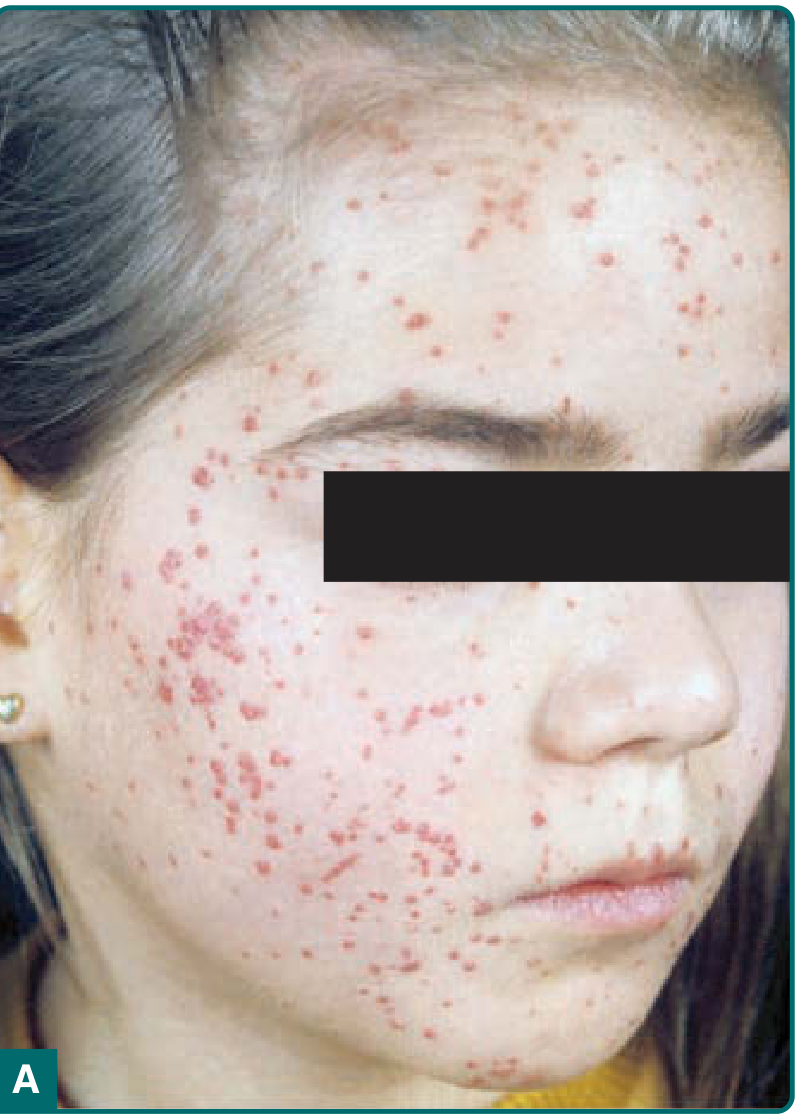
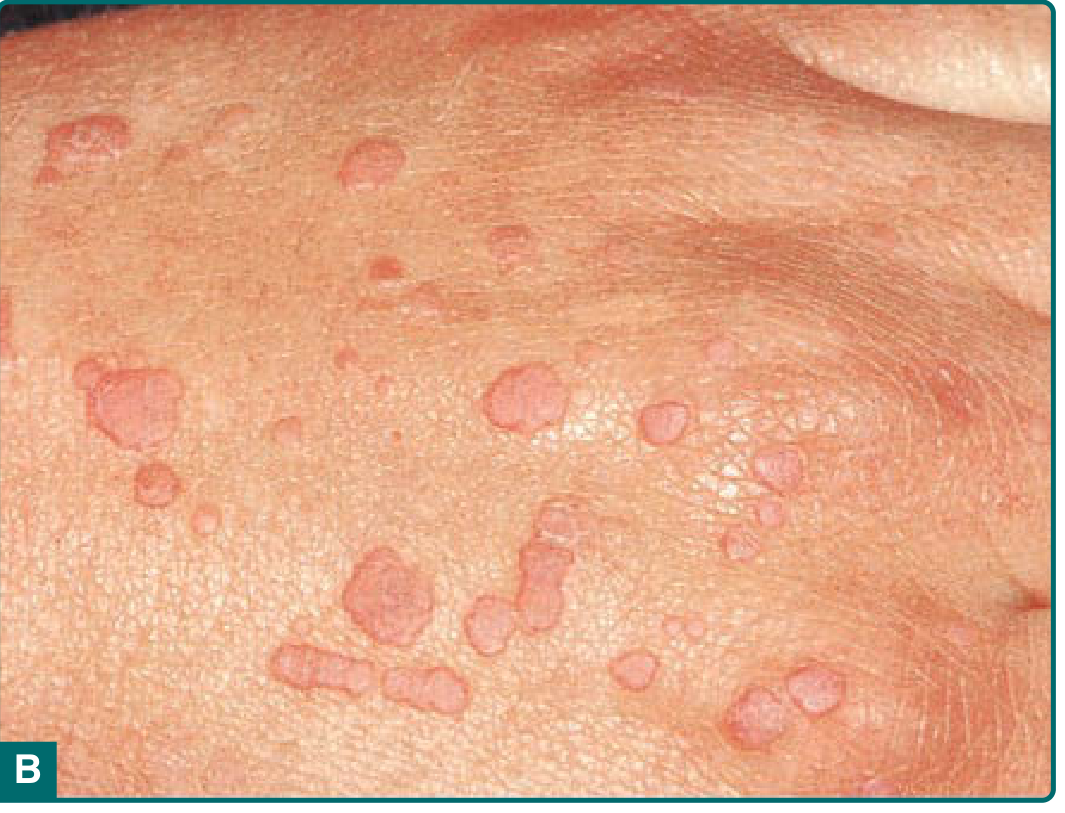
Key Features Supporting This Diagnosis
| Feature | Patient's Image | Verruca Plana |
|---|---|---|
| Morphology | Small, flat-topped, smooth papules | Slightly elevated, flat, smooth |
| Size | 1-3 mm | Generally < verruca vulgaris |
| Color | Flesh/tan/yellowish-white | Flesh-colored to tan |
| Site | Forehead, hairline | Face, dorsum of hands, legs |
| Distribution | Multiple discrete lesions | Multiple, often numerous |
| Inflammation | Absent | Typically absent |
Etiology
Verruca plana is caused by Human Papillomavirus (HPV) - types 3, 10, 28, 38, 42, 49, 75, and 76 (non-genital subtypes). These are distinct from the HPV types causing common warts (HPV-1/2/4/57) or genital warts (HPV-6/11). - Goldman-Cecil Medicine, p. 3598; Fitzpatrick's Dermatology, p. 3128
Differential Diagnosis
- Milia - white, 1-2 mm keratin cysts; tend to be whiter and rounder with no flat top
- Sebaceous hyperplasia - yellowish, often with central dell (umbilication); typically in older adults
- Syringomas - firm, skin-colored papules, usually periorbital or on lower eyelids
- Closed comedones - associated with other acne lesions; found at follicular openings
- Epidermodysplasia verruciformis - if lesions are very widespread and resistant to treatment, consider this rare HPV susceptibility disorder
Distinguishing Clue: Koebner Phenomenon
If new lesions appear in a linear pattern along scratch marks or lines of skin trauma, this strongly confirms flat warts. The HPV virus self-inoculates into minor skin abrasions. - Fitzpatrick's Dermatology, p. 3128
Management
| Option | Notes |
|---|---|
| Watchful waiting | Many flat warts resolve spontaneously in months to years, especially in children |
| Topical retinoids (tretinoin 0.025-0.05%) | First-line for facial flat warts; promotes desquamation |
| Topical salicylic acid | Keratolytic; useful on non-facial sites |
| Topical imiquimod | Immune response modifier |
| 5-Fluorouracil cream | For resistant facial warts |
| Cryotherapy | Liquid nitrogen; effective but use cautiously on face (risk of dyspigmentation) |
| Laser (CO2/PDL) | For recalcitrant cases |
Important patient advice: Avoid picking or scratching - this spreads the virus along scratch lines (Koebner phenomenon), multiplying the lesions.
Bottom line: This is Verruca plana (flat warts, HPV types 3/10) - benign, contagious by self-inoculation, most common on the face and dorsal hands in children and young adults. Dermatoscopy or biopsy can confirm if there is diagnostic uncertainty. Treatment is optional since spontaneous resolution occurs, but topical retinoids are the preferred first-line option for facial lesions. - Robbins & Cotran Pathologic Basis of Disease; Fitzpatrick's Dermatology
This is a shared conversation. Sign in to Orris to start your own chat.