
Ra ,ankylospolisis txt
Reading File
Now I'll search the library for both Rheumatoid Arthritis and Ankylosing Spondylitis simultaneously.
Finding Sources
Finding Sources
Good results. Now let me read the best comprehensive sources for both conditions simultaneously — Family Medicine for RA, Goldman-Cecil for AS, and search for images.
Reading File
Reading File
Searching Images
rheumatoid arthritis joint deformity hands
Searching Images
ankylosing spondylitis bamboo spine X-ray
Now let me get more detailed content on both conditions — the RA section and the AS section from the radiology textbook.
Reading File
Reading File
Excellent content. Let me read more of both sections to get treatment details and AS clinical features.
Reading File
Reading File
Reading File
I now have comprehensive content on both conditions. Let me compile the full structured answer.
Rheumatoid Arthritis (RA) vs. Ankylosing Spondylitis (AS)
RHEUMATOID ARTHRITIS (RA)
Overview
RA is a chronic inflammatory systemic disease in which cellular and autoimmune mechanisms destroy tissues, primarily the synovium. Without treatment, polyarticular, RF-positive RA has >70% chance of joint damage within 2 years. — Textbook of Family Medicine 9e
Epidemiology
| Feature | Detail |
|---|---|
| Sex ratio | Women : Men = 3 : 1 |
| Peak incidence | 20–50 years |
| Prevalence | 1–2% of adults |
| Genetics | HLA-DR association (MHC class II) |
Pathophysiology
An inciting event (possibly infectious) triggers synovial lining cell proliferation, forming a pannus. Leukocyte invasion follows, with a cascade involving proteases and cytokines. Rheumatoid factor (RF) = autoantibody to IgG Fc fragment — associated with more severe extraarticular disease.
Clinical Features
- Onset: Insidious in 70%, acute in 10%, intermediate in 20%
- Hallmark: Symmetric synovitis + morning stiffness >1 hour
- Joints affected first: Small joints — PIP, MCP (hands/feet); DIP joints are spared
- Constitutional symptoms: Fatigue, malaise, weight loss, low-grade fever, anemia
- Cervical spine: C1–C2 instability (transverse ligament tenosynovitis) — can cause neurological complications
- Classic late deformities:
- Swan neck: PIP hyperextension + DIP flexion
- Boutonnière: PIP flexion + DIP hyperextension
- Ulnar deviation at MCP joints
- Z-thumb deformity
Extraarticular Manifestations
- Rheumatoid nodules (subcutaneous, over pressure points)
- Rheumatoid vasculitis
- Pulmonary (pleural effusion, interstitial fibrosis)
- Cardiac (pericarditis)
- Ocular (Sjögren's syndrome, scleritis)
- Felty's syndrome (RA + splenomegaly + neutropenia)
Diagnosis — ACR 1987 Criteria (≥4 required, criteria 1–4 must be ≥6 weeks)
- Morning stiffness ≥1 hour
- Arthritis in ≥3 joint areas
- Arthritis of hand joints (wrist, MCP, or PIP)
- Symmetric arthritis
- Rheumatoid nodules
- Serum RF positive
- Radiographic erosions / periarticular osteoporosis
Investigations
- RF (not specific — positive in normals too)
- Anti-CCP (more specific)
- CBC: normocytic anemia, elevated ESR/CRP
- Synovial fluid: >2000 WBCs/mm³, no crystals
- X-ray: periarticular osteopenia → joint space narrowing → erosions (appears months–1 year after onset)
Treatment
Step 1 — DMARDs (Disease-Modifying): Start early; slow/halt joint destruction
- Methotrexate (MTX) — first-line DMARD; weekly dosing; requires folic acid supplementation; monitor LFTs
- Hydroxychloroquine (Plaquenil) — mild disease; monitor for retinal toxicity
- Sulfasalazine — moderate disease
- Leflunomide — alternative to MTX
Step 2 — Biologics (for MTX-refractory disease):
- Anti-TNF-α: Etanercept (SC weekly), Infliximab (IV q4–8 weeks, must be combined with MTX), Adalimumab (SC q2 weeks)
- Screen for TB (PPD) before starting biologics; treat latent TB with isoniazid ×9 months
Adjuncts:
- NSAIDs: Symptom control only; do not alter disease progression; risk of GI bleed
- Glucocorticoids: Bridge therapy while awaiting DMARD onset; intraarticular injections (≤3×/year per joint)
RA Hand X-ray — classic changes:

Bilateral hand X-ray: ulnar deviation, MCP joint space narrowing, subluxation, and cortical erosions — late-stage RA.

Swan-neck deformity (5th digit left hand), synovial swelling at wrist — characteristic RA hand findings.
ANKYLOSING SPONDYLITIS (AS)
Overview
AS is a chronic multisystem inflammatory spondyloarthropathy primarily affecting the axial skeleton. It belongs to the seronegative spondyloarthropathies (RF negative). Sacroiliitis and enthesitis are its hallmarks. — Grainger & Allison's Diagnostic Radiology; Textbook of Family Medicine 9e
Epidemiology
| Feature | Detail |
|---|---|
| Sex ratio | Men : Women = 5 : 1 |
| Age of onset | 20s–30s (young adults) |
| Genetics | HLA-B27 positive (strong association) |
| Peripheral joints | Involved in ~30% |
Pathophysiology
Inflammation at the annulus fibrosus–vertebral bone margin (enthesis). This is replaced by fibrocartilage, then ossified. Progressive ossification → vertebral fusion = bamboo spine (late finding). Enthesitis also occurs at ligament/tendon attachments in spine and pelvis → ossification.
Clinical Features
- Onset: Insidious low back pain, often felt in buttocks or sacroiliac area
- Morning stiffness relieved by activity (not rest — opposite to mechanical back pain)
- Pain relieved by hot shower or exercise
- Can disturb sleep → fatigue, malaise, low-grade fever, weight loss
- Key clue: Back stiffness in a man <40 years, relieved by exercise, persistent
- Juvenile onset: hip and shoulder symptoms may predominate
- Decreased spinal mobility (early = pain/spasm; late = ankylosis)
- Chest expansion reduced (costovertebral joint involvement → diaphragmatic breathing)
Extraarticular Manifestations
| System | Manifestation |
|---|---|
| Eyes | Acute anterior uveitis (iritis) — most common |
| Cardiovascular | Aortitis, aortic regurgitation |
| Pulmonary | Upper lobe bilateral fibrobullous disease (late) |
| Neurological | Cervical fractures from minor trauma |
Diagnosis
- Clinical: History + physical + radiology
- Physical exam: Palpation of sacroiliac joints; Schober's test (spinal mobility)
- Imaging:
- Plain X-ray: sacroiliitis (bilateral, symmetric) → erosions → sclerosis → ankylosis; vertebral squaring; Romanus lesions (sclerotic 'shiny' corners); bamboo spine (late)
- MRI: Earliest detection — subchondral bone marrow edema at SI joints and vertebral corners (before X-ray changes)
- CT: confirms erosive change and sclerosis
- Labs: HLA-B27 positive (not diagnostic alone); ESR/CRP elevated; RF negative
Radiological Progression
- Romanus lesions — sclerotic shiny corners of vertebral bodies (enthesitis at Sharpey fibers)
- Vertebral squaring — due to erosion + anterior longitudinal ligament ossification
- Syndesmophytes — vertical, thin, bilateral, marginal (annulus fibrosus ossification)
- Bamboo spine — complete bony fusion of spine (end-stage)
- Sacroiliac joints — bilateral symmetric ankylosis
Treatment
- NSAIDs — mainstay; 70–80% report substantial relief; continuous use may slow radiographic progression
- Biologics: Anti-TNF agents (e.g., etanercept, adalimumab) for NSAID-refractory disease
- Physiotherapy: Back extensor strengthening; maintain erect posture; swim for exercise; firm mattress; sleep with spine extended
- Corticosteroids: NOT generally helpful for axial disease
- Supervised group exercise > home exercise > no exercise
- No role for splints or braces
AS — Bamboo spine X-ray:

Lateral lumbosacral X-ray: classic bamboo spine — vertical marginal syndesmophytes, vertebral fusion, loss of lumbar lordosis — end-stage AS.

AP pelvis + lumbar spine: bamboo spine (blue arrows) + bilateral SI joint ankylosis (red arrows).
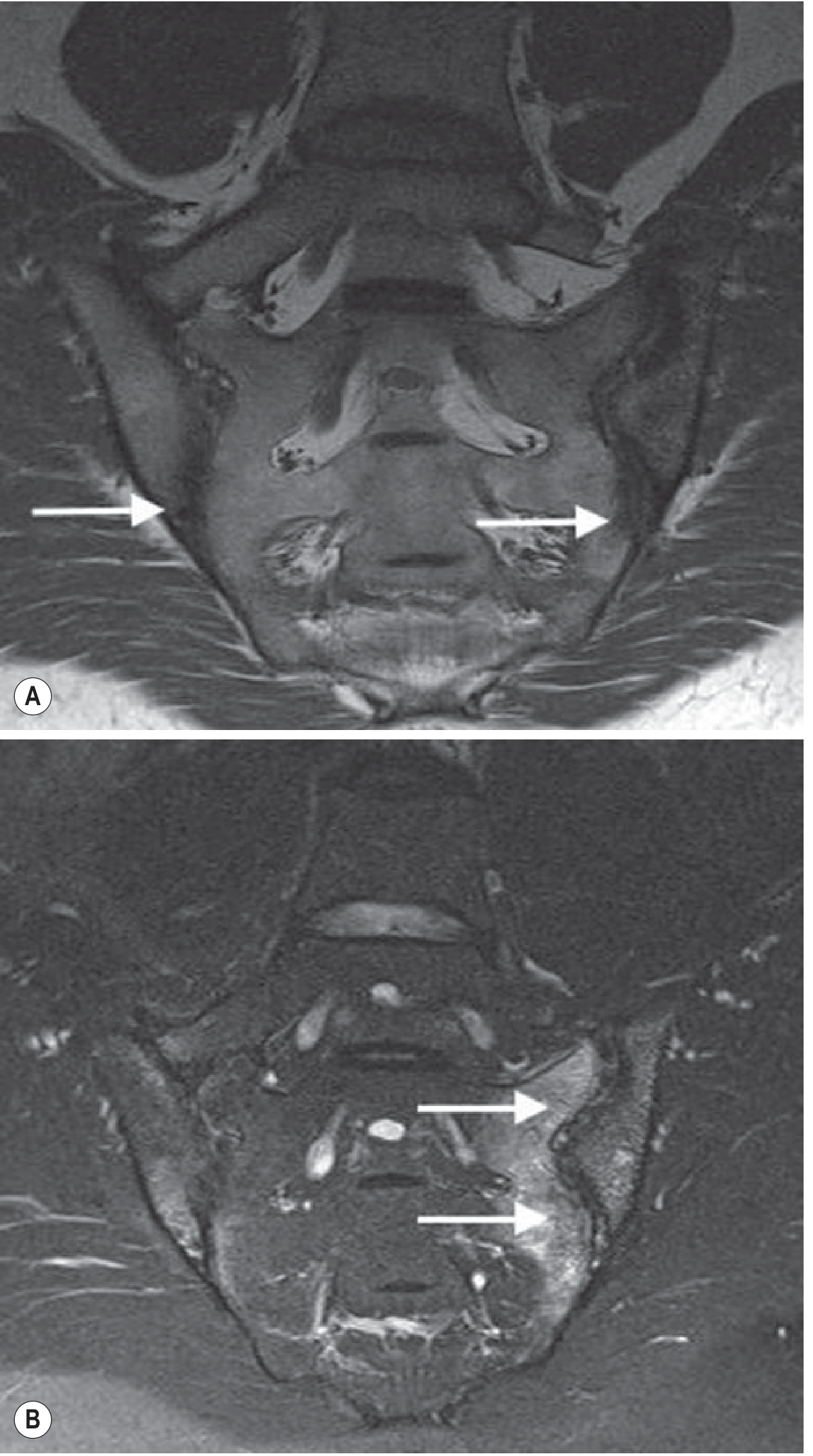
MRI of SI joints in AS: T1 shows erosions with joint space loss; T2 fat-suppressed shows extensive subchondral edema (disease activity).
KEY COMPARISON TABLE: RA vs. AS
| Feature | RA | AS |
|---|---|---|
| Type | Systemic autoimmune | Seronegative spondyloarthropathy |
| Sex | F > M (3:1) | M > F (5:1) |
| Age | 20–50 (any age) | 20s–30s |
| Genetics | HLA-DR | HLA-B27 |
| Joints | Peripheral (small joints) — symmetric | Axial skeleton (SI joints, spine) |
| DIP joints | Spared | Can be involved (if peripheral) |
| Morning stiffness | >1 hour, worsens with activity | Improves with activity |
| RF | Positive (70%) | Negative (seronegative) |
| Key X-ray finding | Periarticular erosions, ulnar deviation | Bamboo spine, sacroiliitis |
| Hallmark pathology | Pannus formation, synovitis | Enthesitis, syndesmophytes |
| Eye involvement | Sjögren's, scleritis | Acute anterior uveitis (iritis) |
| Treatment | MTX + biologics (anti-TNF) | NSAIDs + anti-TNF; physiotherapy |
| Corticosteroids | Bridge therapy (systemic/local) | Not helpful for axial disease |
Sources: Textbook of Family Medicine 9e, p. 878–884; Grainger & Allison's Diagnostic Radiology, p. 1119–1120
This is a shared conversation. Sign in to Orris to start your own chat.