

IMG_3048.jpeg
Diagnose
Reading File
The image shows a neonate in an incubator with a massive, dark-purple/violaceous scrotal swelling — the hallmark of neonatal scrotal hematoma, most likely from neonatal testicular torsion (bilateral). Let me search the library for confirmation.
Finding Sources
Finding Sources
Searching PubMed
neonatal testicular torsion diagnosis management
Reading File
Reading File
Loading Image
Reading File
Diagnosis: Perinatal (Neonatal) Extravaginal Testicular Torsion — Bilateral
The image shows a male neonate in an incubator with a massively enlarged, dark purple-black, edematous scrotum — the classic presentation of bilateral perinatal extravaginal spermatic cord torsion.
What You're Seeing
| Finding | Significance |
|---|---|
| Dark purple-black discoloration of the entire scrotum | Hemorrhagic infarction from venous obstruction |
| Massive bilateral scrotal enlargement | Both testes involved (bilateral torsion) |
| Neonate in NICU (incubator, nasal prongs, umbilical lines) | Consistent with perinatal period |
| Hard, swollen scrotum fixed to overlying skin | Classic for extravaginal torsion |
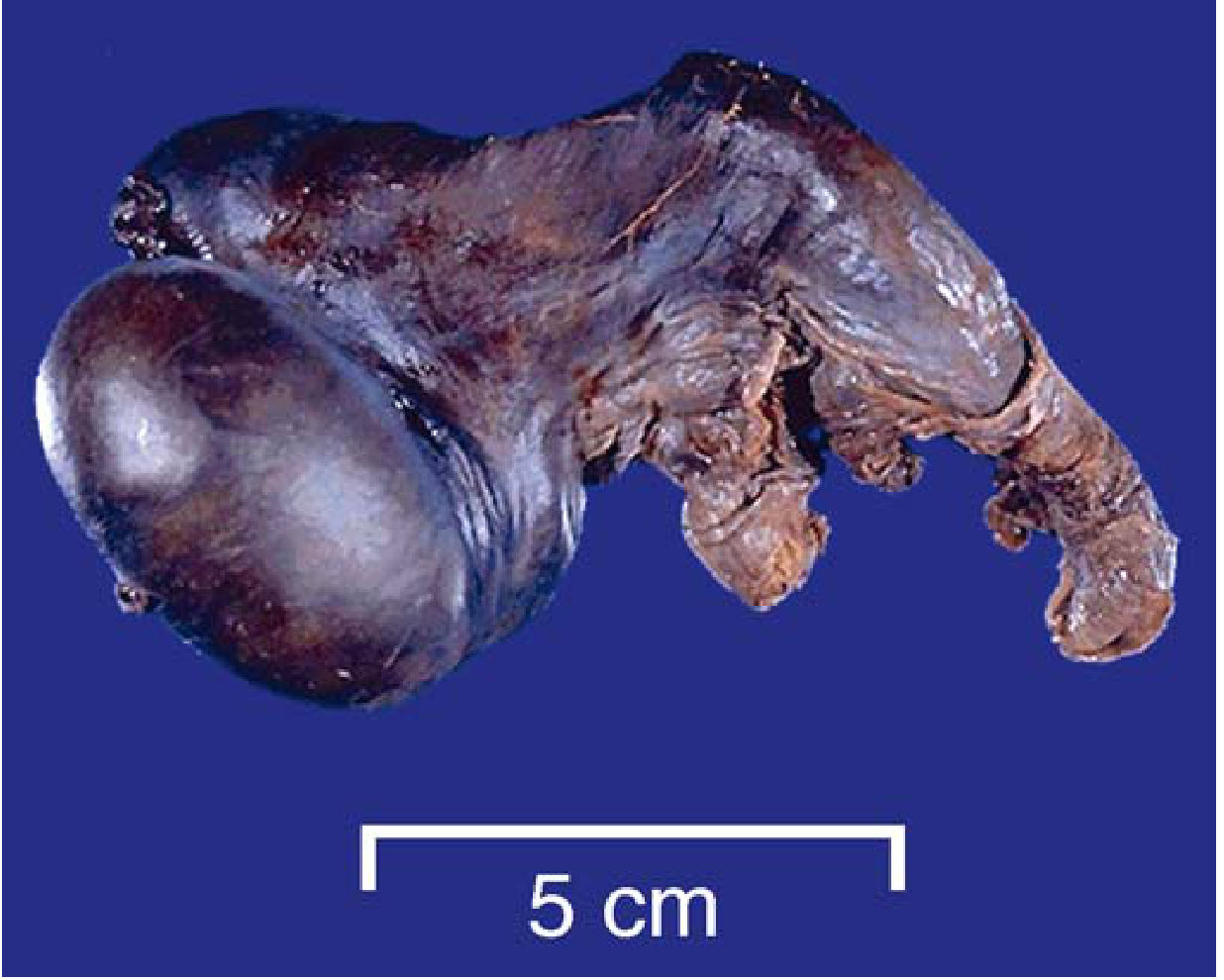
The pathology image from Robbins & Kumar Basic Pathology (below) shows exactly this appearance — dark discoloration from hemorrhage and infarction:
Pathophysiology
Extravaginal (perinatal) torsion is unique to neonates. The entire spermatic cord — including the tunica vaginalis — rotates because the tunica has not yet fused to the scrotal wall. This can occur:
- In utero (prenatal) — most common; testis is already infarcted at birth
- During delivery
- Early postnatal — rarely salvageable
Torsion occludes venous outflow while the arteries temporarily remain patent, causing intense vascular engorgement → hemorrhagic infarction → the dark purple-black appearance seen here.
Campbell-Walsh Urology describes it: "The testis that sustains loss of blood supply close to delivery is a hard, painless testis fixed to the overlying erythematous or dark scrotal skin with or without edema."
Bilateral Involvement
Bilateral synchronous neonatal torsion is rare but well-documented. It represents a surgical emergency — even if one side is non-viable, the contralateral testis must be explored and fixed immediately to prevent asplenia of testicular function.
Differential Diagnoses to Exclude
| Condition | Distinguishing Feature |
|---|---|
| Scrotal hematoma (birth trauma) | Usually unilateral, often clears; no fixed skin |
| Idiopathic scrotal edema | Minimal pain, minimal discoloration, self-limited |
| Incarcerated inguinal hernia | Inguinal mass, bowel loops |
| Orchitis/epididymitis | Rare in neonates, less dramatic discoloration |
| Henoch-Schönlein purpura | Systemic vasculitis, purpuric rash elsewhere |
Immediate Management
- Urgent scrotal exploration — even though prenatal torsion is rarely salvageable, exploration is mandatory to:
- Confirm diagnosis
- Remove non-viable testis (orchiectomy) to prevent autoimmune damage to the contralateral gonad
- Orchidopexy of the contralateral testis (critical — to prevent bilateral asplenia)
- Color Doppler ultrasound (if does not delay surgery) — may show absent or reversed flow
- NICU stabilization — cardiorespiratory support as shown in the image
A 2025 systematic review (PMID 40779052) on idiopathic scrotal hematoma in newborns and a 2026 meta-analysis (PMID 41261439) on acute testicular pain management both emphasize urgent surgical exploration when torsion cannot be excluded.
Bottom line: This neonate has bilateral perinatal extravaginal testicular torsion with hemorrhagic infarction — a urologic emergency requiring immediate surgical exploration and contralateral orchidopexy to preserve any residual testicular function.
This is a shared conversation. Sign in to Orris to start your own chat.