
Pulley system of hand
I'll look this up in the medical library for you right away.
Reading File
Now searching the medical library and web simultaneously:
Finding Sources
Searching the Web
pulley system hand anatomy flexor tendon annular cruciate pulleys
Finding Sources
Loading Image
Loading Image
Now let me get the detailed textbook content on the pulley system:
Reading File
Loading Image
Loading Image
Here is a thorough breakdown of the pulley system of the hand:
Pulley System of the Hand
The flexor pulley system is a series of fibrous rings (pulleys) that hold the flexor tendons tightly against the phalanges. Without them, the tendons would bow away from the bone during finger flexion - a phenomenon called bowstringing - making flexion inefficient or impossible.

The Tendons Involved
Two long flexor tendons run within the digital sheath of each finger (digits 2-5):
- Flexor Digitorum Superficialis (FDS) - inserts on the middle phalanx
- Flexor Digitorum Profundus (FDP) - passes through the split FDS (at Camper's chiasm) to insert on the distal phalanx
These tendons receive blood supply via vincula - short and long mesotenon-like connections from arterial arches in the digits.
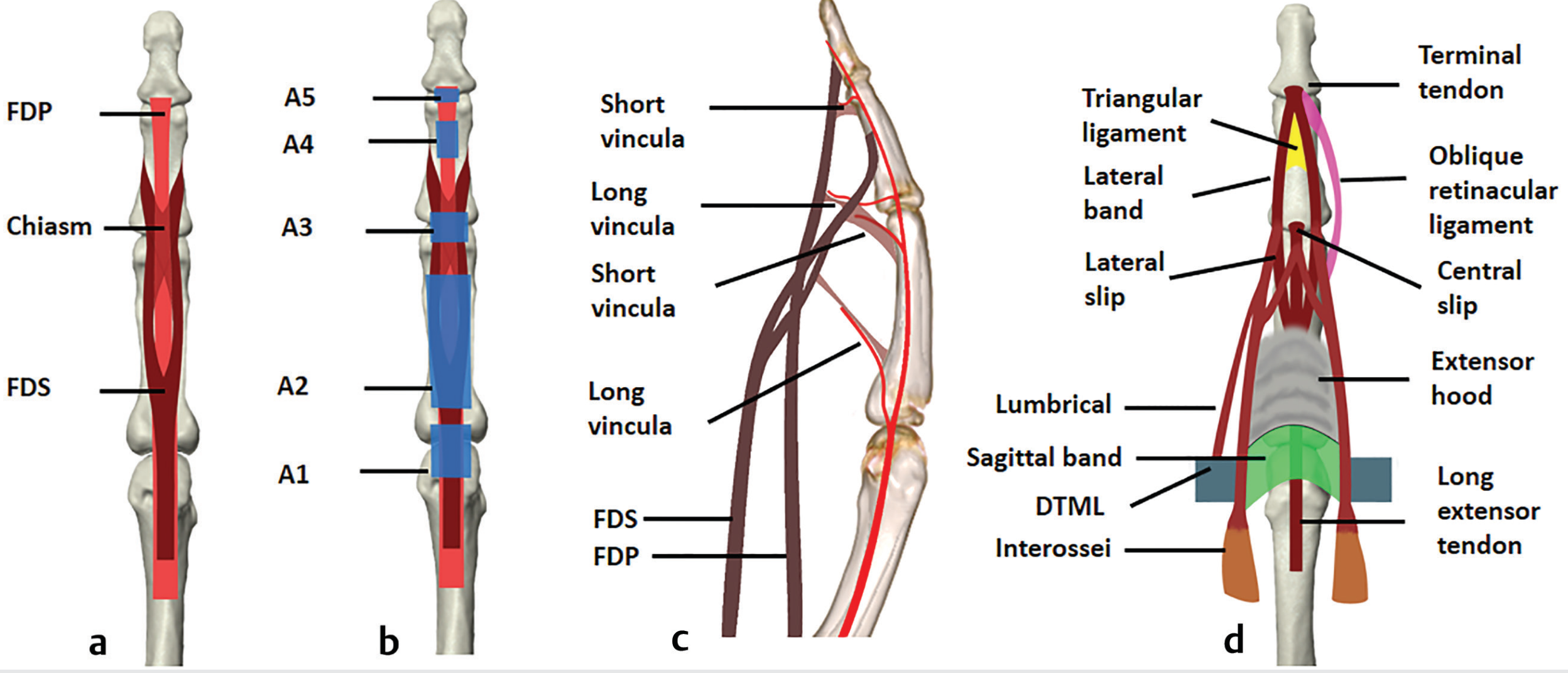
The Finger Pulleys (Digits 2-5)
There are 5 annular pulleys and 3 cruciate pulleys per finger, plus a palmar aponeurosis (PA) pulley proximal to A1.
Annular Pulleys (A1-A5)
These are thick, rigid rings of fibrous tissue that are the primary restraints against bowstringing:
| Pulley | Location | Clinical Note |
|---|---|---|
| A1 | Over the MCP joint | Site of triggering in trigger finger (stenosing tenosynovitis) |
| A2 | Proximal half of proximal phalanx | Most important - critical for preventing bowstringing |
| A3 | Over the PIP joint | Thin; less biomechanically important |
| A4 | Middle portion of middle phalanx | 2nd most important - must preserve in surgery |
| A5 | Over the DIP joint | Thin; least important |
The A2 and A4 pulleys are the most biomechanically critical and should always be preserved or reconstructed whenever possible. Their loss leads to significant bowstringing and loss of finger flexion power.
Cruciate Pulleys (C1-C3)
These are thin, X-shaped (cross-shaped) ligaments that collapse during flexion to allow the annular pulleys to approximate:
- C1 - between A2 and A3
- C2 - between A3 and A4
- C3 - between A4 and A5
Palmar Aponeurosis (PA) Pulley
Formed by the transverse fibers of the palmar aponeurosis (superficial transverse metacarpal ligament) connected to vertical septa (septa of Legueu and Juvara). It lies proximal to A1 in the palm.
The Thumb Pulleys
The thumb (digit 1) has only the Flexor Pollicis Longus (FPL) and a distinct 3-pulley system:
| Pulley | Location |
|---|---|
| A1 | Just proximal to the MCP joint |
| Oblique pulley | Proximal part of proximal phalanx (attached to adductor pollicis); functionally most important |
| A2 | Distal portion of proximal phalanx |
The oblique pulley in the thumb is functionally equivalent to the A2 pulley in the fingers.
Flexor Tendon Zones (related to pulleys)
The zones of the hand are defined largely by pulley anatomy:
| Zone | Location | Significance |
|---|---|---|
| Zone I | Distal to FDS insertion | FDP only |
| Zone II ("No Man's Land") | A1 pulley to FDS insertion | Both FDS & FDP; tight sheath, hardest to repair |
| Zone III | Distal carpal ligament to A1 pulley | Lumbrical origin area |
| Zone IV | Within carpal tunnel | All 9 tendons + median nerve |
| Zone V | Proximal to carpal tunnel | Forearm |
Clinical Relevance
- Trigger finger (stenosing tenosynovitis): The A1 pulley thickens and constricts the FDS/FDP tendon, causing painful catching or locking. Treatment is A1 pulley release (open or percutaneous).
- Bowstringing: Occurs when A2 (most commonly) or A4 is divided. The tendon lifts away from bone, dramatically reducing mechanical efficiency.
- Rock climbing injuries ("pulley injuries"): Forceful crimp grip can rupture the A2 or A4 pulley, causing pain and bowstringing.
- Zone II flexor tendon repair: A2 and A4 must be preserved; partial venting is sometimes performed to allow repaired tendon bulk through, but full division is avoided.
- Pulley reconstruction: Can use tendon grafts (e.g., palmaris longus or A1 pulley as donor) wrapped around the phalanx when critical pulleys are destroyed.
Sources: Imaging Anatomy - Bones, Joints, Vessels and Nerves (Pulley System section); Campbell's Operative Orthopaedics 15th Ed 2026; TeachMeAnatomy
This is a shared conversation. Sign in to Orris to start your own chat.