
Kawasaki vs scarlet fever
Reading File
Both Kawasaki disease and scarlet fever are childhood febrile illnesses with overlapping features (fever, rash, red tongue), but they differ in etiology, diagnostic criteria, and management. Let me pull the authoritative textbook content.
Searching sources...
Finding Sources
Finding Sources
Reading File
Reading File
Finding Sources
Reading File
Reading File
Finding Sources
Reading File
Reading File
Now let me fetch the key clinical images:
Loading Image
Loading Image
I now have comprehensive information from multiple authoritative textbooks. Here is the full comparison:
Kawasaki Disease vs Scarlet Fever
Both are childhood febrile illnesses with rash and a "strawberry tongue," making them a classic diagnostic challenge. The distinctions are clinically critical because their management and complications differ fundamentally.
Etiology
| Kawasaki Disease (KD) | Scarlet Fever | |
|---|---|---|
| Cause | Unknown (likely dysregulated immune response to an unidentified trigger) | Group A beta-hemolytic Streptococcus (GAS); rarely Group C strep |
| Mechanism | Systemic vasculitis of medium-sized vessels | Pyrogenic exotoxin (superantigen)-mediated; SPEA, SPEB, SPEC toxins |
| Confirmatory test | None - clinical diagnosis | Throat culture positive for GAS; rapid strep antigen test |
Epidemiology
| Kawasaki | Scarlet Fever | |
|---|---|---|
| Peak age | 1-2 years; rare >14 years | School-age children (5-15 years) |
| Sex | More common in boys | Equal |
| Seasonality | Winter and spring | Winter and early spring |
| Ethnicity | Highest in Asian children | No predilection |
Clinical Features
Fever
- Kawasaki: Fever lasts 5 or more days (mandatory criterion); typically high and prolonged (~12 days untreated)
- Scarlet fever: Fever is abrupt onset but typically resolves faster with antibiotics; usually accompanied by sore throat
Rash
| Feature | Kawasaki | Scarlet Fever |
|---|---|---|
| Character | Polymorphous - maculopapular, diffuse erythroderma, or erythema multiforme-like | Finely punctate 1-2 mm papules; classic sandpaper texture |
| Distribution | Trunk and extremities; groin desquamation early | Begins on neck/axillae/groin, spreads to trunk; spares palms and soles |
| Special signs | None equivalent | Pastia lines (linear petechiae in antecubital/axillary folds) |
| Circumoral pallor | Not characteristic | Present (facial flushing with circumoral pallor) |
| Blanching | Yes | Yes |
| Late desquamation | Fingers and toes (weeks 2-3) | Face first, then palms/fingers/soles (~1 week after rash; lasts up to 1 month) |
Scarlet fever - sandpaper rash, strawberry tongue, and post-streptococcal desquamation (Fitzpatrick's Dermatology):
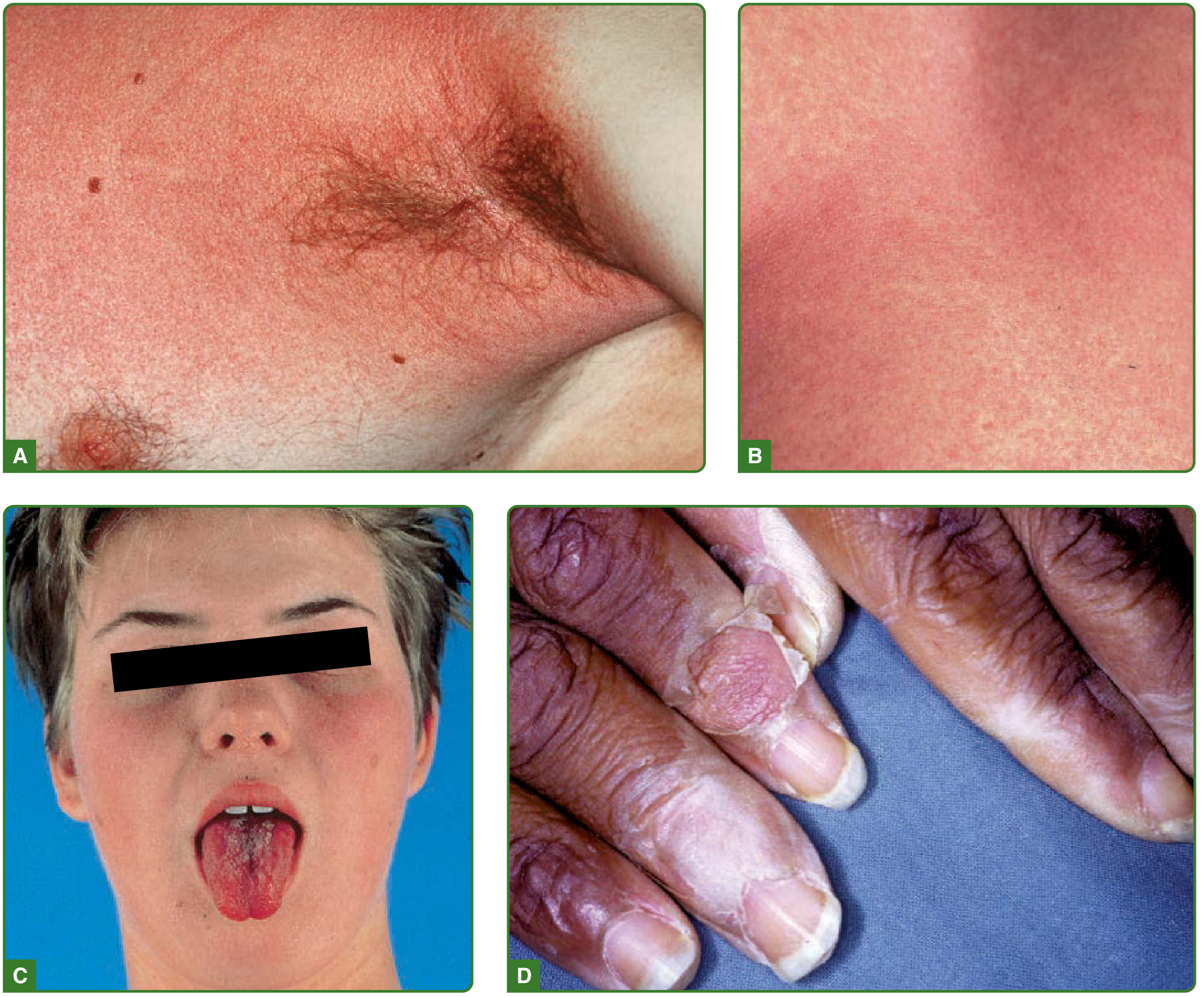
Tongue
Both diseases produce a "strawberry tongue" - this is the most confusing overlap feature.
- Scarlet fever: White strawberry tongue (days 1-2, white coat with red papillae projecting through) → red strawberry tongue (days 4-5 as white coat desquamates)
- Kawasaki: Red strawberry tongue (diffuse oropharyngeal erythema + cracked red lips); no white phase described
Scarlet fever white/red strawberry tongue:
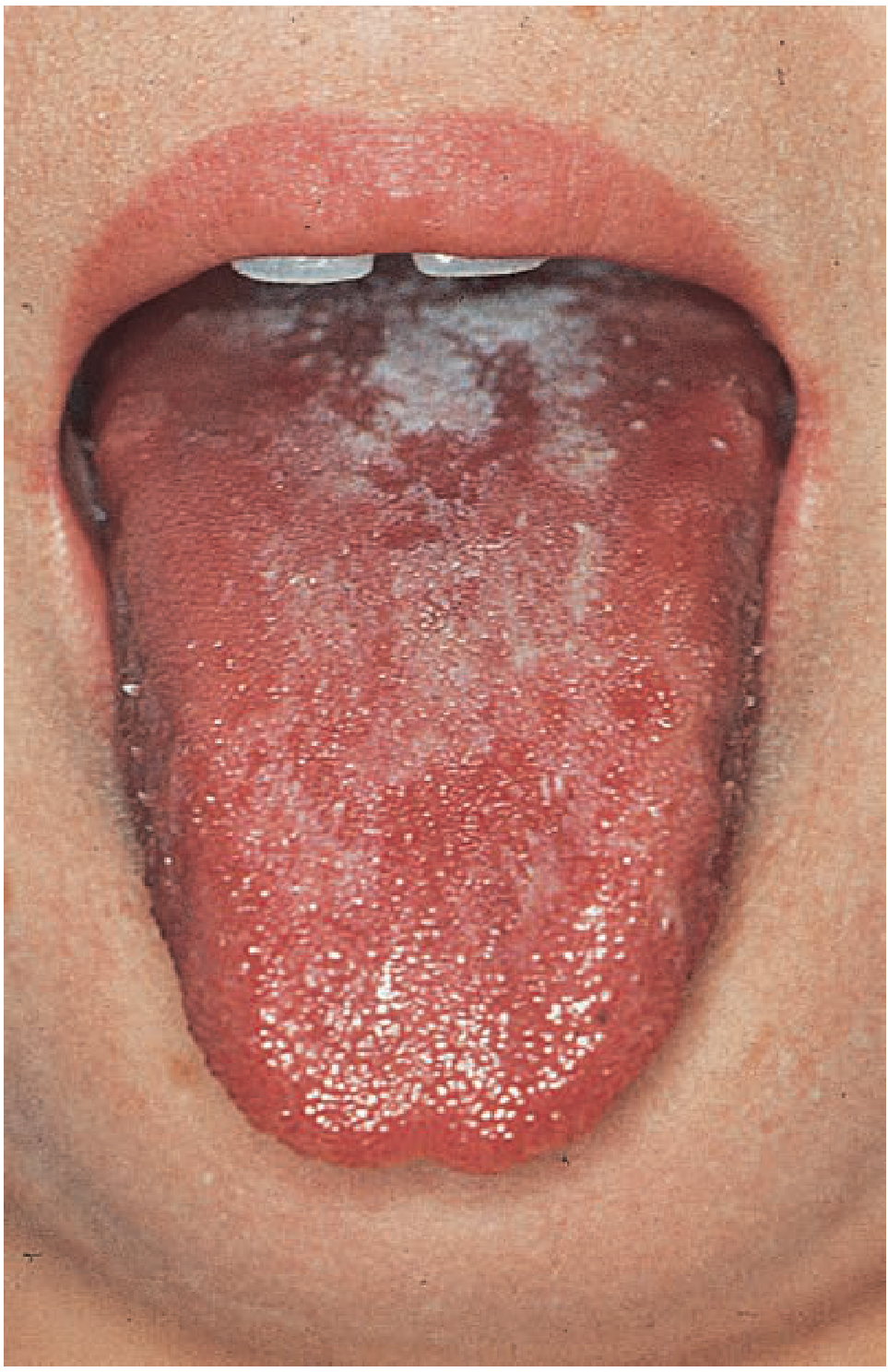
Other Oral/ENT Features
| Kawasaki | Scarlet Fever | |
|---|---|---|
| Pharyngitis/tonsillitis | Diffuse oropharyngeal erythema; no exudate | Exudative tonsillitis; purulent exudate common |
| Palatal lesions | None | Petechiae/red macules on soft palate (Forchheimer spots) |
| Lip changes | Cracked, erythematous, fissured lips | Not characteristic |
| Cervical lymphadenopathy | Unilateral, >1.5 cm, non-fluctuant | Tender anterior cervical nodes |
Eyes
- Kawasaki: Bilateral non-exudative (non-purulent) conjunctival injection in ~90% - a key diagnostic criterion
- Scarlet fever: No conjunctivitis
Extremities
- Kawasaki: Erythema and edema of palms and soles (acute phase); periungual desquamation of fingers and toes (subacute phase) - very characteristic
- Scarlet fever: Rash spares palms and soles; desquamation occurs but is less dramatic
Diagnostic Criteria
Kawasaki Disease (CDC/Classic criteria)
Fever ≥5 days PLUS at least 4 of 5:
- Bilateral bulbar conjunctival injection without exudate
- Erythema/cracking of lips, strawberry tongue, oropharyngeal erythema
- Polymorphous rash
- Erythema/edema of hands and feet (acute) or periungual desquamation (subacute)
- Cervical lymphadenopathy (>1.5 cm, usually unilateral, non-fluctuant)
Incomplete KD: fever ≥5 days + only 2-3 criteria, supported by elevated CRP/ESR and/or positive echo
(Tintinalli's Emergency Medicine)
Scarlet Fever
- Clinical diagnosis: fever + sore throat + characteristic sandpaper rash + strawberry tongue
- Confirmed by positive throat culture or rapid strep test for GAS
Investigations
| Test | Kawasaki | Scarlet Fever |
|---|---|---|
| Culture | Blood culture negative | Throat culture positive for GAS |
| WBC | Leukocytosis | Leukocytosis |
| Platelets | Thrombocytosis (especially phase II, >450,000/mm³ after day 7) | Normal or mildly elevated |
| CRP/ESR | Markedly elevated | Mildly/moderately elevated |
| Urinalysis | Pyuria (sterile, >10 WBC/hpf) | Normal |
| LFTs | Elevated | Normal |
| Albumin | Low (<3 g/dL) in incomplete KD | Normal |
| ECG | PR/QT prolongation, ST-T changes | Normal |
| Echocardiogram | Coronary artery aneurysms/dilation | Normal |
| ASO titre | Normal | Elevated |
Key Differentiating Features at a Glance
| Feature | Kawasaki | Scarlet Fever |
|---|---|---|
| Pharyngeal exudate | Absent | Present |
| Conjunctivitis | Bilateral, non-exudative | Absent |
| Rash texture | Polymorphous, maculopapular | Sandpaper/punctate |
| Pastia lines | Absent | Present |
| Circumoral pallor | Absent | Present |
| Cracked lips | Present | Absent |
| Hand/foot swelling | Present | Absent |
| Periungual desquamation | Present (fingers/toes) | Absent |
| Coronary aneurysms | Risk (15-25% untreated) | None |
| Response to antibiotics | None | Rapid (24-48 hrs) |
Practical tip (from Fitzpatrick's): If a patient with suspected KD has a positive throat culture for GAS, treat with antibiotics and re-evaluate in 24-48 hours. Rapid resolution favors strep; failure to respond favors Kawasaki.
Complications
| Kawasaki | Scarlet Fever | |
|---|---|---|
| Cardiac | Coronary artery aneurysms (15-25% untreated), myocarditis, sudden death | None directly |
| Late sequelae | Coronary artery disease, ischemic heart disease | Rheumatic fever, post-streptococcal glomerulonephritis |
| Local | Hydrops of gallbladder, aseptic meningitis, urethritis | Streptococcal lymphadenitis, otitis media |
Management
Kawasaki Disease
- Hospital admission required
- IVIG 2 g/kg as a single infusion within the first 10 days of illness - reduces coronary aneurysm risk 5-fold
- High-dose aspirin (anti-inflammatory dose) during acute phase → low-dose aspirin (anti-platelet) during subacute/convalescent phase
- Early cardiology evaluation and echocardiogram
- Antibiotics are ineffective (ROSEN's Emergency Medicine)
Scarlet Fever
- Oral penicillin VK: children <27 kg: 250 mg BID or TID x 10 days; adolescents/adults: 500 mg BID x 10 days
- IM benzathine penicillin (Bicillin C-R): <27 kg: 600,000 units single dose; ≥27 kg: 1,200,000 units single dose
- Penicillin-allergic: erythromycin, other macrolides, or cephalosporin (note: increasing macrolide resistance)
- Amoxicillin is also first-line
- No aspirin, no IVIG (ROSEN's Emergency Medicine; Tintinalli's Emergency Medicine)
Summary
Both diseases share fever, rash, strawberry tongue, and cervical lymphadenopathy in children. The cardinal distinguishing features are:
- Kawasaki: non-exudative conjunctivitis + cracked lips + hand/foot edema + periungual desquamation + prolonged fever ≥5 days + no throat exudate + no response to antibiotics
- Scarlet fever: exudative pharyngitis + sandpaper rash + Pastia lines + circumoral pallor + positive strep culture + rapid antibiotic response
The stakes of missing Kawasaki are high - untreated, it is the leading cause of acquired pediatric heart disease in the US.
Sources: ROSEN's Emergency Medicine; Tintinalli's Emergency Medicine; Fitzpatrick's Dermatology; Firestein & Kelley's Textbook of Rheumatology
Antibiotics which are regularly used in opd and icu covering everything gram postive negative anarobic typical atypical
Reading File
This is a broad, clinically rich question. Let me search in parallel across multiple relevant topics.
Finding Sources
Finding Sources
Finding Sources
Finding Sources
Finding Sources
Finding Sources
Reading File
Finding Sources
Reading File
Finding Sources
Reading File
Reading File
Reading File
Reading File
Reading File
I now have more than sufficient data from Katzung's Pharmacology, Washington Manual, Current Surgical Therapy, and ROSEN's. Let me compile the comprehensive answer now.
Antibiotics: OPD vs ICU - Complete Coverage Guide
Organized by drug class, then by clinical setting. "Coverage" refers to intrinsic spectrum assuming no resistance.
Quick Reference: The Spectrum Framework
| Organism Category | Examples |
|---|---|
| Gram-positive cocci | S. aureus (MSSA/MRSA), Streptococcus spp., Enterococcus spp. |
| Gram-negative rods | E. coli, Klebsiella, Pseudomonas, Proteus, Enterobacter, Acinetobacter |
| Gram-negative cocci | Neisseria, Moraxella |
| Anaerobes | Bacteroides fragilis, Clostridium, Peptostreptococcus |
| Atypicals | Mycoplasma, Chlamydophila, Legionella (no cell wall) |
| Typical intracellular | Rickettsia, Coxiella |
CLASS 1 - PENICILLINS
Natural Penicillins (Penicillin G, Penicillin V)
- Setting: OPD (Pen V oral), Hospital (Pen G IV)
- Gram +: Streptococci, sensitive pneumococci, Enterococcus (with aminoglycoside)
- Gram -: Neisseria spp., H. influenzae (if no beta-lactamase)
- Anaerobes: Non-beta-lactamase anaerobes (oral cavity flora)
- Atypicals: None
- OPD uses: Streptococcal pharyngitis, syphilis (Benzathine Pen G), rheumatic fever prophylaxis
- Key limitation: Destroyed by beta-lactamases; no gram-negative rod cover
Aminopenicillins: Amoxicillin, Ampicillin
- Setting: OPD (amoxicillin), Hospital (ampicillin IV)
- Gram +: Streptococci, enterococci, Listeria
- Gram -: E. coli, H. influenzae, Salmonella (if susceptible), Shigella (ampicillin only)
- Anaerobes: Moderate (oral anaerobes)
- Atypicals: None
- OPD uses: Otitis media, sinusitis, community UTI, mild CAP (in combination)
- Key limitation: Beta-lactamase-producing organisms are resistant; Klebsiella, Pseudomonas, Enterobacter are intrinsically resistant
Beta-Lactam + Beta-Lactamase Inhibitor Combinations
| Drug | Setting | Notable Added Coverage |
|---|---|---|
| Amoxicillin-clavulanate (Co-amoxiclav) | OPD | Beta-lactamase + S. aureus (MSSA), oral anaerobes, Moraxella |
| Ampicillin-sulbactam | Hospital | MSSA, gram-negatives, anaerobes; BUT high E. coli resistance - avoid empirically |
| Piperacillin-tazobactam (Pip-Tazo) | ICU | Anti-pseudomonal + gram-positives + anaerobes; broad-spectrum workhorse |
- Amoxicillin-clavulanate OPD uses: Bite wounds, otitis media, sinusitis, community pneumonia, diabetic foot, UTI (when susceptible)
- Pip-Tazo ICU uses: HAP/VAP, intra-abdominal sepsis, febrile neutropenia, sepsis of unknown source
Antistaphylococcal Penicillins: Cloxacillin, Nafcillin, Dicloxacillin
- Setting: OPD (dicloxacillin/cloxacillin oral), Hospital (nafcillin/cloxacillin IV)
- Gram +: MSSA, Streptococcus - very active; NOT Enterococcus
- Gram -: None
- Anaerobes: None
- Uses: MSSA skin/soft tissue, MSSA bacteremia, osteomyelitis (cloxacillin IV is drug of choice for MSSA)
- Key point: Resistant to staphylococcal beta-lactamase by design; completely inactive against MRSA
CLASS 2 - CEPHALOSPORINS
First Generation: Cefalexin (oral), Cefazolin (IV)
- Setting: OPD (cefalexin), Hospital (cefazolin)
- Gram +: Excellent - MSSA, Streptococci
- Gram -: Moderate - E. coli, Klebsiella, Proteus mirabilis
- Anaerobes: Poor
- Atypicals: None
- OPD uses: Skin/soft tissue infections, uncomplicated UTI, strep pharyngitis (pen-allergic)
- Hospital uses: Surgical prophylaxis (cefazolin is #1 surgical prophylaxis drug), MSSA infections
Second Generation: Cefuroxime, Cefaclor, Cefoxitin, Cefprozil
- Setting: OPD and Hospital
- Gram +: Good (less than 1st gen)
- Gram -: Better than 1st gen; H. influenzae, Moraxella, N. gonorrhoeae
- Anaerobes: Cefoxitin has anaerobic cover (Bacteroides fragilis) - useful for mixed infections
- OPD uses: RTI, otitis media, sinusitis, urinary tract
- Hospital uses: Cefoxitin for pelvic inflammatory disease, mild intra-abdominal
Third Generation: Ceftriaxone, Cefotaxime (IV); Cefixime, Cefpodoxime (oral)
- Setting: OPD (oral 3rd gen), Hospital/ICU (IV)
- Gram +: Ceftriaxone/cefotaxime - good against Strep, S. pneumoniae (including PCN-intermediate)
- Gram -: Excellent broad coverage - E. coli, Klebsiella, H. influenzae, N. gonorrhoeae, Proteus, Moraxella; NOT Pseudomonas (except ceftazidime)
- Anaerobes: Poor (except cefoxitin)
- Atypicals: None
- Ceftazidime: Anti-pseudomonal but poor gram-positive
- OPD uses: Gonorrhea (ceftriaxone IM single dose), Lyme disease (ceftriaxone IV), typhoid (ceftriaxone)
- Hospital/ICU uses: CAP (ceftriaxone + macrolide/azithromycin), meningitis (ceftriaxone gold standard), febrile neutropenia, sepsis
- Key limitation: Extended-spectrum beta-lactamase (ESBL) producers are resistant; avoid in Enterobacter (AmpC induction risk)
Fourth Generation: Cefepime
- Setting: ICU
- Gram +: Good (MSSA, Strep, Pneumo)
- Gram -: Excellent including Pseudomonas aeruginosa, Enterobacter (AmpC-stable)
- Anaerobes: Poor
- ICU uses: HAP/VAP, febrile neutropenia, gram-negative sepsis; replaces ceftazidime when gram-positive cover also needed
Fifth Generation: Ceftaroline
- Setting: Hospital
- Unique feature: Only cephalosporin active against MRSA
- Gram -: Standard, not anti-pseudomonal
- Uses: MRSA skin infections, CAP with MRSA risk
CLASS 3 - CARBAPENEMS (ICU Workhorses)
| Drug | Anti-Pseudomonal | Gram+ | Gram- | Anaerobes | Notes |
|---|---|---|---|---|---|
| Meropenem | Yes | Good | Broadest | Excellent | First choice; CNS safe |
| Imipenem-cilastatin | Yes | Good | Excellent | Excellent | Seizure risk (avoid CNS) |
| Doripenem | Yes | Good | Excellent | Excellent | Less seizure risk |
| Ertapenem | No | Good | Excellent | Excellent | OD dosing; ESBL cover; NO Pseudomonas |
- Spectrum summary: Broadest available - gram-positive (not MRSA, not VRE), gram-negative including ESBL producers and AmpC organisms, anaerobes. Add vancomycin for MRSA.
- ICU uses: Severe sepsis, ESBL infections, HAP/VAP, abdominal sepsis, febrile neutropenia, multidrug-resistant organisms
- Ertapenem OPD/step-down: Once-daily; useful for ESBL UTI/pyelonephritis, step-down in OPAT
CLASS 4 - FLUOROQUINOLONES
Respiratory Quinolones: Levofloxacin, Moxifloxacin
- Setting: OPD and Hospital
- Gram +: Good - S. pneumoniae, MSSA, Enterococcus
- Gram -: Excellent - most Enterobacterales, H. influenzae
- Anaerobes: Moxifloxacin only (levofloxacin is poor)
- Atypicals: Excellent - Legionella, Mycoplasma, Chlamydophila - this is their key advantage
- OPD uses: CAP (most common OPD antibiotic for respiratory infection with atypical cover), sinusitis, UTI (levofloxacin), COPD exacerbation
- Hospital uses: CAP requiring hospitalization, Legionella pneumonia, atypical pneumonia
- Key note: Moxifloxacin NOT for UTI (no urinary excretion). Levofloxacin IS for UTI.
Non-respiratory Quinolones: Ciprofloxacin
- Setting: OPD and ICU
- Gram -: Excellent - E. coli, Pseudomonas, Klebsiella, Salmonella, Shigella, Campylobacter, Neisseria
- Gram +: Moderate/poor (NOT reliable for Strep, poor for MRSA)
- Anaerobes: Poor
- Atypicals: Moderate
- OPD uses: UTI/pyelonephritis, traveler's diarrhea, enteric fever, prostatitis, bone/joint gram-negative infections
- ICU uses: Pseudomonal infections (often combined with beta-lactam), nosocomial gram-negative infections
- Warning: High resistance emerging worldwide; avoid as empiric monotherapy for gram-negative sepsis in areas with >10% resistance
CLASS 5 - MACROLIDES & AZALIDES
Azithromycin
- Setting: OPD (primarily), some Hospital
- Gram +: S. pneumoniae (resistance increasing), Group A Strep
- Gram -: H. influenzae (moderate), Moraxella
- Atypicals: Excellent - Mycoplasma, Chlamydophila, Legionella, Chlamydia trachomatis, Bordetella
- Anaerobes: None
- OPD uses: CAP (with or without beta-lactam), atypical pneumonia, STI (Chlamydia), whooping cough, MAC prophylaxis
- Advantage: Once-daily, short course (5 days for Z-pack or single-dose for Chlamydia), tissue concentrations > serum levels
Clarithromycin
- Setting: OPD
- Similar spectrum to azithromycin; also active against H. pylori (triple therapy), Mycobacterium avium
- OPD uses: CAP, H. pylori eradication, MAC treatment, Legionella
Erythromycin
- Setting: OPD
- Same atypical spectrum; more GI side effects; mostly replaced by azithromycin/clarithromycin
CLASS 6 - TETRACYCLINES & GLYCYLCYCLINES
Doxycycline
- Setting: OPD (predominantly)
- Gram +: Moderate
- Gram -: Moderate
- Atypicals: Excellent - Mycoplasma, Chlamydophila, Rickettsia, Coxiella (Q fever), Brucella, Leptospira
- Anaerobes: Some activity
- OPD uses: Atypical pneumonia, CAP (alternate), STIs (Chlamydia, PID), Lyme disease, RMSF, malaria prophylaxis, acne, COPD exacerbation
- Contraindication: Children <8 years, pregnancy
Tigecycline
- Setting: ICU (severe/MDR infections)
- Broad spectrum: Gram-positive (including MRSA, VRE), gram-negative (including ESBL, Acinetobacter), anaerobes, atypicals
- Limitation: NOT active against Pseudomonas; associated with increased mortality in some studies when used for VAP/bacteremia - use with caution; primarily for complicated skin/soft tissue, intra-abdominal, MDR Acinetobacter
CLASS 7 - AMINOGLYCOSIDES
| Drug | Setting | Key Use |
|---|---|---|
| Gentamicin | ICU | Synergy with beta-lactams for enterococcal endocarditis; gram-negative sepsis combination |
| Amikacin | ICU | MDR gram-negatives; tobramycin/gentamicin-resistant isolates |
| Tobramycin | ICU | Pseudomonas (+ beta-lactam) |
- Spectrum: Exclusively gram-negative aerobes (not anaerobes, not atypicals); gram-positive synergy only
- ICU use: Combination therapy for severe gram-negative infections, Pseudomonas with beta-lactam
- Toxicity: Nephrotoxicity + ototoxicity - monitor drug levels; once-daily dosing preferred to reduce toxicity
CLASS 8 - GLYCOPEPTIDES & LIPOPEPTIDES (MRSA Cover)
Vancomycin
- Setting: ICU (IV); Hospital (oral only for C. difficile)
- Gram +: MRSA, VISA, VRE (some), Enterococcus, S. pneumoniae, Clostridioides difficile (oral only)
- Gram -: None (too large to cross outer membrane)
- Anaerobes: Gram-positive anaerobes only (oral for C. difficile)
- ICU uses: MRSA bacteremia, MRSA VAP/HAP, MRSA endocarditis, meningitis (with 3rd gen for PCN-resistant pneumococci), C. difficile (oral)
- Monitoring: Trough or AUC-guided dosing; nephrotoxic especially with aminoglycosides
Daptomycin
- Setting: ICU/Hospital
- Gram +: MRSA, VRE, MSSA, Streptococcus, Enterococcus
- Gram -: None
- Anaerobes: Gram-positive only
- Key note: Inactivated by pulmonary surfactant - do NOT use for pneumonia; excellent for bacteremia, endocarditis, skin infections
CLASS 9 - OXAZOLIDINONES
Linezolid
- Setting: ICU (IV) / Hospital/OPD (oral - same bioavailability)
- Gram +: MRSA, VRE, drug-resistant Enterococcus, Streptococcus - potent
- Gram -: None
- ICU uses: MRSA infections (alternate to vancomycin), VRE infections, oral step-down for MRSA when IV access unavailable
- Monitoring: CBC weekly (thrombocytopenia); avoid serotonergic drugs (MAO inhibitor effect)
CLASS 10 - NITROIMIDAZOLES
Metronidazole
- Setting: OPD and ICU
- Anaerobes: Excellent - broadest anaerobic cover; Bacteroides fragilis, Clostridium, Prevotella, Fusobacterium
- Protozoa: Trichomonas, Giardia, E. histolytica
- Gram +/-: None (only against obligate anaerobes)
- OPD uses: Dental infections, bacterial vaginosis, amoebiasis, giardiasis, Trichomonas STI, H. pylori (triple therapy)
- ICU uses: Component of most anaerobic cover regimens (abdominal sepsis, aspiration pneumonia), C. difficile (oral/IV for mild-moderate)
- Advantage: Cheap, excellent tissue penetration including CNS, excellent bioavailability orally
CLASS 11 - CLINDAMYCIN
- Setting: OPD and Hospital
- Gram +: Excellent - Strep, MSSA, CA-MRSA (community), anaerobic gram-positives
- Gram -: Intrinsically resistant
- Anaerobes: Excellent - oral anaerobes, Bacteroides spp., Clostridium (NOT C. difficile - actually causes CDI)
- OPD uses: Skin/soft tissue (especially CA-MRSA with D-test negative), dental infections, aspiration pneumonia, diabetic foot, pelvic infections (with quinolone/cephalosporin)
- Warning: High risk of C. difficile - avoid in elderly/hospitalized patients without need
CLASS 12 - TRIMETHOPRIM-SULFAMETHOXAZOLE (Co-trimoxazole / TMP-SMX)
- Setting: OPD (primarily)
- Gram +: MSSA, CA-MRSA, Streptococcus (variable)
- Gram -: E. coli, Klebsiella, H. influenzae, Moraxella, Stenotrophomonas maltophilia (drug of choice)
- Atypicals: Pneumocystis jirovecii (PCP) - primary treatment and prophylaxis
- Anaerobes: None
- OPD uses: Uncomplicated UTI, CA-MRSA skin infections, PCP prophylaxis, Nocardia, Stenotrophomonas
- Key limitation: High E. coli resistance in many regions; check local antibiogram
CLASS 13 - MONOBACTAMS
Aztreonam
- Setting: ICU
- Gram -: Excellent including Pseudomonas - same as aminoglycosides/carbapenems for gram-negatives
- Gram +: None
- Anaerobes: None
- Atypicals: None
- ICU uses: Gram-negative sepsis in true beta-lactam/carbapenem-allergic patients (no cross-reactivity with penicillins); always combine with vancomycin/metronidazole to cover gram-positives and anaerobes
OPD vs ICU - The Practical Approach
OPD "Bread and Butter" Antibiotics
| Condition | First-Line Antibiotic | Coverage |
|---|---|---|
| Strep pharyngitis | Amoxicillin or Penicillin V | G+, narrow |
| CAP (outpatient, no comorbidities) | Amoxicillin OR Azithromycin/Doxycycline | Typical + atypical |
| CAP (with comorbidities) | Amoxicillin-clavulanate + Azithromycin OR Levofloxacin monotherapy | Broad typical + atypical |
| Skin/soft tissue (mild, MSSA) | Cefalexin or Dicloxacillin | G+ |
| Skin/soft tissue (CA-MRSA) | TMP-SMX or Doxycycline | MRSA |
| UTI (uncomplicated) | Nitrofurantoin or TMP-SMX or Cefalexin | G- |
| Dental/oral infections | Amoxicillin-clavulanate or Metronidazole + Amoxicillin | G+, anaerobes |
| Atypical pneumonia | Azithromycin or Doxycycline | Atypicals |
| Enteric fever/traveler's diarrhea | Ciprofloxacin or Azithromycin | G- |
ICU "Heavy Hitters"
| Situation | Antibiotic Regimen | Covers |
|---|---|---|
| CAP - severe (ICU) | Ceftriaxone + Azithromycin/Levofloxacin | Typical + atypical + DRSP |
| HAP/VAP - no MRSA risk | Piperacillin-tazobactam OR Cefepime OR Meropenem | Anti-pseudomonal + broad G- |
| HAP/VAP - MRSA risk | Above + Vancomycin or Linezolid | + MRSA |
| Abdominal sepsis (mild) | Ceftriaxone + Metronidazole OR Ertapenem | G-, anaerobes |
| Abdominal sepsis (severe/ICU) | Piperacillin-tazobactam OR Meropenem | Pseudomonas + G- + anaerobes |
| Sepsis (unknown source, ICU) | Meropenem + Vancomycin | Ultra-broad G+/G-/anaerobes |
| Febrile neutropenia | Piperacillin-tazobactam OR Cefepime ± aminoglycoside | Anti-pseudomonal |
| MRSA bacteremia/endocarditis | Vancomycin OR Daptomycin | MRSA |
| VRE infection | Linezolid OR Daptomycin | VRE |
| Acinetobacter MDR | Meropenem + Colistin/Polymyxin | MDR G- |
| ESBL infection | Meropenem or Ertapenem | ESBL G- |
The Atypical Coverage Summary
Only these classes cover atypicals (Mycoplasma, Chlamydophila, Legionella):
- Macrolides/Azalides - Azithromycin, Clarithromycin (OPD)
- Tetracyclines - Doxycycline (OPD), Tigecycline (ICU)
- Fluoroquinolones - Levofloxacin, Moxifloxacin, Ciprofloxacin (OPD + Hospital/ICU)
- Rifampicin - For Legionella (add-on in severe cases)
Beta-lactams, carbapenems, vancomycin, aminoglycosides, metronidazole - all have zero atypical cover
One-Line Spectrum Summary Per Drug
| Drug | G+ | G- | Anaerobe | Atypical | Pseudomonas |
|---|---|---|---|---|---|
| Amoxicillin | ++ | + | + | - | - |
| Co-amoxiclav | ++ | ++ | ++ | - | - |
| Cloxacillin | +++ (MSSA) | - | - | - | - |
| Pip-Tazo | ++ | +++ | ++ | - | ++ |
| Cefazolin | ++ | + | - | - | - |
| Ceftriaxone | ++ | +++ | - | - | - |
| Ceftazidime | + | ++ | - | - | ++ |
| Cefepime | ++ | +++ | - | - | ++ |
| Meropenem | ++ | +++ | +++ | - | ++ |
| Ertapenem | ++ | +++ | +++ | - | - |
| Ciprofloxacin | + | +++ | - | + | ++ |
| Levofloxacin | ++ | +++ | - | +++ | + |
| Moxifloxacin | ++ | ++ | ++ | +++ | - |
| Azithromycin | ++ | + | - | +++ | - |
| Doxycycline | + | + | + | +++ | - |
| Metronidazole | - | - | +++ | - | - |
| Clindamycin | ++ | - | ++ | - | - |
| Vancomycin | +++ (incl. MRSA) | - | G+ only | - | - |
| Linezolid | +++ (incl. MRSA, VRE) | - | G+ only | - | - |
| Daptomycin | +++ (incl. MRSA, VRE) | - | G+ only | - | - |
| Aztreonam | - | +++ | - | - | ++ |
| TMP-SMX | ++ | ++ | - | + (PCP) | - |
| Gentamicin | Synergy only | ++ | - | - | ++ |
| Tigecycline | +++ (MRSA, VRE) | ++ | ++ | + | - |
Sources: Katzung's Basic and Clinical Pharmacology 16th Ed; Washington Manual of Medical Therapeutics; Current Surgical Therapy 14e; ROSEN's Emergency Medicine
Not like this give regularly used antibiotics as broad specturm coverving which type most give all possibilities
Got it - you want each commonly used antibiotic listed with its full coverage profile at a glance. Here it is:
Commonly Used Antibiotics - Full Coverage Profile
Each antibiotic shows exactly what it covers. ✅ = covers, ❌ = does not cover, ⚠️ = variable/partial
🔵 AMOXICILLIN
| Coverage | |
|---|---|
| Gram-positive cocci (Strep, Pneumo) | ✅ |
| MSSA | ✅ (if no beta-lactamase) |
| MRSA | ❌ |
| Enterococcus | ✅ |
| Gram-negative rods (E. coli, Klebsiella) | ⚠️ (susceptible strains only; high resistance) |
| H. influenzae | ⚠️ (non-beta-lactamase strains) |
| Pseudomonas | ❌ |
| Anaerobes | ⚠️ (oral flora only) |
| Atypicals (Mycoplasma, Chlamydia, Legionella) | ❌ |
| Setting | OPD |
🔵 AMOXICILLIN-CLAVULANATE (Co-amoxiclav)
| Coverage | |
|---|---|
| Gram-positive cocci (Strep, Pneumo) | ✅ |
| MSSA | ✅ |
| MRSA | ❌ |
| Enterococcus | ✅ |
| Gram-negative rods (E. coli, Klebsiella, H. influenzae, Moraxella) | ✅ |
| Pseudomonas | ❌ |
| Anaerobes (oral, gut, B. fragilis) | ✅ |
| Atypicals | ❌ |
| Setting | OPD |
🔵 CEFALEXIN (1st gen cephalosporin)
| Coverage | |
|---|---|
| Gram-positive cocci (Strep, MSSA) | ✅ |
| MRSA | ❌ |
| Enterococcus | ❌ |
| Gram-negative rods (E. coli, Klebsiella, Proteus) | ✅ (basic) |
| H. influenzae | ❌ |
| Pseudomonas | ❌ |
| Anaerobes | ❌ |
| Atypicals | ❌ |
| Setting | OPD |
🔵 CEFUROXIME (2nd gen cephalosporin)
| Coverage | |
|---|---|
| Gram-positive cocci (Strep, MSSA, Pneumo) | ✅ |
| MRSA | ❌ |
| Gram-negative rods (E. coli, Klebsiella, Proteus, H. influenzae, Moraxella, Neisseria) | ✅ |
| Pseudomonas | ❌ |
| Anaerobes | ❌ |
| Atypicals | ❌ |
| Setting | OPD / Ward |
🟠 CEFTRIAXONE (3rd gen cephalosporin)
| Coverage | |
|---|---|
| Gram-positive cocci (Strep, Pneumo, MSSA) | ✅ |
| MRSA | ❌ |
| Enterococcus | ❌ |
| Gram-negative rods (E. coli, Klebsiella, Proteus, H. influenzae, Salmonella, Shigella, Neisseria) | ✅ (broad) |
| ESBL producers | ❌ |
| Pseudomonas | ❌ |
| Anaerobes | ❌ |
| Atypicals | ❌ |
| CNS penetration | ✅ (meningitis doses) |
| Setting | Ward / ICU |
🟠 CEFTAZIDIME (3rd gen anti-pseudomonal)
| Coverage | |
|---|---|
| Gram-positive cocci | ⚠️ (poor - weak against Strep/Pneumo) |
| MRSA | ❌ |
| Gram-negative rods (E. coli, Klebsiella, H. influenzae) | ✅ |
| Pseudomonas | ✅ |
| ESBL producers | ❌ |
| Anaerobes | ❌ |
| Atypicals | ❌ |
| Setting | ICU |
🔴 CEFEPIME (4th gen cephalosporin)
| Coverage | |
|---|---|
| Gram-positive cocci (MSSA, Strep, Pneumo) | ✅ |
| MRSA | ❌ |
| Gram-negative rods (E. coli, Klebsiella, Enterobacter, H. influenzae) | ✅ (broad) |
| Pseudomonas | ✅ |
| ESBL producers | ❌ |
| AmpC beta-lactamase producers (Enterobacter) | ✅ (stable) |
| Anaerobes | ❌ |
| Atypicals | ❌ |
| Setting | ICU |
🔴 PIPERACILLIN-TAZOBACTAM (Pip-Tazo)
| Coverage | |
|---|---|
| Gram-positive cocci (Strep, MSSA, Enterococcus) | ✅ |
| MRSA | ❌ |
| Gram-negative rods (E. coli, Klebsiella, Proteus, Enterobacter, H. influenzae) | ✅ (broad) |
| Pseudomonas | ✅ |
| ESBL producers | ⚠️ (unreliable despite in vitro susceptibility - avoid) |
| Anaerobes (including B. fragilis) | ✅ |
| Atypicals | ❌ |
| Setting | ICU / Ward |
🔴 MEROPENEM / IMIPENEM (Carbapenem)
| Coverage | |
|---|---|
| Gram-positive cocci (Strep, MSSA, Enterococcus) | ✅ |
| MRSA | ❌ |
| Gram-negative rods - all including ESBL, AmpC, Enterobacter, Acinetobacter | ✅ (broadest) |
| Pseudomonas | ✅ |
| Carbapenem-resistant organisms (CRE, CRAB) | ❌ |
| Anaerobes (including B. fragilis) | ✅ (excellent) |
| Atypicals | ❌ |
| CNS penetration | ✅ (meropenem preferred; imipenem - seizure risk) |
| Setting | ICU |
🔴 ERTAPENEM (Carbapenem - once daily)
| Coverage | |
|---|---|
| Gram-positive cocci (Strep, MSSA, Enterococcus) | ✅ |
| MRSA | ❌ |
| Gram-negative rods (E. coli, Klebsiella, ESBL producers) | ✅ |
| Pseudomonas | ❌ (key difference from meropenem) |
| Acinetobacter | ❌ |
| Anaerobes | ✅ |
| Atypicals | ❌ |
| Setting | Ward / ICU step-down / OPAT |
🟡 AZITHROMYCIN
| Coverage | |
|---|---|
| Gram-positive cocci (Strep, Pneumo) | ✅ (resistance increasing) |
| MSSA / MRSA | ❌ |
| Gram-negative rods (H. influenzae, Moraxella) | ✅ (moderate) |
| Pseudomonas | ❌ |
| Anaerobes | ❌ |
| Mycoplasma pneumoniae | ✅ |
| Chlamydophila pneumoniae | ✅ |
| Legionella pneumophila | ✅ |
| Chlamydia trachomatis (STI) | ✅ |
| Bordetella pertussis | ✅ |
| Setting | OPD |
🟡 DOXYCYCLINE
| Coverage | |
|---|---|
| Gram-positive cocci | ⚠️ (moderate) |
| MSSA | ✅ |
| CA-MRSA | ✅ |
| Gram-negative rods | ⚠️ (moderate) |
| Pseudomonas | ❌ |
| Anaerobes | ⚠️ (partial) |
| Mycoplasma pneumoniae | ✅ |
| Chlamydophila pneumoniae | ✅ |
| Chlamydia trachomatis (STI) | ✅ |
| Legionella | ✅ |
| Rickettsia / RMSF / Scrub typhus | ✅ (drug of choice) |
| Brucella | ✅ (with rifampicin) |
| Leptospira | ✅ |
| Malaria prophylaxis | ✅ |
| Setting | OPD |
🟡 LEVOFLOXACIN
| Coverage | |
|---|---|
| Gram-positive cocci (Strep, Pneumo, MSSA, Enterococcus) | ✅ |
| MRSA | ❌ |
| Gram-negative rods (E. coli, Klebsiella, H. influenzae, Moraxella) | ✅ (broad) |
| Pseudomonas | ✅ (moderate - not primary choice) |
| Anaerobes | ❌ |
| Mycoplasma | ✅ |
| Chlamydophila | ✅ |
| Legionella | ✅ (drug of choice) |
| Urinary tract penetration | ✅ |
| Setting | OPD / Ward / ICU |
🟡 MOXIFLOXACIN
| Coverage | |
|---|---|
| Gram-positive cocci (Strep, Pneumo, MSSA) | ✅ |
| MRSA | ❌ |
| Gram-negative rods (H. influenzae, Klebsiella, Moraxella) | ✅ |
| Pseudomonas | ❌ |
| Anaerobes (oral, abdominal) | ✅ (unique among quinolones) |
| Mycoplasma | ✅ |
| Chlamydophila | ✅ |
| Legionella | ✅ |
| Urinary tract penetration | ❌ (do NOT use for UTI) |
| Setting | OPD / Ward |
🟡 CIPROFLOXACIN
| Coverage | |
|---|---|
| Gram-positive cocci (Strep, Pneumo) | ❌ (unreliable) |
| MSSA | ⚠️ |
| MRSA | ❌ |
| Gram-negative rods (E. coli, Klebsiella, Salmonella, Shigella, Campylobacter, Neisseria) | ✅ (excellent) |
| Pseudomonas | ✅ (best oral anti-pseudomonal) |
| Anaerobes | ❌ |
| Atypicals | ⚠️ (moderate) |
| Setting | OPD / ICU |
🟢 METRONIDAZOLE
| Coverage | |
|---|---|
| Gram-positive cocci | ❌ |
| Gram-negative rods | ❌ |
| Pseudomonas | ❌ |
| Anaerobes (B. fragilis, Clostridium, Prevotella, Fusobacterium) | ✅✅ (best anaerobic drug) |
| C. difficile | ✅ (oral/IV for mild-moderate) |
| Protozoa (Giardia, E. histolytica, Trichomonas) | ✅ |
| H. pylori (triple therapy) | ✅ |
| Atypicals | ❌ |
| Setting | OPD + ICU (always add-on for anaerobic cover) |
🟢 CLINDAMYCIN
| Coverage | |
|---|---|
| Gram-positive cocci (Strep, MSSA) | ✅ |
| CA-MRSA | ✅ (check D-test) |
| HA-MRSA | ❌ |
| Enterococcus | ❌ |
| Gram-negative rods | ❌ |
| Pseudomonas | ❌ |
| Anaerobes (oral, lung, pelvic, B. fragilis) | ✅ (excellent) |
| Atypicals | ❌ |
| Warning | High C. difficile risk |
| Setting | OPD / Ward |
🟢 TMP-SMX (Co-trimoxazole)
| Coverage | |
|---|---|
| Gram-positive cocci (Strep, MSSA) | ✅ |
| CA-MRSA | ✅ |
| MRSA (HA) | ⚠️ |
| Enterococcus | ❌ |
| Gram-negative rods (E. coli, Klebsiella, H. influenzae, Moraxella) | ✅ (check local resistance) |
| Pseudomonas | ❌ |
| Stenotrophomonas maltophilia | ✅ (drug of choice) |
| Anaerobes | ❌ |
| Pneumocystis jirovecii (PCP) | ✅ (drug of choice) |
| Nocardia | ✅ |
| Atypicals | ❌ |
| Setting | OPD |
🔴 VANCOMYCIN
| Coverage | |
|---|---|
| Gram-positive cocci (Strep, MSSA, MRSA, Enterococcus) | ✅✅ (drug of choice MRSA) |
| VRE | ❌ |
| VISA / VRSA | ❌ |
| Gram-negative rods | ❌ |
| Pseudomonas | ❌ |
| Anaerobes (gram-positive only) | ✅ (oral - C. difficile) |
| Atypicals | ❌ |
| Setting | ICU / Hospital |
🔴 LINEZOLID
| Coverage | |
|---|---|
| Gram-positive cocci (MRSA, VRE, VISA, VRSA, Enterococcus, Strep) | ✅✅ (broadest gram-positive) |
| Gram-negative rods | ❌ |
| Pseudomonas | ❌ |
| Anaerobes (gram-positive) | ✅ |
| Atypicals | ❌ |
| Oral bioavailability | ✅ 100% (IV = oral dose) |
| Setting | ICU / Hospital / OPD step-down |
🔴 DAPTOMYCIN
| Coverage | |
|---|---|
| Gram-positive cocci (MRSA, VRE, MSSA, Enterococcus, Strep) | ✅✅ |
| Gram-negative rods | ❌ |
| Pseudomonas | ❌ |
| Anaerobes | ❌ |
| Lung infections | ❌ (inactivated by surfactant - never use for pneumonia) |
| Setting | ICU - bacteremia, endocarditis, skin |
🔴 COLISTIN / POLYMYXIN B
| Coverage | |
|---|---|
| Gram-positive | ❌ |
| Gram-negative MDR (CRE, CRAB, CRPA) | ✅ (last resort) |
| Pseudomonas (carbapenem-resistant) | ✅ |
| Acinetobacter (MDR) | ✅ |
| Klebsiella (KPC) | ✅ |
| Anaerobes | ❌ |
| Atypicals | ❌ |
| Setting | ICU only - salvage therapy |
🔴 AZTREONAM (Monobactam)
| Coverage | |
|---|---|
| Gram-positive | ❌ |
| Gram-negative rods (all Enterobacterales, Pseudomonas) | ✅ (same as aminoglycosides) |
| ESBL producers | ❌ |
| Anaerobes | ❌ |
| Atypicals | ❌ |
| Use case | True beta-lactam allergy; always combine with vancomycin + metronidazole |
| Setting | ICU |
🟡 GENTAMICIN / AMIKACIN (Aminoglycosides)
| Coverage | |
|---|---|
| Gram-positive (synergy only with beta-lactam) | ⚠️ (not monotherapy) |
| MRSA | ❌ |
| Gram-negative rods (E. coli, Klebsiella, Proteus, Pseudomonas) | ✅ |
| MDR gram-negatives | ✅ (amikacin survives when gentamicin-resistant) |
| Anaerobes | ❌ |
| Atypicals | ❌ |
| CNS penetration | ❌ (poor) |
| Setting | ICU - always combination therapy |
Summary Visual: Who Covers What
                    G+   MRSA  G-   Pseudo  Anaerobe  Atypical
Amoxicillin          ✅    ❌   ⚠️    ❌       ⚠️        ❌
Co-amoxiclav         ✅    ❌   ✅    ❌       ✅         ❌
Ceftriaxone          ✅    ❌   ✅    ❌       ❌         ❌
Cefepime             ✅    ❌   ✅    ✅       ❌         ❌
Pip-Tazo             ✅    ❌   ✅    ✅       ✅         ❌
Meropenem            ✅    ❌   ✅✅  ✅       ✅         ❌
Ertapenem            ✅    ❌   ✅✅  ❌       ✅         ❌
Azithromycin         ✅    ❌   ⚠️    ❌       ❌         ✅✅
Doxycycline          ⚠️   ✅   ⚠️    ❌       ⚠️        ✅✅
Levofloxacin         ✅    ❌   ✅    ⚠️       ❌         ✅✅
Moxifloxacin         ✅    ❌   ✅    ❌       ✅         ✅✅
Ciprofloxacin        ❌    ❌   ✅✅  ✅       ❌         ⚠️
Metronidazole        ❌    ❌   ❌    ❌       ✅✅       ❌
Clindamycin          ✅    ⚠️  ❌    ❌       ✅         ❌
TMP-SMX              ✅    ✅   ✅    ❌       ❌         ❌
Vancomycin           ✅✅  ✅   ❌    ❌       ❌         ❌
Linezolid            ✅✅  ✅   ❌    ❌       ❌         ❌
Daptomycin           ✅✅  ✅   ❌    ❌       ❌         ❌
Aztreonam            ❌    ❌   ✅✅  ✅       ❌         ❌
Gentamicin/Amikacin  ⚠️   ❌   ✅✅  ✅       ❌         ❌
Colistin             ❌    ❌   ✅✅  ✅       ❌         ❌
Key Rules to Remember:
- No single antibiotic covers everything - atypicals always need a macrolide, doxycycline, or fluoroquinolone
- No beta-lactam or carbapenem covers MRSA - always add vancomycin/linezolid for MRSA risk
- Metronidazole is the only reliable anaerobic add-on in ICU regimens
- Pip-Tazo = most used ICU empiric (G+ + G- + Pseudo + anaerobes, only gap is MRSA)
- Meropenem + Vancomycin = broadest empiric combo for unknown sepsis in ICU
Key rules are very useful that you are given can you give all points in that manner for all
Antibiotic Key Rules - Everything You Need to Remember
🔵 AMOXICILLIN
- Covers Strep and Pneumo well - first choice for strep throat and mild CAP
- Completely useless if organism makes beta-lactamase (most S. aureus, many E. coli)
- Never use alone for skin infections - no reliable S. aureus cover
- Higher doses (3g/day) overcome intermediate penicillin-resistant pneumococci
- Useless for any hospital-acquired infection - resistance too high
- No atypical cover at all - always add azithromycin/doxycycline for CAP
🔵 AMOXICILLIN-CLAVULANATE (Co-amoxiclav)
- Adding clavulanate restores activity against beta-lactamase producers - now covers MSSA, H. influenzae, Moraxella
- Best OPD antibiotic for bite wounds (human, animal) - covers oral flora + MSSA + anaerobes
- Good for diabetic foot (mild/moderate) - polymicrobial cover
- Covers oral anaerobes well - good for dental infections
- Still zero MRSA cover, zero Pseudomonas cover - do not use in hospital-acquired infections
- No atypical cover - add azithromycin if CAP with atypical concern
- E. coli resistance very high in many regions - avoid for UTI without culture confirmation
- Causes diarrhea frequently (clavulanate effect) - take with food
🔵 CEFALEXIN (1st gen oral)
- Go-to for uncomplicated skin and soft tissue infections - best OPD choice for MSSA cellulitis
- Does NOT cover MRSA - if no response in 48-72 hours, consider CA-MRSA
- Zero anaerobic cover - not for dental or abdominal infections
- Zero atypical cover
- Reasonable for uncomplicated UTI (better tolerated than TMP-SMX in many patients)
- Covers only basic gram-negatives (E. coli, Klebsiella, Proteus) - not for serious gram-negative infections
🔵 CEFUROXIME (2nd gen)
- Upgrades H. influenzae and Moraxella cover compared to 1st gen - better for COPD exacerbations, sinusitis, otitis
- Still no Pseudomonas, no MRSA, no anaerobe cover
- No atypical cover
- Good step-down oral option after IV ceftriaxone in moderate CAP
- Cefoxitin (2nd gen IV) is unique - covers anaerobes including B. fragilis - useful for PID and mixed infections
🟠 CEFTRIAXONE (3rd gen IV)
- Workhorse of hospital medicine - covers most community-acquired gram-negative infections broadly
- Once-daily dosing (1g OD) - logistic advantage in ward/OPD (IM use)
- Drug of choice for bacterial meningitis (with vancomycin if DRSP suspected)
- Drug of choice for gonorrhea (IM single dose 500mg)
- Drug of choice for typhoid fever in hospitalized patients
- Excellent Salmonella/Shigella cover - good for severe enteric infections
- Always combine with azithromycin/levofloxacin for CAP - ceftriaxone alone misses atypicals
- Zero Pseudomonas cover - do not use if hospital-acquired or Pseudomonas risk
- Zero anaerobe cover - add metronidazole for aspiration pneumonia, abdominal infections
- Zero MRSA cover - add vancomycin if MRSA concern
- ESBL producers are completely resistant - do not use
🟠 CEFTAZIDIME (3rd gen anti-pseudomonal)
- Only 3rd gen with reliable Pseudomonas cover - but at a cost
- Trades away gram-positive cover to gain Pseudomonas activity - weak against Strep/Pneumo
- Never use as monotherapy - always combine with a gram-positive agent (vancomycin/clindamycin)
- Largely replaced by cefepime in ICU - cefepime covers both Pseudomonas AND gram-positives
- No anaerobe cover, no atypical cover
🔴 CEFEPIME (4th gen IV)
- Best of both worlds - covers gram-positives like ceftriaxone AND Pseudomonas like ceftazidime
- Stable against AmpC beta-lactamases - use when Enterobacter or Serratia suspected (unlike 3rd gen)
- Still no MRSA cover, no anaerobe cover - add vancomycin + metronidazole in ICU empiric
- Standard choice for febrile neutropenia along with Pip-Tazo
- Does NOT cover ESBL producers - if ESBL risk, use carbapenem
🔴 PIPERACILLIN-TAZOBACTAM (Pip-Tazo)
- Most commonly used ICU empiric antibiotic - covers G+, G-, Pseudomonas, and anaerobes in one drug
- The only beta-lactam + BLI combo with anti-pseudomonal activity
- Only gap is MRSA - add vancomycin if MRSA risk
- Despite covering ESBL organisms in vitro, DO NOT rely on it for ESBL infections - clinical failures documented ("Eagle effect")
- Covers Enterococcus faecalis (not faecium)
- High sodium load - caution in heart failure, hypertension
- Covers anaerobes well - no need to add metronidazole in most cases
- Preferred over carbapenems to preserve carbapenem use (antibiotic stewardship)
🔴 MEROPENEM
- Broadest available antibiotic - covers almost everything except MRSA, VRE, and resistant organisms
- Preferred carbapenem for CNS infections (meningitis, brain abscess) - imipenem causes seizures
- Covers ESBL producers and AmpC producers - carbapenem is treatment of choice for ESBL infections
- Add vancomycin for MRSA; still does not cover MRSA/VRE
- Does NOT cover Carbapenem-Resistant Enterobacteriaceae (CRE), CRAB, CRPA - last resort agents needed
- Use for severe sepsis of unknown source in ICU (with vancomycin)
- Reserve for serious infections only - using it for mild infections breeds carbapenem resistance
- Covers all anaerobes - no need to add metronidazole
- Covers Pseudomonas - but single agent may select for resistance; combine with aminoglycoside in bacteremia
🔴 ERTAPENEM
- Only carbapenem with once-daily dosing (1g OD) - logistic advantage
- Covers ESBL infections - main OPD/OPAT use for resistant UTI/pyelonephritis
- Critical rule: Does NOT cover Pseudomonas or Acinetobacter - never use if either is suspected
- Use for community-acquired ESBL infections or step-down from meropenem once Pseudomonas excluded
- Good for intra-abdominal infections (covers anaerobes)
- Still does not cover MRSA
🟡 AZITHROMYCIN
- Drug of choice for atypical pneumonia (Mycoplasma, Chlamydophila, Legionella) - no beta-lactam can cover these
- Single 1g dose treats uncomplicated Chlamydia trachomatis STI
- Drug of choice for whooping cough (Bordetella pertussis) and prophylaxis in contacts
- Always paired with ceftriaxone/cefuroxime for CAP in hospitalized patients - covers the atypical gap
- Short tissue half-life advantage - tissue levels persist 5-7 days after a 5-day course
- Beware QTc prolongation - check ECG if combining with other QT-prolonging drugs
- Pneumococcal resistance to azithromycin is rising - do not use as monotherapy for pneumonia in hospitalized patients
- Zero anaerobe cover, zero gram-negative rod cover for serious infections
🟡 DOXYCYCLINE
- Drug of choice for Rickettsial diseases (RMSF, scrub typhus, Q fever) - no other drug works as well
- Drug of choice for Chlamydia trachomatis (STI - 100mg BD x 7 days), PID (with other agents)
- Covers CA-MRSA - useful alternative to TMP-SMX for MRSA skin infections
- Excellent for atypicals - covers Mycoplasma, Legionella, Chlamydophila
- Covers Brucella (with rifampicin - first-line combination)
- Covers Leptospira (mild-moderate disease)
- Malaria prophylaxis in resistant areas
- Never in children under 8 years and never in pregnancy - permanent tooth discoloration, fetal effects
- Must be taken upright with full glass of water - causes severe esophagitis if stays in esophagus
- Photosensitivity - warn patients to use sunscreen
🟡 LEVOFLOXACIN
- Covers atypicals + gram-positives + gram-negatives in one drug - can be used as monotherapy for CAP
- Drug of choice for Legionella pneumonia
- Good urinary penetration - useful for complicated UTI, pyelonephritis, prostatitis (long course)
- Oral bioavailability nearly 100% - oral = IV dose, no need to maintain IV just for this drug
- Moderate Pseudomonas cover - not reliable enough as sole anti-pseudomonal in severe infections
- Reserve for CAP when beta-lactam allergy or atypical cover needed - not a first-line UTI drug (stewardship)
- Tendon rupture risk (Achilles tendon) - especially in elderly, on steroids, or renal failure
- QTc prolongation - avoid with other QT drugs
- Can unmask latent epilepsy - use with caution in seizure history
- Fluoroquinolone resistance is rising worldwide - do not use empirically in areas with >10% resistance
🟡 MOXIFLOXACIN
- Unique among quinolones - the only one with reliable anaerobic cover
- Excellent atypical + gram-positive + gram-negative + anaerobe profile - theoretically for mixed infections
- Never use for UTI - does not achieve adequate urinary concentrations (excreted via bile)
- No Pseudomonas cover - do not use for hospital-acquired or Pseudomonas-risk infections
- Highest QTc prolongation risk among fluoroquinolones - check ECG and avoid combinations
- Good for intra-abdominal infections as monotherapy (covers anaerobes unlike levofloxacin)
- Oral = IV bioavailability
🟡 CIPROFLOXACIN
- Best oral anti-pseudomonal antibiotic available - only oral drug for Pseudomonas outside hospital
- Drug of choice for prostatitis (good prostatic penetration, long course 4-6 weeks)
- Drug of choice for gram-negative osteomyelitis (good bone penetration)
- Typhoid/Salmonella: use only if susceptible - resistance very common now
- Terrible gram-positive cover - never rely on it for Strep, Pneumo, or serious S. aureus
- Zero anaerobe cover - never for abdominal or dental infections alone
- Same QT, tendon, and seizure warnings as all fluoroquinolones
- Resistance in E. coli and Klebsiella is very high - do not use empirically for UTI/gram-negative sepsis without culture
- When used for Pseudomonas in ICU, always combine with a beta-lactam - monotherapy selects rapid resistance
🟢 METRONIDAZOLE
- The go-to anaerobic drug - no serious anaerobic regimen is complete without it (or an agent with anaerobe cover)
- Always add to cephalosporins/aminoglycosides for abdominal, pelvic, or aspiration pneumonia coverage
- Drug of choice for C. difficile (mild-moderate disease, oral route)
- Drug of choice for amoebiasis, giardiasis, trichomoniasis
- Part of all H. pylori triple/quadruple therapy regimens
- Excellent CNS penetration - covers brain abscess anaerobic component
- Oral bioavailability ~100% - oral = IV; only use IV if oral route unavailable
- Do not give alcohol during and 48 hours after - disulfiram-like reaction (severe flushing, vomiting, hypotension)
- Can cause peripheral neuropathy with prolonged use - monitor
- No gram-positive or gram-negative aerobic cover whatsoever - always combine with another drug
🟢 CLINDAMYCIN
- Excellent for oral and lung anaerobes - good for aspiration pneumonia, lung abscess, dental infections
- Covers CA-MRSA in community settings (but always do D-test - inducible resistance can fail therapy)
- High risk of C. difficile colitis - most CDI-causing antibiotic; avoid in elderly and hospitalized patients unless essential
- Zero gram-negative cover - never use alone for mixed or abdominal infections
- Good for pelvic infections when combined with a quinolone
- Drug of choice for necrotizing fasciitis (with penicillin) - blocks toxin production even if bacteria not killed (post-antibiotic effect)
- Covers Toxoplasma (with pyrimethamine) in sulfa-allergic patients
- Add-on for severe streptococcal toxic shock - clindamycin blocks toxin synthesis
- Good bone penetration - used for osteomyelitis caused by gram-positive organisms
🟢 TMP-SMX (Co-trimoxazole)
- First-line for uncomplicated UTI where resistance is acceptable locally - cheap and oral
- Drug of choice for PCP (Pneumocystis pneumonia) - treatment and prophylaxis
- Covers CA-MRSA skin infections - cheap alternative to doxycycline
- Drug of choice for Nocardia and Stenotrophomonas maltophilia (one of very few options for Steno)
- Check local E. coli resistance before using for UTI - >20% resistance means avoid empirically
- Contains sulphonamide - cross-react with sulpha drug allergy (sulphonylureas, furosemide, thiazides in some patients)
- Can cause hyperkalemia - caution in renal failure and with ACE inhibitors/ARBs (trimethoprim blocks potassium secretion)
- Causes folate deficiency - avoid in pregnancy (teratogenic), supplement folate if must use
- Myelosuppression with prolonged use - monitor CBC
🔴 VANCOMYCIN
- Drug of choice for MRSA - every clinical scenario involving MRSA risk starts here
- Add to any regimen when MRSA is possible in ICU (bacteremia, HAP/VAP, endocarditis, meningitis)
- Zero gram-negative cover - never provides cover for any gram-negative organism
- Oral vancomycin = C. difficile treatment only (not absorbed; no systemic effect)
- IV vancomycin does NOT work for C. difficile - must be oral for gut effect
- Dose by AUC-guided monitoring (or traditional troughs) - underdosing causes VISA emergence
- Nephrotoxic - check creatinine every 48-72 hours; high risk when combined with aminoglycosides
- Infuse slowly over 60 minutes - rapid infusion causes "Red Man Syndrome" (flushing, not allergy)
- Does NOT cover VRE - linezolid or daptomycin needed for VRE
- Penetrates CNS only when meninges inflamed - adequate for bacterial meningitis at high doses
🔴 LINEZOLID
- Broadest gram-positive spectrum available - covers MRSA, VRE, VISA, VRSA, Strep, Enterococcus
- Oral bioavailability 100% - oral = IV dose, allows outpatient treatment of serious gram-positive infections
- Serotonin syndrome risk - is a weak MAO inhibitor; never combine with SSRIs, SNRIs, fentanyl, tramadol, meperidine
- Thrombocytopenia with >2 weeks use - check weekly CBC; dose-limiting in prolonged courses
- Peripheral neuropathy and optic neuropathy with prolonged use - limit course length
- Better lung penetration than vancomycin - often preferred for MRSA pneumonia (VAP)
- Zero gram-negative cover - always combine with anti-gram-negative agent
- Avoid for catheter-related bloodstream infections - daptomycin or vancomycin preferred there
🔴 DAPTOMYCIN
- Excellent gram-positive cover including MRSA, VRE - drug of choice for MRSA bacteremia and endocarditis
- Never use for pneumonia - pulmonary surfactant inactivates it completely
- Once-daily dosing - convenient and allows outpatient IV therapy
- Monitor CPK weekly - causes myopathy/rhabdomyolysis (especially with statins - hold statins during therapy)
- Zero gram-negative cover, zero anaerobe cover
- Not for CNS infections - poor CNS penetration
- Dose-dependent bactericidal activity - higher doses (8-10 mg/kg) used for bacteremia/endocarditis
🔴 COLISTIN / POLYMYXIN B
- Last resort drug only - reserve for pan-resistant gram-negatives with no other option
- Covers carbapenem-resistant organisms (CRE, CRAB, CRPA) - very few other drugs do
- Always combine with another agent (meropenem, fosfomycin, rifampicin) - monotherapy fails
- Nephrotoxicity is major dose-limiting toxicity - monitor creatinine closely, adjust dose in renal failure
- Neurotoxicity - paresthesias, dizziness, respiratory neuromuscular blockade
- Zero gram-positive cover, zero anaerobic cover
- Poor CSF penetration - intrathecal/intraventricular colistin used for MDR meningitis
🔴 AZTREONAM (Monobactam)
- Only beta-lactam with no cross-reactivity with penicillin or cephalosporins - safe in true penicillin anaphylaxis
- Covers gram-negatives including Pseudomonas - identical coverage to aminoglycosides
- Zero gram-positive cover, zero anaerobe cover - absolutely must combine with vancomycin + metronidazole for any empiric use
- No renal toxicity (unlike aminoglycosides) - advantage in patients with AKI needing gram-negative cover
- Not useful as monotherapy ever - only used when you need gram-negative cover and cannot use other beta-lactams
🟡 AMINOGLYCOSIDES (Gentamicin, Amikacin, Tobramycin)
- Never adequate as sole therapy for gram-positive infections - synergy role only (e.g., enterococcal endocarditis)
- Excellent gram-negative and anti-pseudomonal activity - Amikacin when gentamicin-resistant
- Never use in anaerobic or low-oxygen environments - oxygen required for their uptake; completely inactive against anaerobes
- Once-daily dosing (extended interval) preferred to minimize nephrotoxicity and ototoxicity
- Monitor trough levels (or peaks and troughs) - nephrotoxic especially with vancomycin or contrast
- Ototoxicity is irreversible - stop immediately if patient reports tinnitus or hearing change
- Check baseline renal function and adjust dose - accumulates rapidly in renal failure
- Poor CNS penetration - not useful for meningitis unless given intrathecally
🟢 NITROFURANTOIN
- Use only for lower UTI (uncomplicated cystitis) - does not achieve tissue/blood levels outside bladder
- Never use for pyelonephritis, urosepsis, or complicated UTI - levels inadequate in kidney parenchyma
- Does NOT cover Proteus, Klebsiella, Pseudomonas - test susceptibility
- Good resistance profile in most regions for E. coli - preferred OPD UTI drug (stewardship)
- Avoid if CrCl <45 mL/min - accumulates to toxic levels and loses efficacy
- Avoid in late pregnancy (haemolytic anaemia in neonate) and in G6PD deficiency
- Take with food - reduces GI side effects and improves absorption
🟢 FOSFOMYCIN
- Oral sachet single-dose treats uncomplicated UTI (E. coli, Enterococcus) - compliance advantage
- Active against ESBL and some MRSA UTIs - useful when resistance limits options
- Only for lower UTI (single-dose oral) - IV fosfomycin for systemic use in MDR infections (not widely available)
- Resistance emerges rapidly if used for systemic infections - preserve for UTI use
- Zero Pseudomonas and Klebsiella reliability
THE MASTER RULES (Principles That Apply to All)
- No beta-lactam covers MRSA (except ceftaroline) - always add vancomycin/linezolid when MRSA is a concern
- No beta-lactam or carbapenem covers atypicals - always add macrolide/doxycycline/fluoroquinolone for CAP
- Metronidazole is the universal anaerobic add-on - add it to any regimen when anaerobic cover is needed alongside a cephalosporin or aminoglycoside
- Daptomycin cannot be used for lung infection - inactivated by surfactant, choose linezolid or vancomycin instead
- Aminoglycosides need oxygen - they are completely inactive against anaerobes
- Ertapenem cannot cover Pseudomonas - use meropenem/pip-tazo/cefepime instead when Pseudomonas possible
- Oral vancomycin is not IV vancomycin - oral = gut only (C. difficile); IV = systemic MRSA
- Fluoroquinolone resistance is high worldwide - never use empirically in sepsis without culture, and never as sole pseudomonal agent in bacteremia
- ESBL infections need carbapenems - pip-tazo, cephalosporins, and aminopenicillins are unreliable despite in vitro sensitivity
- Aztreonam has zero gram-positive and zero anaerobe cover - never use alone; always combine
- Linezolid + serotonergic drugs = serotonin syndrome - hold SSRIs/SNRIs before starting linezolid
- Doxycycline never in children <8 years or in pregnancy - use azithromycin for atypicals in these groups
- Ciprofloxacin is not a gram-positive antibiotic - never rely on it for Strep, Pneumo, or Staphylococcus
- Metronidazole + alcohol = disulfiram reaction - 48-hour abstinence rule strictly
- Nitrofurantoin = bladder only - never for kidney or systemic infection
- Colistin always needs a partner drug - monotherapy with colistin for MDR organisms fails; always combine
- Clindamycin and C. difficile - the #1 antibiotic causing CDI; think twice before prescribing in elderly or hospitalized patients
- Pip-Tazo is not reliable for ESBL - do not be fooled by in vitro susceptibility (inoculum effect)
- Moxifloxacin does not get into urine - never for UTI despite broad spectrum
- Ceftriaxone + azithromycin (not ceftriaxone alone) for CAP - beta-lactam alone misses 30-40% of CAP caused by atypicals
This is a shared conversation. Sign in to Orris to start your own chat.