
Give me detail notes on topic - PERITONITIS - types , presentation, diagnosis, complications for final year MBBS student from standard book so that I can get full out of full marks in examination
Reading File
Now let me search the medical library for peritonitis content in parallel.
Finding Sources
Finding Sources
Excellent - found key sources. Now let me read the most relevant surgical textbook sections in parallel.
Reading File
Finding Sources
Excellent! Let me now read all the key sections from Bailey & Love in parallel batches.
Reading File
Reading File
Reading File
Reading File
Reading File
Reading File
Now let me fetch the key images and get the complications data in parallel.
Loading Image
Finding Sources
Loading Image
Finding Sources
I now have comprehensive content. Let me compile the complete, exam-focused notes from Bailey & Love (the standard surgical text for MBBS).
PERITONITIS - Complete Exam Notes for Final Year MBBS
(Source: Bailey & Love's Short Practice of Surgery, 28th Edition; Harrison's Principles of Internal Medicine 22E)
DEFINITION
Peritonitis is inflammation of the peritoneum (the serous membrane lining the abdominal cavity and its viscera). It can be:
- Localised or diffuse
- Acute or chronic
- Bacterial, chemical, or sterile
The most clinically useful classification is localised vs. diffuse.
CLASSIFICATION / TYPES
A. By Extent
| Type | Description |
|---|---|
| Localised | Inflammation confined to a focal area of peritoneum |
| Diffuse (Generalised) | Widespread involvement of parietal peritoneum - life-threatening |
B. By Aetiology / Cause
1. Primary (Spontaneous) Peritonitis
- No obvious intra-abdominal source of infection
- Infection reaches peritoneum via haematogenous or lymphatic spread
- Subtypes:
- Spontaneous Bacterial Peritonitis (SBP) - in cirrhosis/ascites
- Primary Pneumococcal Peritonitis - in children (girls via vagina/Fallopian tubes)
- TB Peritonitis - chronic form
2. Secondary Peritonitis (most common type)
- Results from perforation or breach of an abdominal viscus
- Causes include:
- Perforated peptic ulcer
- Perforated appendix
- Perforated diverticulum
- Anastomotic leak
- Gangrenous bowel
- Pelvic inflammatory disease (PID)
- Biliary peritonitis (post-cholecystectomy)
3. Tertiary Peritonitis
- Persistent peritonitis after adequate treatment of secondary peritonitis
- Often involves low-virulence organisms (fungi, coagulase-negative staphylococci)
- Associated with high mortality in ICU patients
C. By Causative Agent
| Category | Examples |
|---|---|
| Bacterial | E. coli, Streptococci, Enterococci, Pneumococci, Haemophilus spp. |
| Chemical | Bile (biliary peritonitis), barium, gastric acid |
| Allergic | Starch peritonitis |
| Traumatic | Operative handling, penetrating trauma |
| Ischaemic | Strangulated bowel, vascular occlusion |
| Miscellaneous | Familial Mediterranean fever |
D. Routes of Peritoneal Infection (Exam Favourite)
- GI tract perforation - perforated ulcer, appendix, diverticulum
- Transmural translocation (without perforation) - pancreatitis, ischaemic bowel, SBP
- Exogenous contamination - drains, open surgery, trauma, peritoneal dialysis
- Female genital tract - PID, salpingitis
- Haematogenous spread (rare) - septicaemia
CLINICAL PRESENTATION
Symptoms
| Feature | Details |
|---|---|
| Pain | Abdominal pain, worse on movement, coughing, deep respiration |
| Constitutional | Anorexia, malaise, fever, lassitude |
| GI upset | Nausea ± vomiting |
| Fever | Pyrexia (may be absent in immunosuppressed) |
| Tachycardia | Raised pulse rate |
Signs
| Sign | Description |
|---|---|
| Guarding | Involuntary reflex contraction of abdominal wall muscles |
| Rigidity | Board-like abdomen in diffuse peritonitis |
| Rebound tenderness | Pain worsens on lifting examining hand off abdomen |
| Peritonism | Collective term for guarding + rebound tenderness |
| Absent bowel sounds | Due to generalised ileus |
| Hippocratic facies | Sunken eyes, pale drawn face - in advanced diffuse peritonitis |
| Referred pain | Shoulder tip (C5 dermatome) - from subdiaphragmatic inflammation |
| Rectal/vaginal tenderness | Deep-seated tenderness in pelvic peritonitis |
Localised vs. Diffuse Peritonitis - Key Differences
| Feature | Localised | Diffuse |
|---|---|---|
| Pain | Local area | Generalised, severe |
| Vital signs | May be normal; tachycardia/pyrexia | Usually deranged |
| Abdomen | Focal guarding/rebound | Board-like rigidity |
| Patient appearance | Ill but not moribund | Gravely ill (Hippocratic facies) |
| Posture | Semi-comfortable | Lies absolutely still |
| Consciousness | Alert | May be confused/drowsy in advanced cases |
| Abdomen | Not distended | Distended (generalised ileus) |
Exam tip: In obese patients or those on immunosuppressants, signs of peritonitis may be significantly masked.
SPECIFIC TYPES IN DETAIL
1. Spontaneous Bacterial Peritonitis (SBP)
- Definition: Acute bacterial infection of ascitic fluid WITHOUT an identifiable intra-abdominal source
- Setting: Cirrhosis + ascites (most common), nephrotic syndrome
- Organisms: E. coli (Gram-negative, most common), Streptococci and Enterococci (Gram-positive)
- Presentation: Highly variable - patient may be asymptomatic, or have fever, abdominal pain, altered consciousness
- Diagnosis:
- Paracentesis (diagnostic tap) - ESSENTIAL
- PMN (Polymorphonuclear) neutrophil count ≥250 cells/mm³ in ascitic fluid = diagnostic
- Culture positive in only 40% of cases (negative in up to 60%)
- Treatment:
- 3rd generation cephalosporin (e.g. cefotaxime) - first line
- Alternatives: Amoxicillin/clavulanic acid, Ciprofloxacin
- Empirical treatment must start BEFORE culture results return
2. Primary Pneumococcal Peritonitis (Primary Peritonitis)
- Who: Children (especially girls), nephrotic syndrome, cirrhosis
- Route: Via vagina and Fallopian tubes (girls); blood-borne from respiratory or middle-ear disease
- Organisms: Haemophilus spp., Group A streptococci, pneumococci, rare Gram-negative bacteria
- Onset: Usually sudden
- Features:
- Pain localised to lower abdomen initially
- High fever (39°C or more)
- Frequent vomiting
- After 24-48 hours: profuse diarrhoea (characteristic) due to severe pelvic peritonitis
- Increased urinary frequency
- Peritonism less prominent than perforated viscus
- Management: Antibiotics + rehydration + surgery (laparotomy/laparoscopy) to confirm diagnosis and lavage
3. Biliary Peritonitis
- Causes: Post-cholecystectomy clip slippage from cystic duct, accessory duct bile leak, CBD/hepatic duct perforation
- Management:
- Localised: Percutaneous drain + ERCP (stent across leak)
- Diffuse/high-volume: Surgical exploration + lavage + drainage
4. Tuberculous (TB) Peritonitis
- Epidemiology: Common in resource-poor countries; rising in rich countries (migration, immunosuppression, HIV + Mycobacterium avium intracellulare)
- Routes of spread: Via GI tract (ileocaecal region) → mesenteric lymph nodes → peritoneum; or blood-borne (miliary TB)
- Forms:
- Wet/Ascitic type (90%): Generalised or loculated ascites; multiple tubercle deposits on peritoneum
- Dry/Plastic type (fibrotic): Loops of bowel/omentum matted together; may cause subacute intestinal obstruction; NO ascites
- Presentation: Insidious - abdominal pain, weight loss, abdominal distension, night sweats, malaise
- Diagnosis:
- CT/ultrasound: ascites, lymphadenopathy, peritoneal/mesenteric/omental thickening
- Ascitic fluid: Straw-coloured exudate, protein >25-30 g/L, WBC >500/mL, lymphocytes >40%
- AFB smear: Often NOT diagnostic
- Culture: Takes 4-8 weeks
- Adenosine deaminase (ADA) activity in ascitic fluid - high sensitivity and specificity
- Laparoscopy + peritoneal biopsy - gold standard (couples appearance + histology)
- Management: Nutritional/hydration support + systemic anti-TB therapy (4-drug regimen); surgery for complications (intestinal obstruction)
- Key point: TB peritonitis often diagnosed late. Must distinguish from peritoneal metastases (carcinomatosis) - may need biopsy.
5. Familial Mediterranean Fever (FMF)
- Autosomal recessive, autoinflammatory
- MEFV gene mutation (Arabs, Armenians, Turkish, Sephardic Jews)
- Episodic diffuse abdominal pain + tenderness + mild pyrexia + joint pain
- Symptoms resolve within 24-72 hours
- Long-term complication: Amyloidosis
DIAGNOSIS
Investigations
Laboratory:
- FBC - raised WBC (neutrophilia)
- CRP, ESR - elevated
- LFT, RFT, serum amylase (to exclude pancreatitis)
- Blood cultures
- Urine routine (exclude UTI)
- Pregnancy test in women of reproductive age
Imaging:
| Investigation | Findings |
|---|---|
| Erect CXR | Free gas under diaphragm (pneumoperitoneum) - perforation |
| Lateral decubitus X-ray | Alternative if patient too unwell for erect CXR |
| Ultrasound | Free fluid, tubo-ovarian pathology (limited specificity otherwise) |
| CT abdomen (INVESTIGATION OF CHOICE) | Identifies cause (perforation, abscess, diverticulitis), free fluid/gas, bowel wall changes |
| Laparoscopy | If above investigations inconclusive |
Exam pearl: CT abdomen is the investigation of choice for peritonitis. A lateral decubitus film can substitute for erect CXR when patient cannot stand.
Intraoperative Findings
- Peritoneum: Reddened, thickened, velvety texture
- Yellow/white fibrin plaques causing bowel loops to adhere
- Reactionary serous exudate (leukocytes + plasma proteins) → turbid → frank pus
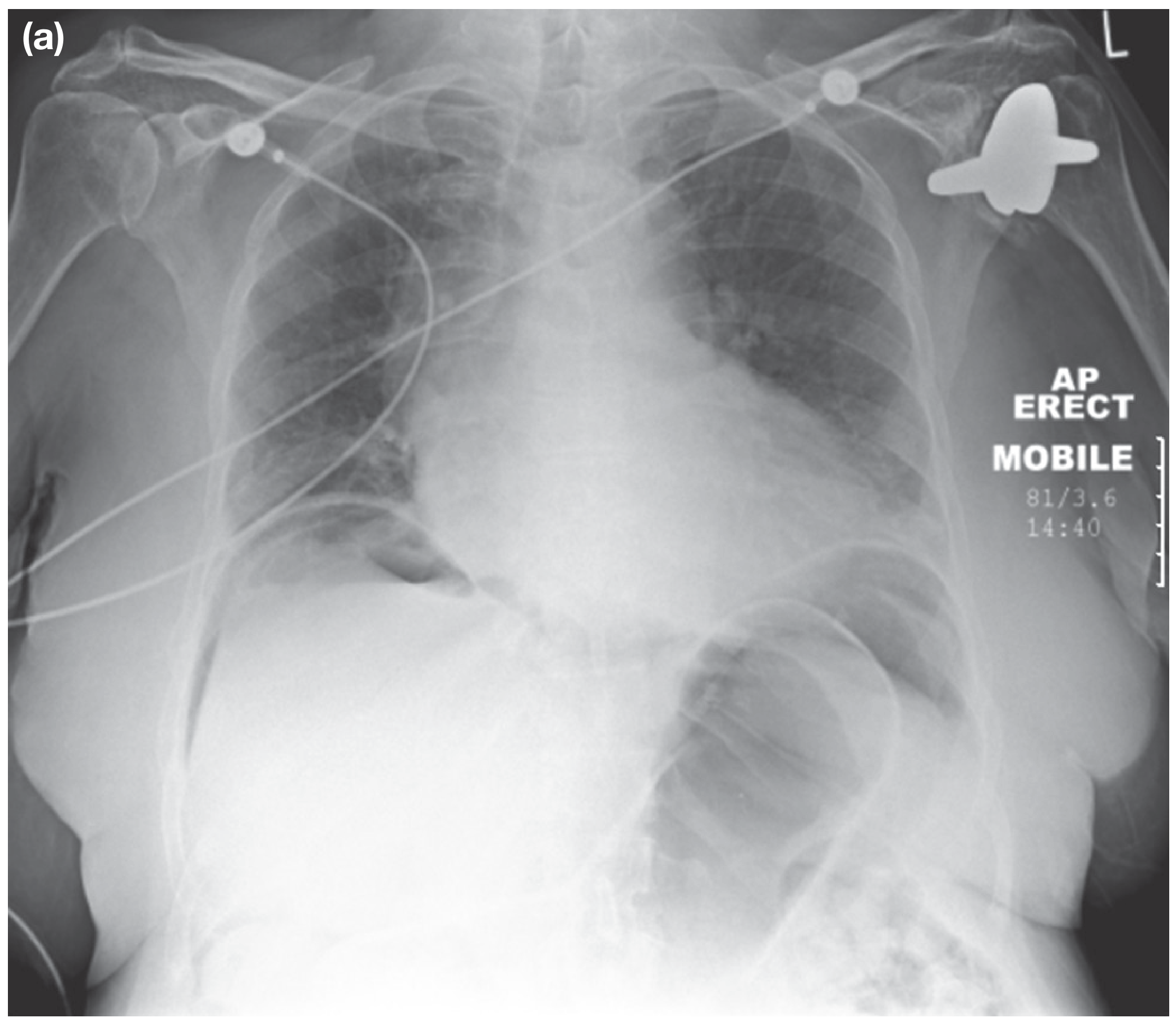
Fig: Erect CXR - note free gas (pneumoperitoneum) on the right side under the diaphragm
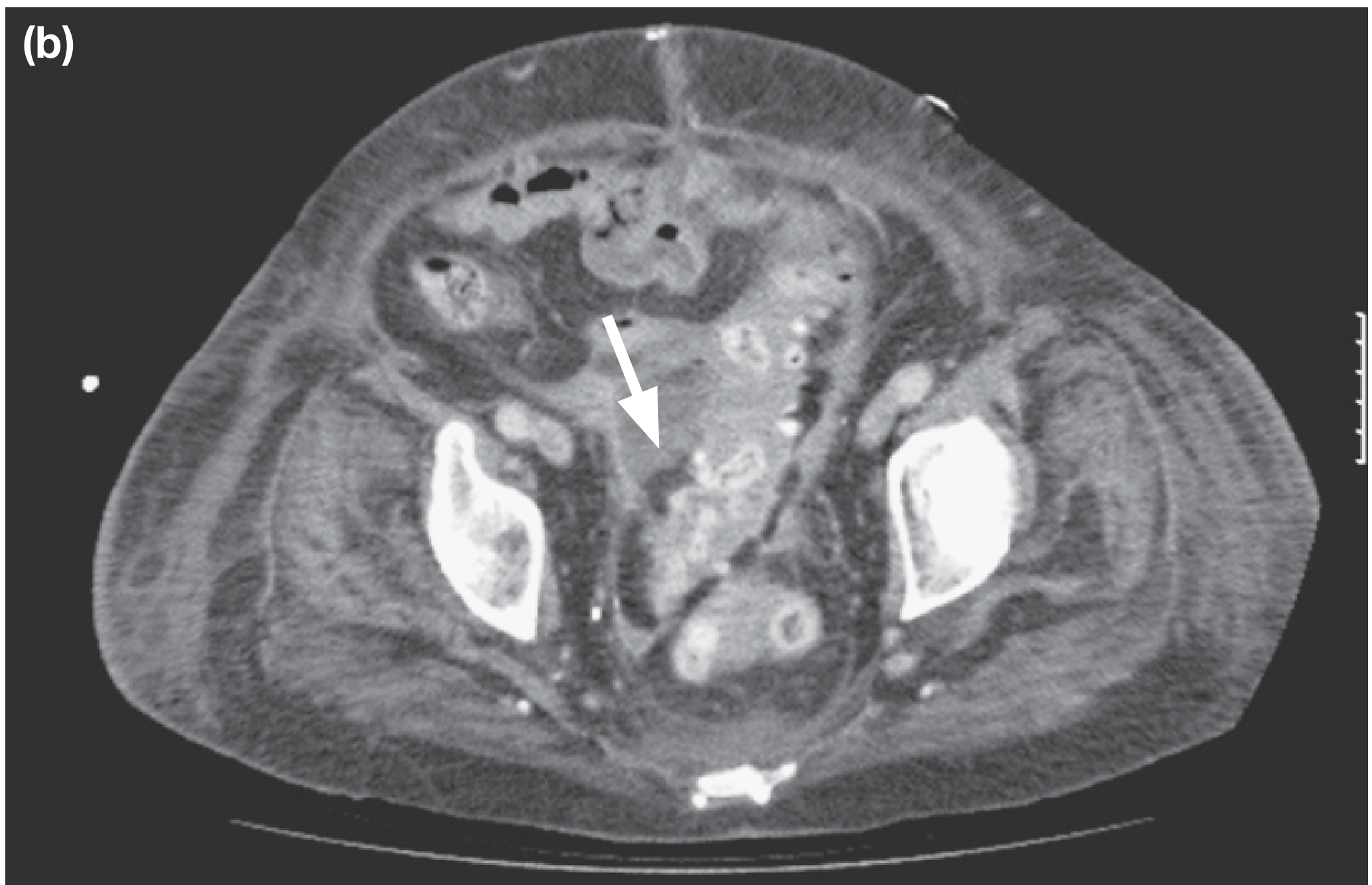
Fig: Axial CT - sigmoid diverticulosis with localised perforation (arrow)
COMPLICATIONS
Early Complications
| Complication | Notes |
|---|---|
| Septic shock | Systemic Inflammatory Response Syndrome (SIRS) - hypotension, tachycardia, fever |
| MODS | Multi-Organ Dysfunction Syndrome - progression from sepsis |
| Paralytic ileus | Generalised bowel paralysis due to peritoneal inflammation |
| Dehydration/electrolyte imbalance | Third-space fluid loss into peritoneal cavity |
| Respiratory failure | Diaphragmatic splinting, abdominal distension limiting ventilation |
| Acute renal failure | Due to hypoperfusion |
| DIC | Disseminated intravascular coagulation in sepsis |
Late Complications
| Complication | Notes |
|---|---|
| Intra-abdominal abscess | Localised collection of pus (subphrenic, pelvic, paracolic) |
| Adhesions | Fibrous bands from fibrin deposition - major cause of small bowel obstruction (years later) |
| Fistula formation | Abnormal connections between gut loops or gut-skin |
| Wound dehiscence/incisional hernia | Post-operative complications |
| Residual peritonitis | Persistent infection if inadequate source control |
| Amyloidosis | Specifically in FMF and chronic TB peritonitis |
MANAGEMENT (Summary)
Non-Surgical / Resuscitation
- IV access + resuscitation - correct fluid/electrolyte imbalance
- IV broad-spectrum antibiotics - cover Gram-negative, Gram-positive, anaerobes
- Nasogastric tube - decompress bowel
- Urinary catheter - monitor urine output
- Analgesia (IV opioids)
- Vital system support - ICU if septic shock/MODS
Surgical
- Source control - remove/exclude the cause (close perforation, resect gangrenous bowel)
- Peritoneal lavage ± drainage
- Laparoscopy (preferred) or laparotomy depending on severity and cause
HIGH-YIELD EXAM POINTS
| Fact | Detail |
|---|---|
| Most useful clinical classification | Localised vs. Diffuse |
| Most common cause overall | Secondary peritonitis from GI perforation |
| Investigation of choice | CT abdomen |
| Classic sign of diffuse peritonitis | Board-like rigidity |
| Referred pain from subdiaphragmatic irritation | Shoulder tip (C5 dermatome) |
| SBP diagnostic criterion | PMN ≥ 250 cells/mm³ in ascitic fluid |
| SBP culture positivity | Only ~40% |
| SBP first-line antibiotic | 3rd-gen cephalosporin (cefotaxime) |
| Most common TB peritonitis form | Wet/Ascitic type (90%) |
| Best test for TB peritonitis | Laparoscopy + biopsy; ADA in ascitic fluid |
| TB peritonitis ascitic fluid | Protein >25-30 g/L; lymphocytes >40%; ADA elevated |
| Signs masked in | Obese patients; immunosuppressed patients |
| FMF long-term complication | Amyloidosis |
| Pneumococcal peritonitis diarrhoea timing | 24-48 hours after onset |
| Fitz-Hugh-Curtis syndrome | Perihepatitis from transperitoneal spread of chlamydia/gonococci - violin-string adhesions on liver capsule |
Sources: Bailey & Love's Short Practice of Surgery, 28th Edition (Chapter 65); Harrison's Principles of Internal Medicine 22E
This is a shared conversation. Sign in to Orris to start your own chat.