
Give me basics idea and things to know about DCM ,RCM HCM make sure I understand I am beginner for fmge
Reading File
Now let me search the library for all three cardiomyopathies simultaneously.
Finding Sources
Finding Sources
Finding Sources
Robbins Pathology has all three — perfect for FMGE. Let me read all three sections in parallel.
Reading File
Reading File
Reading File
I have excellent content. Let me also fetch the HCM image and look for the DCM image, plus get clinical features from another source.
Reading File
Loading Image
Loading Image
Reading File
I now have everything needed to write a comprehensive FMGE-oriented guide. Let me compile the full answer.
Cardiomyopathies for FMGE: DCM, HCM & RCM
Source: Robbins & Kumar Basic Pathology, Table 9.5 + Chapter 9
The Big Picture First 🧠
A cardiomyopathy = primary disease of the heart muscle itself (not due to ischemia, valvular disease, or hypertension).
There are 3 main functional types — remember them by what goes wrong with the heart's job:
| Type | Core Problem | EF | Dysfunction |
|---|---|---|---|
| DCM | Can't squeeze → weak pump | < 40% | Systolic |
| HCM | Can't relax → stiff, outflow blocked | 50–80% (hyperdynamic) | Diastolic |
| RCM | Can't fill → wall too stiff | 25–50% | Diastolic |
Simple memory hook:
- DCM → Dilated → Does not contract → systolic failure
- HCM → Hypertrophied → Hard to fill/relax → diastolic failure
- RCM → Restricted → Rigid wall → diastolic failure
1. Dilated Cardiomyopathy (DCM)
The classic "big, floppy heart"
Pathology
- All 4 chambers dilate (especially LV)
- Wall becomes thin (despite some hypertrophy)
- Heart is enlarged up to 2–3× normal weight, looks flabby
- Mural thrombi common → risk of systemic thromboembolism
- Histo: myocyte hypertrophy + interstitial fibrosis (blue on Masson trichrome)
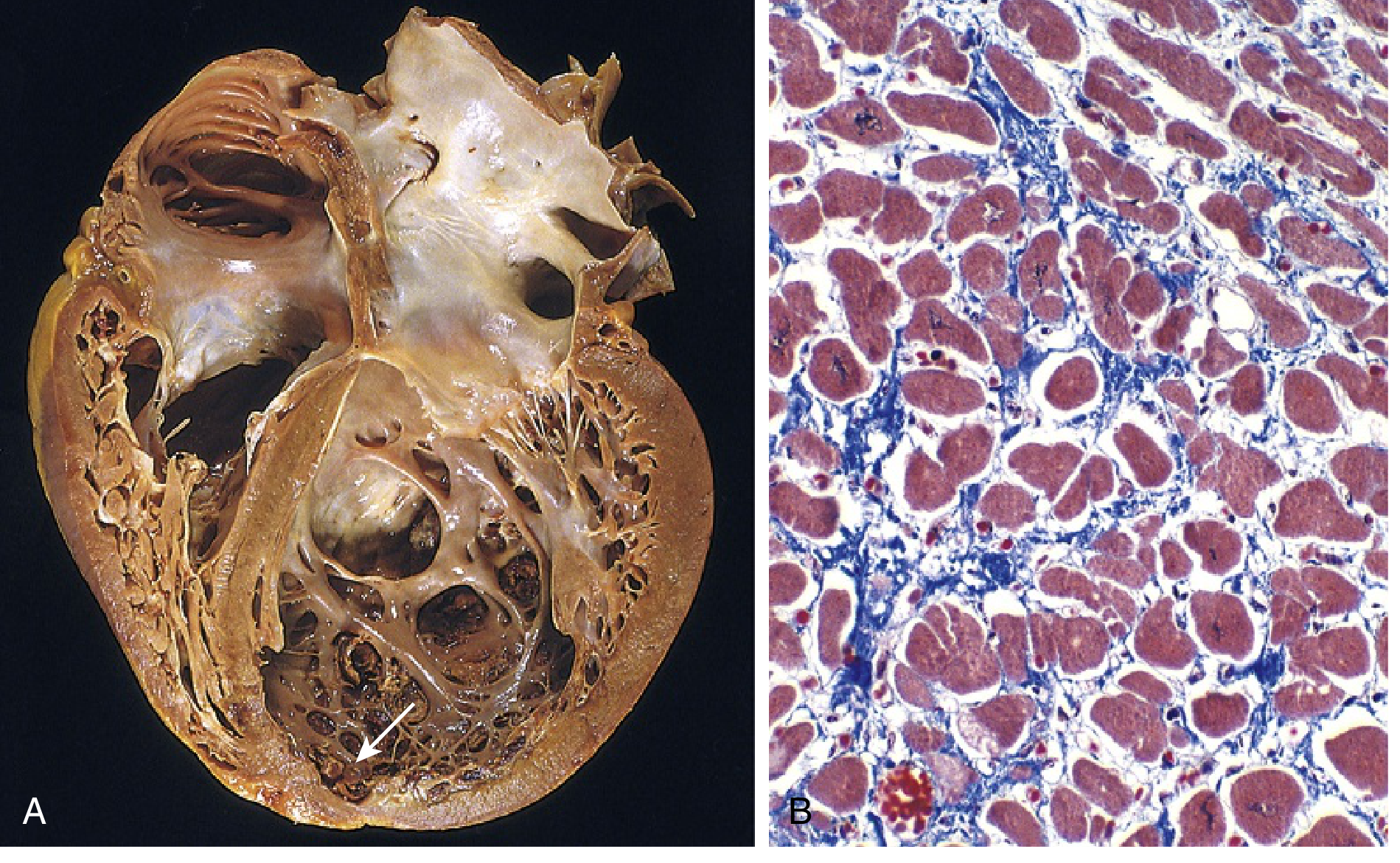
Causes (FMGE favorites — memorize)
| Category | Examples |
|---|---|
| Genetic (20–50%) | Titin mutations (most common), β-myosin heavy chain, dystrophin (X-linked) |
| Viral myocarditis | Coxsackievirus B, parvovirus B19, HHV-6 |
| Alcohol/Toxins | Alcohol (acetaldehyde toxic), doxorubicin (chemo), cobalt |
| Peripartum | Late pregnancy / weeks postpartum |
| Iron overload | Hemochromatosis, multiple transfusions |
| Others | Sarcoidosis, chronic anemia, idiopathic |
FMGE tip: Doxorubicin (adriamycin) → DCM. Peripartum cardiomyopathy → ~50% recover spontaneously.
Clinical Features
- Progressive heart failure (breathlessness, fatigue, leg swelling)
- Systolic dysfunction — EF < 40%
- S3 gallop, cardiomegaly on CXR
- Risk of arrhythmias and thromboemboli
- Treatment: ACE inhibitors, beta-blockers, diuretics, anticoagulation
2. Hypertrophic Cardiomyopathy (HCM)
The "thick, banana-shaped" heart — #1 cause of sudden death in young athletes
Pathology
- Massive myocardial hypertrophy WITHOUT dilation
- 90% asymmetric septal hypertrophy (ASH) — septum thicker than LV free wall
- LV cavity compressed → "banana-shaped" lumen
- Anterior mitral leaflet touches the septum → creates outflow tract obstruction (in ~1/3 cases) + mitral regurgitation
- Systolic anterior motion (SAM) of mitral valve — important on echo
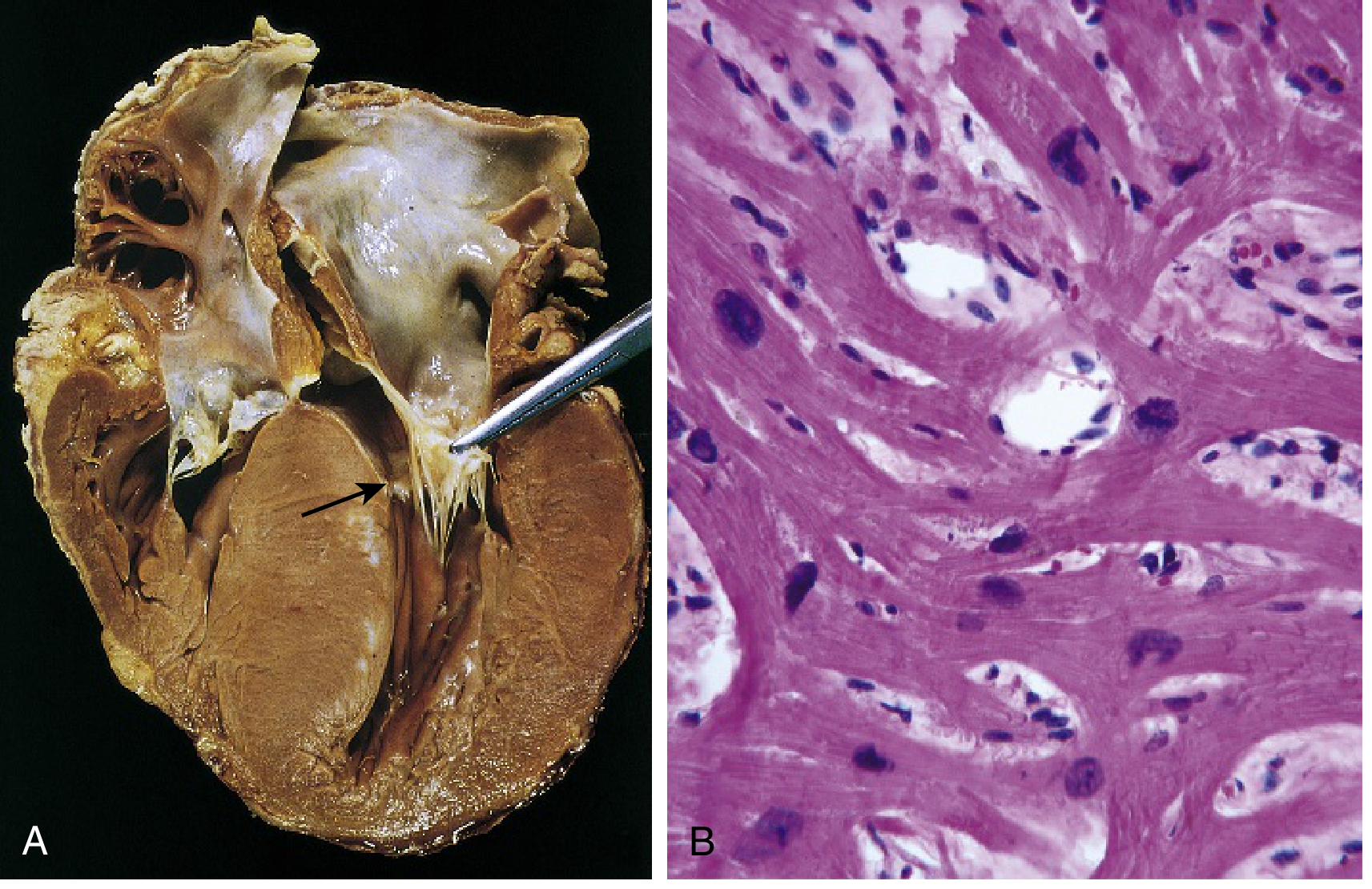
Histology (classic FMGE question):
- Myocyte disarray (haphazard arrangement) ← pathognomonic
- Myocyte hypertrophy
- Interstitial fibrosis
Cause — Almost Always Genetic
- Autosomal dominant, variable expression
- Gain-of-function mutations in sarcomeric proteins
- Most common: β-myosin heavy chain > myosin-binding protein C > troponin T
- These 3 account for 70–80% of all HCM
- Other causes: Friedreich's ataxia, storage diseases, infant of diabetic mother
Key concept: Same genes mutated as in DCM, but HCM = gain-of-function vs. DCM = loss-of-function
Clinical Features
- Diastolic dysfunction — myocardium doesn't relax after systole
- EF is actually HIGH (hypercontractile) but filling is impaired
- Exertional dyspnea + angina + harsh systolic ejection murmur (LVOT obstruction)
- Murmur increases with Valsalva and standing (decreased preload → worsens obstruction)
- Murmur decreases with squatting (increased preload → reduces obstruction)
- Sudden cardiac death — #1 cause in athletes < 35 years
- Atrial fibrillation, infective endocarditis (mitral valve)
- Treatment: Beta-blockers or calcium channel blockers (promote relaxation), avoid inotropes/vasodilators; surgery (septal myectomy) or alcohol ablation for severe cases
3. Restrictive Cardiomyopathy (RCM)
The "rigid, non-compliant" heart — hardest to fill
Pathology
- Ventricles are normal size or slightly enlarged, NOT dilated
- Both atria are typically dilated (blood can't get into stiff ventricles → backs up)
- Wall is firm/stiff
- EF can be relatively preserved but filling is severely impaired
- Histo: variable interstitial fibrosis
Causes (most important for FMGE)
| Cause | Key Fact |
|---|---|
| Amyloidosis | Most tested — Congo red stain, apple-green birefringence; transthyretin (TTR) amyloid in elderly; AL amyloid in myeloma |
| Endomyocardial fibrosis | Most common RCM worldwide; children/young adults in Africa; involves tricuspid & mitral valves |
| Loeffler endomyocarditis | Hypereosinophilia → eosinophil granules toxic to myocardium → fibrosis + mural thrombus |
| Sarcoidosis | Granulomas in myocardium |
| Radiation fibrosis | Post-radiation therapy |
| Hemochromatosis | Iron deposition (can also cause DCM) |
| Storage diseases | Mucopolysaccharides, sphingolipids |
Clinical Features
- Symptoms of heart failure with preserved EF
- JVP elevated with Kussmaul's sign (JVP rises on inspiration)
- Must be distinguished from constrictive pericarditis (clinically very similar — key differentiator is endomyocardial biopsy)
- Treatment: treat underlying cause; diuretics for congestion; anticoagulation in some cases
Master Comparison Table (FMGE Rapid Revision)
| Feature | DCM | HCM | RCM |
|---|---|---|---|
| Heart size | Big & dilated | Big & thick (no dilation) | Normal or slightly enlarged |
| LV wall | Thin (dilated out) | Very thick | Normal/firm |
| Dysfunction | Systolic | Diastolic | Diastolic |
| EF | ↓↓ (<40%) | ↑ or normal (50–80%) | ↓ or normal (25–50%) |
| Atrial dilation | Yes (all chambers) | LA only | Both atria markedly dilated |
| Histology | Hypertrophy + fibrosis | Myocyte disarray + fibrosis | Interstitial fibrosis / specific infiltrate |
| Genetics | Loss-of-function (titin, dystrophin) | Gain-of-function (β-MHC) | Usually NOT genetic (exceptions: TTR amyloid) |
| Key cause | Alcohol, viral, doxorubicin | Genetic (autosomal dominant) | Amyloidosis, endomyocardial fibrosis |
| Sudden death? | Yes | YES — #1 in young athletes | Less common |
| Mural thrombus | Common (LV apex) | Less common | In Loeffler's |
| Key FMGE buzz | Peripartum, doxorubicin | ASH, banana-shaped, SAM | Congo red, Loeffler's eosinophilia |
Quick Memory Mnemonics
DCM causes → "A PIIVD"
- Alcohol, Peripartum, Idiopathic, Iron (hemochromatosis), Virus, Doxorubicin
HCM genes → "β-MHC BT"
- β-myosin heavy chain, myosin-Binding protein C, Troponin T
RCM causes → "SAFE"
- Sarcoidosis, Amyloidosis, Fibrosis (radiation/endomyocardial), Eosinophilia (Loeffler's)
— Robbins & Kumar Basic Pathology, pp. 371–375
This is a shared conversation. Sign in to Orris to start your own chat.