
Hey how can you be helpful for me
Hey! I'm Orris, and here's what I can help you with:
Research & Knowledge
- Answer questions across any domain - science, history, math, technology, business, etc.
- Search the web for current information and news
- Find and summarize peer-reviewed medical/scientific literature (PubMed)
Medical & Clinical
- Explain diagnoses, medications, symptoms, procedures, anatomy, pharmacology
- Search an indexed medical textbook library for authoritative clinical content
- Retrieve medical images, diagrams, and charts from textbooks
Document & File Creation
- Create Word documents (.docx), PowerPoint presentations (.pptx), Excel spreadsheets (.xlsx), and PDFs
- Read, edit, or extract content from uploaded files
Data & Code
- Write and run code (Python, JavaScript, shell scripts, etc.)
- Analyze data, generate charts, perform calculations
- Process CSV/Excel files
Specialized Topics
- Indian taxation (direct taxes, GST, CA/CMA exam prep)
- Medical literature reviews with citations
Creative & Writing
- Generate images, posters, diagrams, and visual content
- Write reports, summaries, emails, essays, and more
Just ask naturally - whether it's a quick factual question, a deep research task, or a file you need built, I'll figure out the right approach. What would you like to work on?
Explain neurotransmitters
Reading File
Searching sources...
Finding Sources
Finding Sources
Good results. Let me now read the most relevant sections - Stahl's Psychopharmacology (the best source for neurotransmitters) and Neuroscience: Exploring the Brain, along with Costanzo Physiology.
Reading File
Reading File
Reading File
Excellent content. Let me read a bit more from Neuroscience: Exploring the Brain on synthesis, release, and receptors, and also get the neuroanatomy snippet about CNS transmitters.
Reading File
Reading File
I now have very rich content from multiple authoritative textbooks. Let me also fetch the synapse diagram image to include visually.
Loading Image
Loading Image
I now have everything needed for a thorough, well-illustrated answer. Here it is:
Neurotransmitters
What Is a Neurotransmitter?
A neurotransmitter is a chemical messenger released by a neuron to communicate with another neuron, muscle cell, or gland. Three formal criteria must be met for a substance to be officially classified as a neurotransmitter:
- It must be synthesized in the presynaptic cell
- It must be released by the presynaptic cell upon stimulation
- When applied exogenously to the postsynaptic membrane at physiologic concentration, the response must mimic the in vivo response
- Costanzo Physiology, 7th Ed., p. 38
How Neurotransmission Works
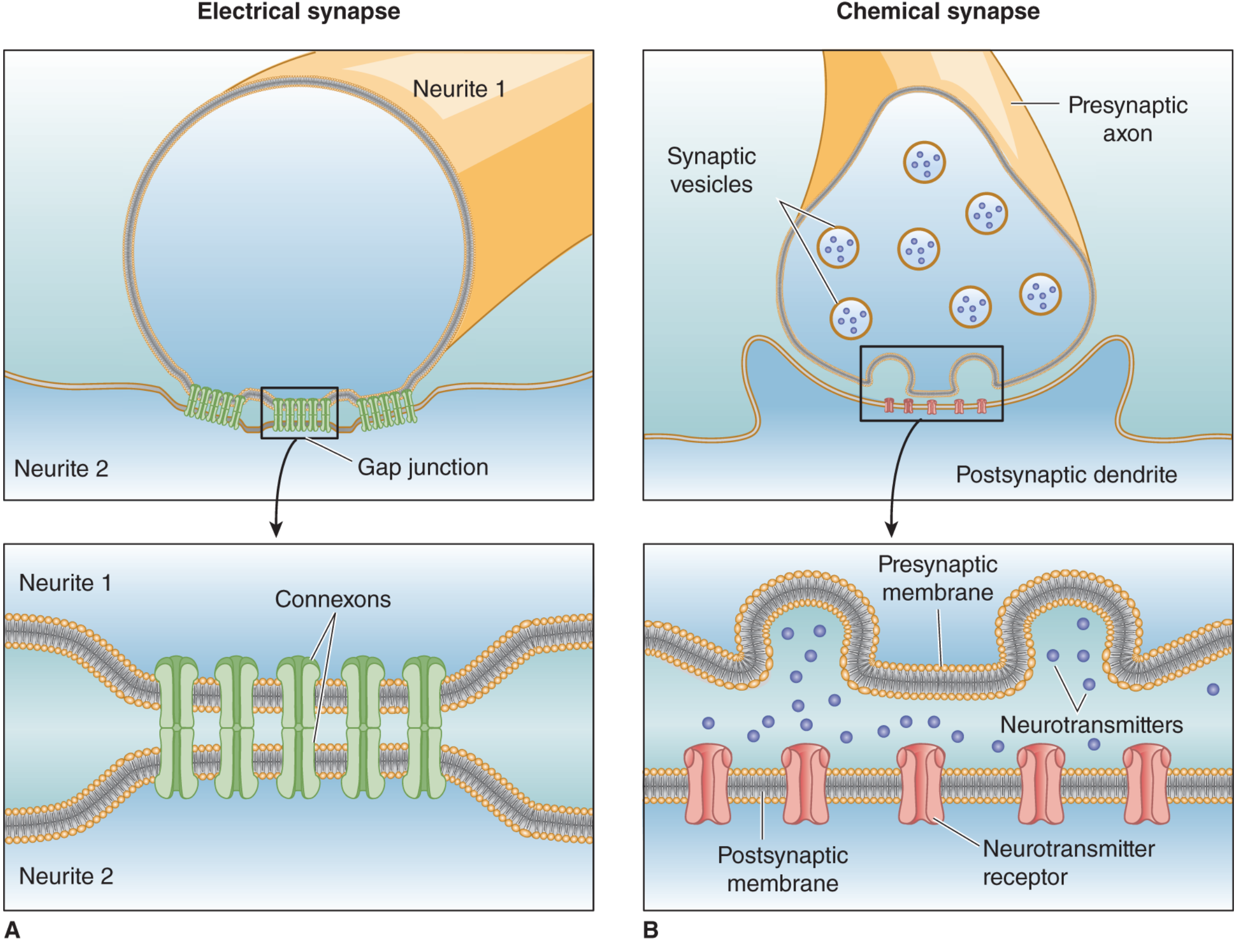
Communication between neurons at synapses is chemical, not electrical. An electrical impulse (action potential) arriving at the presynaptic axon terminal is converted into a chemical signal - a process called excitation-secretion coupling. The steps are:
- Action potential arrives at the axon terminal
- Ca²+ influx triggers fusion of synaptic vesicles with the presynaptic membrane (via SNARE proteins)
- Neurotransmitter is released into the synaptic cleft by exocytosis
- Neurotransmitter diffuses across the cleft (~20 nm wide)
- It binds to receptors on the postsynaptic membrane
- The postsynaptic cell either fires or is inhibited
- The neurotransmitter is then removed from the cleft
There are an estimated 1 trillion chemically neurotransmitting synapses in the human brain.
- Stahl's Essential Psychopharmacology, p. 20
- Neuroscience: Exploring the Brain, 5th Ed., p. 392
Types of Neurotransmitter Receptors
There are two main receptor classes:
| Receptor Type | Mechanism | Speed | Examples |
|---|---|---|---|
| Ionotropic (ligand-gated ion channels) | Directly opens ion channel | Fast (milliseconds) | Nicotinic ACh receptor, GABA-A, NMDA |
| Metabotropic (G protein-coupled receptors) | Activates second messenger cascade | Slow (seconds to minutes) | Dopamine receptors, Muscarinic ACh, Serotonin (5-HT1) |
- Neuroscience: Exploring the Brain, 5th Ed.
Classification of Neurotransmitters
Neurotransmitters fall into four major categories:
1. Choline Esters
Acetylcholine (ACh) - the only neurotransmitter at the neuromuscular junction; used at all autonomic preganglionic neurons and parasympathetic postganglionic neurons. Synthesized from choline + acetyl-CoA (via choline acetyltransferase); degraded by acetylcholinesterase (AChE).
2. Biogenic Amines
All share a common biosynthetic pathway from amino acid precursors:
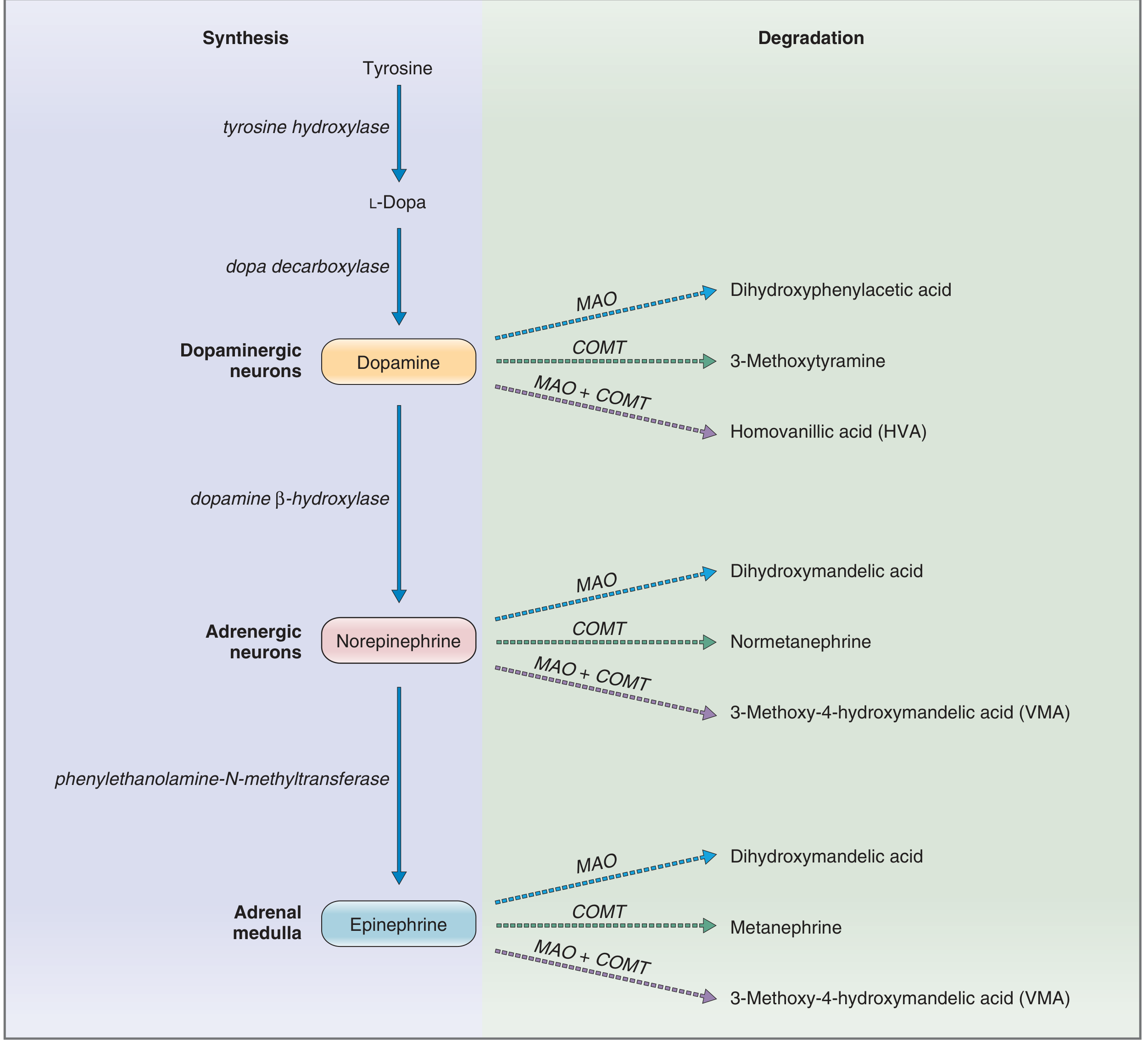
| Neurotransmitter | Precursor | Key Enzyme | Degradation | Main Roles |
|---|---|---|---|---|
| Dopamine | Tyrosine | Tyrosine hydroxylase + DOPA decarboxylase | MAO, COMT | Reward, movement, motivation |
| Norepinephrine | Dopamine | + Dopamine-β-hydroxylase | MAO, COMT | Arousal, stress, fight-or-flight |
| Epinephrine | Norepinephrine | + PNMT | MAO, COMT | Mainly adrenal medulla |
| Serotonin (5-HT) | Tryptophan | Tryptophan hydroxylase | MAO → 5-HIAA | Mood, sleep, appetite |
| Histamine | Histidine | Histidine decarboxylase | MAO | Wakefulness, allergic response |
3. Amino Acids
- Glutamate - the most common excitatory neurotransmitter in the CNS. Activates AMPA, NMDA, and kainate receptors.
- GABA (γ-aminobutyric acid) - the principal inhibitory neurotransmitter in the brain. Acts on GABA-A (ionotropic) and GABA-B (metabotropic) receptors.
- Glycine - inhibitory, especially in the spinal cord and brainstem.
4. Neuropeptides
Larger molecules including endorphins, enkephalins, substance P, oxytocin, vasopressin, somatostatin, and many more. These often act as neuromodulators - they don't just excite or inhibit but modulate how neurons respond to other signals. The brain even makes its own opioids (β-endorphin) and its own cannabinoids (endocannabinoids).
- Costanzo Physiology, 7th Ed., p. 38
- Stahl's Essential Psychopharmacology, p. 21
Neurotransmitter Removal from the Synapse
Once released, the transmitter must be cleared from the cleft to terminate the signal. Three mechanisms:
- Reuptake - transporters (e.g., SERT for serotonin, DAT for dopamine) pull the transmitter back into the presynaptic terminal for recycling
- Enzymatic degradation - e.g., AChE breaks down ACh; MAO degrades catecholamines and serotonin
- Diffusion - the transmitter simply drifts away from the cleft (less common)
The 6 Key Neurotransmitters Targeted by Drugs
According to Stahl's Essential Psychopharmacology, the six systems most targeted by psychiatric and neurologic drugs are:
| Neurotransmitter | Drug Example | Condition |
|---|---|---|
| Serotonin | SSRIs (fluoxetine) | Depression, anxiety |
| Norepinephrine | SNRIs (venlafaxine) | Depression, ADHD |
| Dopamine | Antipsychotics (haloperidol) | Schizophrenia, Parkinson's |
| Acetylcholine | Donepezil (AChE inhibitor) | Alzheimer's disease |
| Glutamate | Memantine (NMDA antagonist) | Alzheimer's disease |
| GABA | Benzodiazepines (diazepam) | Anxiety, epilepsy |
Volume Transmission vs. Classic Transmission
Beyond the classic one-neuron-to-one-neuron synapse, neurotransmitters can also act via volume (paracrine) transmission - diffusing away from the synapse to affect nearby neurons not directly connected. This is how many neuromodulators work and explains why a single neuron's activity can influence widespread circuits.
- Stahl's Essential Psychopharmacology, p. 20
Summary: Neurotransmitters are the chemical language of the nervous system. They are synthesized, stored in vesicles, released into synaptic clefts, act on specific receptors, and are then rapidly cleared. The balance of excitatory (glutamate) and inhibitory (GABA) signaling, modulated by monoamines and neuropeptides, underlies virtually all brain function - and most neuropsychiatric drugs work by altering this signaling.
This is a shared conversation. Sign in to Orris to start your own chat.