
Principlesof sclera buckling with complications
Reading File
Finding Sources
Finding Sources
The primary source is Kanski's Clinical Ophthalmology, block 5. Let me read the dedicated sections on principles and complications.
Reading File
Searching Images
scleral buckling retinal detachment surgery
Reading File
Reading File
Loading Image
Now I have all the content I need from lines 174–299. Let me also fetch the key diagram images to include in the answer.
Loading Image
Loading Image
I now have comprehensive content from Kanski's Clinical Ophthalmology. Let me compile the full answer.
Scleral Buckling: Principles and Complications
Kanski's Clinical Ophthalmology: A Systematic Approach, 10th ed.
Definition & Core Concept
Scleral buckling (SB) is an external (conventional) approach to retinal detachment (RD) surgery, in contrast to the internal approach of pars plana vitrectomy (PPV). An explant — a piece of soft or hard silicone — is sutured onto the outer sclera, creating an inward indentation called the buckle.
Dual Purpose
- Close retinal breaks by apposing the RPE (retinal pigment epithelium) to the detached sensory retina
- Reduce dynamic vitreoretinal traction at sites of local vitreoretinal adhesion
Scleral buckling is always indicated for retinal detachment secondary to post-traumatic dialysis.
Explant Specifications
| Feature | Detail |
|---|---|
| Material | Soft or hard silicone |
| Ideal coverage | ~2 mm of buckle surrounding the entire break |
| Anterior extent | Must cover the vitreous base anterior to the tear (prevents re-opening and anterior SRF leakage) |
| Size estimation | Break dimensions assessed by comparison with the optic disc diameter |
Buckle Configurations
- Radial — perpendicular to the limbus; good for U-tears
- Segmental — covers a localised area of breaks
- Circumferential — parallel to the limbus; spans multiple break locations
- Encircling — a 360° band around the globe
Configuration chosen depends on the size, shape, and number of retinal breaks.
Surgical Technique
- Peritomy — conjunctival incision for access
- Break localisation — breaks are identified and marked externally (Fig. 16.30A)
- Cryotherapy — applied around the break to create chorioretinal adhesion
- Explant placement — sutured to the sclera using mattress sutures; position of buckle checked relative to break (Fig. 16.30B–D)
- Verification — buckle height and position confirmed intraoperatively
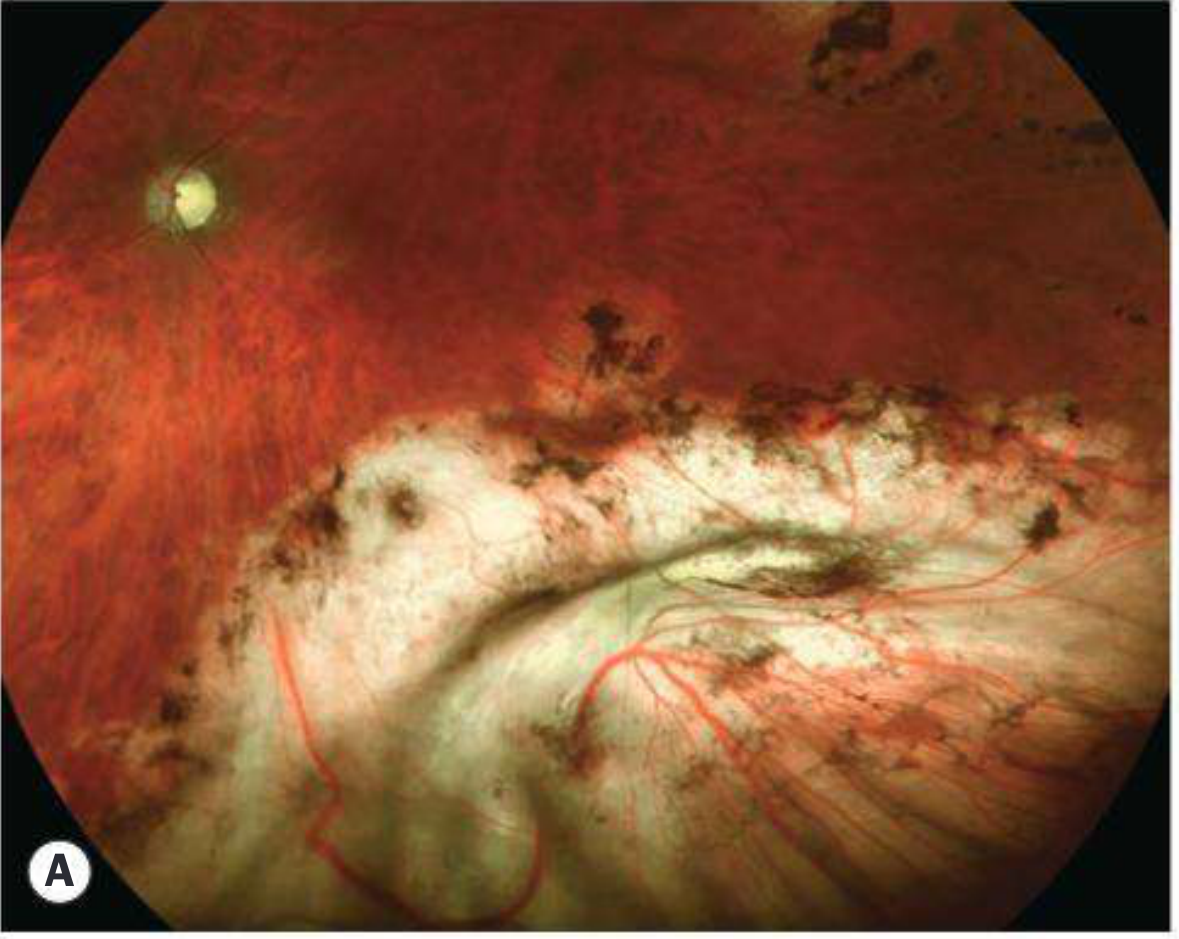
Drainage of Subretinal Fluid (SRF)
SRF can be drained externally through the sclera (the D-ACE sequence: Drainage → Air → Cryotherapy → Explant).
Indications for SRF drainage:
- Bullous (high) detachment where the explant cannot adequately close the break without drainage
- Long-standing RD where SRF is viscous and slow to reabsorb
- Inferior breaks
- Elderly patients (slow reabsorption)
- Situations where postoperative position cannot be controlled (e.g., very young children)
Avoiding SRF drainage (non-drain technique) is preferred when possible as drainage carries its own risks (see below).
Complications
Intraoperative Complications
| Complication | Mechanism / Notes |
|---|---|
| Retinal incarceration | Retina gets sucked into the drainage sclerostomy site — a visually devastating complication |
| Subretinal haemorrhage | Choroidal vessel laceration during drainage; can be massive |
| Vitreous haemorrhage | From choroidal or retinal vessel trauma |
| Iatrogenic retinal break | From scleral suture perforation |
Postoperative Complications
Buckle/Explant-related:
- Buckle extrusion — implant erodes through conjunctiva and becomes exposed (Fig. 16.32A — shows visible buckle material under conjunctiva)
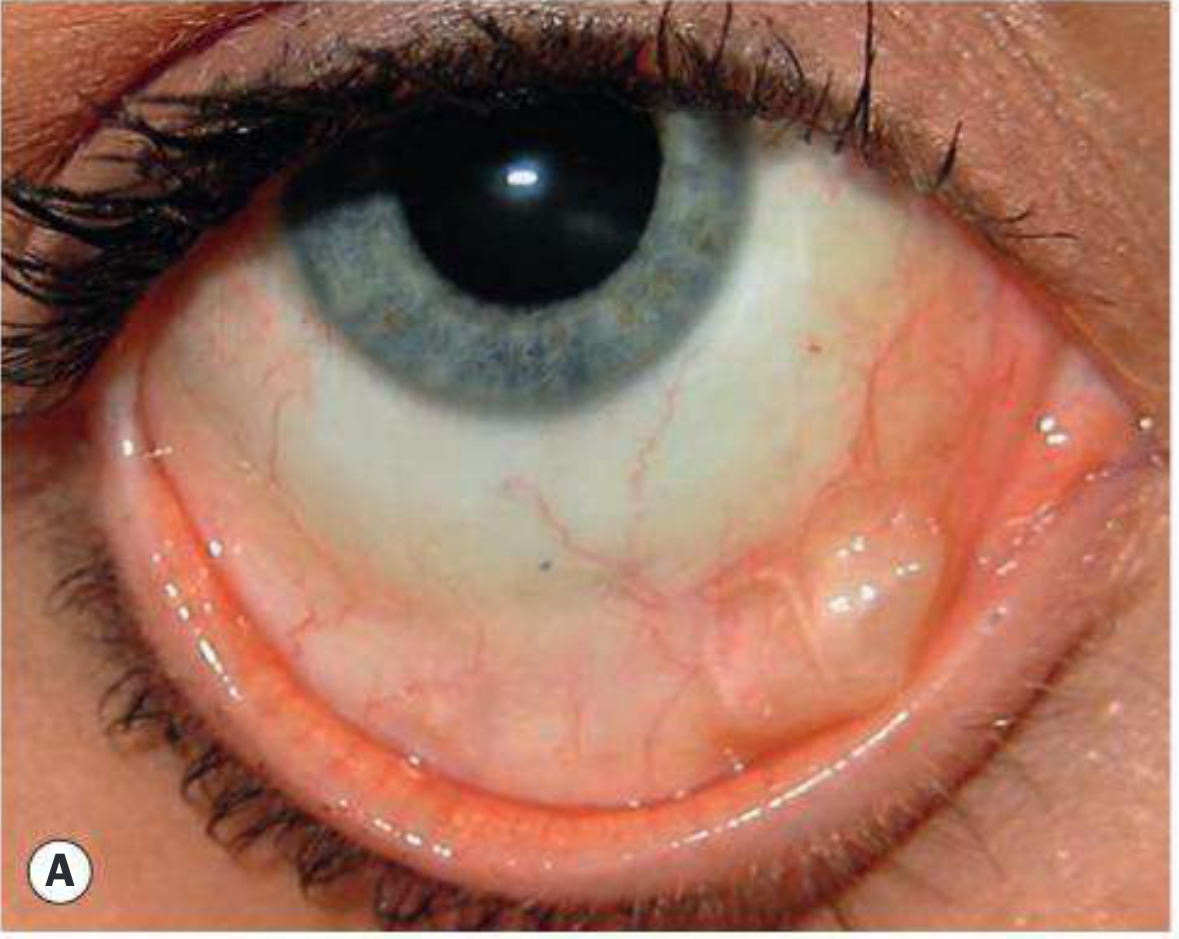
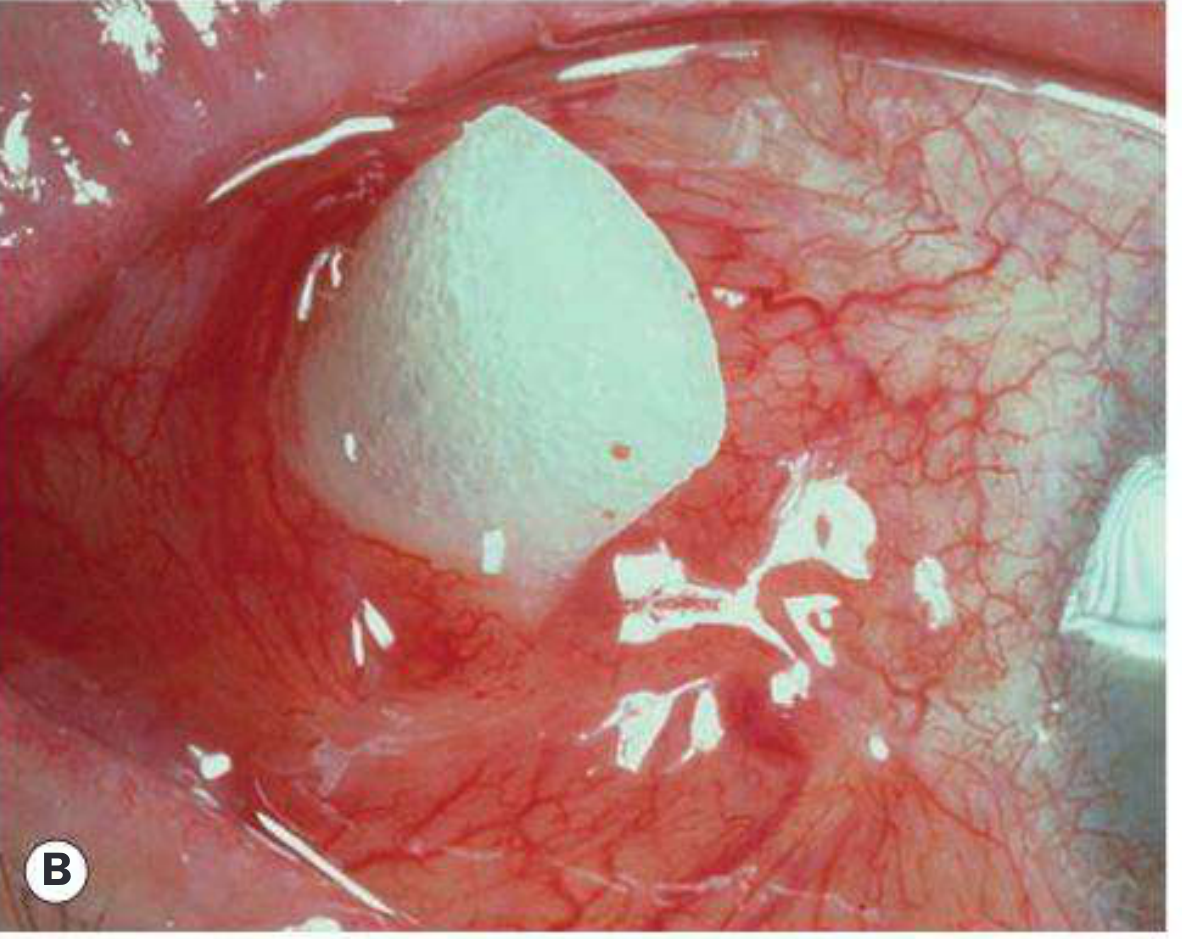
- Buckle infection — requires explant removal
- Buckle migration — changes position over time
Ocular Motility:
- Diplopia / ocular motility disturbance — from extraocular muscle trauma, adhesion, or mechanical effect of an encircling band
- Induced myopia — axial length increase from the encircling band compressing the globe
Anterior Segment:
- Anterior segment ischaemia — from tightening of encircling band compromising anterior ciliary arteries; features: corneal oedema, anterior uveitis, iris ischaemia
- Raised intraocular pressure — angle closure or choroidal effusion
- Choroidal effusion — from vortex vein compression by the buckle
Posterior Segment:
- Macular pucker (epiretinal membrane) — postoperative fibrocellular proliferation
- Cystoid macular oedema — post-surgical inflammation
- "Fish-mouthing" — large superior equatorial U-tear widens following buckling in a bullous RD; the flaps gape open rather than close, requiring further intervention
Surgical Failure
| Cause | Notes |
|---|---|
| Inadequate buckle size | Break not fully supported |
| Incorrect positioning | Explant not aligned under the break |
| Inadequate buckle height | Can treat with SRF drainage or intravitreal gas injection; PPV may be preferred |
| Proliferative vitreoretinopathy (PVR) | Most common cause of late failure — tractional forces re-open old breaks and create new ones; typically presents weeks postop with re-detachment |
| Re-opening of break (no PVR) | Inadequate cryotherapy or buckling, or reduction of buckle height over time / after elective removal |
Key teaching point — The three commonest causes of failed retinal detachment surgery are:
- Proliferative vitreoretinopathy (PVR)
- Failure to close all breaks
- Development of new breaks
Contraindications to Scleral Buckling
PPV is preferred over scleral buckling when breaks are unlikely to be closed by buckling alone:
- Giant tears (≥ 90° circumference)
- Large posterior breaks
- Established PVR
— Kanski's Clinical Ophthalmology: A Systematic Approach, 10th Edition, Chapter 16
More elaborate
Finding Sources
Finding Sources
Finding Sources
Reading File
Reading File
Diabetic retinopathy
Reading File
Finding Sources
Finding Sources
Diabetic retinopathy clinical research , net DR CR NET
I want to make sure I understand exactly what you need.
Asking for Preferences
What specific clinical research topic on diabetic retinopathy are you asking about?
This is a shared conversation. Sign in to Orris to start your own chat.