
traumatic injury big toe and metatarsal while playing football management
Reading File
Searching sources...
Finding Sources
Finding Sources
Searching PubMed
metatarsal fracture football management
Finding Sources
Finding Sources
Finding Sources
Reading File
Reading File
Reading File
Reading File
Reading File
Reading File
Finding Sources
Finding Sources
Reading File
Reading File
Loading Image
I now have comprehensive information from multiple authoritative textbooks. Here is the full management guide:
Traumatic Big Toe and Metatarsal Injuries in Football
Football produces a specific set of forefoot injuries - most commonly "turf toe," phalangeal fractures, and fifth metatarsal (Jones) fractures. Each requires a distinct approach.
1. Turf Toe (First MTP Joint Sprain)
Mechanism: Axial load applied to a dorsiflexed forefoot - the classic football injury, originally described on artificial turf. The plantar capsular ligament and plantar plate are sprained or torn.
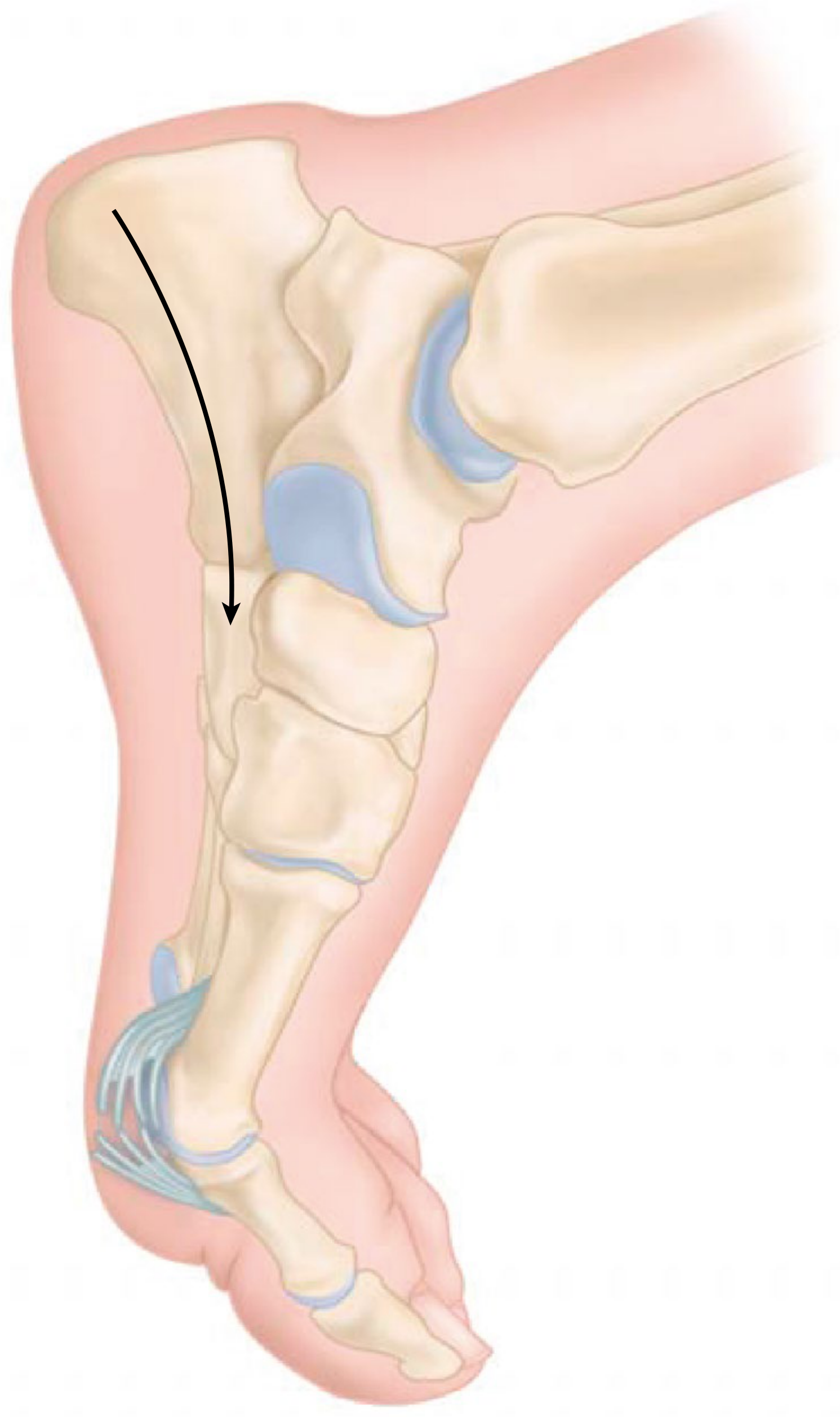
Grading (Campbell's Operative Orthopaedics, 15th Ed 2026)
| Grade | Pathology | Signs | Function |
|---|---|---|---|
| 1 | Minimal stretch of plantar plate | Plantar/medial tenderness, no ecchymosis, minimal ROM restriction | Near normal |
| 2 | Partial tear of plantar plate | Swelling, ecchymosis, restricted ROM | Walks with a limp |
| 3 | Complete plantar plate tear ± sesamoid fracture or bipartite sesamoid diastasis | Severe swelling/ecchymosis | Cannot bear weight |
Imaging
- Plain X-ray: may show avulsion fracture of proximal phalanx, impacted metatarsal fracture, or sesamoid fracture. Check for proximal sesamoid migration (compare with contralateral foot).
- Fluoroscopic stress views: lack of sesamoid migration on dorsiflexion suggests plantar plate rupture.
- MRI: gold standard to confirm plantar plate disruption and cartilage status.
Management
Grade 1 & 2 (non-operative):
- RICE (rest, ice, compression, elevation) + NSAIDs
- Taping and buddy strapping to limit dorsiflexion
- Return to sport in a reinforced shoe with a rigid forefoot plate (limits MTP dorsiflexion)
- Grade 2 may need 2-3 weeks off sport
Grade 3 (surgical - Technique 93.17, Anderson):
Indications: complete plantar plate tear, sesamoid fracture with diastasis, failed conservative treatment
- Medial + plantar-lateral incisions for full plantar plate access
- Protect plantar-medial digital nerve; repair plantar plate with the toe in 15 degrees of plantarflexion
- If tissue insufficient: suture anchors or bone tunnels; abductor hallucis transfer if large defect
- Sesamoid fracture may require partial or complete sesamoidectomy
Post-op rehab:
- Non-weight bearing with toe in 5-10° plantarflexion for 4 weeks
- Weight bearing in a boot from week 4; careful joint mobilization avoiding excessive dorsiflexion
- Rigid carbon plate shoe at ~8 weeks
- Full recovery takes 6-12 months
Prognosis: 50% of patients report some residual pain/stiffness. Most elite athletes return to full activity. - Campbell's Operative Orthopaedics, 15th Ed 2026
2. Phalangeal Fractures (Big Toe / Great Toe)
Mechanism: Stubbing the hallux, direct crush, or axial load.
Initial Assessment
- X-ray is mandatory for the great toe (unlike lesser toes), especially if significant injury, suspected foreign body, or open fracture.
- Examine for nail bed involvement - nail bed bleeding around a displaced distal phalangeal fracture = open fracture (Seymour fracture).
Management
Most phalangeal fractures - conservative:
- Buddy taping to the adjacent toe
- Hard-soled shoe or post-op shoe
- Protected weight bearing as tolerated
Open/nail bed involvement (Seymour fracture):
- Formal debridement and irrigation
- Short course of antibiotics
- Reduce the physeal fracture with or without K-wire fixation (treat as open fracture) - Campbell's, 15th Ed 2026
Operative indications (ORIF):
- Displaced intra-articular fracture at the MTP or IP joint of the great toe
- Technique: 0.045-inch K-wires or mini-fragment screws; pins bent and left subcutaneous, removed at 3-4 weeks
- Protected weight bearing begins once soft-tissue healing permits, no cast required
Phalangeal dislocations:
- Usually dorsal; reduce by longitudinal traction
- After reduction: buddy taping and early motion
- Irreducible dislocations require urgent open reduction
3. Fifth Metatarsal Fractures (Jones vs. Pseudo-Jones)
Three fracture patterns are distinguished by their position relative to the 4th-5th metatarsal articulation:
| Type | Location | Also Called | Healing |
|---|---|---|---|
| Tuberosity avulsion | Proximal to joint | Pseudo-Jones | Generally heals well |
| Jones fracture | Metaphyseal-diaphyseal junction | True Jones | Prone to nonunion |
| Diaphyseal stress | Distal to Jones zone | Dancer's fracture | Variable |
Management
Pseudo-Jones (tuberosity avulsion):
- Walking cast/boot + analgesia, weight bearing as tolerated
- Orthopedic follow-up; generally heals without surgery
True Jones fracture - non-athlete or non-displaced:
- Non-weight bearing in cast for 6-8 weeks
- Risk of nonunion with conservative treatment is significant
True Jones fracture - athlete (competitive footballer):
- Most orthopedic surgeons advocate early surgical fixation to allow faster return to sport and prevent refracture
- Intramedullary screw fixation (cannulated medullary screw)
- Post-op: well-padded short leg non-walking cast; weight bearing begins at 2 weeks; return to competitive sport at 10-12 weeks when healed clinically and radiographically
- Nonunion may require inlay bone graft + intramedullary screw (Torg technique) - Tintinalli's Emergency Medicine; Campbell's, 15th Ed 2026
Distal fifth metatarsal (spiral/dancer's fracture):
- Even displaced fractures can be managed conservatively (cast immobilization or symptomatic bandaging with full weight bearing) with good long-term outcomes
- Rare painful nonunions may need ORIF with bone grafting
4. Acute Initial Management (All Forefoot Injuries)
Regardless of exact injury, the immediate on-field / ED approach is:
- Stop play - remove athlete from field
- RICE: rest, ice (20 min on/off), compression bandage, elevate foot
- Analgesia: NSAIDs (e.g., ibuprofen 400-600 mg TDS with food) ± paracetamol
- Imaging: weight-bearing AP, lateral, and oblique X-rays of the foot
- Assess for Lisfranc injury with proximal first-fourth metatarsal fractures (don't miss this - needs urgent orthopedic input)
- Splinting: posterior plaster slab for displaced/unstable fractures pending definitive management
- Orthopedic referral: within 2-3 days for all metatarsal fractures; urgent for open fractures or suspected Lisfranc
Return to Sport Summary
| Injury | Conservative | Surgical |
|---|---|---|
| Turf toe Grade 1 | Days to 1-2 weeks | - |
| Turf toe Grade 2 | 2-6 weeks | - |
| Turf toe Grade 3 | Fails conservative | 6-12 months post-op |
| Phalangeal fracture | 3-6 weeks | 4-6 weeks |
| Pseudo-Jones | 4-6 weeks | - |
| Jones fracture (athlete) | 6-8 weeks + | 10-12 weeks post-op |
Sources:
- Campbell's Operative Orthopaedics, 15th Ed 2026 - primary surgical reference
- Tintinalli's Emergency Medicine, 9th Ed - acute ED management
- Goldman-Cecil Medicine - turf toe conservative management

Screenshot 2026-06-06 113920.png
rule out fissure
This is a lateral view X-ray of the left foot (marked "L"), dated 6/6/2026 - today's study for this football player.
Radiological Assessment - Ruling Out Fissure/Fracture:
What I Can See on This Lateral View
Bones visible and assessed:
- Calcaneus - cortex intact, no visible fracture line, trabecular pattern appears normal
- Talus - no obvious lucency or cortical break
- Navicular - appears intact
- Cuboid - no obvious abnormality
- Cuneiforms - difficult to fully separate on lateral, no obvious lesion
- Metatarsal shafts - overlapping on lateral view but no gross angulation or displaced fracture visible
- Phalanges - no obvious fracture displacement at the toe tips
Regarding Fissure Fracture at the Big Toe / Metatarsal
On this lateral projection:
- The first metatarsal is the most dorsal long metatarsal visible - no clear fissure/fracture line is seen along its shaft or base
- The first MTP joint area (where turf toe occurs) is visible - no obvious joint space disruption or avulsion fragment is clearly identified on this single view
- No acute cortical break is visible on this lateral
However - important limitations:
- A lateral view alone is insufficient to rule out a fissure fracture of the metatarsals or phalanges. The bones overlap extensively on lateral projection.
- The AP (anteroposterior) and oblique views are the primary views for metatarsal and phalangeal fractures - these are thumbnailed in the PACS viewer (FOOT AP, FOOT OBLIQUE) and need to be reviewed.
- A hairline/fissure fracture can be completely invisible on lateral view and only apparent on AP or oblique.
Recommendation
Cannot rule out a fissure fracture from this lateral view alone.
- Review the AP and oblique views already present in this study (visible as thumbnails in the PACS viewer)
- If plain X-rays are negative but clinical suspicion remains high (point tenderness, significant swelling, inability to bear weight), MRI is the gold standard for occult fissure fractures - detects bone marrow edema before a fracture line is visible on X-ray
- CT is an alternative if MRI is unavailable, particularly useful at the Jones fracture zone
Please share the AP and oblique views for a more complete assessment.
no fracture how to manage
X-rays are clear - no fracture. Given the football mechanism (big toe + metatarsal area injury), this is most likely a soft tissue injury: turf toe (MTP sprain), ligament sprain, or contusion.
Searching sources...
Finding Sources
Finding Sources
Finding Sources
Finding Sources
Reading File
Reading File
Good - X-rays clear, soft tissue injury confirmed. Here is the complete management:
Management: No Fracture - Soft Tissue Injury (Turf Toe / MTP Sprain)
With normal X-rays following a football big toe + metatarsal mechanism, the diagnosis is a first MTP joint sprain (Turf Toe), graded by clinical findings:
Step 1 - Confirm the Grade Clinically
| Feature | Grade 1 | Grade 2 | Grade 3 |
|---|---|---|---|
| Pathology | Plantar plate stretch | Partial plantar plate tear | Complete tear |
| Tenderness | Plantar/medial | Diffuse | Severe |
| Ecchymosis | None | Present | Marked |
| Swelling | Minimal | Moderate | Significant |
| ROM | Near normal | Restricted, painful | Unable to bear weight |
| Walking | Normal | Limp | Cannot walk |
Step 2 - Treatment by Grade
Grade 1 (Mild Sprain)
- RICE for 24-48 hours: Rest, Ice (20 min on/off), Compression bandage, Elevation
- NSAIDs: Ibuprofen 400-600 mg three times daily with food for 5-7 days
- Buddy taping of the great toe to the second toe
- Hard-soled shoe to limit MTP dorsiflexion
- Return to sport: days to 1-2 weeks
Grade 2 (Partial Tear)
- All of the above, plus:
- Boot/walking cast for 1-2 weeks to offload the MTP joint
- Crutches if weight bearing is painful
- NSAIDs for 7-10 days
- Physiotherapy once acute pain settles: gentle ROM exercises, intrinsic foot muscle strengthening
- Return to sport: 2-6 weeks, with rigid forefoot plate in boot on return
Grade 3 (Complete Tear)
- Boot immobilization initially (non-weight bearing)
- Urgent MRI to confirm complete plantar plate rupture and exclude sesamoid injury/osteochondral lesion
- Orthopedic referral
- Surgery rarely required but indicated for complete rupture with functional failure of conservative treatment
- Return to sport: months
Step 3 - Return to Football
When the player returns to sport (any grade), fit them with a full-length rigid carbon fiber forefoot plate inside the boot/cleat. This limits dorsiflexion at the first MTP joint and protects against re-injury - this is the single most important protective measure. - Campbell's Operative Orthopaedics, 15th Ed 2026
Step 4 - Red Flags Warranting Re-imaging / MRI
Order MRI if:
- Symptoms persist beyond expected recovery time
- Suspicion of osteochondral lesion of the metatarsal head
- Loose body suspected
- Sesamoid pathology (stress fracture vs. bipartite sesamoid)
- Plantar plate rupture requiring surgical planning
Medication Summary
| Drug | Dose | Duration |
|---|---|---|
| Ibuprofen | 400-600 mg TDS with food | 5-10 days |
| Paracetamol | 1g QDS | As needed for analgesia |
| Topical diclofenac gel | Apply to joint TDS | 1-2 weeks |
In short: X-ray clear = soft tissue injury only. Manage with RICE + NSAIDs + taping + hard-soled shoe, grade accordingly by clinical exam, and use a rigid forefoot plate on return to football. MRI only if symptoms don't resolve as expected.
- Campbell's Operative Orthopaedics, 15th Ed 2026
- Tintinalli's Emergency Medicine, 9th Ed
- Goldman-Cecil Medicine
This is a shared conversation. Sign in to Orris to start your own chat.