
Hepatorenal syndrome
Reading File
Now I'll search for hepatorenal syndrome across the medical library and PubMed simultaneously.
Finding Sources
Searching PubMed
"hepatorenal syndrome"[MeSH Terms] AND treatment
Excellent hits. Now I'll read the most comprehensive sources in parallel - Harrison's, Goldman-Cecil, Sleisenger-Fordtran (the dedicated GI/Liver chapter), and the Kidney textbook.
Reading File
Reading File
Reading File
Reading File
Good content from Harrison's and Sleisenger-Fordtran. Now let me get the detailed pathophysiology and diagnostic criteria sections from Sleisenger-Fordtran, plus the Sabiston surgical perspective and Goldman-Cecil continuation.
Reading File
Reading File
Reading File
I have a pathophysiology diagram. Let me fetch it and also get the diagnostic criteria table and more of the Sleisenger text.
Loading Image
Reading File
I now have rich diagnostic criteria, pathophysiology, and treatment content. Let me get the treatment section from Sleisenger-Fordtran.
Reading File
I now have comprehensive information from multiple authoritative textbooks. Let me compile the full answer.
Hepatorenal Syndrome (HRS)
Definition
Hepatorenal syndrome is a form of functional renal failure - the kidneys are structurally normal but develop profound vasoconstriction - occurring in patients with advanced cirrhosis, acute liver failure, or alcoholic hepatitis. Histologically the kidneys show no intrinsic pathology; this is confirmed by the fact that kidneys transplanted from HRS patients into non-cirrhotic recipients recover normal function. - Sleisenger and Fordtran's Gastrointestinal and Liver Disease, p. 1817
HRS occurs in ~10-30% of hospitalized cirrhotic patients with ascites, with an annual incidence of roughly 8% in cirrhotic patients with ascites (some reports up to 40%). It develops in approximately 30% of cirrhotics admitted with SBP, 25% with severe alcoholic hepatitis, and 10% requiring serial large-volume paracenteses. - Sleisenger & Fordtran, p. 1817
Classification (Updated Nomenclature)
| Old Term | New Term | Characteristics |
|---|---|---|
| Type 1 HRS | HRS-AKI | Rapidly progressive (over 1-2 weeks); ≥50% rise in creatinine or ≥0.3 mg/dL rise in 48h; Stage 2 or 3 AKI; worse prognosis |
| Type 2 HRS | HRS-CKD (or HRS-NAKI) | Gradual course; stable but elevated creatinine; associated with diuretic-resistant ascites; relatively better outcome |
The updated International Club of Ascites (ICA) 2015 terminology replaced the old "type 1/type 2" distinction to align with general AKI staging frameworks. - Harrison's Principles of Internal Medicine 22E, p. 1378
Pathophysiology
The three key components that drive HRS (see diagram below):
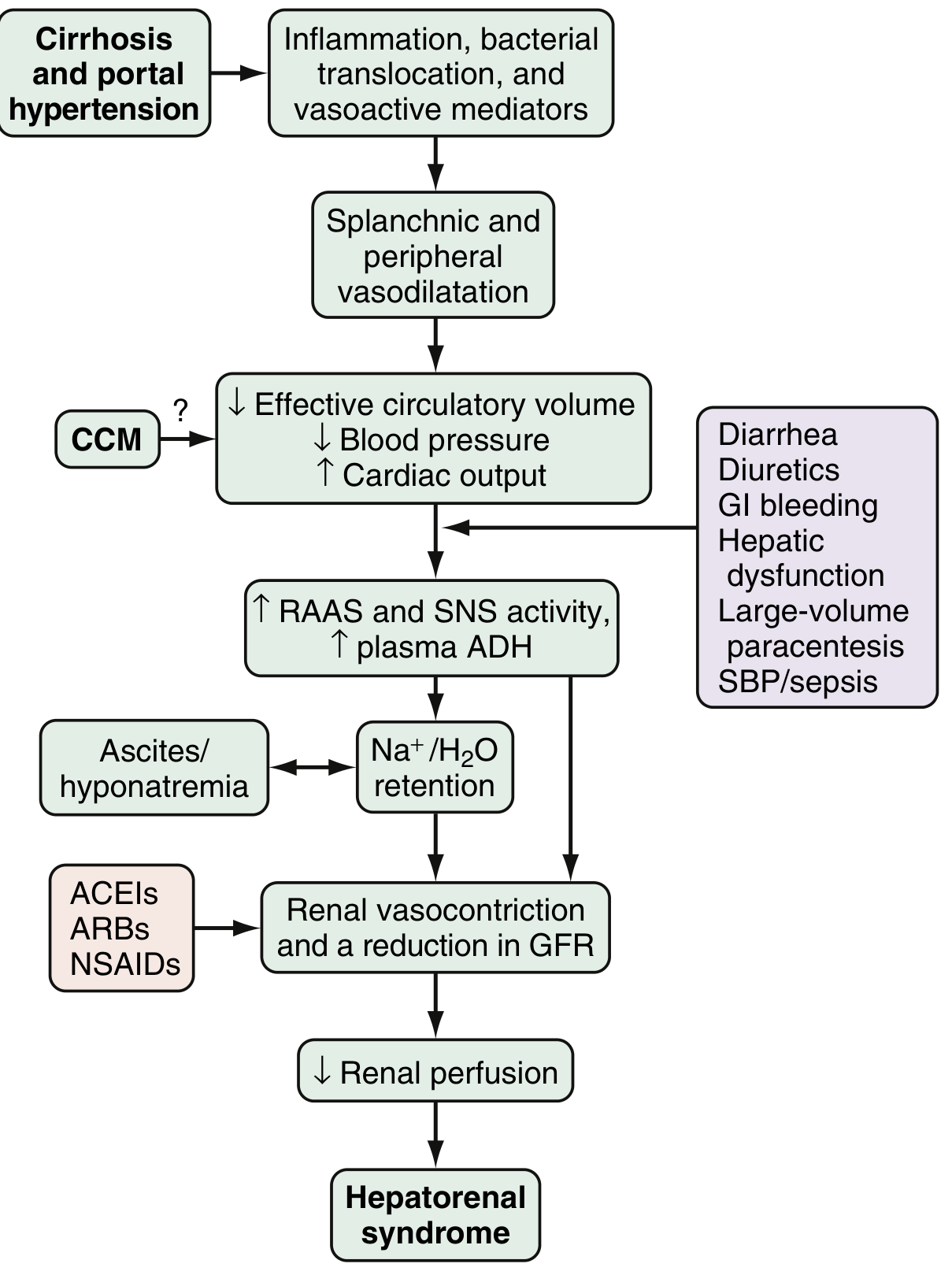
1. Splanchnic and systemic arterial vasodilation
Portal hypertension in cirrhosis leads to release of vasoactive substances - nitric oxide (NO), carbon monoxide, glucagon, prostacyclin, adrenomedullin, and endogenous opiates - causing progressive splanchnic and systemic vasodilation. This decreases effective circulating blood volume and blood pressure. Early on, increased cardiac output compensates (hyperdynamic circulation), but this becomes insufficient over time.
2. Compensatory renal vasoconstriction
To maintain perfusion pressure, the body activates:
- Sympathetic nervous system (SNS)
- Renin-angiotensin-aldosterone system (RAAS)
- Non-osmotic release of arginine vasopressin (ADH)
- Intrarenal mediators (endothelins, altered prostaglandins, kallikreins)
The resulting intense renal vasoconstriction reduces renal perfusion and GFR. Eventually, tubular damage can occur - HRS can transition from a functional syndrome to organic disease.
3. Cardiac dysfunction (cirrhotic cardiomyopathy - CCM)
Cirrhotic cardiomyopathy with reduced cardiac output is an additional contributing factor - patients who develop HRS have lower cardiac output than those who do not. - Sleisenger & Fordtran, p. 1818
Precipitating triggers include: diarrhea, diuretic overuse, GI bleeding, large-volume paracentesis without albumin, SBP/sepsis, and hepatic decompensation.
Diagnostic Criteria (ICA 2015)
All of the following must be present (Box 94.2):
- Cirrhosis with ascites
- AKI by ICA criteria:
- Rise in serum creatinine ≥0.3 mg/dL within 48 hours, OR
- ≥50% rise from baseline within 7 days
- No response to 48 hours of diuretic withdrawal + IV albumin (1 g/kg/day, max 100 g/day)
- Absence of shock
- No recent nephrotoxic agents (NSAIDs, aminoglycosides, contrast)
- No intrinsic renal disease - proteinuria <500 mg/day, no microhematuria (>50 RBC/HPF), normal renal ultrasound
- Sleisenger & Fordtran, p. 1819
AKI Staging (ICA):
- Stage 1: creatinine rise ≥0.3 mg/dL or 1.5-2x baseline
- Stage 2: creatinine rise >2-3x baseline
- Stage 3: creatinine rise >3x baseline or creatinine ≥4 mg/dL with acute rise ≥0.3 mg/dL, or initiation of RRT
Urinary findings: Urine Na <10 mmol/L, urine osmolality > plasma osmolality (tubular function preserved). Oliguria is NOT used as a criterion because cirrhotic patients are frequently oliguric at baseline. - Sabiston Textbook of Surgery, p. 943
Important note on creatinine: Patients with advanced cirrhosis often have reduced muscle mass and impaired urea synthesis, causing artificially low baseline creatinine - even a small rise should prompt concern.
Differential Diagnosis of AKI in Cirrhosis
Must exclude before diagnosing HRS:
- Pre-renal: GI hemorrhage, overdiuresis, diarrhea, lactulose overdose
- Intrinsic renal: Acute tubular necrosis (ATN), acute interstitial nephritis, glomerulonephritis
- Drug-induced: NSAIDs (renal vasoconstriction), aminoglycosides (nephrotoxic), ACE inhibitors, ARBs
- Obstructive: Obstruction
- Sepsis: SBP, other infections (must treat before diagnosing HRS)
- Large-volume paracentesis without albumin replacement
Urinary biomarkers such as IL-18, NGAL (neutrophil gelatinase-associated lipocalin), urinary EGF, and FABP2 can help distinguish ATN from HRS (ATN typically shows higher NGAL).
Treatment
Step 1: Remove precipitants
- Stop diuretics, NSAIDs, ACE inhibitors, ARBs, nephrotoxins
- Treat infections (SBP, sepsis)
Step 2: Volume expansion
- IV albumin 1 g/kg/day (max 100 g/day) for 48 hours - mandatory before diagnosing HRS
Step 3: Vasoconstrictors (for HRS-AKI)
| Drug | Role | Notes |
|---|---|---|
| Terlipressin | First-line | Vasopressin analogue, 0.5-2.0 mg IV every 4-6 hours; FDA-approved in USA after CONFIRM trial; continued up to 14 days after creatinine returns to baseline |
| Norepinephrine | Second-line (ICU) | Low-dose; requires intensive monitoring |
| Midodrine + Octreotide + Albumin | Third-line (USA) | Alpha-agonist + somatostatin analogue; now considered inferior to terlipressin |
The CONFIRM trial (phase III RCT) confirmed terlipressin + albumin leads to higher HRS reversal rates vs. placebo, leading to FDA approval. However, terlipressin carries risk of respiratory failure (ischemic adverse effects) and must be used with caution in patients with baseline pulmonary compromise. - Sabiston Textbook of Surgery, p. 944; Goldman-Cecil Medicine, p. 49
Step 4: Renal replacement therapy
If pharmacologic treatment fails, RRT (dialysis) can be initiated as a bridge.
Step 5: Definitive therapy - Liver transplantation
The only curative treatment. Renal function typically recovers after liver transplantation. HRS represents a priority indication for transplant listing. - Harrison's 22E, p. 1380
TIPS (transjugular intrahepatic portosystemic shunt) can be used as a bridge in some patients.
Prevention
- Albumin infusion with large-volume paracentesis (1.5 g albumin per liter of ascites removed)
- Albumin + antibiotics in SBP (1.5 g/kg on day 1, 1 g/kg on day 3 - reduces HRS incidence and improves survival)
- Avoidance of nephrotoxins in cirrhotic patients
- Primary and secondary prophylaxis of variceal bleeding
- Quinolone prophylaxis after a first SBP episode
Prognosis
- HRS-AKI carries very high in-hospital mortality without treatment
- Median survival without treatment: weeks to months
- Recovery of renal function is typical following liver transplantation
- In patients with either HRS-AKI or HRS-CKD, prognosis is poor without transplantation - Harrison's 22E, p. 1380
Recent Evidence (2024-2026)
Two recent meta-analyses support current practice:
- Terlipressin meta-analysis (Braga et al., 2025) - Confirmed terlipressin's superiority for HRS reversal in a meta-analysis of RCTs (PMID 40207491).
- Adverse events of terlipressin (Shang et al., 2024) - Systematic review characterizing adverse events including respiratory complications (PMID 39298544).
- Living-donor liver transplant in HRS (Viana et al., 2025) - Meta-analysis showing acceptable outcomes with living-donor LT in HRS patients (PMID 41118136).
Sources: Harrison's Principles of Internal Medicine 22E (2025) | Sleisenger & Fordtran's GI and Liver Disease | Goldman-Cecil Medicine | Sabiston Textbook of Surgery 14e | ICA Consensus Criteria (2015)
This is a shared conversation. Sign in to Orris to start your own chat.