
What is a DASH diet in hypertension as per park textbook 28th edition
Reading File
Now let me search the library for DASH diet content in Park's textbook.
Finding Sources
Finding Sources
Finding Sources
Finding Sources
Found it. Let me read the relevant block extensively to get all DASH diet content.
Reading File
Finding Sources
Reading File
I now have all the necessary information from Park's Textbook. Let me compile the complete answer.
DASH Diet in Hypertension - Park's Textbook of Preventive and Social Medicine
DASH stands for Dietary Approaches to Stop Hypertension.
What is the DASH Diet?
As per Park's Textbook, the DASH eating plan is one of the key lifestyle modifications recommended to manage hypertension. It is listed under the population strategy for primary prevention of hypertension.
The DASH eating plan recommends:
"Consume a diet rich in fruits, vegetables, and low-fat dairy products with a reduced content of saturated fat and total fat."
DASH Diet in Context: Lifestyle Modifications Table (Table 2)
Park's presents the DASH diet as part of a larger table of lifestyle modifications, along with the approximate reduction in systolic blood pressure (BP) each modification achieves:
| Modification | Recommendation | Approximate Systolic BP Reduction |
|---|---|---|
| Weight reduction | Maintain normal body weight (BMI 18.5-24.9) | 5-20 mmHg per 10 kg weight loss |
| Adopt DASH eating plan | Diet rich in fruits, vegetables, and low-fat dairy; reduced saturated and total fat | 8-14 mmHg |
| Dietary sodium reduction | No more than 100 mEq/day (2.4 g sodium or 6 g sodium chloride) | 2-8 mmHg |
| Physical activity | Regular aerobic activity such as brisk walking (at least 30 min/day, most days of the week) | 4-9 mmHg |
| Moderation of alcohol | Men: ≤2 drinks/day; Women and lighter-weight persons: ≤1 drink/day | 2-4 mmHg |
Note: For overall cardiovascular risk reduction, stop smoking. The effects of implementing these modifications are dose and time dependent and could be higher for some individuals.
Key Points about the DASH Diet
-
Mechanism of BP reduction: The DASH diet achieves one of the greatest BP reductions among lifestyle modifications - 8 to 14 mmHg reduction in systolic BP - second only to weight reduction.
-
Core components:
- High intake of fruits and vegetables
- High intake of low-fat dairy products
- Reduced saturated fat
- Reduced total fat
-
Role in prevention: It is recommended as part of the population strategy (primary prevention of hypertension), directed at the whole population regardless of individual risk level.
-
Combined effect: When combined with sodium restriction and other lifestyle measures, the cumulative benefit on blood pressure can be substantial.
-
Context in nutrition interventions: Park's also notes under the population approach that dietary changes are of "paramount importance" and include: reduction of salt intake to ≤5 g/day, moderate fat intake, avoidance of high alcohol intake, and restriction of energy intake appropriate to body needs - all principles consistent with the DASH framework.
Source: Park's Textbook of Preventive and Social Medicine, p. 427 - Table 2: Lifestyle modifications to manage hypertension
Warning signs of cancer
The classic mnemonic for cancer warning signs is CAUTION - Change in bowel/bladder habits, A sore that doesn't heal, Unusual bleeding/discharge, Thickening or lump, Indigestion or difficulty swallowing, Obvious change in a wart/mole, Nagging cough or hoarseness.
Searching sources...
Finding Sources
Park's textbook has a section on this. Let me read it directly.
Reading File
I have all the content needed. Here is the complete answer:
Warning Signs of Cancer
As per Park's Textbook of Preventive and Social Medicine (p. 436)
Cancer organizations remind the public of the early warning signs (also called "danger signals") of cancer. These are listed under Cancer Education, which is an important part of primary prevention:
| # | Warning Sign |
|---|---|
| a | A lump or hard area in the breast |
| b | A change in a wart or mole |
| c | A persistent change in digestive and bowel habits |
| d | A persistent cough or hoarseness |
| e | Excessive loss of blood at the monthly period or loss of blood outside the usual dates |
| f | Blood loss from any natural orifice |
| g | A swelling or sore that does not get better |
| h | Unexplained loss of weight |
The CAUTION Mnemonic (American Cancer Society)
The same warning signs are classically remembered using the mnemonic CAUTION:
| Letter | Warning Sign |
|---|---|
| C | Change in bowel or bladder habits |
| A | A sore that does not heal |
| U | Unusual bleeding or discharge from any orifice |
| T | Thickening or lump in the breast or elsewhere |
| I | Indigestion or difficulty in swallowing |
| O | Obvious change in a wart or mole |
| N | Nagging cough or hoarseness of voice |
ABCDE Warning Signs - For Melanoma Specifically
For skin cancer (melanoma), the additional ABCDE checklist is used (as per Robbins Pathology and Cummings Otolaryngology):
| Letter | Sign |
|---|---|
| A | Asymmetry in appearance |
| B | Border irregularity (scalloped, poorly defined margins) |
| C | Variegated Color (multiple shades) |
| D | Increasing Diameter (>6 mm) |
| E | Evolution or change over time, especially rapid change |
Key Points
- The aim of publicizing these warning signs is to motivate people to seek early diagnosis and early treatment (cancer education as primary prevention).
- These danger signals are directed especially at "high-risk" groups.
- Most warning signs are non-specific - their importance lies in prompting early medical evaluation, not in confirming a diagnosis.
- No early warning signs have been established for some cancers like pancreatic cancer, which is why it often presents at a late stage.
Source: Park's Textbook of Preventive and Social Medicine, p. 436
Causes of mental illness
The causes of mental illness are multifactorial - biological (genetics, neurochemistry, brain structure), psychological (early trauma, personality, coping styles), and social (poverty, isolation, life events). No single cause explains most disorders.
Searching sources...
Finding Sources
Finding Sources
Finding Sources
Finding Sources
Park's has a dedicated "Causes of mental ill-health" section. Let me read it fully.
Reading File
Finding Sources
Reading File
I now have all the content needed from Park's textbook. Here is the full, well-organized answer:
Causes of Mental Illness
As per Park's Textbook of Preventive and Social Medicine
"Mental illness like physical illness is due to multiple causes. There are many known factors of agent, host and environment in the natural histories of mental disorders."
Park's classifies the causes under three broad headings:
1. Organic Conditions
Mental illnesses may have their origin in organic (physical/biological) conditions such as:
- Cerebral arteriosclerosis
- Neoplasms (brain tumors)
- Metabolic diseases
- Neurological diseases
- Endocrine diseases
- Chronic diseases - tuberculosis, leprosy, epilepsy, etc.
2. Heredity
Heredity may be an important factor in some cases.
- Classic example: The child of two schizophrenic parents is 40 times more likely to develop schizophrenia than the child of healthy parents.
- Genetic predisposition interacts with environmental triggers to produce disease.
3. Social and Pathological Causes
"To produce any disease, there must be a combination of genetic and environmental factors."
The social and environmental factors associated with mental ill-health include:
| Category | Specific Factors |
|---|---|
| Psychological stressors | Worries, anxieties, emotional stress, tension, frustration |
| Family factors | Unhappy marriages, broken homes, cruelty, rejection, neglect |
| Socioeconomic factors | Poverty, economic insecurity |
| Social change factors | Industrialization, urbanization, changing family structure, population mobility |
"The social environment not only determines the individual's attitudes but also provides the 'framework' within which mental health is formulated."
4. Other Environmental Factors
Environmental factors other than psychosocial ones that can produce abnormal human behaviour:
| Factor | Examples |
|---|---|
| Toxic substances | Carbon disulfide, mercury, manganese, tin, lead compounds |
| Psychotropic drugs | Barbiturates, alcohol, griseofulvin |
| Nutritional deficiencies | Deficiency of thiamine (B1), pyridoxine (B6) |
| Mineral deficiencies | Deficiency of iodine |
| Infective agents | Measles, rubella during prenatal, perinatal, and postnatal periods - can adversely affect brain development |
| Traumatic factors | Road accidents, occupational accidents |
| Radiation | The nervous system is most sensitive to radiation during the period of neural development |
Causes at Crucial Life-Cycle Points
Park's also highlights mental illness risks at specific life stages:
| Life Stage | Key Causes / Risks |
|---|---|
| Prenatal period | Maternal emotional stress during pregnancy |
| First 5 years | Broken homes, lack of warm intimate relationship with parents; roots of mental health are in early childhood |
| School age | Unsatisfactory teacher-pupil relationships, school environment failing emotional needs |
| Adolescence | Failure to meet basic needs (independence, peer relationships, identity), juvenile delinquency |
| Old age | Organic brain conditions, economic insecurity, lack of a home, poor social status and insecurity |
Summary Framework
Park's uses the classic agent-host-environment triad to understand mental illness:
- Agent - biological/organic triggers, infective agents, toxins
- Host - hereditary predisposition, age, developmental stage
- Environment - social, economic, family, cultural stressors
Source: Park's Textbook of Preventive and Social Medicine, pp. 935-936 - "Causes of mental ill-health"
Management of dengue shock syndrome
Dengue shock syndrome (DSS) management centers on aggressive IV fluid resuscitation with crystalloids, close hemodynamic monitoring, and correction of complications like bleeding and electrolyte disturbances. Early recognition of shock is key.
Searching sources...
Finding Sources
Finding Sources
Finding Sources
Finding Sources
Finding Sources
Finding Sources
Reading File
Reading File
Let me now read the Harrison's dengue management section and the Park's DSS management section directly.
Reading File
Reading File
Reading File
Reading File
Now let me get the specific management/treatment section from Park's textbook for DSS.
Reading File
Reading File
Reading File
Reading File
Reading File
Now let me also read the critical section specifically about Grade III/IV (DSS) initial fluid management that was referenced.
Reading File
Loading Image
I now have a comprehensive set of information including the management flowchart. Here is the complete, well-organized answer:
Management of Dengue Shock Syndrome (DSS)
Sources: Park's Textbook of Preventive and Social Medicine; Harrison's Principles of Internal Medicine 22nd Ed.
Understanding DSS in the WHO Grading System
DSS corresponds to DHF Grade III and Grade IV:
| Grade | Features |
|---|---|
| Grade III | Circulatory failure - weak rapid pulse, pulse pressure ≤20 mmHg OR hypotension, cold clammy skin, restlessness |
| Grade IV (DSS) | Profound shock - undetectable blood pressure or pulse |
Both grades show: platelet count <100,000/cu.mm + haematocrit rise >20%
Pathophysiology of Shock in DSS
- Shock results from critical plasma leakage due to increased vascular permeability
- Typically occurs at defervescence (day 3-7 of illness, usually day 4-5)
- Compensated shock: diastolic BP rises towards systolic → pulse pressure narrows ≤20 mmHg
- Then decompensation: both pressures disappear abruptly
- Prolonged shock → hypoxia → metabolic acidosis → DIC → multi-organ failure
Step-by-Step Management of DHF Grade III & IV
Immediate Steps on Admission
- Check haematocrit, platelet count, and vital signs immediately
- Start IV fluid therapy without delay
- Administer oxygen to all patients in shock
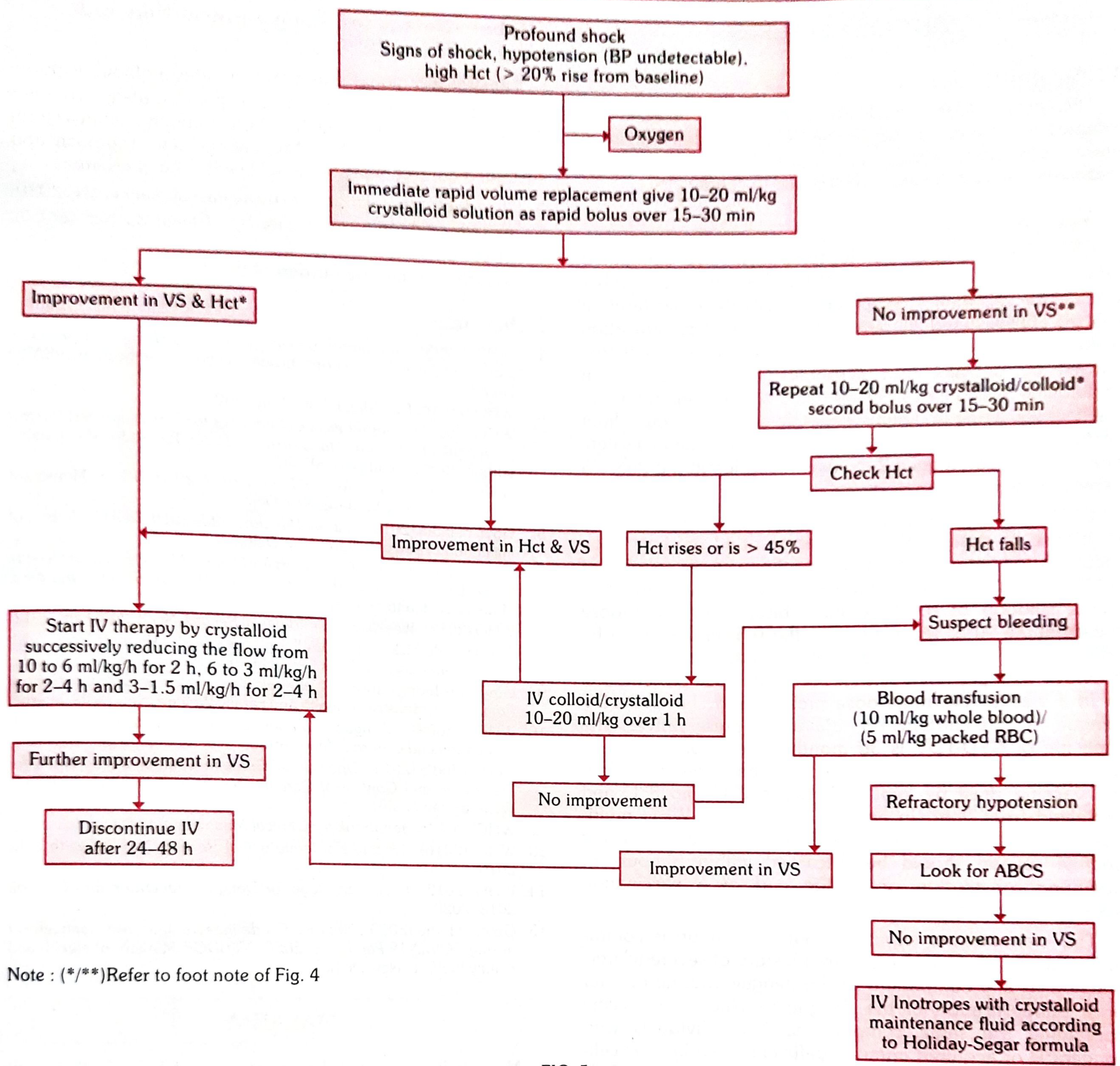
Fluid Resuscitation Algorithm (DHF Grade IV / DSS)
This is the core of DSS management, following the WHO algorithm:
STEP 1 - Initial Bolus:
Give 10-20 ml/kg crystalloid solution (Normal saline or Ringer's Lactate) as a rapid bolus over 15-30 minutes
If improvement in vital signs (VS) and haematocrit (Hct):
- Start IV crystalloid, successively reducing the rate:
- 10 → 6 ml/kg/h for 2 hours
- 6 → 3 ml/kg/h for 2-4 hours
- 3 → 1.5 ml/kg/h for 2-4 hours
- Discontinue IV after 24-48 hours
If NO improvement in VS:
STEP 2 - Second Bolus:
Repeat 10-20 ml/kg crystalloid OR colloid as second bolus over 15-30 minutes
Then check haematocrit:
| Haematocrit Result | Action |
|---|---|
| Hct improves | Give IV colloid/crystalloid 10-20 ml/kg over 1 hour |
| Hct rises or >45% (ongoing plasma leakage) | Give IV colloid/crystalloid 10-20 ml/kg over 1 hour |
| Hct falls (suspect internal bleeding) | Blood transfusion - 10 ml/kg whole blood OR 5 ml/kg packed RBCs |
If refractory hypotension persists:
- Look for ABCS (Acidosis, Bleeding, Calcium/electrolytes, Sugar)
- If still no improvement → IV inotropes with crystalloid maintenance fluid according to Holiday-Segar formula
Management algorithm (Fig. 5, DSS - DHF Grade IV):
Fluid Types
| Type | Examples |
|---|---|
| Crystalloid | Normal saline (0.9% NaCl), Ringer's lactate |
| Colloid | Dextran 40, degraded gelatine polymer (polygeline/haemaccel) |
Note: If the patient has already received ~1000 ml IV crystalloid without response, change to colloidal solution (Dextran 40 or haemaccel). If haematocrit is declining despite fluids, give fresh whole blood 10-20 ml/kg/hour.
Blood and Platelet Transfusion
Red Cell/Whole Blood Transfusion - Indications:
- Overt blood loss ≥10% of total blood volume
- Refractory shock despite adequate fluids + declining haematocrit
- Replacement volume: 10 ml/kg body weight at a time; check coagulogram
- If fluid overload is present: use packed cells instead of whole blood
Platelet Transfusion - Indications:
- Prophylactic platelet transfusion at <10,000/cu.mm (not required at <20,000 unless bleeding)
- Prolonged shock with coagulopathy and abnormal coagulogram
- Systemic massive bleeding (platelet + red cell transfusion together)
No prophylactic platelet transfusion is recommended at <20,000/cu.mm in the absence of bleeding.
Monitoring Parameters (Every Hour)
- Vital signs (pulse rate, BP, pulse pressure)
- Urine output
- Haematocrit (serial)
- Platelet count
- Signs of fluid overload (respiratory distress, pulmonary oedema)
Medications - What to AVOID
| Drug | Reason to Avoid |
|---|---|
| Aspirin / NSAIDs | Aggravate gastritis, worsen bleeding |
| Ibuprofen | Worsen bleeding, platelet inhibition |
| Corticosteroids | May cause massive bleeding |
| Hyperosmolar or Ringer's lactate | Should not be used in acidosis |
Permitted: Paracetamol for fever (minimum 6-hour intervals)
Criteria for Discharge After DSS Recovery
- Absence of fever for ≥24 hours without antipyretics
- Return of appetite
- Visible clinical improvement
- Good urine output
- Minimum 2-3 days after recovery from shock
- No respiratory distress from pleural effusion or ascites
- Platelet count >50,000/cu.mm
Key Principle (Harrison's)
"Most patients with severe dengue respond well to supportive therapy, and the overall CFR at experienced clinical centers in the tropics is probably as low as 1%. Early recognition and action long before the critical period are crucial to initiate appropriate supportive care."
Sources: Park's Textbook of Preventive and Social Medicine, pp. 294-297; Harrison's Principles of Internal Medicine 22nd Ed., p. 1721
This is a shared conversation. Sign in to Orris to start your own chat.