
Coobs thest
It looks like you might be asking about Coomb's test (also written as Coombs test). This is a blood test used to detect antibodies that attack red blood cells.
There are two main types:
- Direct Coombs test (DAT): Detects antibodies already attached to the surface of red blood cells - used to diagnose autoimmune hemolytic anemia, hemolytic disease of the newborn, and transfusion reactions.
- Indirect Coombs test (IAT): Detects free antibodies circulating in the serum - used in blood cross-matching before transfusions and in prenatal testing.
Searching sources...
Reading File
Finding Sources
Searching the Web
Coombs test direct indirect mechanism clinical uses
Reading File
Reading File
Loading Image
Here is a thorough breakdown of the Coombs test (also called the antiglobulin test), drawn from Janeway's Immunobiology, Robbins & Kumar Basic Pathology, and other authoritative textbooks.
Coombs Test (Antiglobulin Test)
The Coombs test detects antibodies (and/or complement) that bind to the surface of red blood cells (RBCs). It is the cornerstone test for diagnosing immunohemolytic anemia and for blood bank safety.
The Key Principle
Anti-Rh antibodies (IgG) do not naturally cause RBC agglutination because Rh antigens are widely spaced on the RBC surface - the antibodies cannot bridge two cells. To solve this, anti-human immunoglobulin (Coombs reagent) is added. It cross-links the IgG molecules already bound to RBCs, producing visible agglutination.
Direct Coombs Test (DAT - Direct Antiglobulin Test)
What it detects: Antibodies or complement already bound to the patient's RBCs in vivo.
How it works:
- Blood is collected and RBCs are washed in saline (removes free/unbound antibodies that could confound results)
- Coombs reagent (anti-human IgG and/or anti-C3 complement) is added to the washed RBCs
- If antibodies/complement are coating the RBCs → agglutination = positive DAT
Clinical uses:
- Autoimmune hemolytic anemia (AIHA) - most common use; positive in warm IgG-mediated and cold IgM-mediated types
- Hemolytic disease of the newborn (HDN) - detects maternal IgG antibodies (anti-Rh) bound to the baby's RBCs
- Hemolytic transfusion reactions - both acute and delayed; LAD, elevated LDH, and positive DAT confirm the reaction
- Drug-induced hemolytic anemia - e.g., alpha-methyldopa induces autoantibodies; penicillin binds RBC membranes as a neoantigen
Indirect Coombs Test (IAT - Indirect Antiglobulin Test)
What it detects: Free antibodies circulating in the patient's serum, not yet bound to RBCs.
How it works:
- The patient's serum is incubated with test RBCs of known antigen type (e.g., Rh+)
- If the serum contains anti-Rh antibodies, they bind to the test RBCs
- The cells are washed to remove unbound antibody
- Coombs reagent is added → agglutination = positive IAT
Clinical uses:
- Pre-transfusion crossmatching - ensures donor RBCs won't be attacked by recipient antibodies
- Antenatal screening - detects Rh or other antibodies in an Rh-negative mother that could cause HDN in an Rh+ fetus
- RBC phenotyping / antibody identification - characterizes which red cell antigen the antibody is targeting
Diagram
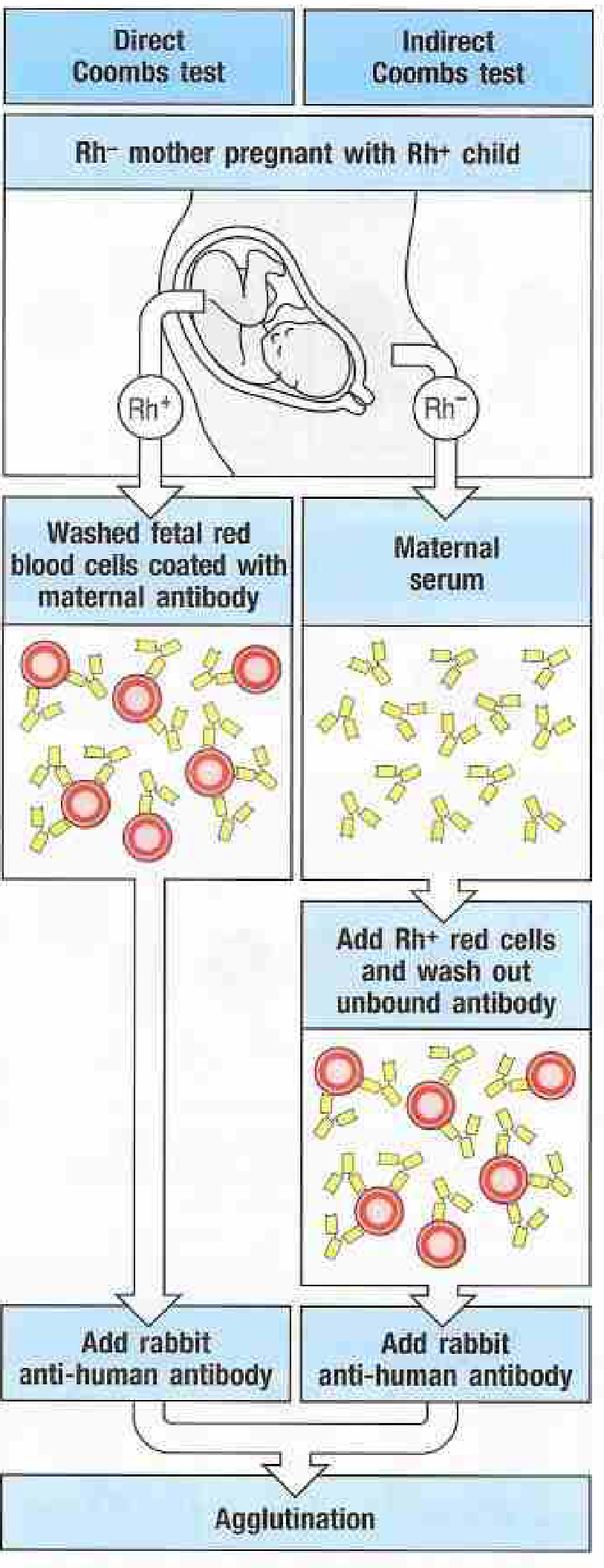
The left side shows the Direct Coombs test on fetal RBCs already coated with maternal antibody. The right side shows the Indirect Coombs test on maternal serum, where free antibodies are first captured onto Rh+ test cells before Coombs reagent is added. Both steps end with agglutination if the test is positive.
Classification of Immunohemolytic Anemias (Robbins)
| Type | Examples |
|---|---|
| Warm antibody (IgG, active at 37°C) | Idiopathic; SLE; drugs (alpha-methyldopa, penicillin, quinidine); CLL |
| Cold antibody (IgM) | Mycoplasma infection; infectious mononucleosis; lymphoplasmacytic lymphoma |
In warm AIHA, macrophages in the spleen "nibble" antibody-coated RBCs, removing membrane and creating spherocytes that are rapidly destroyed - the mechanism behind the spherocytosis seen on blood smear.
Result Interpretation at a Glance
| Test | Positive means... | Negative means... |
|---|---|---|
| DAT | Antibodies/complement coat the patient's RBCs | No in-vivo sensitization |
| IAT | Free anti-RBC antibodies in the serum | No circulating alloantibodies detected |
A positive DAT does not always mean active hemolysis - the clinical picture (falling Hgb, elevated LDH, reticulocytosis, low haptoglobin, spherocytes on smear) must be interpreted together.
Sources: Robbins & Kumar Basic Pathology, p. 391; Janeway's Immunobiology 10e, Appendix A; StatPearls - Coombs Test; Johns Hopkins Lupus Center
This is a shared conversation. Sign in to Orris to start your own chat.