
Short note on glycolysis with chart
Reading File
Searching sources...
Finding Sources
Reading File
Reading File
Reading File
Reading File
Loading Image
Reading File
Reading File
I now have enough to write a thorough short note on glycolysis. Let me compile the answer.
Glycolysis - Short Note
Glycolysis is the universal pathway for oxidation of glucose to pyruvate, occurring in the cytoplasm of all cells. It generates ATP both aerobically and anaerobically, making it the central hub of carbohydrate metabolism.
Overview
- Converts 1 molecule of glucose into 2 molecules of pyruvate
- Occurs in the cytoplasm (cytosol)
- Net yield: 2 ATP, 2 NADH, 2 pyruvate per glucose
- Does not require oxygen (can function anaerobically)
Two Phases
| Phase | Steps | Purpose |
|---|---|---|
| Preparative (Investment) Phase | Steps 1-5 | Phosphorylates glucose, uses 2 ATP, splits into 2 triose phosphates |
| ATP-Generating (Payoff) Phase | Steps 6-10 | Oxidizes triose phosphates, produces 4 ATP + 2 NADH |
The 10 Steps of Glycolysis
| Step | Reaction | Enzyme | Notes |
|---|---|---|---|
| 1 | Glucose → Glucose 6-phosphate (G6P) | Hexokinase (all tissues) / Glucokinase (liver, pancreas) | ATP consumed; irreversible; commits glucose to metabolism |
| 2 | G6P → Fructose 6-phosphate (F6P) | Phosphoglucose isomerase | Reversible; not regulated |
| 3 | F6P → Fructose 1,6-bisphosphate (F1,6-BP) | Phosphofructokinase-1 (PFK-1) | ATP consumed; rate-limiting step; irreversible; regulated by AMP (+), ATP (-), citrate (-), fructose 2,6-bisphosphate (+) |
| 4 | F1,6-BP → DHAP + Glyceraldehyde 3-phosphate (G3P) | Aldolase | Reversible; not regulated |
| 5 | DHAP → G3P | Triose phosphate isomerase | Reversible; yields 2x G3P for further metabolism |
| 6 | G3P → 1,3-Bisphosphoglycerate (1,3-BPG) | G3P dehydrogenase | NAD+ → NADH; first redox reaction; coupled to Pi attachment |
| 7 | 1,3-BPG → 3-Phosphoglycerate (3-PG) | Phosphoglycerate kinase | First ATP synthesis (substrate-level phosphorylation) x2 |
| 8 | 3-PG → 2-Phosphoglycerate (2-PG) | Phosphoglycerate mutase | Reversible |
| 9 | 2-PG → Phosphoenolpyruvate (PEP) | Enolase | Removes water; creates high-energy phosphate |
| 10 | PEP → Pyruvate | Pyruvate kinase | Second ATP synthesis x2; irreversible; regulated by F1,6-BP (+), ATP (-), alanine (-) |
Pathway Chart
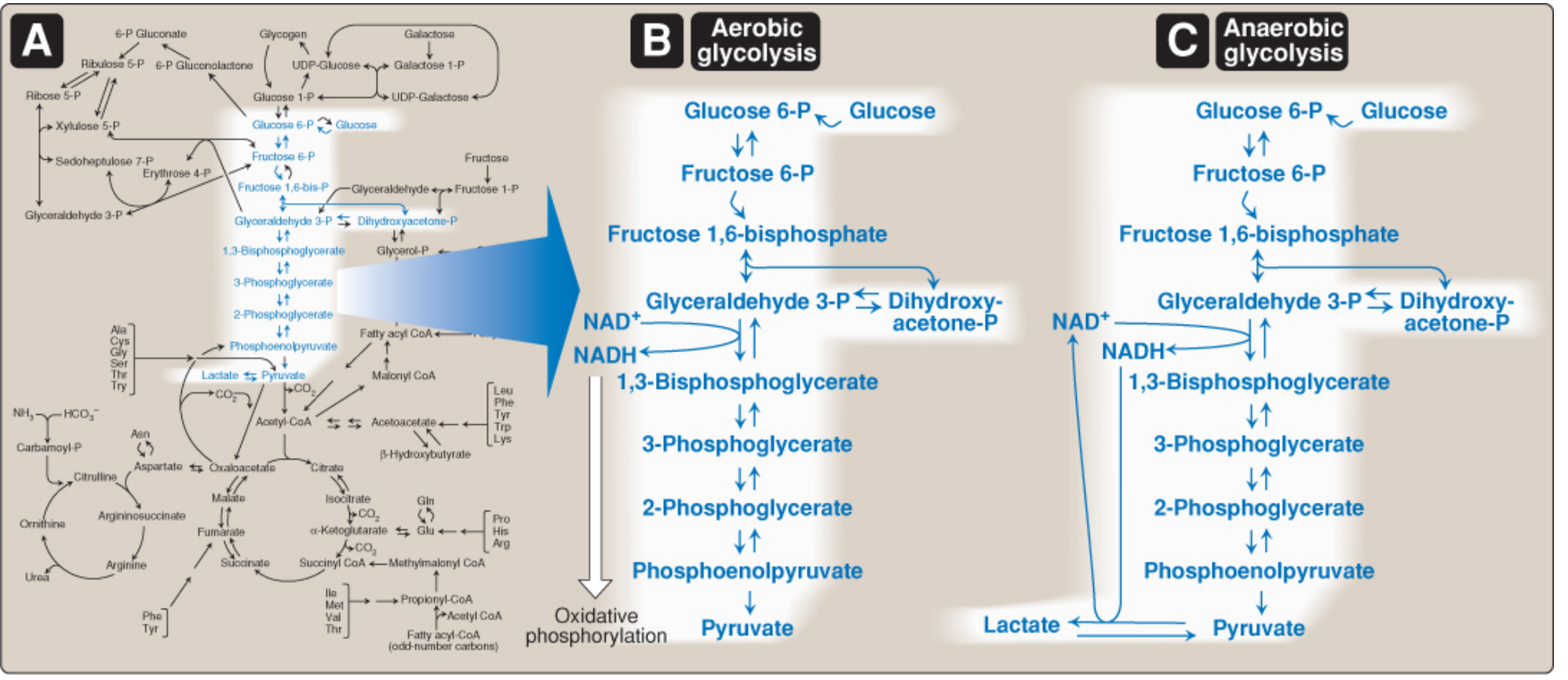
Figure 8.9 - A: Glycolysis in the context of overall energy metabolism. B: Aerobic glycolysis (pyruvate → oxidative phosphorylation). C: Anaerobic glycolysis (pyruvate → lactate). (Lippincott Illustrated Reviews Biochemistry, 8th ed.)
Energy Balance
| Per glucose | |
|---|---|
| ATP consumed (steps 1 & 3) | -2 ATP |
| ATP produced (steps 7 & 10, x2 each) | +4 ATP |
| Net ATP gain | +2 ATP |
| NADH produced (step 6) | 2 NADH |
Fate of Pyruvate
| Condition | Fate | Outcome |
|---|---|---|
| Aerobic (O2 available) | → Acetyl-CoA (via pyruvate dehydrogenase) → TCA cycle | Full oxidation; more ATP |
| Anaerobic (no O2) | → Lactate (via LDH) | Regenerates NAD+; allows glycolysis to continue |
| Liver/excess glucose | → Fatty acid synthesis | Energy storage |
Key Regulatory Enzymes (Irreversible Steps)
Three enzymes catalyze the irreversible steps and are the main regulation points:
-
Hexokinase/Glucokinase - Step 1
- Hexokinase: inhibited by G6P (product inhibition)
- Glucokinase: high Km, induced by insulin, not inhibited by G6P
-
PFK-1 - Step 3 (rate-limiting step)
- Activated by: AMP, ADP, fructose 2,6-bisphosphate (major activator in liver, stimulated by insulin)
- Inhibited by: ATP, citrate, H+
-
Pyruvate kinase - Step 10
- Activated by: fructose 1,6-bisphosphate (feedforward)
- Inhibited by: ATP, alanine, glucagon (via phosphorylation in liver)
Aerobic vs Anaerobic Glycolysis
| Feature | Aerobic | Anaerobic |
|---|---|---|
| O2 required | Yes (for NADH reoxidation via ETC) | No |
| End product | Pyruvate → TCA cycle | Lactate |
| ATP yield (glycolysis only) | 2 ATP | 2 ATP |
| Total ATP (full oxidation) | ~30-32 ATP | 2 ATP |
| Tissues | Most tissues | RBCs, exercising muscle, hypoxic cells, lens of eye |
Clinical Relevance
- Arsenic poisoning: Arsenate competes with inorganic phosphate at step 6 (G3P dehydrogenase), bypassing 1,3-BPG formation and uncoupling ATP generation from glycolysis
- Warburg effect: Cancer cells preferentially use anaerobic glycolysis even in the presence of O2 ("aerobic glycolysis"), producing lactate - forms the basis of PET imaging with fluorodeoxyglucose
- RBC dependence: Red blood cells lack mitochondria and rely entirely on anaerobic glycolysis for ATP; also produce 2,3-BPG (from 1,3-BPG) which regulates hemoglobin-O2 affinity
- Pyruvate kinase deficiency: Most common enzyme deficiency in the glycolytic pathway; causes hemolytic anemia
Sources: Lippincott Illustrated Reviews Biochemistry, 8th ed.; Basic Medical Biochemistry: A Clinical Approach, 6th ed.
This is a shared conversation. Sign in to Orris to start your own chat.