
Short bowel syndrome in detail
Reading File
Now let me search the library for Short Bowel Syndrome content in parallel with a PubMed search for recent evidence.
Finding Sources
Searching PubMed
"short bowel syndrome"[MeSH Terms] AND management
Excellent finds. Now let me read the most comprehensive sources in parallel - Sabiston, Yamada, Goldman-Cecil, and Harrison's.
Reading File
Reading File
Reading File
Reading File
Good content so far. Let me now read the Sabiston block 7 (more detail) and Harrison's block, plus search for more specific topics like intestinal adaptation and teduglutide.
Reading File
Reading File
Finding Sources
Excellent detail. Now let me read from Schwartz's (pathophysiology section) and Sleisenger & Fordtran's (comprehensive SBS chapter) in parallel, and also get Harrison's treatment content.
Reading File
Reading File
Reading File
Now let me read the Sleisenger & Fordtran SBS chapter in more depth (pathophysiology, complications, surgical management) and get the Schwartz's therapy section:
Reading File
Reading File
I now have comprehensive content. Let me also fetch the image from Sabiston showing bowel-lengthening procedures, and get Sleisenger's complications section:
Loading Image
Reading File
I now have extremely comprehensive content from multiple authoritative textbooks. Let me compile the full detailed response.
Short Bowel Syndrome (SBS)
Definition
Short bowel syndrome is characterized by malabsorption resulting from extensive small intestinal resection or functional loss, typically leaving an adult with less than 150-200 cm of functional small bowel. The anatomical threshold most commonly cited is <200 cm of residual small intestine in adults, though the condition is better understood as a functional state of significant malabsorption of macronutrients, micronutrients, electrolytes, and water. Intestinal failure - a more severe endpoint - is functionally defined as persistent parenteral nutrition (PN) dependence, generally found in patients with <100 cm of remaining small bowel without residual colon.
- Harrison's Principles of Internal Medicine 22E, p. 2591
- Sleisenger and Fordtran's Gastrointestinal and Liver Disease, p. 1720
Etiology
Adults
| Cause | Notes |
|---|---|
| Crohn's disease | Most common cause overall; cumulative resections over time (25% of SBS cases) |
| Mesenteric infarction | Venous or arterial thrombosis, embolism, or midgut volvulus (75% of cases result from single large resection) |
| Volvulus | Midgut volvulus leading to massive ischemia |
| Trauma | Massive enterectomy for injury |
| Radiation enteritis | Less common now due to improved RT techniques |
| Gastric bypass | Jejunal exclusion causing functional SBS |
| Malignancy | Tumor resection |
Pediatric/Congenital
| Cause | Approximate frequency |
|---|---|
| Necrotizing enterocolitis (NEC) | ~35% |
| Intestinal atresia | ~25% |
| Gastroschisis | ~18% |
| Midgut volvulus | ~14% |
| Malrotation | - |
| Aganglionosis (Hirschsprung's) | - |
| Congenital villus atrophy | - |
90% of infants now survive the extensive resections required for these conditions, but require long-term follow-up.
- Sabiston Textbook of Surgery, p. 2686
- Schwartz's Principles of Surgery 11th Ed., p. 1282
Incidence & Prevalence
-
The incidence of severe SBS requiring long-term PN is estimated at 2-4 cases per million persons per year (multinational European data).
-
An estimated 10,000-20,000 patients in the USA follow a home PN regimen for SBS.
-
~50-70% of patients who initially require PN can eventually be weaned from it.
-
The incidence of SBS from Crohn's disease is likely decreasing due to biological therapies and bowel-sparing surgical techniques (strictureplasty).
-
Sleisenger and Fordtran's, p. 1720
Anatomy and Physiology of Absorption (Why SBS Causes Problems)
The normal small intestine is estimated at 3-8 m in length. Key functional zones:
- Proximal 100-150 cm (duodenum/jejunum): Absorbs most macronutrients - carbohydrate, fat, nitrogen, and most minerals (calcium, iron, magnesium, folate)
- Jejunum: Site of absorption of most macronutrients and many minerals; contains the ileal brake (GLP-1 mediated) which suppresses gastric secretion and slows emptying
- Terminal ileum: Essential and site-specific for:
- Bile salt reabsorption (enterohepatic circulation)
- Vitamin B12 absorption (via intrinsic factor receptors)
- Fat-soluble vitamins (A, D, E, K)
- Carbohydrates, proteins, fluids, electrolytes
- Production of GLP-1 and GLP-2 from L-cells
- Colon: Absorbs water and electrolytes; metabolizes malabsorbed carbohydrates into short-chain fatty acids (SCFAs) via bacterial fermentation - contributing several hundred extra kcal/day
The ileocecal valve was traditionally thought critical, but recent literature suggests the terminal ileum itself (with its high adaptive capacity) is more important - the valve is largely a surrogate marker for presence of terminal ileum.
- Sabiston Textbook of Surgery
- Sleisenger and Fordtran's, p. 1722
Pathophysiology
1. Loss of Absorptive Surface Area
Resection of <50% of small intestine is generally well tolerated. Clinically significant malabsorption develops with >50-80% resection. The consequences depend on:
- Length of remnant intestine
- Site of resection (ileal > jejunal in severity)
- Presence/absence of the colon
- Ileocecal valve status
- Health of residual bowel (diseased vs. normal)
2. Gastric Acid Hypersecretion
A characteristic hypergastrinemia-driven gastric acid hypersecretion persists for 1-2 years postoperatively. The high acid load:
- Inhibits digestive enzymes (which function optimally at alkaline pH)
- Causes diarrhea and mucosal damage
- Overwhelms the buffering capacity of the residual intestine
3. Bile Salt Wasting
- Resection of <100 cm of ileum: Bile salts reach the colon and cause secretory diarrhea (cholerheic diarrhea). Hepatic synthesis can compensate.
- Resection of >100 cm of ileum: Bile salt malabsorption so severe that the liver cannot compensate → fat malabsorption (steatorrhea) due to bile salt insufficiency
4. Loss of Ileal Brake
Loss of GLP-1 production leads to unregulated proximal gastric secretion and rapid gastric emptying - causing maldigestion and lack of satiety.
5. Rapid Transit
Reduced intestinal length shortens contact time between nutrients and absorptive epithelium.
6. Bacterial Overgrowth
Stasis (dilated bowel, motility dysfunction), loss of ileocecal valve, and altered flora favor small intestinal bacterial overgrowth (SIBO), which:
- Deconjugates bile salts
- Competes for nutrients
- Causes mucosal inflammation and diarrhea
7. Specific Nutrient Deficiencies
Based on what is resected:
| Nutrient | Site of Absorption | Effect of Loss |
|---|---|---|
| Vitamin B12 | Terminal ileum | B12 deficiency (neuropathy, megaloblastic anemia) |
| Bile salts | Terminal ileum | Fat malabsorption, fat-soluble vitamin deficiency |
| Fat-soluble vitamins (A, D, E, K) | Ileum (bile-dependent) | Bone disease, coagulopathy, night blindness |
| Calcium | Proximal jejunum | Osteoporosis |
| Iron | Duodenum/proximal jejunum | Iron deficiency anemia |
| Magnesium | Small bowel (diffuse) | Hypomagnesemia, muscle cramps |
| Zinc | Small bowel | Skin lesions, impaired healing |
| Water & electrolytes | Colon (if lost) | Dehydration, severe electrolyte imbalances |
- Harrison's Principles, p. 2591
- Schwartz's Principles, p. 1282
Clinical Phases
Phase 1: Early Postoperative (0-3 months)
- Massive diarrhea (may be several liters/day, especially with jejunostomy)
- Severe dehydration
- Electrolyte disturbances (Na+, K+, Mg2+, HCO3- loss)
- Gastric acid hypersecretion peaks
- TPN dependence
Phase 2: Intestinal Adaptation (up to 1-2 years; improvements possible 3-5 years)
- Gradual reduction in stool volume and frequency
- Increasing capacity for enteral nutrition
- Adaptive hyperplasia developing in residual bowel
Phase 3: Stabilization / Chronic Phase
- Ongoing nutritional monitoring required
- Some patients achieve enteral autonomy; others remain PN-dependent
- Long-term complications become the focus of management
Intestinal Adaptation
After massive small bowel resection, a physiologic compensatory process begins:
Structural changes:
- Mucosal hyperplasia begins within 48 hours of resection
- Increased crypt cell proliferation → epithelial hyperplasia
- Villous hypertrophy increases surface area
- Bowel dilation and elongation
Mediators of adaptation:
- GLP-2 (from L-cells in terminal ileum/colon) - most potent known stimulant; mediates trophic effects on villous heights and crypt depths
- EGF (epidermal growth factor)
- IGF-1 (insulin-like growth factor-1)
- TGF-α (transforming growth factor-alpha)
- IL-11
- VEGF, CCK, gastrin, insulin, neurotensin, PDGF-α
- Polyamine synthesis in crypt cells
- Luminal nutrients and biliary/pancreatic secretions (essential - adaptation fails with PN-only feeding)
Factors promoting adaptation:
- Elemental/enteral diet
- Presence of food in the lumen (early oral feeding)
- Presence of bile and pancreatic secretions
- Colonic flora changes (increased Lactobacillus species)
Prognostic marker: Plasma citrulline concentration >20 μmol/L predicts nutritional autonomy with 92% sensitivity and 90% specificity in children.
Important: Infants have the most robust adaptive responses; up to 50% of infants with <20 cm of residual small bowel may eventually be weaned from PN. Patients with 35-40 cm of remaining bowel have a 50% probability of weaning from TPN, with each additional centimeter increasing enteral autonomy by ~4%.
- Sleisenger and Fordtran's, p. 2108
- Goldman-Cecil Medicine International Edition
Long-Term Complications
1. Gallstones
Bile stasis (reduced enteral stimulation of gallbladder contraction during TPN) + bile salt malabsorption → cholesterol or pigment gallstones.
2. TPN-associated Liver Disease
- Cholestasis, hepatic steatosis → cirrhosis
- Significant source of morbidity; can require combined liver + small bowel transplantation
3. Calcium Oxalate Kidney Stones
- Occurs in patients with an intact colon
- Mechanism: Fat malabsorption → fatty acids bind calcium in the lumen (saponification) → oxalate not bound → free oxalate absorbed in colon → hyperoxaluria → calcium oxalate stones
4. Osteoporosis
- Fat malabsorption → vitamin D deficiency (very difficult to treat even with high-dose oral vitamin D)
- Calcium malabsorption
- Monitor with DEXA scans
5. D-Lactic Acidosis
- Colonic bacteria ferment malabsorbed carbohydrates to D-lactate (not metabolized by mammalian lactate dehydrogenase)
- Presents with: encephalopathy, ataxia, slurred speech, high anion gap metabolic acidosis
6. Bacterial Overgrowth
- Multiple surgeries → adhesions → abnormal motility and strictures → recurrent SIBO
7. TPN-specific complications
-
Catheter-related bloodstream infections (CRBSI)
-
Central venous thrombosis
-
Renal failure
-
5-year survival on long-term TPN: 50-75%
-
Harrison's Principles, p. 2591-2592
-
Schwartz's Principles, p. 1282
Management
Immediate / Perioperative
- Hemodynamic stabilization and aggressive fluid/electrolyte resuscitation
- TPN initiation - almost universally required initially
- High-dose IV H2 antagonists or PPIs - to suppress hypergastrinemia-driven acid hypersecretion
- Measure losses - weigh patient, measure stoma/fecal outputs, urinary losses of water, Na+, K+ daily
- Second-look laparotomy at 24-48 hours for extensive resections to assess anastomotic healing
Medical Management
Antidiarrheal / Antimotility Agents
- Loperamide: 2-8 mg PO up to 4 times daily (first-line)
- Diphenoxylate/atropine: 1-2 tablets PO up to 4 times daily
- Codeine: 15-60 mg PO up to 4 times daily
- Tincture of opium: 0.3-1 mL PO 4 times daily (severe cases)
- Liquid morphine 20 mg/mL: 1 mL PO 4 times daily (severe cases)
Acid Suppression (first 1-2 years post-resection)
- PPI: Omeprazole 40 mg daily, or lansoprazole 30 mg daily
- H2RA: IV initially, then oral
Antisecretory Therapy
- Octreotide: 100-250 mcg SC three times daily for high-volume outputs (>3 L/day); if effective, convert to long-acting monthly formulation
- Caution: Octreotide inhibits intestinal adaptation and impairs pancreatic enzyme secretion - so benefit may be offset
Oral Rehydration
- ORS with sodium concentration 75-90 mmol/L (absorbed best)
- High-salt, nutrient-dense diet in small frequent meals
- Patients with <100 cm jejunum and no colon often require IV fluids or PN to survive
Antibiotic Therapy for SIBO
- Rifaximin, metronidazole, or rotating antibiotics when SIBO is suspected
Bile Acid Resins
- Cholestyramine: Only for ileal resection <100 cm (cholerheic diarrhea); contraindicated if >100 cm resected (worsens fat malabsorption)
Vitamin and Micronutrient Supplementation
- High-potency daily multivitamin
- Vitamin B12: 500-1000 mcg IM or SC monthly (parenteral route mandatory with ileal resection)
- Magnesium: liquid preparation sipped throughout day in ORS (IV if severe)
- Fat-soluble vitamins, folic acid, iron, zinc
- Monitor copper, selenium, chromium in TPN-dependent patients
- Periodic DEXA scans, vitamin D levels, and calcium
Pharmacologic Enhancement of Bowel Adaptation
Teduglutide (GLP-2 analogue) - FDA Approved
- Mechanism: Enhances crypt cell proliferation and villus hyperplasia; increases nutrient, fluid, and electrolyte absorption; improves intestinal barrier function; reduces gastric secretions; improves intestinal blood flow
- Efficacy: Average 20% reduction in PN requirements; greater efficacy in patients without a residual colon (lower endogenous GLP-2 levels)
- Indication: PN/IV fluid-dependent adult patients with SBS
GLP-1 Agonists (e.g., Exenatide)
- GLP-1 delays gastric emptying and slows small bowel motility
- Showing promising results in reducing TPN need
Growth Hormone + Glutamine
- Combination with dietary adjustment has shown promise in reducing or eliminating TPN
- However, trials are short and patients often return to baseline undernourishment after stopping
- Current evidence is inconclusive; not routinely recommended
Nutritional/Dietary Therapy
| Situation | Dietary Strategy |
|---|---|
| Intact colon | Low-fat diet, high complex carbohydrate diet (SCFAs via fermentation) |
| No colon (jejunostomy) | High-fat, nutrient-rich diet acceptable; ORS essential |
| All patients | 3-4x normal caloric intake; frequent small meals |
| Early feeding | Start enteral nutrition as early as possible post-op (even if TPN required) |
| TPN weaning | Gradual titration over 1-2 year adaptation period |
Surgical Management (Non-Transplant)
The goals are to slow intestinal transit or increase intestinal length.
Procedures to Slow Transit (mostly historical/rarely used)
- Reversed intestinal segment
- Recirculating loop
- Artificial intestinal valve
- Colon interposition
- Intestinal pacing
- Outcome: Poor efficacy, high risk of obstruction - largely abandoned
Intestinal Lengthening Procedures (for dilated residual bowel)
1. Bianchi Procedure (LILT - Longitudinal Intestinal Lengthening and Tailoring)
- Mesenteric vascular bed separated into two systems
- Dilated small intestine split longitudinally into two parallel segments, each with its own blood supply
- Ends anastomosed isoperistaltically
- Result: 50% decrease in diameter, 100% increase in length
- Technically demanding; risk of ischemia if blood supply compromised
2. STEP (Serial Transverse Enteroplasty) - now more widely used
- Dilated bowel stapled serially in a transverse V-shape on alternating sides
- Decreases width and increases length without separating mesenteric vasculature
- International registry of 111 patients: 47% achieved enteral autonomy at median 21 months
- Can be repeated if bowel re-dilates
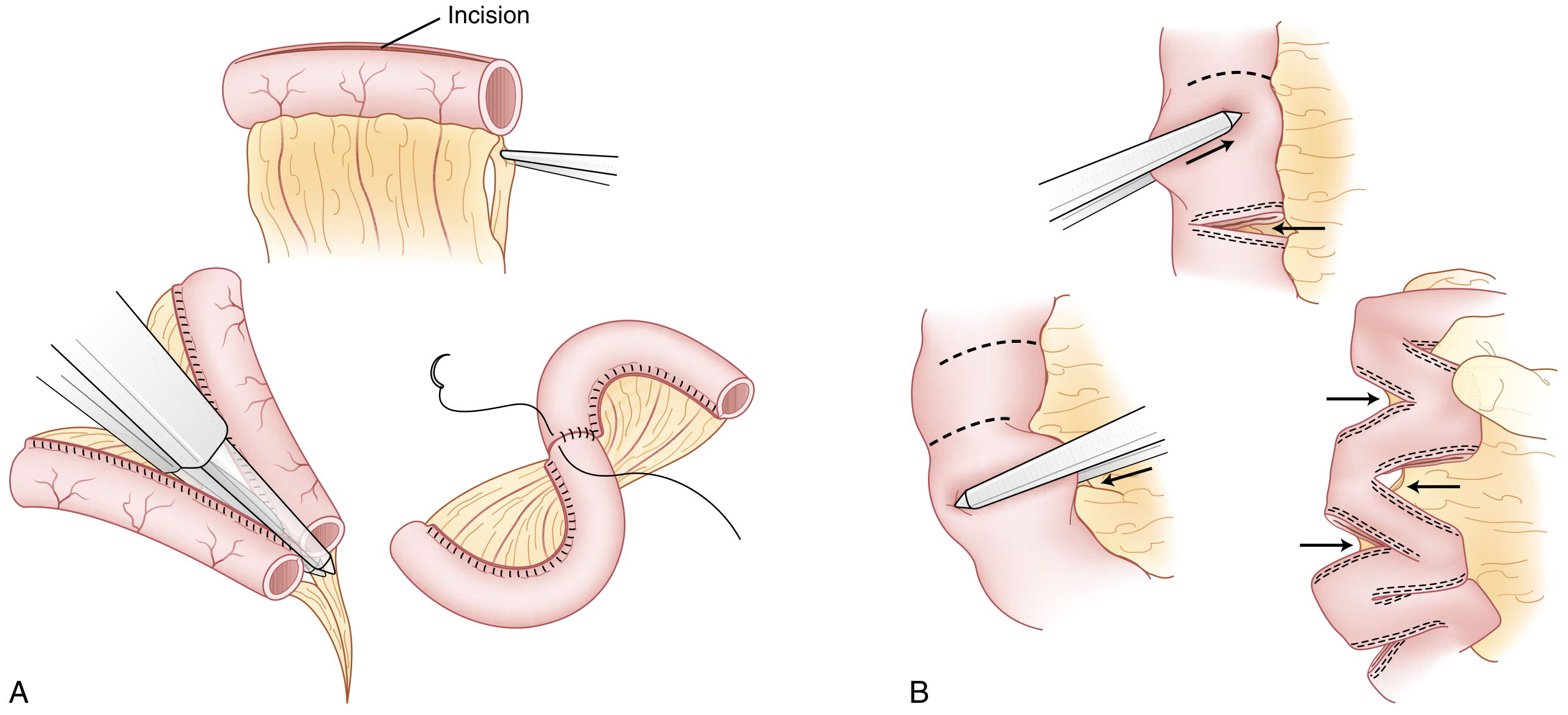
- Sabiston Textbook of Surgery, p. 2686
Restoration of Intestinal Continuity
- Among patients with stomas, restore continuity whenever possible to maximize absorptive surface
Intestinal Transplantation
Indications (life-threatening complications of intestinal failure or long-term TPN):
- Impending or overt liver failure (TPN-associated cholestasis/cirrhosis)
- Thrombosis of major central veins (loss of venous access)
- Frequent catheter-related sepsis (recurrent CRBSI)
- Frequent episodes of severe dehydration
Types of intestinal transplants:
- Intestine-alone: 37%
- Intestine + liver + pancreas: 30%
- Intestine + liver: 24%
Home TPN, when successfully maintained, can extend life expectancy by 10-20 years; this makes liver failure timing from TPN cholestasis a key determinant of when to proceed to transplantation.
- Schwartz's Principles, p. 1282
Summary of Anatomic Outcomes and TPN Dependence
| Residual bowel | Colon status | TPN dependence risk |
|---|---|---|
| >100 cm + colon | Intact | Often achievable independence with medical therapy |
| <100 cm + colon | Intact | High risk, but colon provides caloric salvage via SCFA |
| <100 cm, no colon | Jejunostomy | Near-certain long-term PN dependence |
| <60 cm + colon | Intact | Likely lifelong TPN |
| 35-40 cm | Any | 50% probability of TPN weaning |
Key Points Summary
- SBS = malabsorption from <200 cm residual small bowel; intestinal failure = PN dependence, typically <100 cm without colon
- Most common adult cause: Crohn's disease; pediatric: NEC
- Severity determined by: length, site of resection (ileum > jejunum), colon presence, ileocecal valve, bowel health
- Ileal resection is uniquely devastating (B12, bile salts, GLP-2 loss)
- Colon salvages fluid and calories (SCFAs); its presence significantly changes management
- Intestinal adaptation takes 1-2 years (up to 5 years); requires luminal nutrients - early oral/enteral feeding is mandatory
- Citrulline >20 μmol/L predicts nutritional autonomy
- Teduglutide (GLP-2 analogue) is the only FDA-approved SBS-specific pharmacotherapy; averages 20% PN reduction
- Bowel-lengthening procedures (STEP/Bianchi) used for dilated bowel in pediatric patients
- Transplantation reserved for life-threatening TPN complications
Sources: Sleisenger & Fordtran's Gastrointestinal and Liver Disease, Harrison's Principles of Internal Medicine 22E, Schwartz's Principles of Surgery 11E, Sabiston Textbook of Surgery, Goldman-Cecil Medicine International Edition, Yamada's Textbook of Gastroenterology
This is a shared conversation. Sign in to Orris to start your own chat.