
clicking sound between patella and knee
Reading File
Now let me search the medical library and web in parallel for patellar crepitus / clicking sounds at the knee.
Finding Sources
Finding Sources
Searching the Web
clicking sound between patella and knee causes crepitus patellofemoral
Finding Sources
Finding Sources
Reading File
Reading File
Searching PubMed
patellofemoral crepitus knee clicking
I have good content from the textbooks. Let me fetch the chondromalacia image and search for more on plica syndrome and osteoarthritis of the knee joint.
Loading Image
Finding Sources
Reading File
Reading File
I now have comprehensive textbook content. Let me also get the chondromalacia section from S. Das to capture clinical details on crepitus and clicking.
Reading File
I now have thorough content. Here is a comprehensive answer:
Clicking Sound at the Patellofemoral Joint (Patellar Crepitus)
A clicking, grinding, or popping sensation felt between the patella and the knee is called patellar crepitus (or patellofemoral crepitus). It has several possible causes ranging from benign to pathological.
What Produces the Sound?
The patella glides along the trochlear groove of the femur during flexion/extension. Anything that disrupts smooth cartilage contact — roughness, softening, loose tissue, or malalignment — can produce audible or palpable clicking and grinding.
"During active or passive movement, the palm of one hand placed over the patella, crepitus will be felt if osteoarthritis has involved the patellofemoral joint." — S. Das, Manual on Clinical Surgery
Main Causes
1. Chondromalacia Patellae (most common in young adults)
- Pathology: Softening, fissuring, and fibrillation of the articular cartilage on the posterior surface of the patella; a "kissing lesion" may form on the opposing femoral condyle.
- Who: Young adults, especially females.
- Symptoms: Anterior knee pain worsened by stair climbing, prolonged sitting ("theater sign"), kneeling; knee may give way. Occasional swelling.
- Exam: Tenderness at patellar margin; crepitus when the patella is pushed medially/laterally against the femoral condyles; patellar grind test positive (pain with anterior-posterior pressure on the patella while the patient contracts the quadriceps).
- Note: The term has largely been replaced by patellofemoral pain syndrome (PFPS) clinically, as the correlation between cartilage pathology and symptoms is imprecise. Definitive diagnosis requires arthroscopy (ragged cartilage appearance).
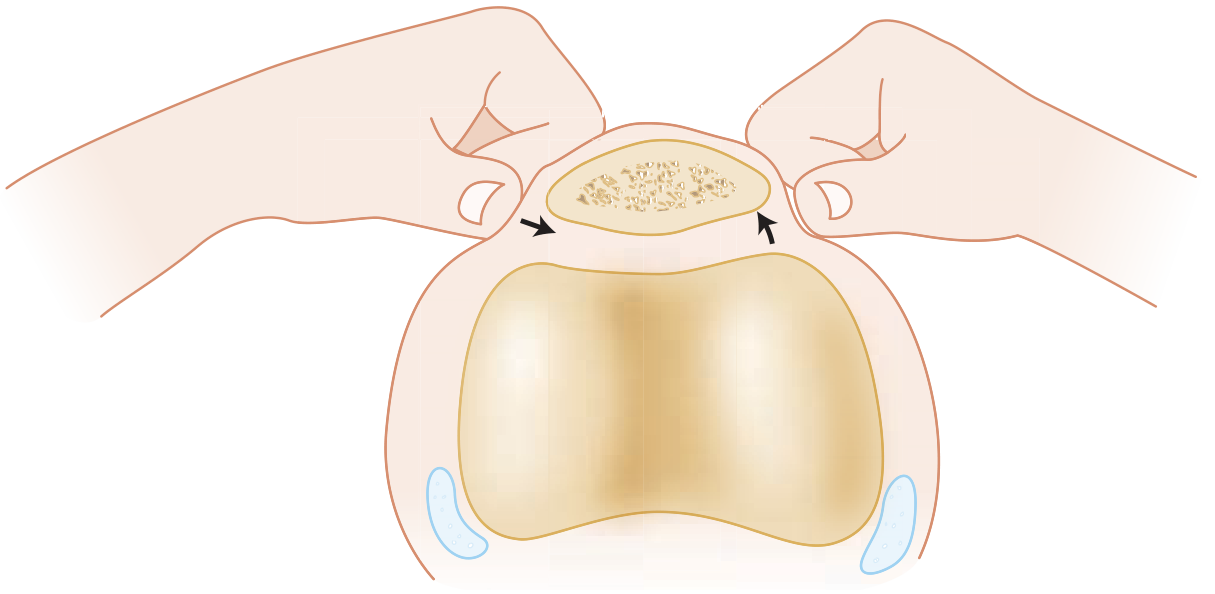
Palpation of the undersurface of the patella elicits tenderness in chondromalacia.
2. Patellofemoral Pain Syndrome (PFPS)
- Most common cause of knee pain overall, especially in 20s–30s, women > men.
- Mechanism: Altered patellofemoral tracking due to quadriceps weakness (especially vastus medialis), hip abductor weakness, patellar subluxation, or malalignment.
- Symptoms: Gradual-onset anterior knee pain; worse going up/down stairs, squatting, prolonged sitting; clicking or grinding is common.
- Risk factors: Gluteal weakness, quadriceps weakness, patellar subluxation, prepatellar bursitis, arthritis, meniscal tears, quadriceps/patellar tendinopathy.
- Diagnosis: Clinical; knee X-rays to assess patellofemoral joint space and rule out osteoarthritis.
- — Rosen's Emergency Medicine
3. Osteoarthritis of the Patellofemoral Joint
- Pathology: Progressive cartilage loss; the commonest intra-articular source of clicking in older adults.
- Exam: Crepitus palpable (and sometimes audible) with passive flexion/extension while the palm rests over the patella.
- X-ray: Narrowing of patellofemoral joint space; osteophytes.
4. Medial Plica Syndrome
- Plica are embryological remnant folds of synovial tissue inside the knee that normally disappear; when they persist and become thickened (often after repetitive activity or synovitis), they snap over the medial femoral condyle.
- Symptoms: Medial knee pain, a snapping sensation (sometimes a visible snap) with repeated flexion/extension; palpable band parallel to the medial border of the patella.
- Diagnosis: Confirmed by MRI or arthroscopy.
- Treatment: Conservative (strengthening, stretching); arthroscopic resection if refractory.
- — Tintinalli's Emergency Medicine
5. Extra-articular Causes (dull thud, not a sharp click)
- Tendons snapping over bony prominences: medial hamstring tendon over the medial condyle, biceps femoris tendon over the fibular head, or iliotibial band over the lateral condyle.
- Tendon snapping over an exostosis (bony outgrowth).
- These typically produce a dull thud rather than a sharp intra-articular click.
6. Normal / Benign Crepitus
- In children and adolescents, a painless click as the patella moves over the condyle can occur in a completely normal joint and requires no treatment.
- Gas cavitation within the joint (like knuckle-cracking) is also benign.
Outerbridge Classification of Articular Cartilage Damage
(used in chondromalacia staging at arthroscopy)
| Grade | Finding |
|---|---|
| I | Softening/swelling of cartilage |
| II | Fragmentation/fissuring < 1.3 cm |
| III | Fragmentation/fissuring > 1.3 cm, not down to bone |
| IV | Erosion down to subchondral bone |
Clinical Assessment
| Feature | Suggests |
|---|---|
| Young woman, pain on stairs/sitting | Chondromalacia / PFPS |
| Medial snapping band, activity-related | Plica syndrome |
| Older patient, bilateral, bony enlargement | Patellofemoral osteoarthritis |
| Snapping lateral knee with running | IT band syndrome |
| Painless click in child | Normal variant |
| Locking + clicking + swelling after activity | Loose body (osteochondritis dissecans) |
Management Principles
| Approach | Details |
|---|---|
| Physical therapy | Cornerstone — quadriceps strengthening (especially VMO), hip abductor strengthening |
| NSAIDs | Short-term for pain relief to allow PT |
| Bracing/taping | Patellar bracing or McConnell taping (evidence mixed) |
| Activity modification | Avoid aggravating activities during acute phase |
| Arthroscopy | Reserved for refractory cases, loose bodies, or plica resection |
Key point: Crepitus alone (without pain, swelling, or functional limitation) at the patellofemoral joint is not necessarily pathological — it may reflect minor cartilage surface irregularity or normal variation, particularly in the absence of other symptoms. Investigation and treatment are guided by pain and functional impact.
— Sources: Rosen's Emergency Medicine; Tintinalli's Emergency Medicine; S. Das, Manual on Clinical Surgery; Miller's Review of Orthopaedics
This is a shared conversation. Sign in to Orris to start your own chat.