
Elisa
Hey there! How can I help you today? Are you looking for information about the name Elisa, a person named Elisa, or something else entirely? Let me know what you have in mind!
ELISA
ELISA (Enzyme-Linked Immunosorbent Assay) is a plate-based immunological technique used to detect and quantify proteins, antibodies, hormones, and other molecules. It works by using antibodies linked to enzymes that produce a measurable signal when bound to a target antigen. It is one of the most widely used diagnostic and research tools in medicine and biology.
Searching sources...
Reading File
Searching the Web
ELISA enzyme-linked immunosorbent assay types principle procedure
Finding Sources
Reading File
Reading File
Loading Image
Loading Image
Reading File
Here is a thorough breakdown of ELISA (Enzyme-Linked Immunosorbent Assay):
ELISA - Enzyme-Linked Immunosorbent Assay
What is it?
ELISA is a plate-based immunological technique used to detect and quantify specific proteins, antibodies, hormones, cytokines, and other molecules. It belongs to the broader category of enzyme immunoassays (EIA). Unlike radioimmunoassay (RIA), ELISA uses a non-radioactive enzyme label, making it safer and easier to perform while still achieving very high sensitivity.
- Janeway's Immunobiology 10e, p. 822
Core Principle
The basic principle relies on three elements:
- Solid-phase capture - one partner (antigen or antibody) is coated onto plastic microtiter plate wells
- Antibody-enzyme conjugate - an antibody linked to an enzyme (e.g., horseradish peroxidase or alkaline phosphatase) binds the target
- Colorimetric detection - the enzyme converts a colorless substrate into a colored product, measured spectrophotometrically (absorbance reading)
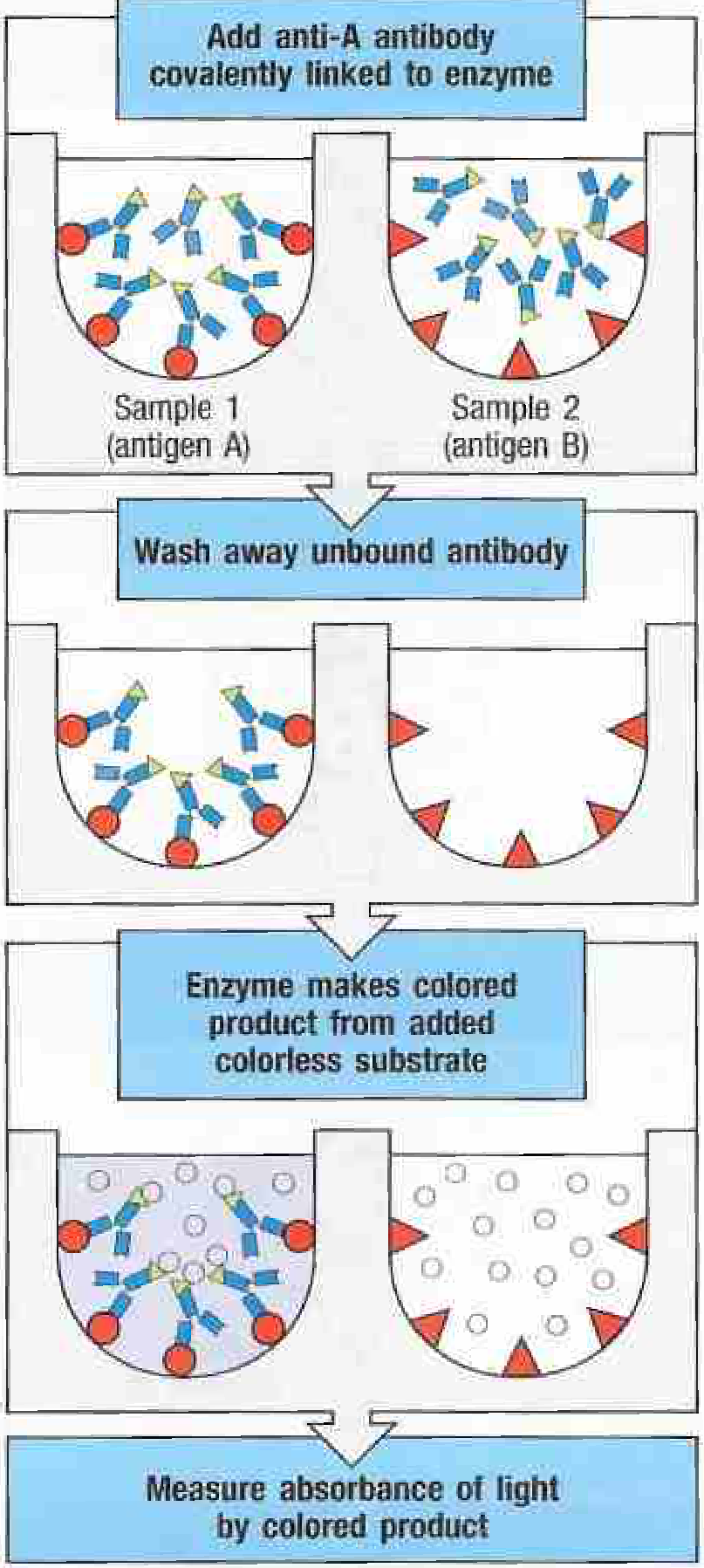
Fig. A.5 - The principle of ELISA. Sample 1 (antigen A present) retains labeled antibody, producing a color change. Sample 2 (antigen B, no binding) remains colorless after washing. - Janeway's Immunobiology 10e
Types of ELISA
| Type | How it works | Best for |
|---|---|---|
| Direct ELISA | Antigen coated to plate; enzyme-linked primary antibody added directly | Screening antigens; quick turnaround |
| Indirect ELISA | Antigen coated to plate; unlabeled primary antibody binds; enzyme-linked secondary antibody detects it | Detecting antibodies in serum (e.g., HIV Ab testing); signal amplified |
| Sandwich (Capture) ELISA | Capture antibody coated to plate; antigen binds; detection antibody added; enzyme-linked secondary antibody detects | Cytokines, antigens in low concentrations; high specificity |
| Competitive ELISA | Labeled and unlabeled antigens compete for a fixed amount of antibody; more unlabeled = less signal | Measuring antigens in complex, unknown samples |
The sandwich ELISA is particularly powerful because it traps antigen between two antibodies - each recognizing a different epitope - greatly increasing specificity. It can detect even very low concentrations of antigen.
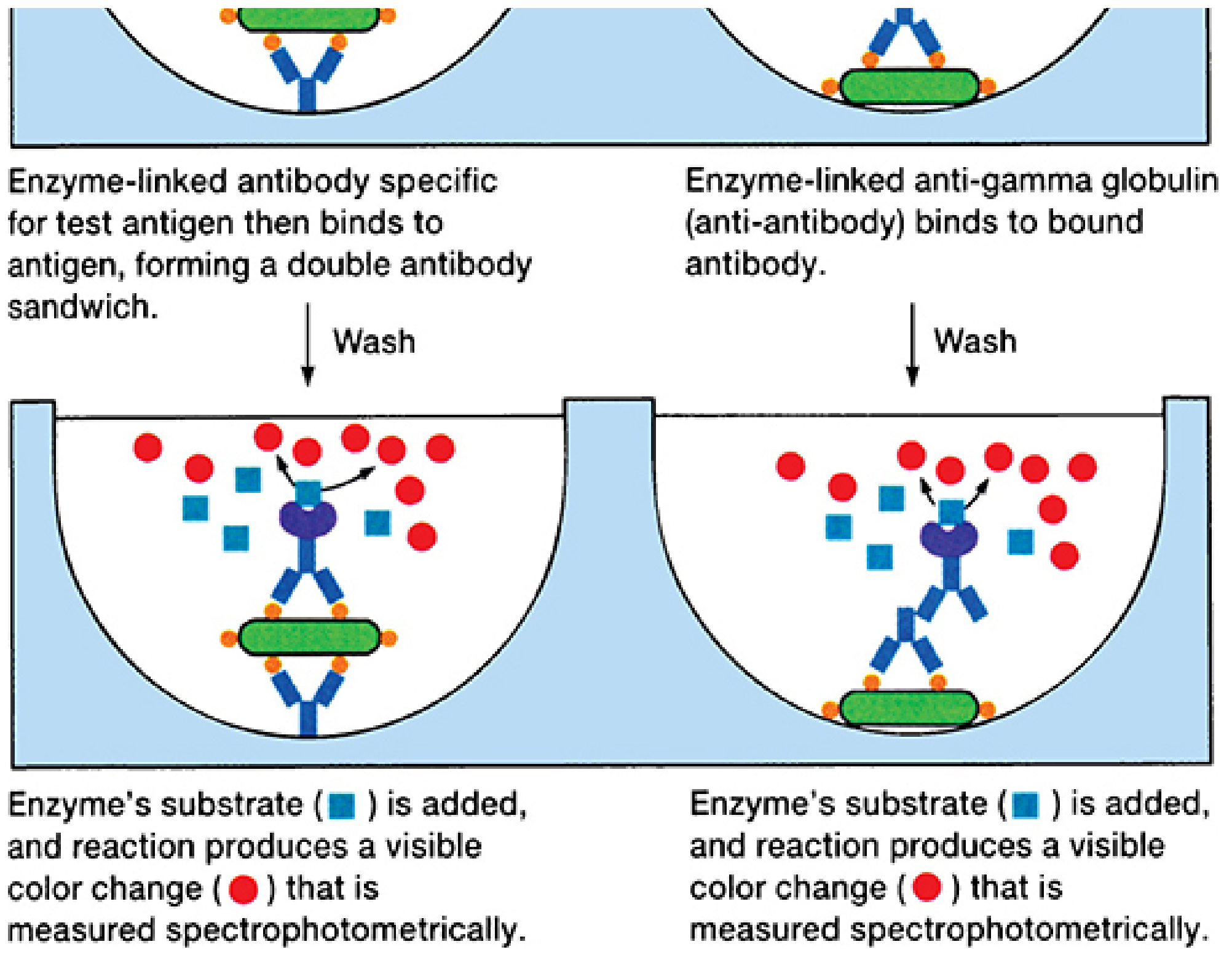
Fig. 4-7. A: Sandwich (double antibody) method for antigen detection. B: Indirect assay for antibody detection. - Sherris & Ryan's Medical Microbiology, 8e
Step-by-Step Procedure (Basic Direct ELISA)
- Coat - Antigen adsorbed to plastic wells of a 96-well microtiter plate
- Block - Add irrelevant protein (e.g., BSA) to block nonspecific binding sites
- Incubate - Add enzyme-conjugated antibody specific to the antigen
- Wash - Remove unbound antibody
- Add substrate - Enzyme converts colorless substrate to colored product
- Stop reaction - Add stop solution (e.g., H2SO4)
- Read - Measure absorbance (OD) in a plate reader; color intensity is proportional to antigen concentration
Key Enzymes Used
- Horseradish peroxidase (HRP) - most common; uses TMB substrate (turns blue, then yellow after stop)
- Alkaline phosphatase (AP) - uses pNPP substrate (turns yellow)
Clinical & Research Applications
| Application | Example |
|---|---|
| Infectious disease diagnosis | HIV antibody detection (indirect ELISA used in screening) |
| Viral diagnostics | Detecting HIV p24 antigen |
| Hormone measurement | hCG (pregnancy tests), insulin, thyroid hormones |
| Autoimmune disease | Detecting anti-dsDNA, anti-BP180 antibodies in bullous pemphigoid |
| Cytokine quantification | IL-6, TNF-alpha in research |
| Drug testing | Screening for drugs of abuse |
| Food safety | Allergen detection |
Advantages
- No radioactivity (safer than RIA)
- High sensitivity and specificity
- Amenable to automation and batch testing
- Results readable directly in the reaction tray
- Quantitative (via standard curve)
- 96-well format allows high-throughput screening
Signal Amplification
A second-layer approach uses enzyme-linked anti-immunoglobulin antibodies (secondary antibodies) after the primary antibody binds. This amplifies the signal because multiple secondary antibody molecules bind each primary antibody, increasing sensitivity significantly. - Janeway's Immunobiology 10e, p. 822
ELISA vs RIA
| Feature | ELISA | RIA |
|---|---|---|
| Label | Enzyme | Radioactive isotope (¹²⁵I) |
| Safety | Safe | Radiation hazard |
| Detection | Colorimetric | Scintillation counting |
| Sensitivity | Very high | Slightly higher |
| Preferred use | Most diagnostic/research | Some hormone assays |
ELISA has largely replaced RIA in most clinical and research settings due to its safety profile and ease of use.
This is a shared conversation. Sign in to Orris to start your own chat.