
Give me a 10marks answer about TEC-6 Vaporizers from standard textbooks for AIIMS md anaesthesia exams
Reading File
Now let me search the library for TEC-6 vaporizer content across all anaesthesia textbooks in parallel.
Finding Sources
Finding Sources
Excellent results. Now let me read the key sections from both Miller's and Barash in parallel.
Reading File
Reading File
Excellent content. Let me read more of the Barash section (factors affecting output, altitude, tipping) and more of Miller's.
Reading File
Reading File
Good content. Let me also read the Barash section on factors/altitude/safety and the rest of Miller's safety features section.
Reading File
Reading File
I now have comprehensive content from both Miller's Anesthesia (10e) and Barash's Clinical Anesthesia (9e). Let me also fetch the schematic diagram from Barash to include in the answer.
Loading Image
Reading File
I now have all the content needed for a comprehensive 10-mark answer. Let me compile the full structured answer.
Tec-6 Vaporizer - 10 Marks Answer (AIIMS MD Anaesthesia)
(Sources: Miller's Anesthesia 10e, Ch. 20; Barash's Clinical Anesthesia 9e, Ch. 25)
Introduction
The Tec-6 (Datex-Ohmeda) is an electrically heated, pressurized vaporizer specifically designed for the delivery of desflurane. Introduced into clinical use in the early 1990s, it is more accurately described as a dual-gas blender than a conventional vaporizer. The Dräger D-Vapor is a later equivalent device operating on the same principles; both received FDA approval (D-Vapor in 2004).
Why Desflurane Cannot Be Used in a Variable Bypass Vaporizer
Desflurane's unique physical properties make it unsuitable for variable bypass vaporizers for three reasons:
| Reason | Explanation |
|---|---|
| Boiling point | 22.8°C (73°F) at 1 atm - at the upper range of normal OR temperatures. Boiling inside a variable bypass vaporizer would make output completely uncontrolled. |
| High vapor pressure | SVP = 669 mmHg at 20°C (almost 1 atm). To achieve a clinical output of 6% (approx. 1 MAC), a prohibitively high bypass flow of ~12 L/min would be required. |
| Excessive evaporative cooling | MAC for desflurane is 6-7%, which is 4-9 times higher than other agents. Vaporizing large quantities causes severe cooling that mechanical temperature compensation cannot overcome. |
(Miller's Anesthesia 10e, p. 2299; Barash 9e, p. 1983)
Operating Principles of the Tec-6
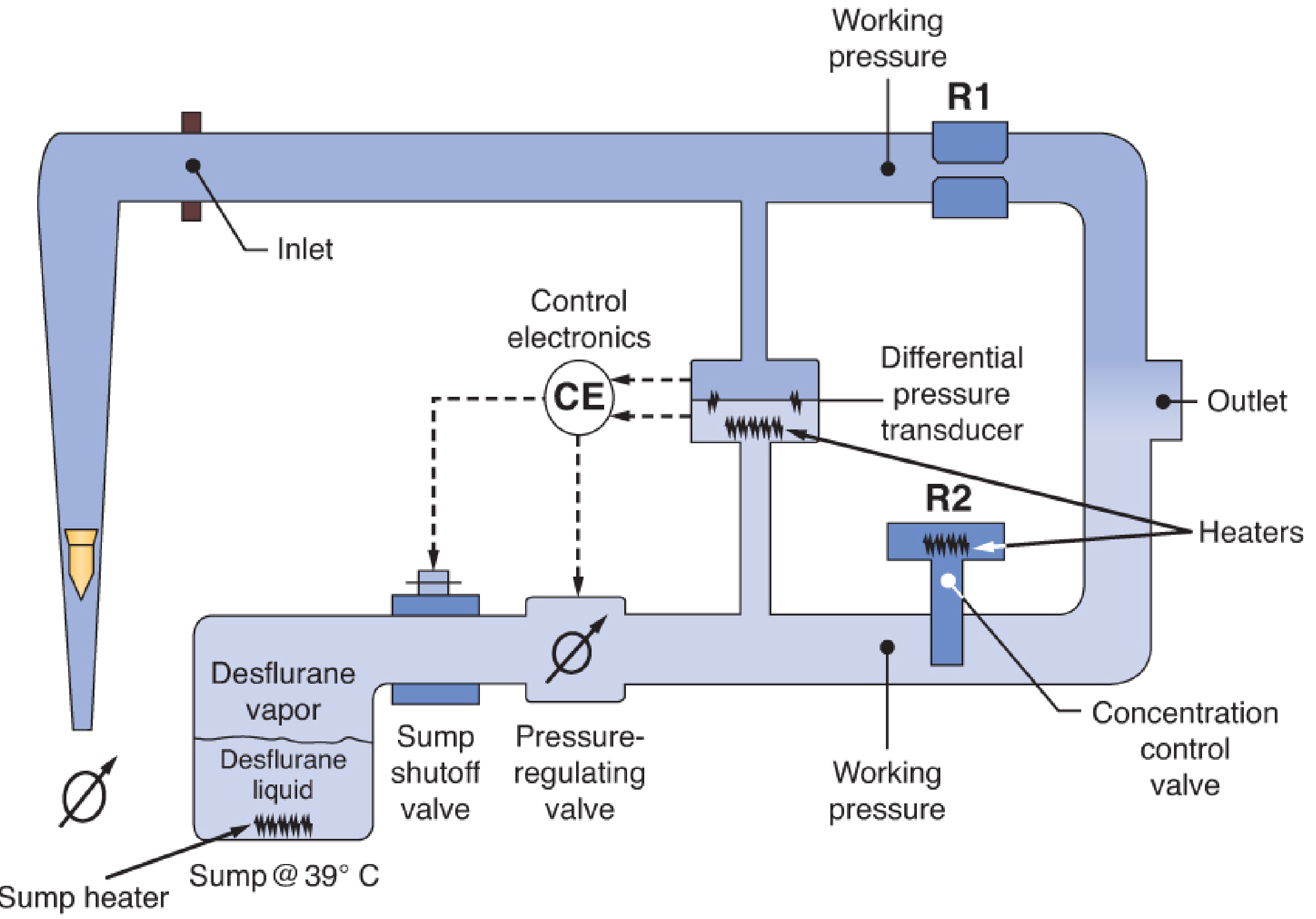
Figure: Simplified schematic of the Tec 6 desflurane vaporizer (from Barash's Clinical Anesthesia 9e, Fig. 25-26)
Two Independent Parallel Gas Circuits
1. Fresh Gas Circuit (orange/dark gray):
- Fresh gas from the flowmeters enters the fresh gas inlet
- Passes through a fixed restrictor (R1)
- Exits at the vaporizer gas outlet
2. Vapor Circuit (blue/light gray):
- Originates at the desflurane sump
- The sump is electrically heated to 39°C (well above desflurane's boiling point of 22.8°C)
- At 39°C, vapor pressure in the sump = approximately 1,300-1,500 mmHg (about 2 atm absolute)
- A shut-off valve just downstream (fully closed when dial is off, fully open when on)
- A pressure-regulating valve downregulates desflurane vapor pressure to match the fresh gas circuit pressure (~74 mmHg gauge at 10 L/min FGF)
- The operator adjusts the concentration control valve (R2) - a variable restrictor - to set the desired output concentration
- Desflurane vapor from R2 joins the fresh gas from R1 downstream of both restrictors
Pressure-Matching Mechanism (The Key Innovation)
- When fresh gas flows through the fixed restrictor R1, a backpressure proportional to FGF rate is generated
- This pushes against the diaphragm of the differential pressure transducer
- The transducer relays pressure difference between the two circuits to the control electronics system (CE)
- The CE adjusts the pressure-regulating valve so that the vapor circuit pressure equals the fresh gas circuit pressure - this is the "working pressure"
- Working pressure is linear with FGF rate (Table):
| FGF Rate (L/min) | Working Pressure (mbar) | Working Pressure (mmHg) |
|---|---|---|
| 1 | 10 | 7.4 |
| 5 | 50 | 37.0 |
| 10 | 100 | 74.0 |
- If FGF increases at a constant dial setting, working pressure increases proportionally, so more desflurane flows through R2, maintaining constant output concentration
(Miller's Anesthesia 10e, p. 2300-2302; Barash 9e, p. 1984-1985)
Factors Affecting Tec-6 Output
1. Barometric Pressure / Altitude
This is a critical difference from variable bypass vaporizers:
- Variable bypass vaporizers (Tec-5, Tec-7, Dräger Vapor 2000): at high altitude, volume% output increases but partial pressure (anesthetic potency) remains nearly constant - they are inherently altitude-compensated
- Tec-6 maintains constant volume% output regardless of ambient pressure (because it is a gas blender mixing fixed proportions)
- Therefore, at high altitude, the partial pressure of desflurane FALLS in proportion to atmospheric pressure / calibration pressure (760 mmHg):
Partial pressure at altitude = (Atmospheric pressure / 760) × Dial setting (vol%) × 760
- At altitude (low atmospheric pressure): underdosing - anesthetic depth is reduced
- In hyperbaric conditions: desflurane partial pressure increases - risk of overdose
- Clinically: at high altitude, the dial setting must be increased to achieve equivalent anesthetic depth
(Miller's Anesthesia 10e, p. 2303; Barash 9e, p. 1988-1989)
2. Carrier Gas Composition
- Nitrous oxide has lower viscosity than oxygen
- At low FGF rates with high N₂O concentrations, less backpressure is generated across R1
- Working pressure decreases → less desflurane flows through R2
- Net effect: reduced vaporizer output at low FGF with high N₂O - can be clinically significant
- At high FGF rates, this effect is minimal
(Miller's Anesthesia 10e, p. 2303; Barash 9e)
3. Fresh Gas Flow Rate
The Tec-6 compensates automatically for FGF changes via the pressure-matching mechanism. The working pressure adjusts proportionally, keeping concentration output constant across a wide FGF range.
Safety Features
The shut-off valve on the sump closes automatically (output is terminated) and a no-output alarm is activated under any of these conditions:
- Low anesthetic level - desflurane falls below the low alarm threshold
- Tipping - vaporizer is tilted (eliminating the danger seen with older vaporizers)
- Power failure - electrical failure defaults to no output (fail-safe)
- Pressure mismatch - the pressure difference between vapor and fresh gas circuits exceeds a specified tolerance
Additional safety features:
- Agent-specific filling nozzle - prevents accidental filling with other agents (misfilling with desflurane into a variable bypass vaporizer could cause overdose or hypoxic mixture due to vapor pressure near 1 atm)
- Warm-up period required - the sump must reach 39°C before the shut-off valve opens; typically takes a few minutes
- The design essentially eliminates the danger of tipping (unlike older wick-type vaporizers)
(Miller's Anesthesia 10e, p. 2303-2304; Barash 9e)
Summary Comparison: Tec-6 vs. Variable Bypass Vaporizer
| Feature | Variable Bypass (e.g., Tec-5/7) | Tec-6 (Desflurane) |
|---|---|---|
| Principle | Flow-splitting through vaporizing chamber | Dual-gas blending |
| Heat source | Ambient heat + thermal compensation | Electrical heating to 39°C |
| Pressurized | No | Yes (~1,300-1,500 mmHg in sump) |
| Temperature compensation | Bimetallic strip / expansion element | Electronic (thermostatically controlled) |
| Altitude effect on vol% | Increases | Constant |
| Altitude effect on partial pressure | Near constant | Decreases (clinically significant) |
| Power requirement | None | Required (electric) |
| Suitable agents | Halothane, isoflurane, sevoflurane, enflurane | Desflurane only |
| Tipping hazard | Yes (older models) | No (shut-off valve) |
Key Points for Exam
- Tec-6 is a dual-gas blender, not a true vaporizer
- Sump heated to 39°C → vapor pressure ~1,300-1,500 mmHg
- Pressure-matching via differential pressure transducer + control electronics is the central mechanism
- At high altitude: constant vol% output but falling partial pressure → must increase dial setting
- At high N₂O + low FGF: reduced output due to lower working pressure
- Safety: shut-off valve + alarm for low level, tipping, power failure, pressure mismatch
- D-Vapor (Dräger) is the equivalent alternative - same principles, FDA approved 2004
(Miller's Anesthesia 10e, pp. 2299-2304; Barash's Clinical Anesthesia 9e, pp. 1983-1990)
This is a shared conversation. Sign in to Orris to start your own chat.