
Steroid resistant nephrotic syndrome caused by mutation in gene encoding.
Reading File
Steroid-resistant nephrotic syndrome (SRNS) is caused by mutations in genes encoding structural and regulatory proteins of the glomerular filtration barrier, particularly the podocyte slit diaphragm.
Searching sources...
Finding Sources
Finding Sources
Searching PubMed
"steroid-resistant nephrotic syndrome" AND "genetic mutations"
Now let me get the detailed content from the key sections:
Reading File
Reading File
Reading File
Finding Sources
Reading File
Finding Sources
Reading File
Finding Sources
Now let me fetch the informative figures and get the comprehensive table:
Loading Image
Reading File
I now have comprehensive data from authoritative nephrology textbooks. Here is the complete answer:
Steroid-Resistant Nephrotic Syndrome (SRNS) - Genetic Causes
SRNS is caused by mutations in genes encoding proteins that maintain the integrity of the glomerular filtration barrier, particularly the podocyte slit diaphragm, podocyte cytoskeleton, and podocyte-GBM adhesion complex. A single-gene cause is identifiable in approximately 25-30% of SRNS cases.
Key Concept: Why These Mutations Cause Steroid Resistance
SRNS due to genetic mutations is not immune-mediated - the defect is structural, affecting the podocyte architecture. Steroids have no effect on a structurally defective slit diaphragm, which explains the resistance.
Genes and Their Encoded Proteins
GROUP 1 - Slit Diaphragm Proteins (Most Common)
| Gene | Protein Encoded | Inheritance | Disease / Notes |
|---|---|---|---|
| NPHS2 | Podocin | AR | Most common genetic cause of childhood SRNS (~18-30% of familial cases). Podocin is a 383-amino acid integral membrane protein at the slit diaphragm. R138Q mutation = severe phenotype; R229Q = late-onset FSGS |
| NPHS1 | Nephrin | AR | Classic congenital nephrotic syndrome (Finnish type); nephrin forms the zipper-like slit diaphragm structure. Over 200 mutations described |
| CD2AP | CD2-associated protein | AR/AD | Scaffolding molecule at slit diaphragm; interacts with nephrin and regulates actin cytoskeleton |
| PLCE1 | Phospholipase C epsilon 1 | AR | Early-onset SRNS with diffuse mesangial sclerosis; important in podocyte development |
| FAT1 | FAT protocadherin 1 | AR | Slit diaphragm component; causes glomerular and tubular ectasia |
| MAGI-2 | Membrane-associated guanylate kinase inverted 2 | AR | Slit diaphragm scaffolding protein; binds nephrin |
GROUP 2 - Podocyte Cytoskeletal Proteins
| Gene | Protein Encoded | Inheritance | Disease / Notes |
|---|---|---|---|
| ACTN4 | Alpha-actinin-4 | AD | Actin cross-linking protein; late-onset proteinuria with slow progression; mutations in the actin-binding domain alter cytoskeletal dynamics |
| INF2 | Inverted formin-2 | AD | Formin (actin regulatory protein); among the most common forms of AD FSGS (>45 mutations); subset also have Charcot-Marie-Tooth disease |
| TRPC6 | Transient receptor potential cation channel 6 | AD | Calcium-permeable cation channel in podocytes; interacts with nephrin and podocin; adult-onset FSGS |
| MYO1E | Myosin 1E | AR | Non-muscle myosin; actin motor protein in podocytes |
GROUP 3 - Podocyte-GBM Adhesion
| Gene | Protein Encoded | Inheritance | Notes |
|---|---|---|---|
| LAMB2 | Laminin beta-2 | AR | GBM component; early-onset; Pierson syndrome (nephrotic syndrome + ocular defects) |
| ITGB4 | Integrin beta-4 | AR | Recessive; associated with epidermolysis bullosa + congenital nephrosis |
| ITGA3 | Integrin alpha-3 | AR | Gain of glycosylation mutation; nephrosis + interstitial lung disease |
| CD151 | Tetraspanin CD151 | AR | Modulates integrin-laminin interactions |
GROUP 4 - Transcription Factors
| Gene | Protein Encoded | Inheritance | Notes |
|---|---|---|---|
| WT1 | Wilms tumor suppressor 1 | AD/AR | Biphasic onset: peaks at 4-12 months AND >18 years; associated with Denys-Drash syndrome and Frasier syndrome |
GROUP 5 - Nuclear Pore Proteins (Rare)
| Gene | Protein Encoded | Inheritance | Notes |
|---|---|---|---|
| NUP93 | Nucleoporin 93 | AR | Recessive early-onset SRNS; can present with microcephaly |
| NUP107 | Nucleoporin 107 | AR | Similar phenotype; links to Galloway-Mowat syndrome |
| NUP205 | Nucleoporin 205 | AR | Early-onset SRNS |
| XPO5 | Exportin-5 | AR | Rare cause of SRNS |
GROUP 6 - Coenzyme Q Biosynthesis (Mitochondrial)
| Gene | Protein Encoded | Notes |
|---|---|---|
| COQ2, COQ6, ADCK4, PDSS2 | CoQ biosynthesis enzymes | Rare mitochondrial causes; importantly, CoQ10 supplementation can help in some CoQ-pathway mutations |
GROUP 7 - Rho GTPase Regulators
| Gene | Protein Encoded | Notes |
|---|---|---|
| ARHGDIA | Rho GDP-dissociation inhibitor alpha | Rare; affects Rho GTPase signaling in podocytes |
Age of Onset Pattern (Clinically Useful)
The chart below shows how gene mutations distribute by age of onset:
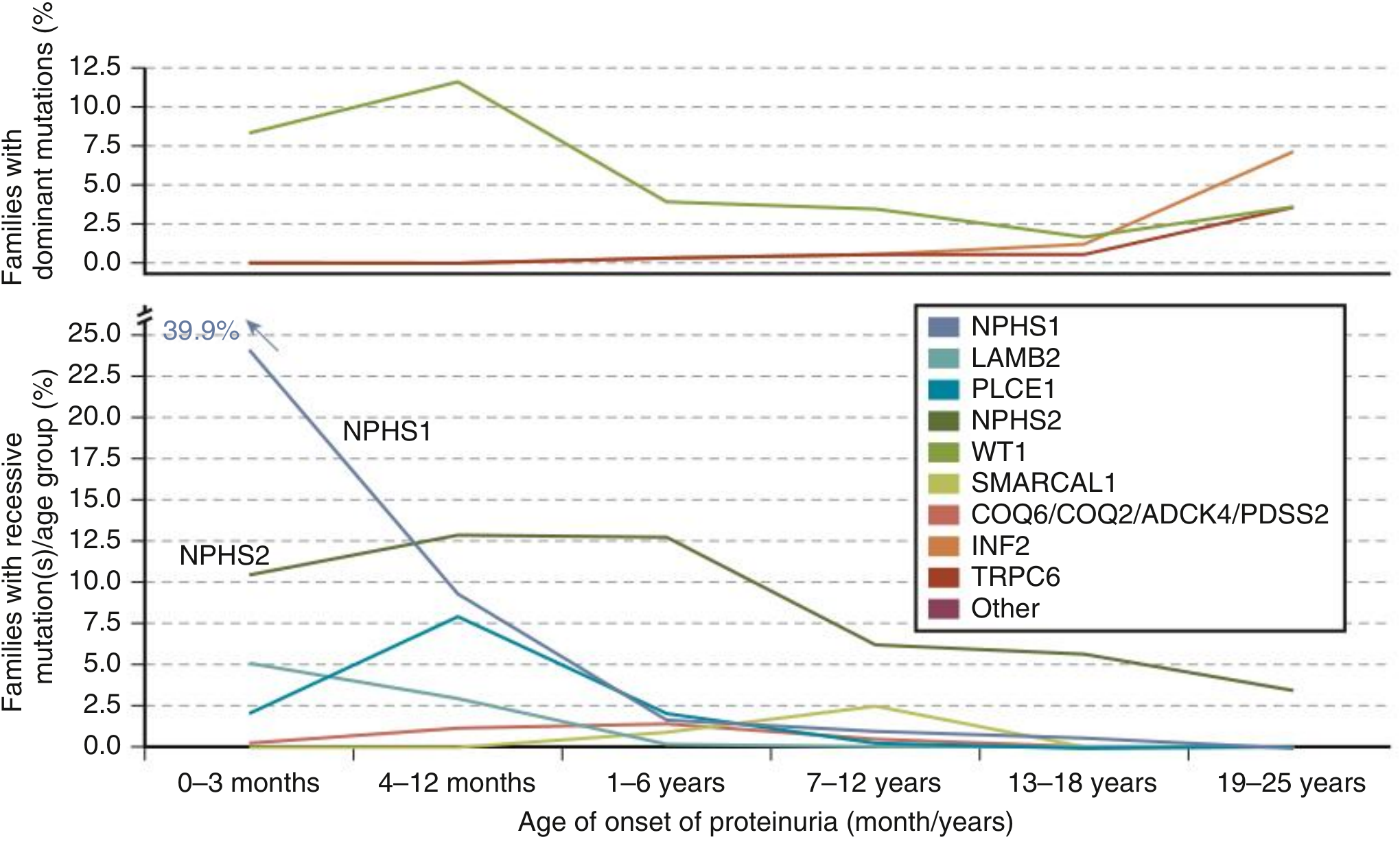
Key pattern:
- Neonatal/infantile (0-3 months): NPHS1 (nephrin) - 39.9% of this age group
- Infant to early childhood (0-6 years): NPHS1, LAMB2, PLCE1 - all recessive genes
- Childhood (1-6 years): NPHS2 (podocin) predominates
- Adolescent/young adult: INF2, TRPC6 (dominant genes rise)
- Bimodal: WT1 (peaks at 4-12 months and again >18 years)
- Recessive genes are more common in early-onset disease; dominant genes more common in adult-onset disease
Key Clinical Points
- NPHS2 mutations: Do NOT respond to steroids; treatment is ACE inhibitor/ARB + supportive care; transplant is NOT contraindicated; FSGS does not recur post-transplant
- NPHS1 mutations: FSGS does not recur, but anti-nephrin antibodies can cause proteinuria in the allograft
- Whole-exome sequencing identifies a causal mutation in ~25% of SRNS families across 20+ known genes (Warejko et al., CJASN 2018)
- Genetic SRNS should not receive aggressive immunosuppression (no benefit, potential harm)
Sources: Brenner and Rector's The Kidney, 2-Volume Set; Comprehensive Clinical Nephrology, 7th Edition; Robbins, Cotran & Kumar Pathologic Basis of Disease
This is a shared conversation. Sign in to Orris to start your own chat.