
Neuromuscular transmission and factors modifying the block . For md anaesthesia exam with possible viva questions .
Reading File
Now let me search the medical library for neuromuscular transmission and related topics in parallel.
Finding Sources
Finding Sources
Finding Sources
Reading File
Reading File
Finding Sources
Reading File
Reading File
Reading File
Reading File
Reading File
Finding Sources
Reading File
Finding Sources
Finding Sources
Finding Sources
Finding Sources
Loading Image
Loading Image
Reading File
I now have comprehensive content from Miller's Anesthesia and Morgan & Mikhail to construct a thorough MD anaesthesia exam answer. Let me compile the complete response.
Neuromuscular Transmission and Factors Modifying the Block
Sources: Miller's Anesthesia 10e; Morgan & Mikhail's Clinical Anesthesiology 7e
PART 1: ANATOMY OF THE NEUROMUSCULAR JUNCTION (NMJ)
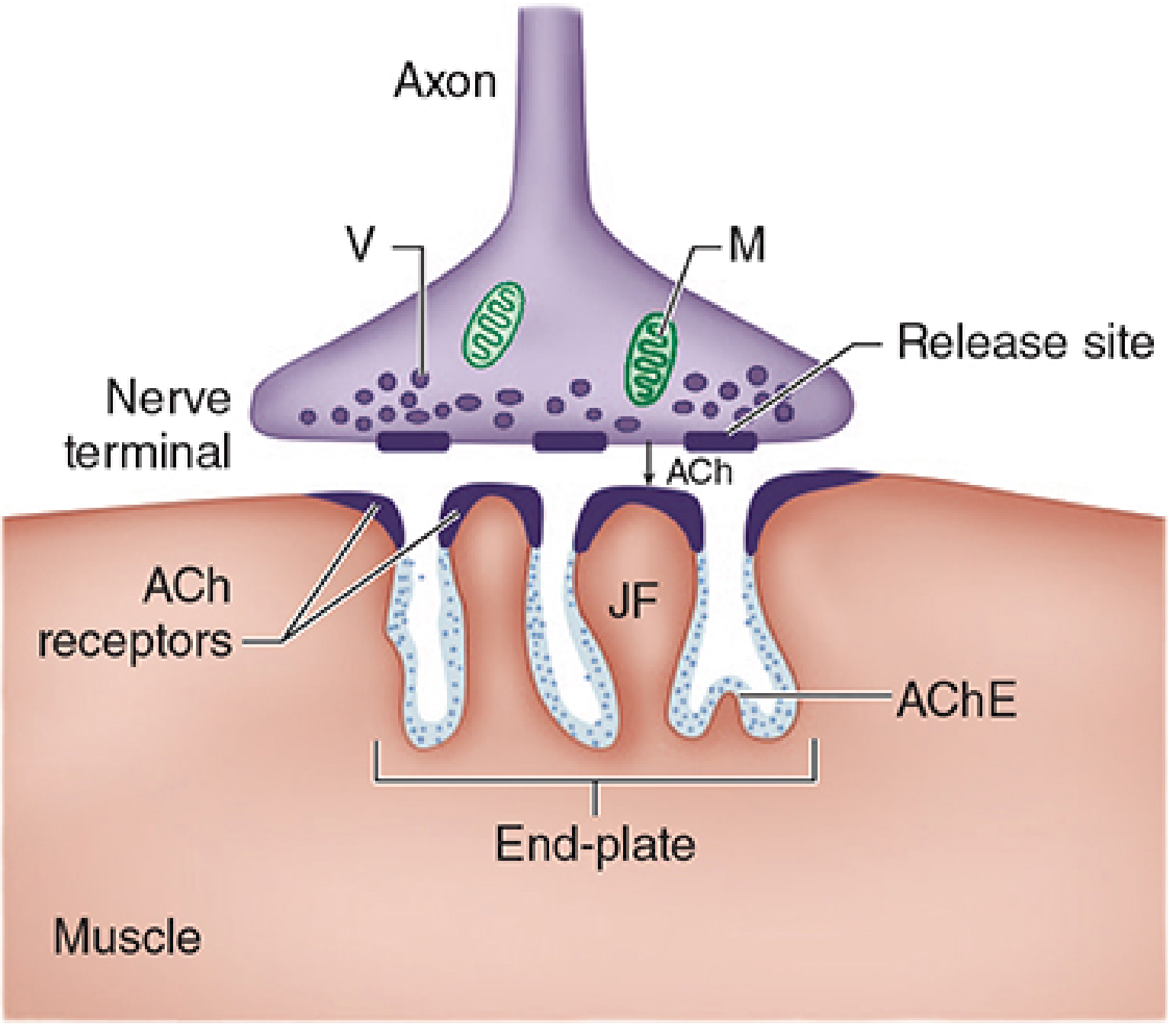
The NMJ is a tripartite synapse consisting of:
- The motor nerve terminal (presynaptic)
- The synaptic cleft (20 nm wide)
- The motor end-plate (postsynaptic muscle membrane)
Nerve terminal: Each motor neuron runs from the ventral horn of the spinal cord as a large myelinated axon. As it approaches the muscle, it branches to innervate many muscle fibers - forming a motor unit. The terminal loses its myelin and forms multiple presynaptic boutons. The nerve contains:
- ACh storage vesicles (~10,000 molecules/vesicle = one quantum)
- Mitochondria (for ACh synthesis)
- Active zones (release sites)
- Voltage-gated calcium channels
Synaptic cleft: Contains acetylcholinesterase (AChE) enzyme embedded in proteoglycans.
Motor end-plate: Highly corrugated membrane with junctional folds. The shoulders of the folds are densely packed with ~5 million nicotinic ACh receptors (nAChRs). Sodium channels are located at the depths of the folds. Only ~500,000 receptors need to be activated for normal muscle contraction - this constitutes a large safety margin of neuromuscular transmission.
PART 2: THE ACh RECEPTOR STRUCTURE
Each mature (junctional) nicotinic AChR is a pentameric glycoprotein with five subunits arranged around a central ion channel:
- 2 α subunits - the ACh-binding sites
- 1 β subunit
- 1 δ subunit
- 1 ε subunit (mature form) OR γ subunit (fetal/immature/extrajunctional form)
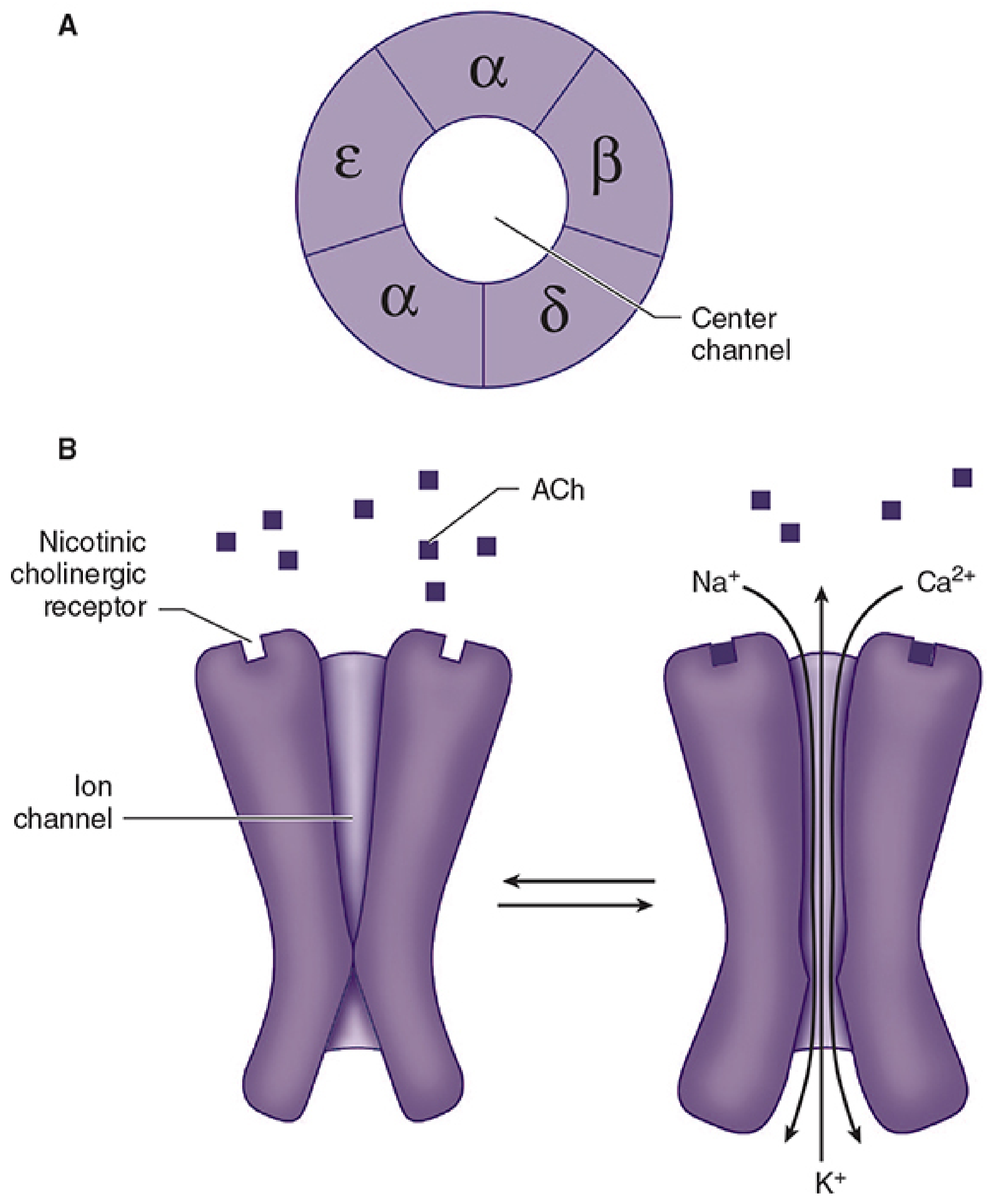
Key point: BOTH α-subunits must be simultaneously occupied by ACh for the channel to open. If only one is occupied, the channel remains closed. This is the basis for competitive antagonism by NDMRs.
Mature vs. Fetal/Immature receptors:
| Feature | Mature (Junctional) | Fetal/Extrajunctional |
|---|---|---|
| Subunits | 2α, β, δ, ε | 2α, β, δ, γ |
| Location | Restricted to NMJ | Entire muscle membrane |
| Channel open time | Short (1 ms) | Longer |
| Sensitivity to SCh | Normal | Increased (upregulated states) |
| Sensitivity to NDMRs | Normal | Decreased (resistant) |
| Expressed in | Normal adults | Fetal life, denervation, burns, immobilization, ICU myopathy |
PART 3: STEPS OF NEUROMUSCULAR TRANSMISSION
Step 1 - ACh Synthesis:
Choline + Acetyl-CoA → ACh (catalyzed by choline acetyltransferase in the nerve terminal). ACh is packaged into vesicles (~10,000 molecules/vesicle).
Step 2 - Action potential arrives at nerve terminal:
Depolarization of the nerve terminal opens voltage-gated calcium channels → Ca²⁺ influx into the nerve cytoplasm.
Step 3 - Vesicle fusion and ACh release:
Ca²⁺ triggers the SNARE protein complex → vesicles migrate to active zones, fuse with the presynaptic membrane, and release quanta of ACh into the cleft (exocytosis). One action potential releases ~200-300 quanta (~2-3 million ACh molecules).
Step 4 - ACh diffuses across the synaptic cleft (20 nm) to bind postjunctional nAChRs.
Step 5 - End-plate potential (EPP) generation:
ACh binds to both α-subunits → conformational change → ion channel opens for ~1 ms → Na⁺ and Ca²⁺ flow IN; K⁺ flows OUT → generates an EPP. Normally this is a suprathreshold event (large safety margin).
Step 6 - Muscle action potential and contraction:
The EPP propagates along the muscle membrane by opening voltage-gated Na⁺ channels (located in the depths of the junctional folds) → muscle action potential → excitation-contraction coupling → muscle contraction.
Step 7 - ACh hydrolysis:
AChE (in the synaptic cleft) rapidly hydrolyzes ACh → acetate + choline. Choline is taken up by the nerve terminal for re-synthesis. This terminates the signal.
Safety Margin of NMJ:
About 75-80% of receptors can be blocked before transmission fails. This is because the EPP is normally several times larger than the threshold needed for muscle action potential generation.
PART 4: PREJUNCTIONAL EFFECTS
Presynaptic (nerve terminal) receptors also play important roles:
- Presynaptic nicotinic (α3β2) receptors: positive feedback - facilitate ACh mobilization and release during high-frequency stimulation. NDMRs blocking these receptors contributes to fade on tetanic/TOF stimulation.
- Presynaptic muscarinic M1 receptors: facilitate ACh release
- Presynaptic muscarinic M2 receptors: inhibit ACh release (autoinhibition)
PART 5: MECHANISMS OF NEUROMUSCULAR BLOCK
A. Depolarizing Block (Phase I)
Agent: Succinylcholine (SCh)
Mechanism:
- SCh binds ACh receptors (is an agonist) and causes persistent depolarization of the end-plate
- Unlike ACh, SCh is NOT hydrolyzed by AChE (it is metabolized by plasma cholinesterase in the blood)
- Persistent end-plate depolarization → perijunctional Na⁺ channels undergo inactivation (time-dependent gate closure) → muscle cannot respond to further stimulation → flaccid paralysis
Characteristics of Phase I block:
- Preceded by fasciculations
- No fade on TOF or tetanus
- No post-tetanic potentiation
- Augmented by anticholinesterases
- Reversed by normal plasma cholinesterase activity
B. Non-depolarizing Block (Competitive/Phase II)
Agents: Rocuronium, vecuronium, atracurium, cisatracurium, pancuronium, mivacurium
Mechanism:
- NDMRs compete with ACh for the α-subunit binding sites on nAChRs
- Binding of even ONE α-subunit by an NDMR prevents channel opening (since BOTH must be occupied by ACh)
- Outcome depends on relative concentrations (law of mass action)
- AChE inhibitors (neostigmine) → increase ACh → displace NDMR → reverse block
Characteristics of Non-depolarizing Block:
- No fasciculations
- Fade on TOF and tetanic stimulation (due to presynaptic nicotinic receptor blockade impairing ACh mobilization)
- Post-tetanic potentiation (PTP) - after tetanus, ACh stores are replenished and temporarily displace NDMR
- Reversed by anticholinesterases (neostigmine, pyridostigmine, edrophonium) or sugammadex
C. Phase II (Dual) Block
With prolonged or large-dose SCh:
- The block transitions from Phase I to Phase II (dual block)
- Phase II resembles non-depolarizing block: fade on TOF, post-tetanic potentiation
- Mechanism: receptor desensitization (ACh-bound receptor that fails to open), channel block, and receptor conformational changes
PART 6: FACTORS MODIFYING NEUROMUSCULAR BLOCK
(Morgan & Mikhail Table 12-4; Miller's Anesthesia Chapter 11)
A. DRUGS THAT POTENTIATE (ENHANCE) NMB
1. Volatile Anesthetic Agents (most clinically important)
- Dose-dependent enhancement of NDMRs (isoflurane > desflurane > sevoflurane > halothane > N₂O)
- Mechanisms: enhanced postjunctional receptor sensitivity, reduced presynaptic ACh release, muscle membrane stabilization, improved muscle blood flow (increased drug delivery)
- Clinical importance: dose reduction of NDMRs by ~30-50% needed; volatile agents also impair reversal
2. Antibiotics
- Aminoglycosides (gentamicin, tobramycin, neomycin, streptomycin): block voltage-gated Ca²⁺ channels at the nerve terminal (reducing ACh release) AND stabilize postjunctional membrane
- Polymyxin B and colistin: act similarly
- Clindamycin, lincomycin: postjunctional membrane stabilization
- Tetracyclines: chelate Ca²⁺
- NOT enhanced by anticholinesterases reliably - calcium gluconate may partially reverse aminoglycoside-induced block
3. Local Anesthetics
- Low doses: potentiate NDMR block (stabilize nerve/muscle membranes)
- High doses: can block NMT directly (Na⁺ channel blockade)
4. Antiarrhythmics
- Quinidine: potentiates both depolarizing and non-depolarizing block
- Calcium channel blockers (verapamil): reduce Ca²⁺-dependent ACh release
- Lidocaine: at high doses, can potentiate block
5. Diuretics
- Furosemide (frusemide): potentiates NDMR block
- Mechanism: inhibits cAMP-mediated ACh synthesis, reduces phosphorylation of end-plate proteins
6. Magnesium Sulfate
- Markedly potentiates both depolarizing and non-depolarizing block
- Mechanisms:
- Competes with Ca²⁺ at the voltage-gated Ca²⁺ channels → reduces ACh release
- Reduces end-plate sensitivity to ACh
- Decreases muscle fiber excitability
- Dose of NDMR must be significantly reduced in eclampsia patients receiving MgSO₄
7. Lithium - prolongs NMB (reduces ACh synthesis and release)
8. Dantrolene - reduces ACh release (presynaptic) and depresses muscle contraction directly
9. Corticosteroids - chronic use can cause myopathy; combined with NDMR in ICU → critical illness myopathy
B. ELECTROLYTE AND ACID-BASE DISTURBANCES
| Condition | Effect on NMB |
|---|---|
| Hypermagnesemia | Potentiates block (reduces ACh release + reduces end-plate sensitivity) |
| Hypocalcemia | Potentiates block (reduced Ca²⁺-dependent ACh release) |
| Hypercalcemia | Antagonizes NDMR block |
| Hypokalemia | Potentiates NDMR block; resists SCh depolarization |
| Hyperkalemia | Potentiates SCh block; antagonizes NDMR block |
| Respiratory acidosis | Potentiates NDMR block, impairs reversal |
| Metabolic alkalosis | Potentiates NDMR block (decreased ionized Ca²⁺, hypokalemia) |
| Metabolic acidosis | Variable; may antagonize reversal |
C. TEMPERATURE
Hypothermia:
- Potentiates and prolongs NDMR block
- Mechanisms:
- Reduces plasma clearance and hepatic metabolism of relaxants
- Reduces renal excretion
- Reduces AChE activity (less ACh hydrolysis but also reduced receptor sensitivity)
- Slows offset of effect at the NMJ level
- Profound hypothermia (<34°C) can markedly impair reversal with neostigmine
- Temperature must be normalized before reliable TOF assessment
D. DISEASE STATES
| Condition | Effect |
|---|---|
| Myasthenia Gravis | Resistance to SCh (fewer functional receptors); markedly sensitive to NDMRs (even tiny doses cause block) |
| Eaton-Lambert Syndrome | Sensitive to BOTH SCh and NDMRs (impaired presynaptic Ca²⁺-dependent ACh release) |
| Burns/Denervation/Immobility/ICU myopathy | Upregulation of extrajunctional (fetal) receptors → resistance to NDMRs + SCh causes life-threatening hyperkalemia |
| Severe liver disease | Prolonged effect of SCh (reduced plasma cholinesterase) and relaxants metabolized hepatically |
| Renal failure | Prolonged effect of renally excreted relaxants (pancuronium, vecuronium partially) |
| Hypothyroidism | Prolonged NMB |
| Myotonic dystrophy | May precipitate myotonic crisis with SCh |
E. AGE
- Neonates and infants: NMJ immature, more extrajunctional receptors, larger volume of distribution → sensitivity to NDMRs increased; response variable. Tracheal intubating doses similar per kg.
- Elderly: Reduced plasma clearance, reduced cardiac output, reduced lean body mass → prolonged effect of most NDMRs. Cisatracurium (Hofmann elimination) least affected.
F. DEPTH OF BLOCK AT TIME OF REVERSAL
- Anticholinesterases (neostigmine) work best with moderate block (TOF count ≥2)
- Reversal at deep block (TOF count 0) is unreliable with neostigmine
- Sugammadex can reliably reverse even profound rocuronium/vecuronium block (including immediate post-induction reversal at 16 mg/kg)
PART 7: MONITORING NEUROMUSCULAR BLOCK
Peripheral nerve stimulator patterns:
| Pattern | Depolarizing Block | Non-depolarizing Block |
|---|---|---|
| TOF (Train of Four) | No fade (equal T1-T4) | Fade (T4/T1 ratio <0.9) |
| Tetanus | Sustained | Fade |
| Post-tetanic potentiation | Absent | Present |
| Double burst | No fade | Fade |
TOF ratio interpretation:
- <0.7 = significant weakness, unable to sustain head lift
- <0.9 = subclinical weakness, risk of aspiration, hypoxia
- ≥0.9 = adequate clinical recovery
POSSIBLE VIVA QUESTIONS (MD Anaesthesia)
Q1. Describe the steps of neuromuscular transmission.
Answer: ACh synthesis → vesicle storage → Ca²⁺-dependent quantal release → diffusion across cleft → binding to both α-subunits of nAChR → channel opening → ion flux → EPP → Na⁺ channel-mediated action potential propagation → muscle contraction → ACh hydrolysis by AChE.
Q2. What is the safety margin of the NMJ? What is its clinical significance?
Answer: Only ~500,000 of 5 million receptors need activation; EPP is 2-3x above threshold. Clinically: 70-75% of receptors must be blocked before neuromuscular transmission fails (explains why TOF fade precedes actual weakness).
Q3. What are mature vs. fetal receptors? Where are fetal receptors expressed in adults?
Answer: Mature (ε subunit, NMJ only) vs. fetal (γ subunit, extrajunctional). Fetal receptors are upregulated in burns >48h, denervation, prolonged immobility, ICU myopathy, upper motor neuron lesions. They have longer channel open time and greater sensitivity to succinylcholine-induced K⁺ efflux.
Q4. Why does succinylcholine cause hyperkalemia in burn patients?
Answer: Upregulation of extrajunctional (fetal/immature) receptors across the entire muscle surface. SCh binds these receptors → prolonged channel opening → massive K⁺ efflux from all muscle cells → life-threatening hyperkalemia (up to 10-12 mEq/L). Risk begins 24-48h post-burn and persists for months to years.
Q5. How do volatile anesthetics potentiate non-depolarizing block?
Answer: Enhanced postjunctional sensitivity (lower EPP amplitude), reduced presynaptic ACh release, stabilization of muscle membrane (increased threshold), improved muscle blood flow. Effect is isoflurane > sevoflurane/desflurane > N₂O; reduces NDMR dose requirement by ~30-50%.
Q6. How does magnesium affect the NMJ?
Answer: Competes with Ca²⁺ at presynaptic voltage-gated Ca²⁺ channels → reduces ACh release. Also reduces end-plate sensitivity to ACh and decreases muscle excitability. Potentiates both SCh and NDMRs. Critical to reduce NDMR dose in eclampsia patients on MgSO₄.
Q7. Why does hypothermia prolong neuromuscular block?
Answer: Reduces metabolism and renal/hepatic clearance of relaxants; slows Hofmann elimination (for atracurium/cisatracurium - temperature and pH dependent); reduces AChE activity and NMJ function. Impairs neostigmine reversal. Normalize temperature before reliable TOF assessment.
Q8. What is post-tetanic potentiation? What does it indicate?
Answer: After a tetanic stimulus (50 Hz), a single twitch applied within ~5 min is augmented compared to pre-tetanic twitch. Indicates a non-depolarizing block. Mechanism: tetanic stimulation mobilizes and releases extra ACh quanta; this residual ACh accumulation briefly overcomes the NDMR block, enhancing subsequent single twitch. Used clinically to confirm NMB is present when TOF count = 0.
Q9. What are the differences between Myasthenia Gravis and Lambert-Eaton syndrome in terms of response to muscle relaxants?
Answer:
| Myasthenia Gravis | Lambert-Eaton | |
|---|---|---|
| Pathology | Auto-Ab against postjunctional nAChR | Auto-Ab against presynaptic VGCC |
| Response to SCh | Resistant (fewer functional receptors) | Sensitive (reduced ACh release) |
| Response to NDMRs | Very sensitive (even small doses) | Sensitive |
| Reversal | May be incomplete | Variable |
Q10. What is the mechanism of Phase II block? How is it identified?
Answer: With large/prolonged SCh doses, the initial Phase I (depolarizing) block transitions to Phase II (desensitization block). The end-plate remains depolarized and receptors enter a desensitized, refractory state where ACh cannot reactivate them even after the membrane has repolarized. On nerve stimulation monitoring: fade on TOF (like NDMR), post-tetanic potentiation present. Unlike Phase I, anticholinesterases do NOT reliably reverse it (may briefly worsen before improving).
Q11. Why do aminoglycosides potentiate NDMR block and why is it not reliably reversed by neostigmine?
Answer: Aminoglycosides block presynaptic voltage-gated Ca²⁺ channels → reduce ACh release (presynaptic mechanism). Neostigmine increases ACh at the postsynaptic receptor but cannot overcome the reduced presynaptic release. Calcium gluconate (by competing with Mg²⁺ or directly facilitating Ca²⁺ entry) may partially reverse it.
Q12. What is the mechanism of sugammadex?
Answer: Modified γ-cyclodextrin with a hydrophobic core. Encapsulates (chelates) aminosteroid NDMRs (rocuronium > vecuronium >> pancuronium) in a tight 1:1 guest-host complex in plasma, creating a concentration gradient that draws the drug away from the NMJ. The complex is renally excreted unchanged. No muscarinic side effects - no need for anticholinergic co-administration. Dose: 2 mg/kg for moderate block (TOF ≥2), 4 mg/kg for deep block (PTC 1-2), 16 mg/kg for immediate reversal post-induction.
References: Miller's Anesthesia 10e, pp. 1149-1195; Morgan & Mikhail's Clinical Anesthesiology 7e, pp. 369-424
This is a shared conversation. Sign in to Orris to start your own chat.