
Hey Alice, I am a medical student. Can you please explain me about the menstrual cycle disorders?
Reading File
Now let me search the medical library for comprehensive content on menstrual cycle disorders.
Finding Sources
Finding Sources
Finding Sources
Finding Sources
Good results found. Let me now read the key sections in parallel - Berek & Novak's Gynecology on Amenorrhea, Goldman-Cecil on Menstrual Symptoms, Ganong's on Menstrual Abnormalities, and Family Medicine on Menstrual Irregularities.
Reading File
Reading File
Reading File
Reading File
Excellent content retrieved. Now let me get more detail from Berek & Novak's Gynecology on amenorrhea causes/evaluation, and also get information on abnormal uterine bleeding (AUB), PCOS, and dysmenorrhea from the Tietz/Goldman-Cecil textbooks.
Reading File
Finding Sources
Finding Sources
Reading File
Reading File
Reading File
I now have very rich content. Let me compile a comprehensive, well-structured answer for a medical student. I also have an image of an ovarian endometriosis "chocolate cyst" from Robbins - let me include that.
Menstrual Cycle Disorders - A Comprehensive Overview for Medical Students
Hi there! You've picked a very high-yield topic for your studies. Here is a thorough breakdown covering all the major menstrual cycle disorders.
1. Normal Menstrual Cycle - Quick Recap
Before disorders, a brief anchor:
- Cycle length: 21-35 days (average 28)
- Duration of flow: 2-7 days
- Blood loss: 20-80 mL per cycle
- Controlled by the hypothalamic-pituitary-ovarian (HPO) axis via GnRH → FSH/LH → estrogen/progesterone
2. Classification of Menstrual Disorders
Terminology You Must Know (Ganong's Physiology)
| Term | Definition |
|---|---|
| Amenorrhea | Absence of periods |
| Oligomenorrhea | Reduced frequency of periods |
| Menorrhagia | Abnormally heavy flow during regular periods |
| Hypomenorrhea | Scanty flow during regular periods |
| Metrorrhagia | Uterine bleeding between periods |
| Dysmenorrhea | Painful menstruation |
| PMS | Premenstrual syndrome |
3. Amenorrhea
Amenorrhea is divided into Primary and Secondary.
Primary Amenorrhea
Defined as failure of menstruation to begin by age 15 in the presence of normal secondary sexual development, or by age 13 in the absence of any secondary sexual characteristics.
Causes (Tietz Textbook of Laboratory Medicine):
Lower tract defects:
- Imperforate hymen
- Vaginal aplasia / congenital vaginal atresia
Uterine disorders:
- Congenital absence of the uterus
- Mullerian agenesis (Mayer-Rokitansky-Kuster-Hauser [MRKH] syndrome)
Ovarian disorders:
- Turner syndrome (45,X) - streak gonads, webbed neck, short stature
- XO gonadal dysgenesis and variants
- Polycystic ovary syndrome (PCOS)
- 17-hydroxylase deficiency
Pituitary-Hypothalamic disorders:
- Kallmann syndrome (hypogonadotropic hypogonadism + anosmia)
- Constitutional delay
- Nutritional disorders
Secondary Amenorrhea
Cessation of previously normal cycles for 3+ months.
The most common cause is PREGNANCY - always rule this out first. (Ganong's: "secondary amenorrhea should be considered to be due to pregnancy until proved otherwise")
Other causes (Tietz Textbook of Laboratory Medicine):
Ovarian causes:
- Polycystic ovary syndrome (PCOS)
- Primary ovarian insufficiency (POI) / premature ovarian failure (POF) - failure of ovarian estrogen production in a hypergonadotropic state before age 40
- Ovarian tumors
- Chemo/radiation toxicity
Pituitary causes:
- Hyperprolactinemia (prolactinoma)
- Sheehan syndrome (postpartum pituitary necrosis)
- Acquired hypopituitarism
Hypothalamic causes:
- Functional hypothalamic amenorrhea (excessive exercise, stress, low body weight) - GnRH pulse frequency is slowed due to excess opioid activity; notably responds to naltrexone
- Infiltrative/tumoral disease
Uterine causes:
- Asherman syndrome (intrauterine synechiae post-trauma/curettage)
Systemic/Drug causes:
- Thyroid disorders (hypo- or hyperthyroidism)
- Cushing syndrome, adrenal disorders
- Drugs: antipsychotics (haloperidol, phenothiazines), antidepressants, antihypertensives (methyldopa), oral contraceptives, drugs with ovarian toxicity (busulfan, cisplatin)
Hypergonadotropic Amenorrhea (Goldman-Cecil Medicine)
This is primary ovarian insufficiency - the ovaries fail to respond, so the pituitary pours out LH and FSH. Causes include genetic (Turner syndrome, FMR1 premutation/fragile X carriers - >5% of XX spontaneous POI have FMR1 mutations), autoimmune, or iatrogenic (chemotherapy/radiation).
4. Abnormal Uterine Bleeding (AUB)
AUB affects 10-30% of women of reproductive age and is a warning sign for endometrial cancer in postmenopausal women. (Goldman-Cecil Medicine)
Epidemiology:
- ~20% is postmenarchal (adolescent) bleeding due to immaturity of the HPO axis
- ~50% is perimenopausal, related to incipient ovarian failure
- ~75% of cases have no demonstrable organic cause = anovulatory (dysfunctional) bleeding
Pathophysiology of anovulatory bleeding:
Unopposed estrogen stimulates endometrial proliferation without progestogenic stabilization. The thickened endometrium sheds irregularly, causing erratic, unpredictable bleeding.
Causes by age group (Robbins & Kumar Basic Pathology):
| Age Group | Common Causes |
|---|---|
| Prepuberty | Precocious puberty (hypothalamic, pituitary, or ovarian origin) |
| Adolescence | Anovulatory cycles, coagulation disorders (e.g., von Willebrand disease) |
| Reproductive age | Pregnancy complications, leiomyomas, polyps, adenomyosis, anovulatory DUB, endometrial hyperplasia/carcinoma |
| Perimenopausal | Anovulatory cycles, endometrial hyperplasia/carcinoma |
| Postmenopausal | Endometrial atrophy, carcinoma, exogenous estrogen |
Structural causes include:
- Endometrial polyps
- Submucosal leiomyomas (fibroids)
- Adenomyosis
- Endometrial hyperplasia/carcinoma
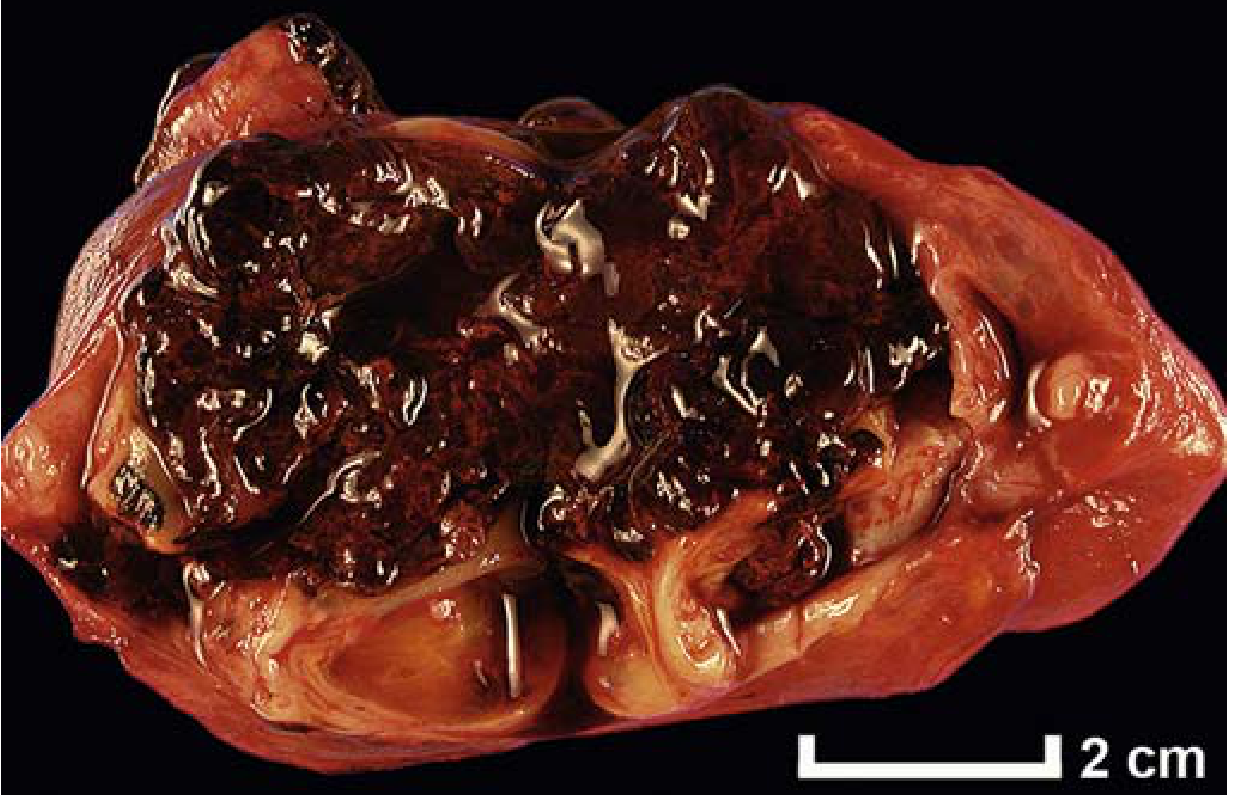
Below is a classic image of ovarian endometriosis - the "chocolate cyst" - which is also a major cause of abnormal menstrual symptoms:
Loading Image
Loading Image
Now I have all the content I need. Let me compile the full, comprehensive response:
Menstrual Cycle Disorders - A Comprehensive Guide for Medical Students
1. Terminology You Must Know
(Ganong's Review of Medical Physiology, 26th Edition)
| Term | Definition |
|---|---|
| Amenorrhea | Absence of menstrual periods |
| Primary amenorrhea | Menstruation has never occurred |
| Secondary amenorrhea | Cessation of cycles in a woman with previously normal periods |
| Oligomenorrhea | Reduced frequency of periods |
| Menorrhagia | Abnormally heavy/profuse flow during regular periods |
| Hypomenorrhea | Scanty flow during regular periods |
| Metrorrhagia | Uterine bleeding between periods |
| Dysmenorrhea | Painful menstruation |
| PMS | Premenstrual syndrome |
2. Amenorrhea
Primary Amenorrhea
Failure of menstruation to start - conventionally defined as no menses by age 15 with normal secondary sex characteristics, or by age 13 without them.
Causes (Tietz Textbook of Laboratory Medicine, 7th Edition):
Lower tract/outflow defects:
- Imperforate hymen
- Vaginal aplasia / congenital vaginal atresia
Uterine disorders:
- Congenital absence of the uterus
- Mullerian agenesis (Mayer-Rokitansky-Kuster-Hauser syndrome)
- Androgen insensitivity syndrome (46,XY - phenotypic female, no uterus)
Ovarian disorders:
- Turner syndrome (45,X) - streak gonads, short stature, webbed neck
- XX/XY gonadal dysgenesis
- PCOS
- 17-hydroxylase deficiency (sexual infantilism + elevated gonadotropins)
- Autoimmune oophoritis, resistant ovary syndrome
Pituitary-Hypothalamic:
- Kallmann syndrome - GnRH deficiency + hyposmia/anosmia
- Constitutional delay
- Nutritional disorders, excessive exercise
Adrenal: Congenital adrenal hyperplasia
Secondary Amenorrhea
Cessation of previously normal menstruation for 3+ months.
Rule #1: Always exclude pregnancy first. Ganong's states: "secondary amenorrhea should be considered to be due to pregnancy until proved otherwise."
Causes organized by anatomical level:
| Level | Cause |
|---|---|
| Uterine (outflow) | Asherman syndrome (post-curettage intrauterine synechiae) |
| Ovarian | PCOS, primary ovarian insufficiency (POI/POF), ovarian tumors, chemo/radiation damage |
| Pituitary | Hyperprolactinemia (prolactinoma), Sheehan syndrome, acquired hypopituitarism |
| Hypothalamic | Functional hypothalamic amenorrhea (stress, exercise, anorexia), infiltrative disease |
| Systemic | Hypothyroidism, hyperthyroidism, Cushing syndrome, adrenal insufficiency, renal disease |
| Drugs | Antipsychotics (haloperidol, phenothiazines, clozapine), antidepressants, methyldopa, OCPs, busulfan, cisplatin |
Mechanism of functional hypothalamic amenorrhea: Excess opioid activity in the hypothalamus slows the frequency of GnRH pulses → low FSH/LH → no ovulation. Notably, the opioid blocker naltrexone has shown promising results in restoring GnRH pulse frequency. (Ganong's)
Hypergonadotropic Amenorrhea (Primary Ovarian Insufficiency)
(Goldman-Cecil Medicine)
When the ovaries fail, negative estrogen feedback to the HPO axis is lost → FSH and LH rise dramatically. Causes include:
- Genetic: Turner syndrome (45,X - most common), pure gonadal dysgenesis (46,XX or 46,XY), Trisomy X, FMR1 premutation (>5% of women with XX spontaneous POI carry FMR1 mutations - important for genetic counseling about fragile X in offspring)
- Autoimmune oophoritis
- Iatrogenic: busulfan, cisplatin, cyclophosphamide, radiation
3. Abnormal Uterine Bleeding (AUB)
(Goldman-Cecil Medicine; Robbins & Kumar Basic Pathology)
AUB affects 10-30% of reproductive-age women. In postmenopausal women, it must be considered endometrial cancer until proven otherwise.
Epidemiology:
- ~20% is postmenarchal (adolescent) - due to HPO axis immaturity
- ~50% is perimenopausal - incipient ovarian failure
- ~75% of cases have no structural cause = anovulatory (dysfunctional) uterine bleeding
Pathophysiology of anovulatory AUB:
Unopposed estrogen → endometrial proliferation without progestogenic withdrawal → thick, fragile endometrium that sheds irregularly. Most commonly due to estrogen withdrawal or estrogen breakthrough.
Causes by age group:
| Age Group | Common Causes |
|---|---|
| Prepuberty | Precocious puberty |
| Adolescence | Anovulatory cycles (HPO immaturity), coagulation disorders (von Willebrand disease - always screen!) |
| Reproductive age | Pregnancy complications, leiomyomas, polyps, adenomyosis, DUB/anovulation, endometrial hyperplasia/carcinoma |
| Perimenopausal | Anovulatory cycles, endometrial hyperplasia/carcinoma |
| Postmenopausal | Endometrial atrophy, carcinoma, exogenous estrogen |
Structural causes (PALM-COEIN mnemonic used in modern classification):
- Polyps, Adenomyosis, Leiomyoma, Malignancy
- Coagulopathy, Ovulatory dysfunction, Endometrial, Iatrogenic, Not classified
Diagnosis: Full history + CBC, coagulation studies (including vWD screening), thyroid function, fasting glucose, pregnancy test. Women >35 or at risk for endometrial carcinoma require endometrial biopsy or D&C.
Treatment:
- Hemodynamically stable: oral contraceptive pill (off-label) every 6 hours for 5-7 days; bleeding should stop within 24 hours
- Hormonal therapy (progestins, OCPs) long-term
- Surgical options (D&C, endometrial ablation, hysterectomy) for refractory cases
4. Dysmenorrhea and Endometriosis
(Goldman-Cecil Medicine)
Dysmenorrhea (painful menstruation) affects ~50% of postpubertal women and is the most common gynecologic complaint.
Primary Dysmenorrhea
- No underlying pathology
- Usually occurs in ovulatory cycles
- Mechanism: Prostaglandins cause exaggerated uterine contractions and myometrial ischemia
- Associated symptoms: nausea, diarrhea, headache, emotional changes
- Treatment:
- First-line: NSAIDs (e.g., ibuprofen, naproxen, mefenamic acid) - start at onset of bleeding/cramping, continue for up to 3 days
- If NSAIDs fail: add oral contraceptives (inhibit ovulation → reduce prostaglandin release)
- If still intractable: laparoscopy to rule out secondary causes
Secondary Dysmenorrhea
Has an underlying pathologic cause. Most common: endometriosis.
Other causes: PID, cervical stenosis, congenital outflow tract anomalies, leiomyomas.
Endometriosis
- Affects ~10% of reproductive-age women
- Ectopic endometrial tissue (glands + stroma), most commonly within the peritoneal cavity
- Classic triad: dysmenorrhea + infertility + dyspareunia
- Can also appear in surgical scars, umbilicus, vulva
The "chocolate cyst" of the ovary (endometrioma) - a classic gross pathology finding:
Treatment of endometriosis (Goldman-Cecil Medicine):
- Surgical: fulguration/excision of implants, lysis of adhesions at laparoscopy
- Medical (hormonal suppression):
- Continuous oral contraceptives
- Progestins (e.g., norethindrone 5 mg/day)
- GnRH analogues (e.g., leuprorelin 3.75 mg SC monthly)
- GnRH antagonists: elagolix (150 mg orally daily up to 24 months) or relugolix (40 mg orally daily)
- Danazol (androgenic steroid - less commonly used now)
- After a course of treatment, maintain on OCP until fertility desired
- Surgery for severe pain, large endometriomas, or infertility work-up
5. Premenstrual Syndrome (PMS)
(Ganong's Review of Medical Physiology)
PMS refers to a cluster of symptoms in the last 7-10 days of the menstrual cycle (late luteal phase):
- Irritability, mood changes, depression
- Bloating, edema
- Headache, fatigue
- Decreased concentration, constipation
Pathophysiology: Not fully understood. Hormonal fluctuations in the late luteal phase are involved but interestingly, the symptoms are not modified if the luteal phase is terminated early by mifepristone - suggesting a more complex mechanism, possibly involving serotonin.
Treatment:
- SSRIs (fluoxetine) - effective (serotonin involvement)
- Alprazolam (benzodiazepine) - short-term relief
- GnRH agonists in doses that suppress the pituitary-ovarian axis
- Lifestyle measures: salt restriction, regular exercise
PMDD (Premenstrual Dysphoric Disorder) is a more severe form with predominantly emotional symptoms, meeting DSM criteria.
6. Quick Diagnostic Approach Summary
Menstrual Disorder
       |
   Amenorrhea?
   /          \
Primary      Secondary
(no period    (was having
 ever)         periods)
   |               |
Check:          βhCG first!
- Karyotype        |
- FSH/LH        Elevated FSH → POI
- Pelvic US     Low FSH → Hypothalamic/Pituitary
- MRI brain     Normal FSH + ↑Prolactin → Prolactinoma
                Uterine cause → Asherman's
Key Exam High-Yield Points
- Primary amenorrhea most common cause with secondary sexual characteristics present = imperforate hymen / anatomic outflow obstruction
- Most common cause of secondary amenorrhea = pregnancy
- Turner syndrome = 45,X, elevated FSH/LH, streak gonads, amenorrhea
- Asherman syndrome = post-D&C synechiae, secondary amenorrhea with normal FSH/LH/prolactin
- Sheehan syndrome = postpartum hemorrhage → pituitary infarction → panhypopituitarism
- Kallmann syndrome = GnRH deficiency + anosmia
- Primary dysmenorrhea = prostaglandins → treat with NSAIDs
- Endometriosis = "chocolate cysts," CA-125 may be elevated, diagnosed definitively by laparoscopy
- FMR1 premutation (fragile X carrier) is found in >5% of XX spontaneous POI cases
- Adolescent AUB - always screen for von Willebrand disease
Sources: Goldman-Cecil Medicine; Ganong's Review of Medical Physiology (26th Ed.); Berek & Novak's Gynecology; Tietz Textbook of Laboratory Medicine (7th Ed.); Robbins & Kumar Basic Pathology
This is a shared conversation. Sign in to Orris to start your own chat.