
Latest guidelines on hypokalemia and ODS
Reading File
Reading File
Finding Sources
Finding Sources
Searching PubMed
"hypokalemia"[MeSH Terms] AND "guideline"[pt]
Searching PubMed
"osmotic demyelination syndrome" AND sodium correction
Searching the Web
latest guidelines hypokalemia management 2024 2025
Searching the Web
osmotic demyelination syndrome prevention guidelines rapid correction hyponatremia
Reading File
Reading File
Reading File
Searching PubMed
hyponatremia correction rate osmotic demyelination meta-analysis
Hypokalemia and Osmotic Demyelination Syndrome (ODS)
These two conditions intersect in an important, often under-recognized way: correcting hypokalemia in a hyponatremic patient can itself drive an unexpectedly rapid rise in serum sodium, because potassium repletion shifts potassium into cells while sodium (and water) shift out, raising serum [Na+] independent of any saline given. Hypokalemia is therefore listed as a recognized risk factor for ODS in major nephrology texts, alongside malnutrition, alcoholism, and liver transplantation - Comprehensive Clinical Nephrology, 7th Ed., p. 148.
1. Hypokalemia - current management framework
Definitions/severity (consistent across AAFP 2023 and current texts):
- Mild: K+ 3.0-3.4 mEq/L
- Moderate: K+ 2.5-2.9 mEq/L
- Severe: K+ <2.5 mEq/L, or any level with ECG changes/arrhythmia/paralysis
Treatment principles (AAFP 2023 Potassium Disorders review; Brenner & Rector's The Kidney):
- Identify and treat the underlying cause (GI loss, renal loss, transcellular shift, diuretics, hyperaldosteronism, RTA, Bartter/Gitelman syndromes).
- Oral repletion is preferred for mild-moderate, asymptomatic hypokalemia.
- IV replacement is reserved for severe hypokalemia, inability to tolerate oral intake, or symptomatic/ECG changes (flattened T waves, U waves, arrhythmia).
- Peripheral IV: generally capped around 10 mEq/hour (higher rates are a venous irritant and risk phlebitis).
- Central line with continuous cardiac monitoring, ideally in an ICU/monitored setting, is required for faster replacement (up to ~20-40 mEq/hour in genuinely life-threatening hypokalemia).
- Magnesium should be checked and repleted concurrently - hypomagnesemia causes refractory hypokalemia via renal K+ wasting.
- Recheck levels frequently; avoid overcorrection, especially in renal impairment.
There is no single unified "2024/2025 guideline" body publishing a formal hypokalemia guideline - management still rests on this same evidence-based framework reaffirmed in recent reviews (JAAPA 2021; AAFP 2023; British Journal of Hospital Medicine, 2024, PMID 39212569) rather than a new society statement.
2. ODS - correction limits and the hypokalemia interaction
Standard correction limits for hyponatremia to avoid ODS:
- European Clinical Practice Guidelines (Spasovski et al., 2014): ≤10 mmol/L rise in the first 24 hours, ≤8 mmol/L per 24-hour period thereafter.
- U.S. Expert Panel recommendations: 10-12 mmol/L/24h and 18 mmol/L/48h for average-risk patients; 8 mmol/L/24h for high-risk patients (which includes hypokalemic patients).
- Harrison's 22nd Ed. gives a more conservative modern target: ≤8 mmol/L/24h and ≤15 mmol/L/48h - Harrison's Principles of Internal Medicine, 22E, p. 2392.
Why hypokalemia matters specifically: When a chronically hyponatremic patient is also hypokalemic (common with diuretic use, vomiting, or malnutrition), giving potassium alone - even without any saline - can push serum sodium up faster than intended, because administered K+ enters cells and obligates a reciprocal efflux of Na+/water into the extracellular space. Clinically, this means the total planned correction must account for potassium replacement as part of the sodium correction "budget," not as a separate, unrelated intervention. This is a well-documented mechanism behind ODS occurring "despite appropriate cautious correction" of serum sodium alone (Practical Neurology, 2022, PMID 35577547; Electrolyte & Blood Pressure, 2023, PMID 38152601).
High-risk features for ODS (per Comprehensive Clinical Nephrology, p. 148 and Harrison's):
- Chronic hyponatremia (>48h), serum Na+ <105-110 mmol/L
- Hypokalemia
- Alcoholism, malnutrition, cirrhosis/liver transplant (13-29% incidence at autopsy in transplant patients)
- Elderly women on thiazides
Management if correction is running too fast: desmopressin (DDAVP) and/or IV dextrose (D5W) are used to arrest or "re-lower" serum sodium if the rate exceeds the daily limit - a strategy reinforced in recent literature.
3. Recent evidence (last 1-2 years) - worth flagging
- JAMA Internal Medicine 2025 (Ayus, Moritz, Fuentes et al.) - systematic review/meta-analysis of correction rates and clinical outcomes in hospitalized adults with severe hyponatremia [PMID: 39556338]. This is the most current high-tier evidence and should be checked against any older guideline recommendation you're applying.
- Kidney Medicine 2024 meta-analysis found correction rates >8 mmol/L/24h significantly correlated with ODS risk, supporting the more conservative 8 mmol/L/24h limit over the older 10-12 mmol/L figure, and noted rapid correction still occurs in ~21.5% of hospitalized hyponatremic patients.
- Jornal Brasileiro de Nefrologia 2024 systematic review on ODS as a complication of hyponatremia correction explicitly lists hypokalemia as a contributing/independent risk factor [PMID: 37523718].
- Emerging case literature (2024-2026) documents ODS occurring with normal serum sodium, non-rapid correction, and in cancer patients - suggesting rate-of-correction alone doesn't fully explain risk, and per-patient risk stratification (nutritional status, alcohol use, potassium status) matters as much as the numeric rate limit.
Bottom line for practice: Treat hypokalemia per standard severity-based protocol, but if the patient is also hyponatremic, plan potassium and sodium correction together, target the more conservative ≤8 mmol/L/24h (≤15-18 mmol/L/48h) sodium rise, monitor serum sodium closely during K+ repletion (not just during saline administration), and have desmopressin/D5W available to correct overshoot in high-risk patients.
Diagrams on hyponatremia correction in hyperbole mic states
Finding Sources
Searching Images
algorithm for management of hypervolemic hyponatremia
Searching Images
hyponatremia correction algorithm flowchart sodium correction rate
Reading File
Reading File
Reading File
Finding Sources
Searching Images
treatment of hyponatremia based on volume status heart failure cirrhosis
Searching Images
SIADH hypervolemic hypovolemic euvolemic hyponatremia diagnostic algorithm diagram
Reading File
query_images_db
Searching Images
heart failure hyponatremia tolvaptan diuretic treatment diagram
Loading Image
Hyponatremia Correction in Hypervolemic States - Diagrams & Framework
I found one figure in the library that gives a general correction algorithm, and I'll pair it with a hypervolemic-specific pathway built from textbook content, since no image in this library is drawn specifically for the hypervolemic subtype.
Diagram 1: General hyponatremia correction algorithm (applies once volume status is established)
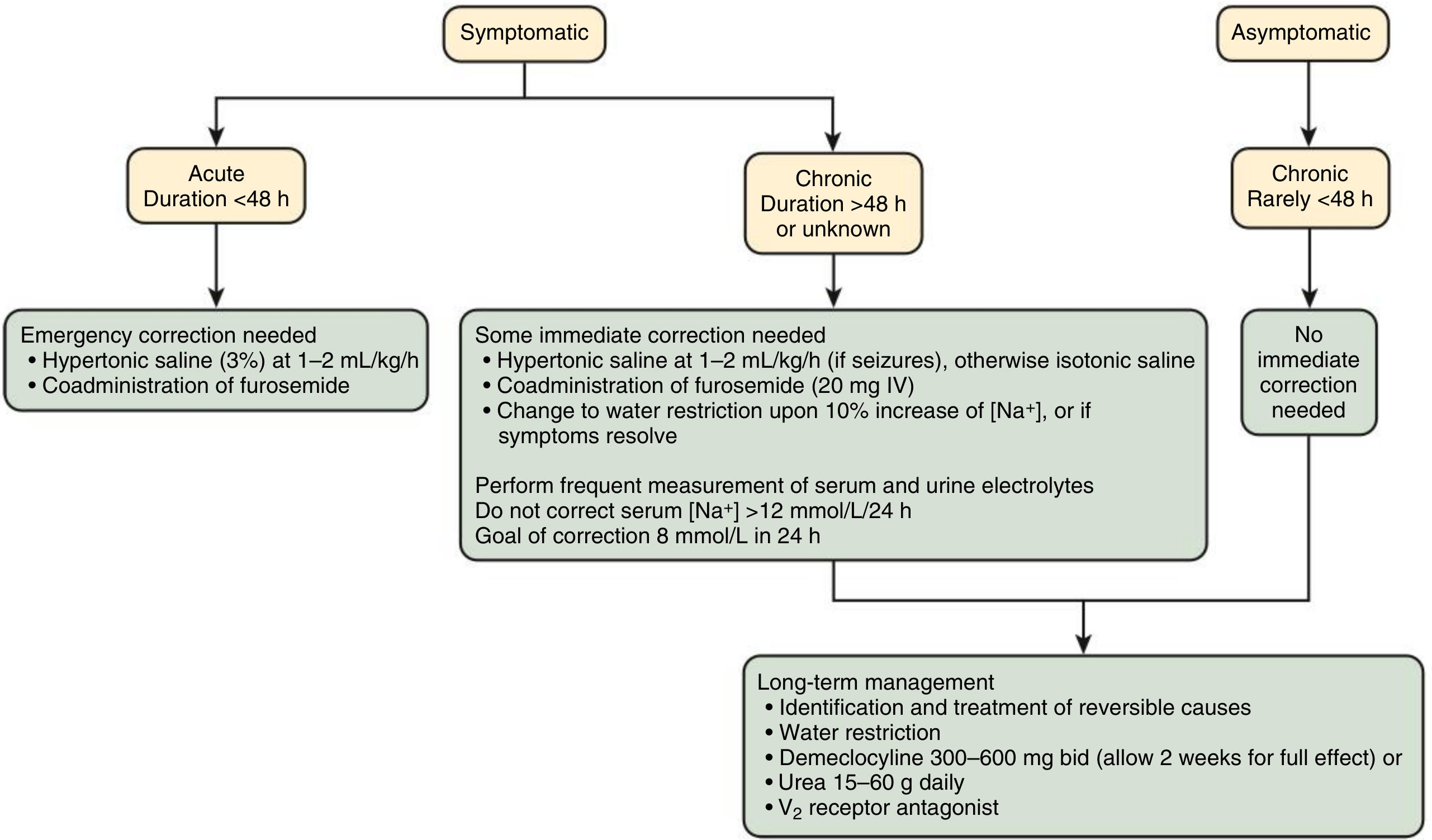
This algorithm (Fig. 9.8) shows the backbone that applies to any volume category, including hypervolemic hyponatremia, once you've decided correction is needed:
-
Symptomatic + acute (<48h): emergency correction with 3% saline 1-2 mL/kg/h plus furosemide.
-
Symptomatic + chronic/unknown duration: some immediate correction (3% saline if seizing, otherwise isotonic saline is not appropriate in hypervolemic patients - see below), furosemide co-administration, switch to water restriction once [Na+] rises ~10% or symptoms resolve. Do not exceed 12 mmol/L/24h; target ~8 mmol/L/24h.
-
Asymptomatic/chronic: no immediate correction needed - go straight to long-term management (water restriction, demeclocycline, urea, or a V2 antagonist).
-
Comprehensive Clinical Nephrology, 7th Ed., p. 149
Diagram 2: Hypervolemic hyponatremia - decision pathway (constructed from textbook sources)
                    HYPERVOLEMIC HYPONATREMIA
        (edema present; water retention > sodium retention;
         urine Na+ <20 mmol/L, FENa <1% unless on diuretics)
                              |
        ---------------------------------------------------
        |                    |                             |
  Heart Failure          Cirrhosis/                  Advanced Renal
                          Ascites                      Failure/Nephrotic
        |                    |                             |
  Na+ & water            Na+ & water                  Na+ & water
  restriction             restriction                  restriction
  + ACE-I/ARNI            (mainstay)                   + dialysis
  + loop diuretic                                       optimization
  (increases CO,           |
  blunts AVP action)   Loop diuretics
        |              increase free-
  AVOID thiazides       water clearance
  (worsen Na+                |
  dilution)             AVOID combined
        |               V1+V2 antagonists
  V2 antagonist          (e.g. conivaptan) -
  (tolvaptan) raises     hepatotoxic risk;
  serum Na+ and          tolvaptan use limited
  improves congestion    to pre-transplant
  symptoms, but                |
  EVEREST trial: no      Vaptan response
  long-term mortality/   blunted vs SIADH/CHF
  morbidity benefit      (non-AVP mechanisms
                          also contribute)
        |                    |
        -----------  ---------
                  |
          SAME SAFETY LIMITS APPLY:
     ≤8 mmol/L rise per 24h (high-risk patients)
     ≤10-12 mmol/L/24h and ≤18 mmol/L/48h (average risk)
     Never use hypotonic/isotonic saline boluses to "correct"
     hypervolemic hyponatremia - it worsens volume overload
     without fixing the free-water excess
                  |
        Monitor for overcorrection -> risk of
        Osmotic Demyelination Syndrome
        (esp. if also hypokalemic, malnourished,
        alcohol use disorder, or [Na+] <105 mmol/L)
Key sourced points behind this pathway:
- In CHF: ACE inhibitors/ARNI plus loop diuretics raise cardiac output and reduce the neurohormonal drive (AVP, aldosterone) causing water retention; thiazides are avoided because they impair urinary dilution and worsen hyponatremia; tolvaptan (V2 antagonist) raises serum sodium and improves congestive symptoms, but the EVEREST trial showed no long-term mortality/morbidity benefit - Goldman-Cecil Medicine, p. 3750; Comprehensive Clinical Nephrology, p. 148.
- In cirrhosis: sodium/water restriction is the mainstay; loop diuretics and V2 antagonists increase free water excretion, but the response is blunted compared with SIADH or CHF because non-vasopressin mechanisms also drive the hyponatremia; combined V1/V2 antagonists (conivaptan) should be avoided due to hepatotoxicity risk, and tolvaptan use is generally reserved for pre-liver-transplant correction - Comprehensive Clinical Nephrology, p. 148.
- Risk factors that make ODS more likely during correction of any hyponatremia subtype, including hypervolemic: serum [Na+] <105 mmol/L, hypokalemia, alcohol use disorder, malnutrition, and advanced liver disease - Goldman-Cecil Medicine, p. 3770.
- Safe correction ceilings: ≤10-12 mmol/L/24h and ≤18 mmol/L/48h for average-risk patients, ≤8 mmol/L/24h for high-risk patients (European guideline figures cited in Harrison's and Comprehensive Clinical Nephrology).
Practical point specific to hypervolemic states: because these patients are volume-overloaded, the correction tool is different from hypovolemic hyponatremia - you never give isotonic or hypertonic saline as maintenance therapy (it will worsen edema); the mainstay is water restriction plus loop diuretic and treatment of the underlying organ failure, with a vaptan added selectively. The same sodium-rise ceilings for preventing ODS still apply regardless of which volume category you're treating.
This is a shared conversation. Sign in to Orris to start your own chat.