
Anti glide plating mechanism
Reading File
Anti-glide plating is a technique in orthopedic fracture fixation where the plate is positioned to prevent fracture fragment displacement (gliding) rather than acting as a neutralization or compression plate. It is most commonly used for oblique or spiral fibula fractures (Weber B/lateral malleolus). The plate is placed on the posterior surface of the fibula, using the fracture geometry to block the proximal fragment from sliding proximally.
Searching sources...
Finding Sources
Searching the Web
anti-glide plating mechanism orthopedic fracture fixation
Reading File
Reading File
Loading Image
Loading Image
Here is a thorough breakdown of anti-glide plating, sourced from Rockwood and Green's Fractures in Adults (10th ed, 2025) and the AO Foundation.
Anti-Glide Plating - Mechanism and Principles
Definition
Anti-glide plating is a method of fracture fixation where the plate is positioned to physically block the mobile fracture fragment from "gliding" (translating/shortening) along the fracture plane under axial load. The plate does not primarily generate compression itself - it prevents displacement.
"Antiglide plating is a term many surgeons use to describe plating of shearing-type fractures where the plate primarily acts to prevent shortening (whereas a buttress plate also applies compression). Antiglide plates are often shorter than buttress plates and generally rely on lag screws to generate compression."
- Rockwood and Green's Fractures in Adults, 10th ed.
Biomechanical Mechanism
The key concept is the "axilla" effect:
- The plate is placed at the apex of the fracture, on the side toward which the distal fragment would tend to displace
- The proximal edge of the plate, sitting just proximal to the fracture line, forms an "axilla" (armpit) with the intact cortex
- Under axial loading, when the distal fragment tries to slide proximally along the oblique fracture surface, the plate's proximal edge acts as a physical block - the fragment cannot ride up past the plate
- This converts shear forces at the fracture site into compressive forces across the fracture plane
- Lag screws (through or separate from the plate) provide interfragmentary compression
Critical plate positioning: The proximal hole nearest the fracture should sit 3-5 mm proximal to the fracture line. If the plate is improperly positioned or over-contoured, bony contact at the apex is lost and the anti-glide effect fails.
Anti-Glide vs. Buttress Plating - Key Distinction
| Feature | Anti-Glide | Buttress |
|---|---|---|
| Fracture type | Diaphyseal oblique/spiral | Metaphyseal/partial articular (OTA B-type) |
| Primary function | Prevents shortening/sliding | Also generates compression |
| Plate length | Shorter | Longer |
| Compression source | Lag screws | Undercontoured plate + axillary screw |
| Environment | Usually relative stability | Absolute stability, primary bone healing |
The terms are frequently used interchangeably in clinical practice, but the distinction matters mechanically.
Prototype Application: Distal Fibula (Weber B / Denis-Weber B)
The classic example is a posterolateral plate on the distal fibula for an oblique lateral malleolus fracture:
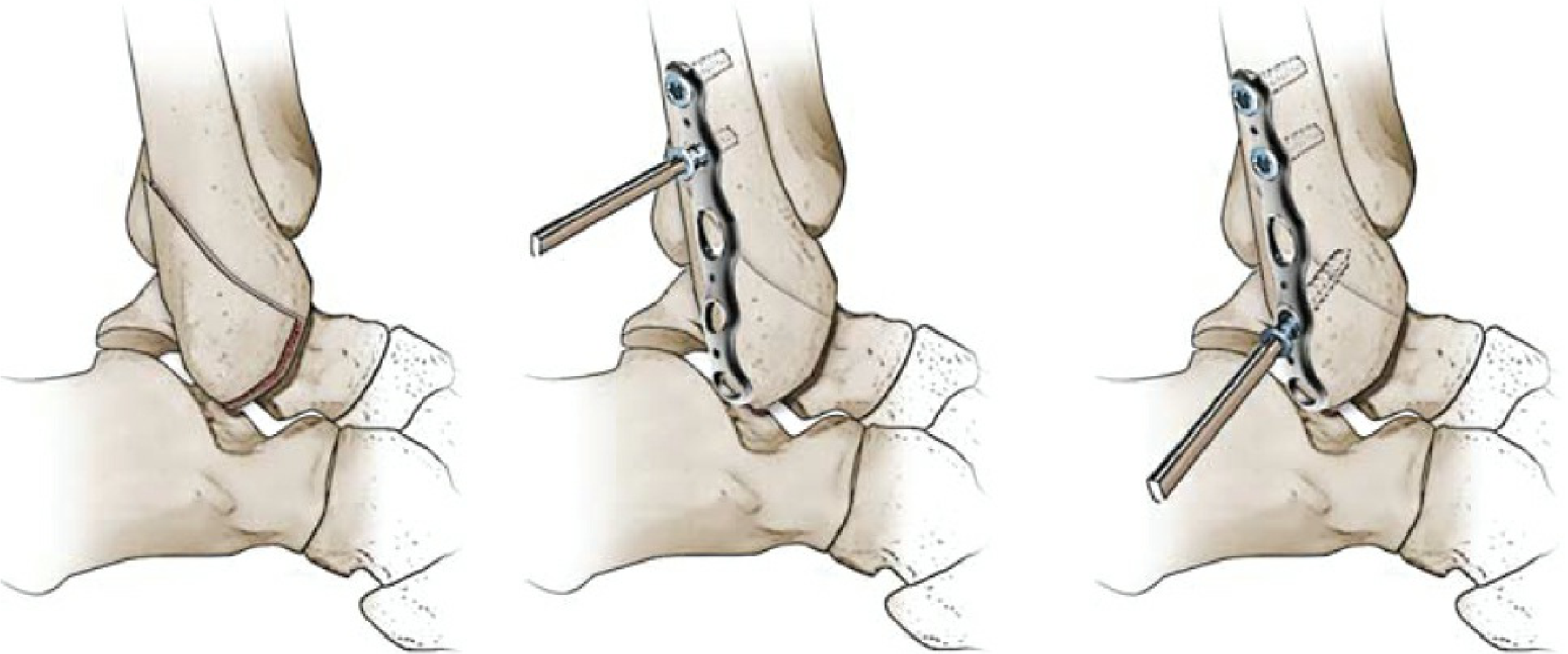
Antiglide technique for a type B distal fibular fracture - the plate is applied posteriorly, with a lag screw supplementing interfragmentary compression. (Rockwood and Green's, 10th ed, Fig. 13-23)
- The fracture line runs obliquely from anteroinferior to posterosuperior
- With axial load (walking), the distal fragment tends to ride proximally and posteriorly
- The posterior plate sits directly in the path of this displacement
- The proximal plate edge "catches" the distal fragment at the fracture apex
- A lag screw is typically added through the plate across the fracture for interfragmentary compression
- Advantages: lower soft tissue profile compared to a lateral plate, less wound complication risk, potentially stronger construct
Other Locations
- Medial malleolus - anti-glide plating used as an alternative to lag screws for oblique medial malleolar fractures
- Femoral neck - medial anti-glide plate at the medial apex for certain femoral neck fracture patterns (Mir and Collinge technique)
- Posterior malleolus - posterior plate in anti-glide mode for posterior tibial plafond fractures
Plate Contouring Rules
- Slightly undercontoured at the apex - this ensures the plate contacts bone at the fracture apex when screws are tightened, maximizing the blocking/axilla effect
- If over-contoured (plate bows away from bone at apex): no contact at apex, anti-glide effect lost, fragment can still displace
- If under-contoured too aggressively: tightening screws can actually displace the fracture
Summary
The anti-glide plate works by geometric obstruction - it sits proximal to the fracture apex on the tension/displacement side, physically blocking the distal fragment from sliding along the fracture plane. Lag screws generate compression; the plate prevents shortening and rotational displacement. It is not a neutralization plate (which only protects a lag screw) and is not a pure compression plate.
- Source: Rockwood and Green's Fractures in Adults, 10th ed (2025), Chapter 12 - Buttress and Antiglide Plating section; Chapter 13
- AO Foundation Surgery Reference - Antiglide Plate technique
This is a shared conversation. Sign in to Orris to start your own chat.