
Uses of screening test spm park book
Reading File
Screening tests are used in preventive medicine to identify disease in apparently healthy individuals before symptoms appear. Let me pull this from the Park's textbook of SPM directly.
Searching sources...
Finding Sources
Finding Sources
Finding Sources
Finding Sources
Found it. ISBN is
9789382219163. Now let me search for screening sections in Park's textbook.Finding Sources
"Uses of screening" is at line 4773. Let me read that section along with surrounding content for full context.
Reading File
Reading File
Reading File
I now have all the content needed. Here is the complete answer directly from Park's Textbook of Preventive and Social Medicine.
Uses of Screening Test
(Park's Textbook of Preventive and Social Medicine, p. 155-156)
Before listing the uses, it helps to understand the concept. Screening is defined as "the search for unrecognized disease or defect by means of rapidly applied tests, examinations or other procedures in apparently healthy individuals." It arises from the iceberg phenomenon of disease - the hidden submerged portion represents undiagnosed cases in the community that screening aims to detect.
Four Main Uses of Screening
a. Case Detection (Prescriptive Screening)
- Defined as the presumptive identification of unrecognized disease, which does NOT arise from a patient's request.
- People are screened primarily for their own benefit.
- Examples of diseases sought: bacteriuria in pregnancy, breast cancer, cervical cancer, deafness in children, diabetes mellitus, iron deficiency anaemia, PKU (phenylketonuria), pulmonary tuberculosis, haemolytic disease of the newborn.
- Example: neonatal screening.
- Since disease detection is initiated by medical/public health personnel, they have a special obligation to ensure appropriate early treatment is started.
b. Control of Disease (Prospective Screening)
- People are examined for the benefit of others (not just themselves).
- Examples: screening of immigrants for tuberculosis and syphilis to protect the home population; screening for streptococcal infection to prevent rheumatic fever.
- The screening programme, by leading to early diagnosis, allows more effective treatment and reduces the spread of infectious disease and/or mortality.
c. Research Purposes
- Screening may be performed to obtain more basic knowledge about the natural history of diseases (especially chronic diseases like cancer, hypertension, where natural history is not fully known).
- Initial screening provides a prevalence estimate; subsequent screening provides an incidence figure.
- When done for research purposes, the investigator should inform study participants that no follow-up therapy will be available.
d. Educational Opportunities
- Apart from benefits to individuals and public health information, screening programmes (e.g., screening for diabetes) provide:
- Opportunities for creating public awareness
- Educating health professionals
Key Distinction: Screening vs. Diagnostic Test
| Screening Test | Diagnostic Test |
|---|---|
| Done on apparently healthy persons | Done on those with symptoms or sick |
| Applied to groups | Applied to single patients |
| Based on one criterion/cut-off point | Based on evaluation of symptoms, signs, and lab findings |
| Less accurate | More accurate |
| Less expensive | More expensive |
| Not a basis for treatment | Used as a basis for treatment |
| Initiative comes from the investigator/agency | Initiative comes from the patient with a complaint |
Types of Screening (Bonus)
Since commonly asked alongside uses:
- Mass screening - Screening of a whole population or sub-group, offered to all irrespective of individual risk (e.g., tuberculosis).
- High-risk/Selective screening - Applied to high-risk groups defined by epidemiological research; most productive approach. Also includes screening for risk factors (e.g., serum cholesterol for CHD risk).
- Multiphasic screening - Application of two or more screening tests in combination to a large number of people at one time (includes questionnaire, clinical exam, blood/urine tests, lung function, audiometry, visual acuity assessment).
Source: Park's Textbook of Preventive and Social Medicine (ISBN 9789382219163), Chapter on Epidemiology, pp. 155-156
Types of screening parks spm book
From the previous session, I already located Park's textbook (ISBN 9789382219163) and read the Types of Screening section. Let me pull the full detailed content now.
Searching sources...
Reading File
I also have the Criteria for Screening section starting right after. Let me read that too for completeness.
Reading File
I have all the content needed. Here is the complete answer directly from Park's textbook.
Types of Screening
(Park's Textbook of Preventive and Social Medicine, p. 156)
Park describes three types of screening:
a. Mass Screening
- Screening of a whole population or a sub-group (e.g., all adults).
- Offered to all individuals, irrespective of the particular risk any individual may run of contracting the disease in question.
- Classic example: screening for tuberculosis.
- Mass screening received enthusiastic support in the past. However, when subjected to critical review, there appeared to be little justification for its use in many instances.
- Key point: Indiscriminate mass screening is NOT a useful preventive measure unless it is backed up by suitable treatment that will reduce the duration of illness or alter its final outcome.
b. High-Risk or Selective Screening
- Screening is most productive when applied selectively to high-risk groups, defined on the basis of epidemiological research.
- Example: Cancer cervix tends to occur less often in upper social groups, so screening the lower social groups increases the yield of new cases.
- Family aggregation of disease (diabetes, hypertension, breast cancer) - by screening other family members and close relatives, additional cases can be detected.
- Epidemiologists have extended this concept to screening for "risk factors" which antedate actual disease development:
- Example: Elevated serum cholesterol - associated with high risk of coronary heart disease.
- Risk factors of a pathophysiological nature (serum cholesterol, blood pressure) are amenable to effective interventions - preventive measures can be applied before disease occurs.
- Also economically advantageous - resources are used efficiently when tests are applied selectively to high-risk individuals.
c. Multiphasic Screening
- Defined as the application of two or more screening tests in combination to a large number of people at one time, rather than carrying out separate tests for single diseases.
- The procedure may include:
- Health questionnaire
- Clinical examination
- Chemical and haematological tests on blood and urine specimens
- Lung function assessment
- Audiometry
- Measurement of visual acuity
- All these can be performed rapidly with appropriate staffing, organization, and equipment.
- Multiphasic screening has enjoyed considerable popularity, BUT evidence from randomized controlled studies in UK and USA showed it has NOT demonstrated any benefit in terms of mortality and morbidity reduction.
- It has instead increased the cost of health services without any observable benefit.
- Furthermore, most of the tests currently used in multiphasic screening have not been validated.
- These observations have cast doubts on the utility of multiphasic screening.
Criteria for Screening (Bonus - commonly asked alongside types)
Before initiating a screening programme, the criteria are based on two considerations:
1. The Disease
- Should be an important health problem (high prevalence)
- Should have a recognizable latent or early asymptomatic stage
- Natural history should be adequately understood
- A test should be able to detect disease prior to onset of signs/symptoms
- Facilities available for confirmation of diagnosis
- Effective treatment exists
- Agreed-on policy on whom to treat (e.g., borderline cases)
- Good evidence that early detection reduces morbidity and mortality
- Expected benefits exceed the risks and costs
2. The Screening Test
The test must satisfy criteria of:
- Acceptability - must be acceptable to the target population; painful, discomforting or embarrassing tests (e.g., rectal/vaginal examinations) are not likely to be accepted in mass campaigns
- Repeatability (Reliability/Precision/Reproducibility) - must give consistent results when repeated under the same conditions; depends on observer variation, biological/subject variation, and technical errors
- Validity - must accurately measure what it purports to measure
- Besides: yield, simplicity, safety, rapidity, ease of administration, and cost
Source: Park's Textbook of Preventive and Social Medicine (ISBN 9789382219163), p. 156-157
A note on lead time ,,park spm
Lead time is the period between detection of disease by screening and when it would have been diagnosed clinically. Let me fetch the exact content from Park's textbook.
Searching sources...
Finding Sources
Reading File
I have all the content. Let me also fetch the diagram image for visual clarity.
Loading Image
Here is the complete note on Lead Time directly from Park's textbook, with the original diagram.
Concept of "Lead Time"
(Park's Textbook of Preventive and Social Medicine, p. 155)
Definition
"Lead time" is the advantage gained by screening - i.e., the period between diagnosis by early detection (screening) and diagnosis by other means (usual clinical diagnosis).
In simple terms, it is the extra time gained by detecting a disease earlier through screening than it would have been detected through normal clinical presentation.
The Model for Early Detection (Fig. 1)
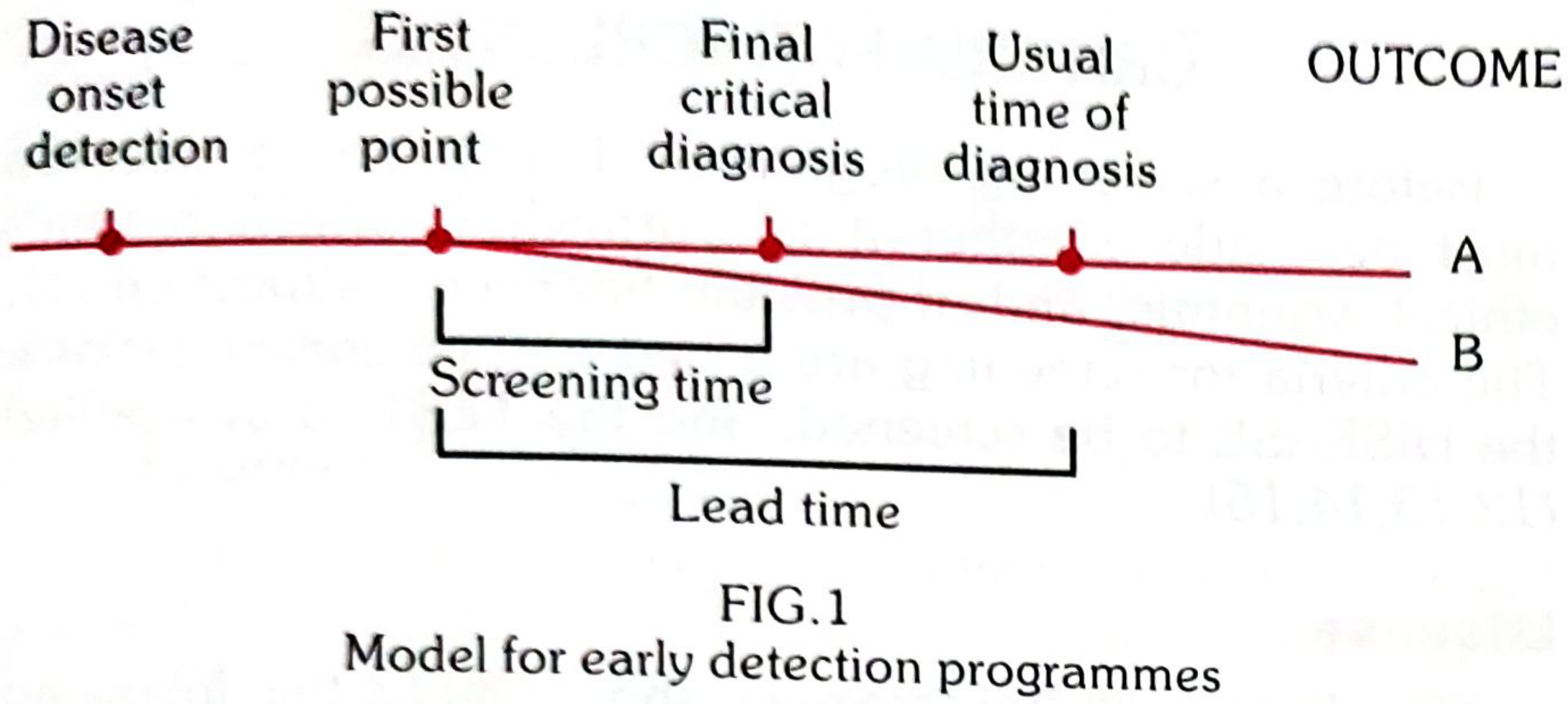
The diagram shows the timeline of a disease process with the following key points:
| Point on Timeline | Meaning |
|---|---|
| Disease onset/detection | The biological start of disease |
| First possible point | Earliest point at which disease can be detected by screening |
| Final critical diagnosis | Last point at which treatment can successfully alter the disease outcome |
| Usual time of diagnosis | When the disease would normally be diagnosed clinically (without screening) |
| Screening time | Period from first possible detection to final critical diagnosis |
| Lead time | Period from screening detection to usual time of clinical diagnosis |
- Line A = Usual outcome of disease (without screening)
- Line B = Outcome when disease is detected at the earliest possible moment (with screening)
- Benefits of the programme = B - A
Key Concepts Explained
When is screening worthwhile?
- There is nothing to be gained in screening for diseases whose onset is quite obvious.
- Detection programmes should be restricted to conditions where there is a considerable time lag between disease onset and the usual time of diagnosis.
- During this period, there are a number of critical points which determine both the severity of the disease and the success of treatment in reversing the disease process.
The "Final Critical Point" concept
- There is little value in detecting disease in advance of the usual time of diagnosis unless such detection precedes the final critical point - beyond which:
- Treatment would be unsuccessful, and/or
- Permanent damage would be done
- Detection programmes should therefore concentrate on conditions where the time lag between disease onset and its final critical point is sufficiently long to be suitable for population screening.
Benefits must justify costs
- The benefits of the screening programme (B - A) must be seen in terms of its outcomes.
- The complexities and costs of any detection programme must be viewed against the benefits accruing from it.
Aims and Objectives of Screening (linked concept)
The basic purpose of screening is to:
- Sort out from a large group of apparently healthy persons those likely to have the disease or at increased risk
- Bring those who are "apparently abnormal" under medical supervision and treatment
- The hope is that earlier diagnosis and subsequent treatment favourably alters the natural history of the disease in a significant proportion of those who test positive
Summary (Exam Point)
Lead time = the period of time by which the diagnosis is advanced (brought forward) through screening, compared to when the disease would have been clinically diagnosed without screening.
It represents the "head start" gained by the patient and clinician. The longer the lead time AND the more effective the early treatment, the more beneficial the screening programme.
Source: Park's Textbook of Preventive and Social Medicine (ISBN 9789382219163), p. 155
Lead time bias
Lead time bias is a common bias in screening studies where early detection appears to improve survival even when it doesn't actually change the outcome. Let me get the exact content from Park's textbook.
Searching sources...
Finding Sources
Finding Sources
Finding Sources
Finding Sources
Finding Sources
Finding Sources
Lead time bias is not explicitly a separate section in Park's SPM - it is covered as a concept within the "lead time" discussion. Let me read from Park's block2 around line 4693-4714 (already retrieved) and also pull the excellent explanations from Harrison's and Campbell Walsh which have diagrams and clear definitions, and also read the relevant section from "Symptom to Diagnosis" which has a clear diagram.
Reading File
Reading File
Reading File
Loading Image
Loading Image
Excellent - I have everything needed including two excellent diagrams. Here is the complete, well-illustrated answer.
Lead Time Bias
Definition
Lead time bias is an artefactual (false) increase in apparent survival time that results from screening detecting disease earlier, without actually changing the date of death or altering the natural history of the disease.
"Lead time bias occurs because screening identifies a case before it would have presented clinically, thereby creating the perception that a patient lived longer after diagnosis simply by moving the date of diagnosis earlier rather than the date of death later."
- Harrison's Principles of Internal Medicine, 22e
The Core Problem
- Lead time = the period between detection by screening and the usual time of clinical diagnosis.
- When a disease is detected earlier by screening, the clock of "survival after diagnosis" starts earlier.
- If the treatment is NOT effective, the patient still dies at the same time - but because diagnosis was made earlier, survival from diagnosis appears longer.
- This creates the false impression that screening improved survival, when in reality it only moved the start date of counting.
Diagram 1 - Lead Time Bias (from Campbell Walsh Wein Urology)
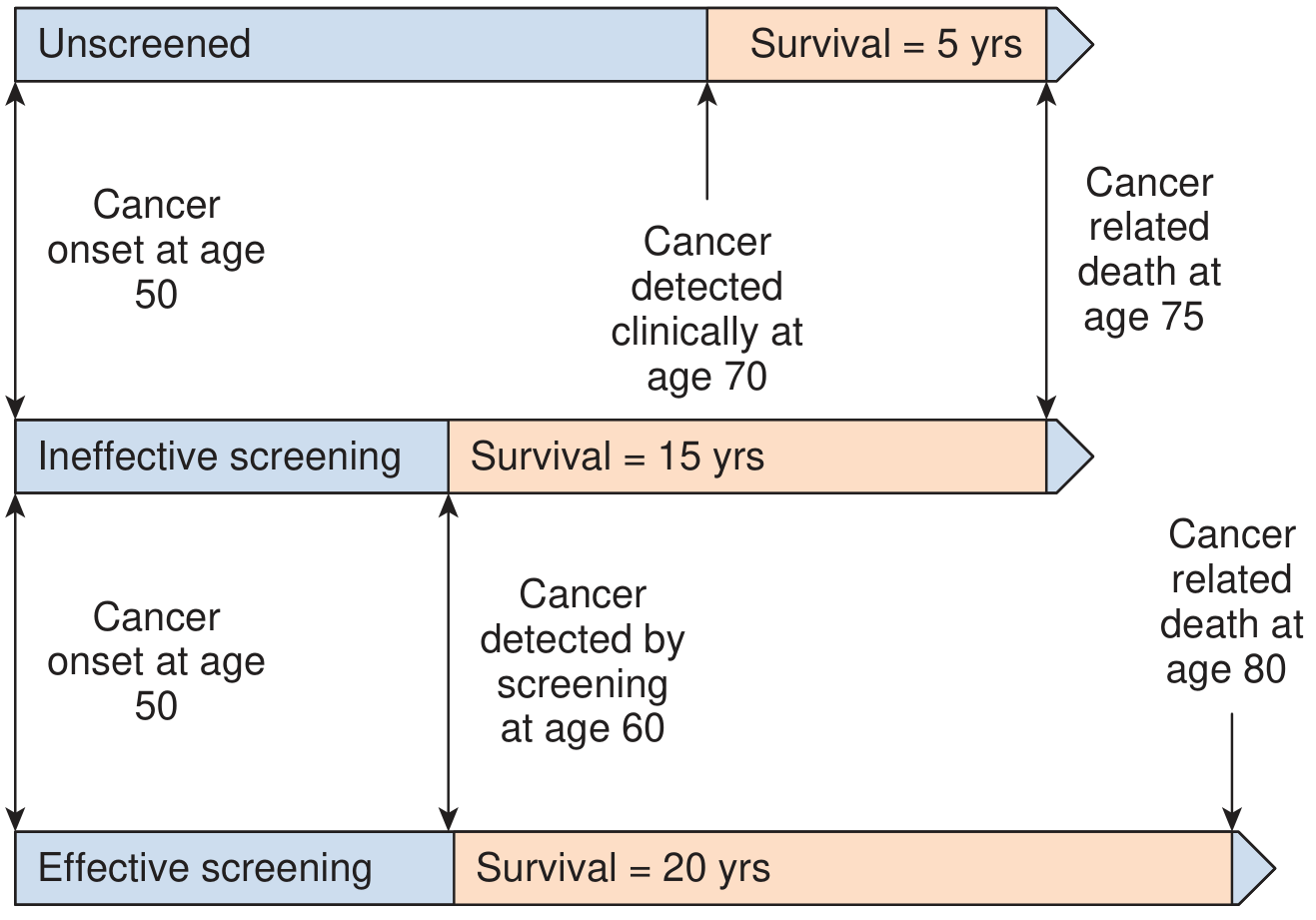
Reading the diagram:
| Scenario | Cancer Onset | Detected | Death | Survival |
|---|---|---|---|---|
| Unscreened | Age 50 | Age 70 (clinically) | Age 75 | 5 years |
| Ineffective screening | Age 50 | Age 60 (by screening) | Age 75 | 15 years (false benefit!) |
| Effective screening | Age 50 | Age 60 (by screening) | Age 80 | 20 years (true benefit) |
- In the ineffective screening scenario, survival appears 3x longer (15 vs 5 years), but the patient dies at the same age (75). The extra 10 years is pure lead time bias - it is the lead time being counted as "survival."
- Only in effective screening is there a genuine prolongation of life.
Diagram 2 - Lead Time Bias (from Symptom to Diagnosis)
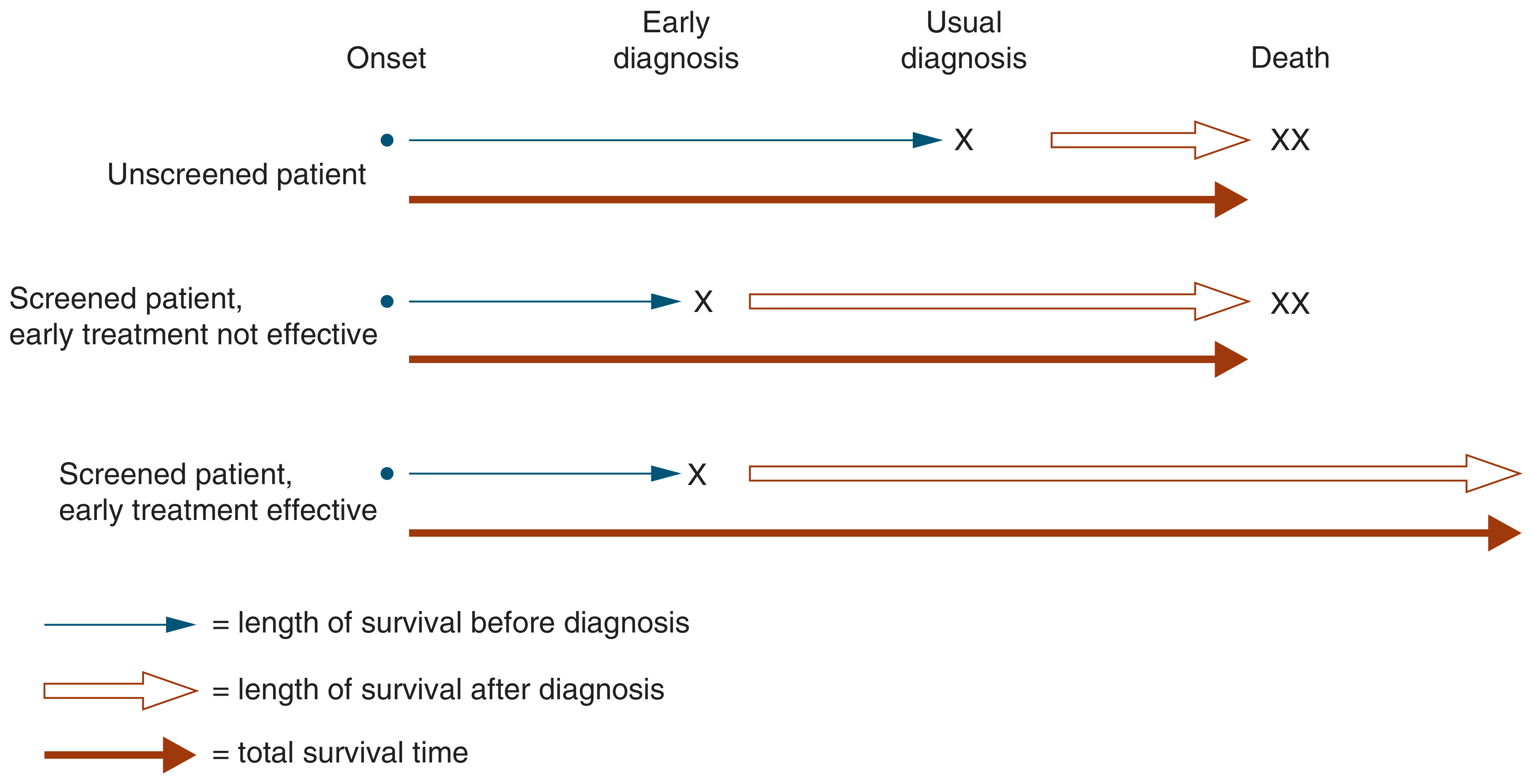
This diagram clearly shows:
- Unscreened patient: Short pre-diagnosis time, shorter post-diagnosis survival, but same total survival
- Screened patient, early treatment NOT effective: Longer post-diagnosis survival (appears better) - but total survival is identical to unscreened
- Screened patient, early treatment effective: Genuinely longer total survival - this is real benefit, not bias
How Lead Time Bias Distorts Results
| What appears to happen | What actually happens |
|---|---|
| Screened patients "survive longer" after diagnosis | Diagnosis clock started earlier; death unchanged |
| 5-year survival rate improves | More people alive at 5 years post-diagnosis, but dying at same time |
| Screening looks effective | No true reduction in mortality |
Classic Real-World Example
Kidney cancer (Campbell Walsh Wein Urology):
- Over 30 years, increased use of abdominal CT detected more asymptomatic renal masses
- 5-year survival improved: 50% → 75%
- BUT the mortality rate from kidney cancer remained stable
- Conclusion: the apparent survival improvement is lead time bias, not true benefit
Similarly, claims of improved survival from PSA testing in prostate cancer have been attributed to lead time bias by many researchers.
How to Avoid / Correct for Lead Time Bias
- Use mortality (not survival) as the primary endpoint - measure disease-specific deaths per 100,000 population, not survival from diagnosis
- Use all-cause mortality or disease-specific mortality in randomized controlled trials
- Randomized controlled trials (RCTs) with mortality outcomes are the gold standard for evaluating screening efficacy
- Mathematical correction: Estimate the lead time and subtract it from the screened group's survival
"It is critical that disease incidence or mortality is the primary endpoint rather than length of disease survival... because lead time bias and length time bias can create the appearance of an improvement in disease survival from a screening test when there is no actual effect."
- Harrison's Principles of Internal Medicine, 22e
Lead Time Bias vs Length Time Bias (Comparison)
| Feature | Lead Time Bias | Length Time Bias |
|---|---|---|
| Cause | Diagnosis moved earlier in time | Screening preferentially detects slow-growing disease |
| Mechanism | Longer time counted from diagnosis to death | Screened group has more indolent disease |
| Effect | Apparent survival increase | Apparent survival increase |
| Solution | Use mortality rate, not survival | Use mortality rate; compare fast vs slow progressors |
Park's SPM Connection
Park's textbook defines lead time as "the advantage gained by screening - the period between diagnosis by early detection and diagnosis by other means." Lead time becomes a bias when this period is misinterpreted as increased survival, rather than just an earlier start to counting. The benefits of any screening programme must therefore always be assessed in terms of actual outcomes (mortality reduction), not just survival from diagnosis.
Sources: Park's Textbook of Preventive and Social Medicine; Harrison's Principles of Internal Medicine 22e; Campbell Walsh Wein Urology; Symptom to Diagnosis 4e
This is a shared conversation. Sign in to Orris to start your own chat.