
Hmp shunt
The HMP shunt (Hexose Monophosphate shunt), also called the Pentose Phosphate Pathway (PPP), is an alternative glucose oxidation pathway that runs parallel to glycolysis. It operates in the cytoplasm and serves two main purposes: generating NADPH and producing ribose-5-phosphate.
Searching sources...
Reading File
Finding Sources
Finding Sources
Reading File
Reading File
Reading File
Reading File
Finding Sources
Reading File
Reading File
Reading File
Reading File
Now let me fetch the key pathway diagrams to include in the answer.
Loading Image
Loading Image
Here is a complete, textbook-sourced overview of the HMP shunt.
HMP Shunt (Hexose Monophosphate Shunt / Pentose Phosphate Pathway)
Synonyms
Also called the Pentose Phosphate Pathway (PPP) or Phosphogluconate Pathway.
Location and Basic Features
- Occurs entirely in the cytosol
- Runs in all cells (since all cells need NADPH for reductive detoxification, and most need ribose-5-P for nucleotides)
- Does not produce or consume ATP
- About 10% of glucose is metabolized via this route in most tissues; the rest goes through glycolysis
Two Main Products
| Product | Primary Use |
|---|---|
| NADPH | Fatty acid synthesis, cholesterol synthesis, steroid hormone synthesis, glutathione regeneration, CYP450 reactions |
| Ribose 5-phosphate | Nucleotide and nucleic acid biosynthesis |
Phase 1: Irreversible Oxidative Phase
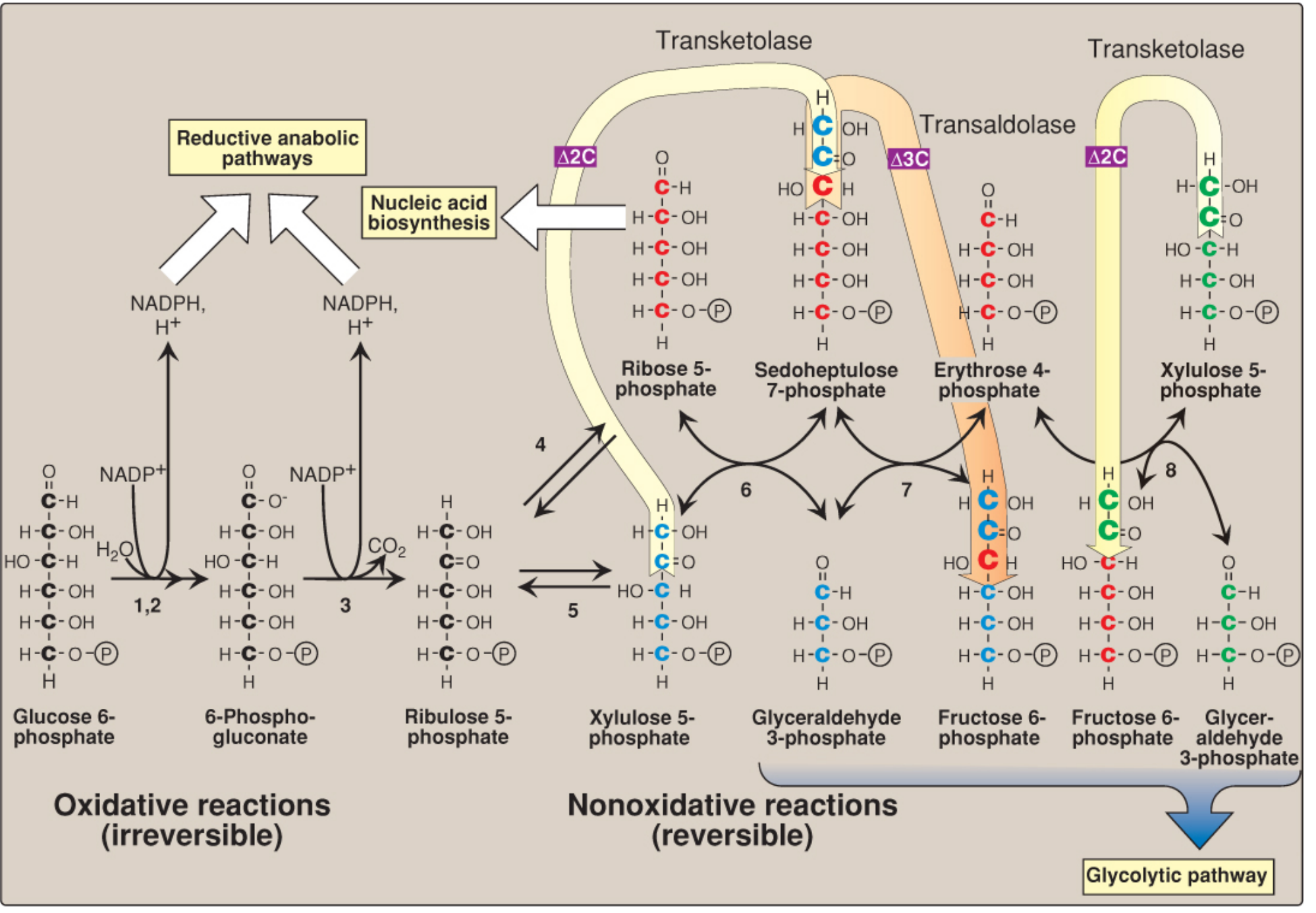
Glucose 6-phosphate → → → Ribulose 5-phosphate + 2 NADPH + CO2
Step-by-step:
-
Glucose 6-phosphate dehydrogenase (G6PD) - the committed, rate-limiting step
- Oxidizes glucose 6-P → 6-phosphogluconolactone
- Reduces NADP+ → NADPH (#1)
- Regulated: NADPH is a potent competitive inhibitor of G6PD; when NADPH/NADP+ falls, flux increases
- Insulin upregulates G6PD expression (active in the fed/absorptive state)
-
6-Phosphogluconolactone hydrolase
- Hydrolyzes the lactone → 6-phosphogluconate
-
6-Phosphogluconate dehydrogenase
- Oxidative decarboxylation: releases C1 as CO2
- Reduces NADP+ → NADPH (#2)
- Product: Ribulose 5-phosphate
Net from oxidative phase per glucose 6-P: 2 NADPH + CO2 + ribulose 5-P
Phase 2: Reversible Nonoxidative Phase
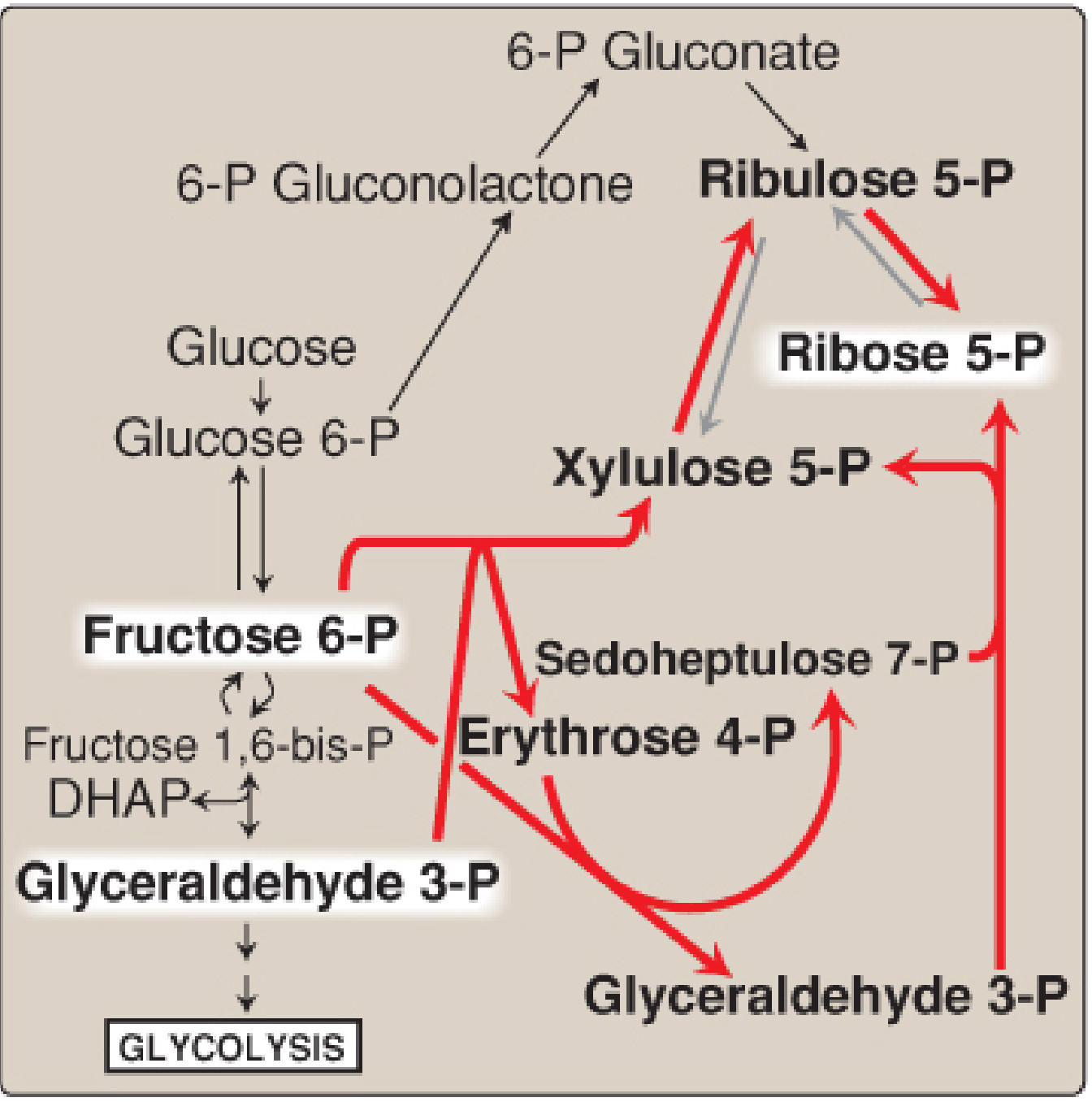
Ribulose 5-P is interconverted among various sugar phosphates by four enzymes:
| Enzyme | Action | Coenzyme |
|---|---|---|
| Isomerase | Ribulose 5-P → Ribose 5-P | - |
| Epimerase | Ribulose 5-P → Xylulose 5-P | - |
| Transketolase | Transfers 2-carbon fragments (Δ2C) | Thiamine pyrophosphate (TPP) |
| Transaldolase | Transfers 3-carbon fragments (Δ3C) | - |
Sugar interconversions:
5C + 5C → 7C + 3C → 4C + 6CThe reversible phase feeds fructose 6-phosphate and glyceraldehyde 3-phosphate back into glycolysis.
Overall Equation (for 3 glucose 6-P through the full pathway)
3 Glucose 6-P + 6 NADP+ → 3 CO2 + 6 NADPH + 2 fructose 6-P + glyceraldehyde 3-P
Compared to glycolysis of 3 glucose 6-P: the HMP shunt yields more NADPH (6 mol) but less ATP (8 vs 9 mol) and less pyruvate.
Regulation
The pathway direction depends on the cell's metabolic needs:
| Situation | What happens |
|---|---|
| Need NADPH + ribose 5-P | Oxidative phase runs fully |
| Need ribose 5-P only (NADPH adequate) | Inhibit oxidative phase; use glycolytic intermediates via nonoxidative phase in reverse |
| Need NADPH only (ribose 5-P adequate) | Run nonoxidative phase to recycle ribose 5-P back to glucose 6-P |
| Adequate NADPH, adequate ribose 5-P | Return pentose phosphates to glycolysis |
Tissue Distribution (Importance)
| Tissue | Why HMP shunt is active |
|---|---|
| Liver, adipose, lactating mammary gland | NADPH for fatty acid synthesis |
| Adrenal cortex, testes, ovaries, placenta | NADPH for steroid hormone synthesis |
| Red blood cells | NADPH to regenerate reduced glutathione (antioxidant protection) |
| All proliferating cells | Ribose 5-P for nucleotide biosynthesis |
Critical Role in Erythrocytes and G6PD Deficiency
In mature RBCs (no mitochondria), the HMP shunt is the only source of NADPH. NADPH is required to regenerate reduced glutathione (GSH) via glutathione reductase. GSH detoxifies H2O2 and other reactive oxygen species (ROS) via glutathione peroxidase.
The cycle: Oxidant stress → GSSG forms → G6PD activated (NADPH/NADP+ falls) → more NADPH → GSH regenerated
G6PD deficiency (most common human enzyme defect, X-linked) disrupts this cycle:
- NADPH cannot be made → GSH cannot be regenerated → RBCs susceptible to oxidative hemolysis
- Triggered by: oxidant drugs (primaquine, dapsone, nitrofurantoin), infections, fava beans
- Causes episodic hemolytic anemia
Thiamine Deficiency Link
Transketolase requires thiamine pyrophosphate (TPP). Transketolase activity in RBCs is used as a functional marker of thiamine (vitamin B1) nutritional status - low activity that is dramatically stimulated by adding TPP in vitro indicates thiamine deficiency (as seen in beriberi and Wernicke's encephalopathy).
Sources: Biochemistry (Lippincott Illustrated Reviews) 8e, p. 424-435; Basic Medical Biochemistry: A Clinical Approach 6e, p. 959-964; Goldman-Cecil Medicine, p. 1700-1701; Henry's Clinical Diagnosis and Management by Laboratory Methods
This is a shared conversation. Sign in to Orris to start your own chat.