
Explaim endocrine system
I'll read the medical library skill first, then search for endocrine system content.
Reading File
Now let me search the medical library for endocrine system content in parallel.
Finding Sources
Finding Sources
Excellent results. Now let me read the core physiology and histology sections in parallel, and grab the diagram image.
Reading File
Reading File
Reading File
Great content. Let me now fetch the key diagrams and read deeper into the physiology content on hormone mechanisms and individual glands.
Loading Image
Loading Image
Reading File
I now have rich content and two excellent diagrams. Let me read the feedback mechanism image and get more content on the individual glands and hormone action mechanisms.
Loading Image
Reading File
I now have comprehensive content from multiple authoritative textbooks. Let me compile the full, well-structured explanation.
The Endocrine System
Overview
The endocrine system, working in concert with the nervous system, is responsible for homeostasis - maintaining a stable internal environment. It regulates growth, development, reproduction, blood pressure, fluid balance, ion concentrations, metabolism, and even behavior. The system operates by secreting hormones - chemical messengers released into the bloodstream that act on distant target tissues.
The key distinction from the nervous system is speed: nervous signals are fast and short-lived; endocrine signals are slower but sustained and body-wide.
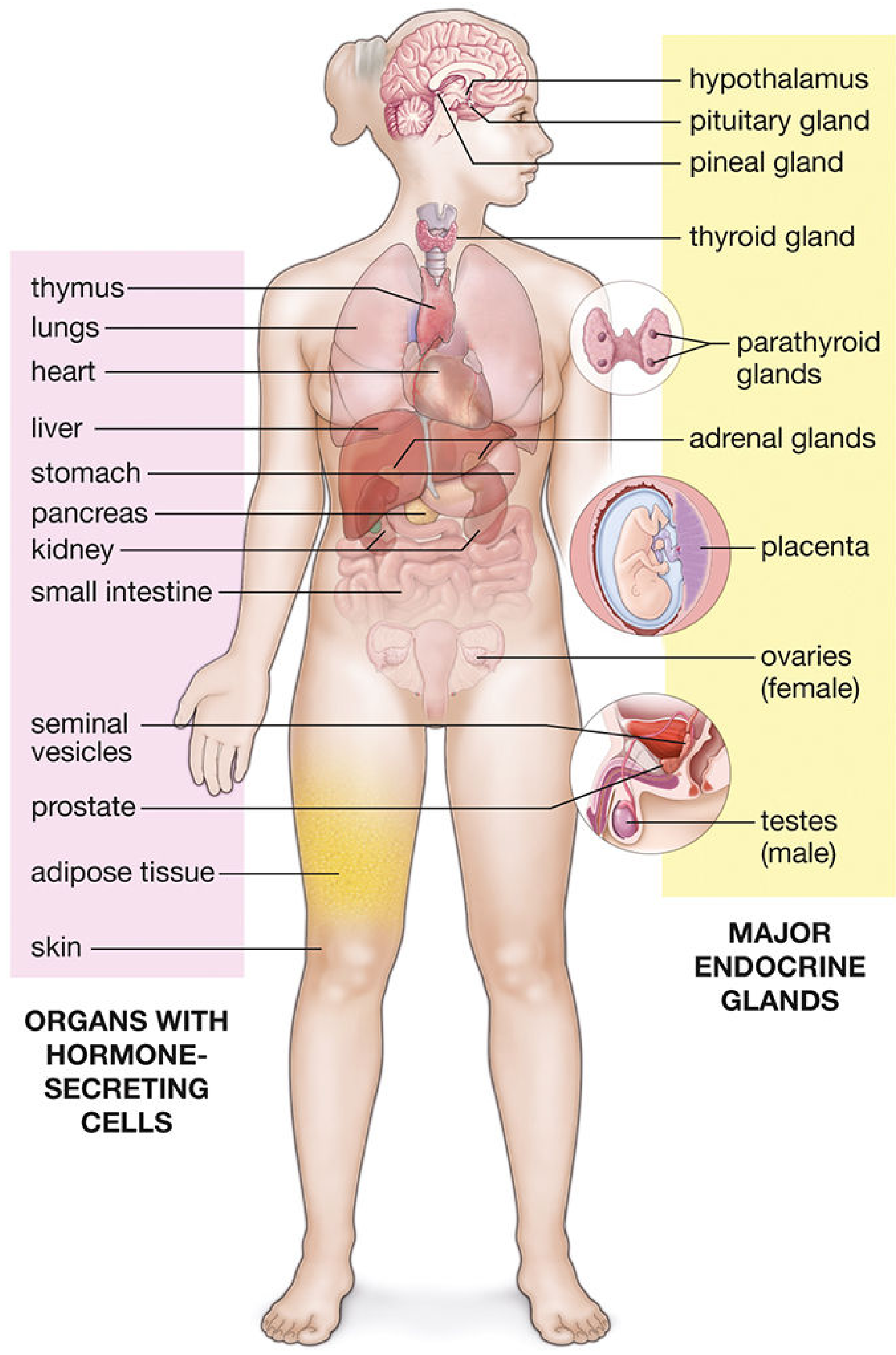
What Are Hormones?
A hormone is a chemical substance classified into one of three types:
| Class | Chemistry | Examples |
|---|---|---|
| Peptide/Protein | Amino acid chains | Insulin, GH, PTH, ADH, LH, FSH |
| Steroid | Cholesterol derivatives | Cortisol, aldosterone, estrogen, testosterone |
| Amines | Tyrosine derivatives | Epinephrine, norepinephrine, T3, T4 |
Hormones are secreted in small amounts, travel through the blood, and only act on cells bearing specific receptors for them.
- Costanzo Physiology 7th Edition, p. 395
Types of Chemical Signaling
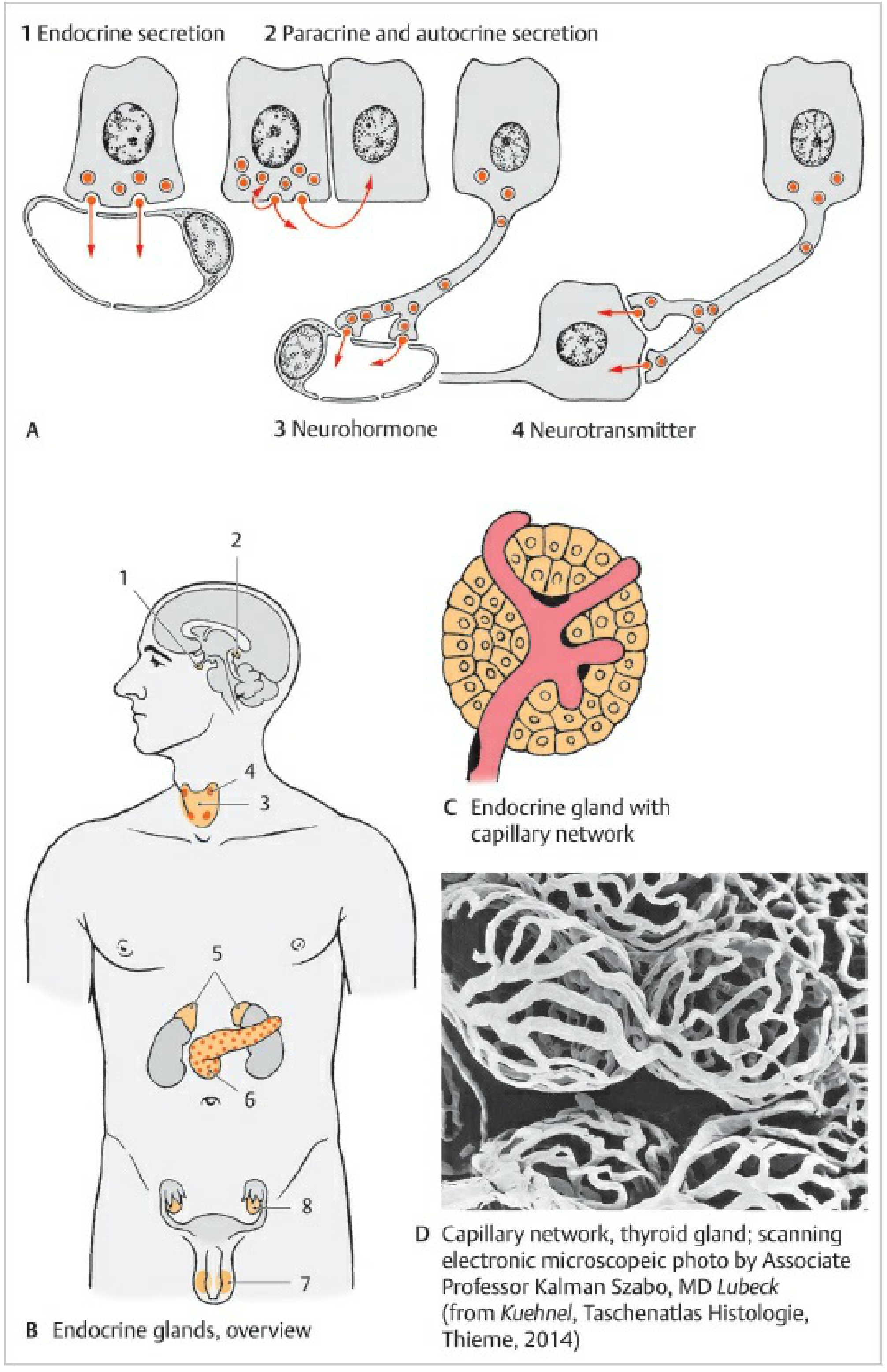
- Endocrine signaling - Hormones are released into the bloodstream and act on distant target organs (classic, long-range).
- Paracrine signaling - Hormones act on nearby cells (short-range, no blood transport).
- Autocrine signaling - A cell secretes a hormone that acts on itself.
- Neurosecretion - A neuron releases its product into the bloodstream to act as a hormone (e.g., ADH, oxytocin from the hypothalamus).
Major Endocrine Glands and Their Hormones
1. Hypothalamus
The master regulator. Secretes releasing and inhibiting hormones that control the anterior pituitary (e.g., GnRH, TRH, CRH, GHRH, somatostatin, dopamine). It also produces ADH and oxytocin, stored in the posterior pituitary.
2. Pituitary Gland (Hypophysis)
Called the "master gland." Has two lobes:
- Anterior lobe - Secretes GH, TSH, ACTH, FSH, LH, prolactin
- Posterior lobe - Releases ADH (antidiuretic hormone/vasopressin) and oxytocin (made in the hypothalamus)
3. Thyroid Gland
Secretes T3 (triiodothyronine) and T4 (thyroxine), which regulate metabolism, growth, and development. Also secretes calcitonin, which lowers blood calcium.
4. Parathyroid Glands (4 small glands behind the thyroid)
Secrete PTH (parathyroid hormone), which raises blood calcium by acting on bone, kidneys, and gut.
5. Adrenal Glands (one atop each kidney)
Two functional zones:
- Adrenal cortex - Secretes:
- Glucocorticoids (cortisol) - stress response, blood glucose, immune suppression
- Mineralocorticoids (aldosterone) - sodium and potassium balance
- Androgens (sex hormones)
- Adrenal medulla - Secretes catecholamines: epinephrine and norepinephrine (fight-or-flight response). These are released via direct neural stimulation from preganglionic sympathetic nerves.
6. Pancreas (Islets of Langerhans)
The endocrine part of the pancreas contains cell clusters:
- Beta (β) cells - Secrete insulin (lowers blood glucose)
- Alpha (α) cells - Secrete glucagon (raises blood glucose)
- Delta (δ) cells - Secrete somatostatin (inhibits both insulin and glucagon)
7. Gonads
- Ovaries - Estrogen and progesterone (female sex characteristics, reproductive cycle)
- Testes - Testosterone (male sex characteristics, spermatogenesis)
8. Pineal Gland
Secretes melatonin, regulating circadian rhythms and sleep-wake cycles.
9. Kidney
Produces erythropoietin (EPO, stimulates red blood cell production) and activates vitamin D to its active form (1,25-dihydroxycholecalciferol / calcitriol).
10. Placenta (during pregnancy)
A temporary endocrine organ that secretes hCG, estrogen, and progesterone to maintain pregnancy.
- Color Atlas of Human Anatomy Vol. 2, p. 561-562
Regulation of Hormone Secretion
Negative Feedback (most common)
The most important regulatory mechanism. When a hormone reaches a sufficient concentration, it "feeds back" to inhibit its own production. Example:
Hypothalamus → CRH → Anterior Pituitary → ACTH → Adrenal Cortex → Cortisol → inhibits hypothalamus & pituitary
This keeps hormone levels within a narrow physiologic range.
Positive Feedback (rare)
Hormone action amplifies further hormone release. The classic example is the LH surge just before ovulation: rising estrogen stimulates a massive LH surge from the pituitary, triggering ovulation.
Neural Mechanisms
The adrenal medulla is an exception - it is directly innervated by preganglionic sympathetic nerves, so catecholamine release is triggered by neural signals (stress, exercise, hypoglycemia).
- Costanzo Physiology 7th Edition, p. 399-402
Mechanisms of Hormone Action
How hormones communicate their message inside target cells depends on their chemistry:
Peptide/Protein Hormones (hydrophilic - cannot cross cell membrane)
Act on surface receptors and use second messengers:
- cAMP pathway: Hormone → G-protein-coupled receptor → adenylyl cyclase → cAMP → protein kinase A → cellular response. (Examples: glucagon, PTH, TSH, ACTH, LH, FSH, ADH)
- IP3/Ca²+ pathway: Hormone → phospholipase C → IP3 + DAG → Ca²+ release → protein kinase C. (Examples: GnRH, TRH, oxytocin)
- Tyrosine kinase pathway: Insulin and IGF-1 bind receptor tyrosine kinases to activate intracellular signaling cascades.
Steroid Hormones & Thyroid Hormones (lipophilic - cross the cell membrane)
Diffuse through the plasma membrane, bind to intracellular receptors, and the hormone-receptor complex acts directly as a transcription factor, turning genes on or off. Effects are slower but longer-lasting (hours to days). Examples: cortisol, estrogen, testosterone, T3/T4.
- Costanzo Physiology 7th Edition, p. 402-407
Receptor Regulation
- Down-regulation: Prolonged high hormone levels cause target cells to reduce receptor numbers, decreasing sensitivity. This is seen with chronically elevated insulin.
- Up-regulation: A hormone increases receptor numbers or affinity in target cells, enhancing sensitivity. Example: estrogen up-regulates its own receptors in the uterus and also LH receptors in the ovaries.
Structural Features of Endocrine Glands
Endocrine glands share several common features:
-
They are composed of epithelioid cells lacking a free surface
-
They have no ducts - hormones are secreted directly into the extracellular space and absorbed into blood or lymph vessels
-
They are richly vascularized with dense capillary networks to facilitate hormone delivery
-
Cells form characteristic microscopic arrangements: follicles (thyroid), cords (adrenal cortex), nests (parathyroid), islets (pancreas)
-
Histology: A Text and Atlas, p. 1972-1973
Diffuse Neuroendocrine System (DNES)
Beyond the classic glands, individual hormone-secreting cells are scattered throughout many organs (the gut, respiratory tract, skin, adipose tissue, heart, kidney). These are collectively called the diffuse neuroendocrine system (DNES). For example:
- GI tract enteroendocrine cells secrete CCK, secretin, ghrelin
- Adipose tissue secretes adipokines (leptin, adiponectin)
- The heart secretes ANP (atrial natriuretic peptide) to regulate blood pressure
Clinical Relevance
Endocrine disorders arise from:
-
Hypersecretion - excess hormone (e.g., Cushing's syndrome = excess cortisol; hyperthyroidism; acromegaly from excess GH)
-
Hyposecretion - deficiency (e.g., Type 1 diabetes = absent insulin; hypothyroidism; Addison's disease = adrenal insufficiency)
-
Receptor defects - Normal hormone levels but loss of target tissue response (e.g., Type 2 diabetes = insulin resistance)
-
Color Atlas of Human Anatomy Vol. 2, p. 562
Key takeaway: The endocrine system is a distributed, hierarchical chemical communication network. The hypothalamus-pituitary axis sits at the top, driving lower glands through tropic hormones, while negative feedback loops constantly fine-tune secretion to maintain homeostasis. Hormones work either via surface receptors and second messengers (peptides) or by entering cells and altering gene transcription (steroids/thyroid hormones).
This is a shared conversation. Sign in to Orris to start your own chat.