
Hypothyroidism
Reading File
Finding Sources
Finding Sources
Searching PubMed
"hypothyroidism"[MeSH Terms] AND "management"[MeSH Terms]
Finding Sources
Finding Sources
Reading File
Reading File
Reading File
Reading File
Reading File
Reading File
Reading File
Finding Sources
Reading File
Loading Image
I now have comprehensive content to write a detailed, well-structured answer on hypothyroidism.
Hypothyroidism
A condition of deficient thyroid hormone production resulting in a slowed metabolic state. It is one of the most common endocrine disorders, with primary autoimmune hypothyroidism (Hashimoto's thyroiditis) being the leading cause in iodine-sufficient regions.
Causes (Etiology)
Primary Hypothyroidism (thyroid gland failure)
| Category | Examples |
|---|---|
| Autoimmune | Hashimoto's thyroiditis (goitrous), atrophic thyroiditis |
| Iatrogenic | Radioiodine (¹³¹I) therapy, subtotal/total thyroidectomy, neck irradiation for lymphoma/cancer |
| Drugs | Iodine excess (including contrast media), amiodarone, lithium, antithyroid drugs, interferon-alpha, tyrosine kinase inhibitors (sunitinib), immune checkpoint inhibitors (ipilimumab, nivolumab, pembrolizumab) |
| Congenital | Absent/ectopic thyroid, dyshormonogenesis, TSH receptor mutation |
| Iodine deficiency | Most common global cause; endemic goiter/cretinism |
| Infiltrative | Amyloidosis, sarcoidosis, hemochromatosis, scleroderma, Riedel's thyroiditis |
| Consumptive | Overexpression of type 3 deiodinase in infantile hemangioma |
Transient Hypothyroidism
- Silent (postpartum) thyroiditis
- Subacute thyroiditis (de Quervain's)
- After radioiodine treatment (first 3-4 months)
Secondary / Central Hypothyroidism
- Pituitary or hypothalamic disease (low or normal/slightly elevated TSH with low free T4)
Epidemiology
- Mean annual incidence: up to 4 per 1000 women, 1 per 1000 men
- Subclinical hypothyroidism: 6-8% of women (10% over age 60) and 3% of men
- Typically presents between 30-50 years of age; mean age at diagnosis is 60 years
- Annual risk of progressing to overt hypothyroidism: ~4% when subclinical hypothyroidism is associated with positive TPO antibodies
Pathogenesis (Hashimoto's Thyroiditis)
- Marked lymphocytic infiltration with germinal center formation
- Atrophy of thyroid follicles with oxyphil (Hurthle cell) metaplasia, absence of colloid, and fibrosis
- Thyroid cell destruction is primarily mediated by CD8+ cytotoxic T cells; local cytokines (TNF, IL-1, IFN-γ) also contribute
- Autoantibodies include anti-TPO (thyroid peroxidase) and anti-thyroglobulin antibodies; these are markers of the disease but not necessarily the primary cause
- In atrophic thyroiditis: marked fibrosis, minimal lymphocytic infiltrate - represents end-stage Hashimoto's
- Genetic factors: HLA-DR3, DR4, DR5 in Caucasians; associations with PTPN22 and CTLA-4 polymorphisms; explains co-occurrence with type 1 DM, Addison's disease, pernicious anemia, and vitiligo
Clinical Features
The onset is usually insidious; patients may only recognize symptoms in retrospect after treatment restores euthyroidism.
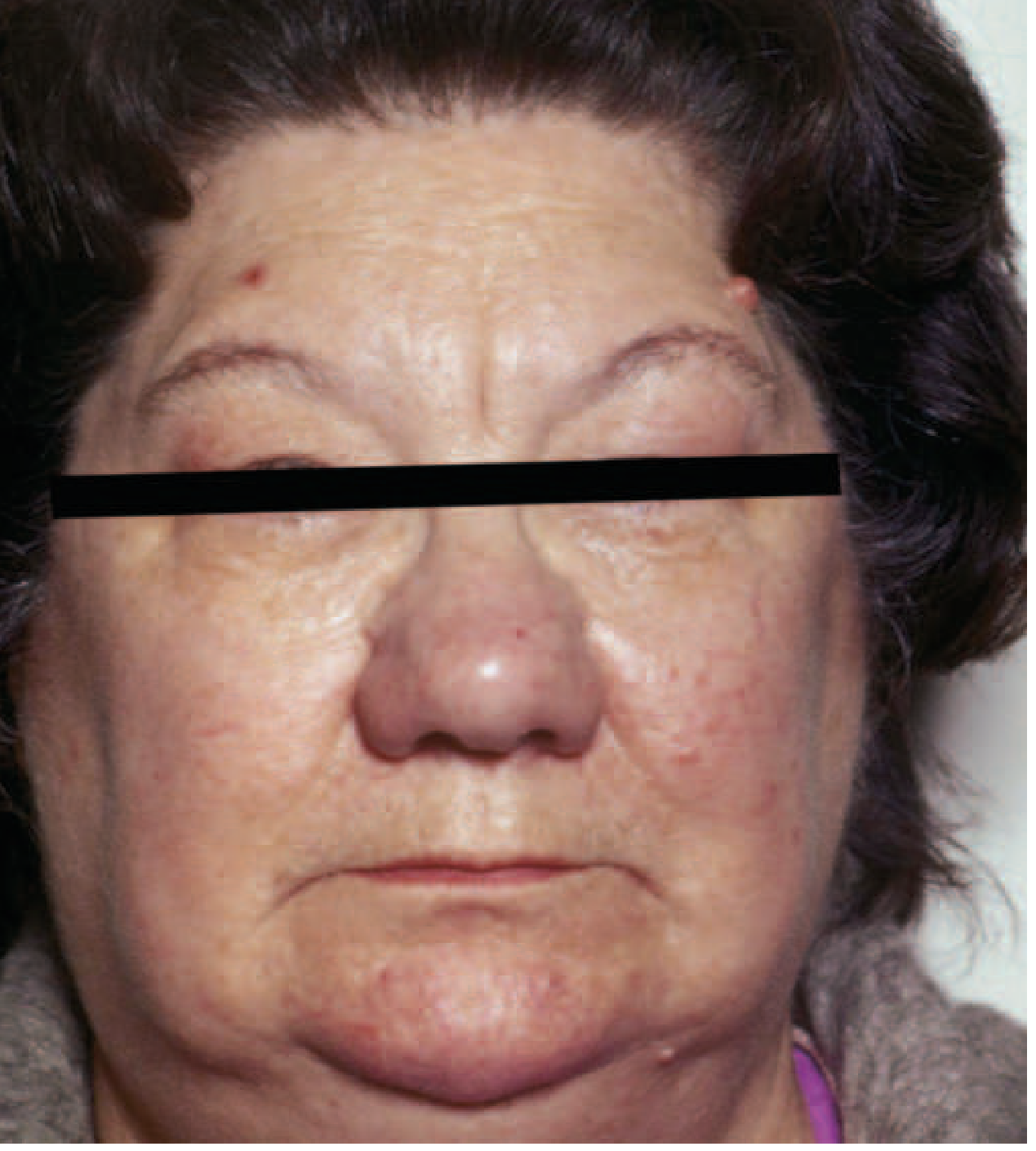
Skin and Hair
- Dry skin, decreased sweating, thinning epidermis, hyperkeratosis
- Myxedema: increased dermal glycosaminoglycans trap water → non-pitting skin thickening
- Puffy face, periorbital edema, non-pitting pretibial edema
- Pallor with yellow tinge (carotene accumulation)
- Dry, brittle hair that falls out easily; thinning of outer third of eyebrows (Hertoghe's sign)
- Retarded nail growth
Metabolic and Weight
- Weight gain (mainly fluid retention) despite poor appetite
- Cold intolerance
- Fatigue and lethargy
Cardiovascular
- Bradycardia, reduced myocardial contractility, reduced stroke volume
- Increased peripheral resistance → diastolic hypertension
- Pericardial effusion (up to 30% of patients, rarely hemodynamically significant)
- Cool extremities (blood flow diverted from skin)
GI and Reproductive
- Constipation
- Decreased libido in both sexes
- Oligomenorrhea or amenorrhea in long-standing disease; menorrhagia at early stage
- Reduced fertility; increased miscarriage rate
- Mildly elevated prolactin (can cause galactorrhea)
Neuromuscular and Psychiatric
- Slowed cognition, poor concentration, poor memory
- Psychosis can occur ("myxedema madness")
- Carpal tunnel syndrome (common association)
- Cerebellar ataxia (rare)
- Delayed relaxation of tendon reflexes (classic sign)
- Muscle cramps, myalgia, weakness; elevated CK
Other
- Conductive and sensorineural deafness (fluid in middle ear)
- Normochromic normocytic or macrocytic anemia
- Hyponatremia (SIADH-like)
- Hyperlipidemia (elevated LDL cholesterol)
Laboratory Diagnosis
| Test | Finding |
|---|---|
| Serum TSH | Elevated in primary hypothyroidism (most sensitive test) |
| Free T4 | Low |
| Anti-TPO antibodies | Positive in Hashimoto's (>90% of cases) |
| Anti-thyroglobulin antibodies | Positive in ~60% |
| Cholesterol | Elevated (LDL) |
| CK | Elevated (muscle involvement) |
| CBC | Anemia |
| Prolactin | Mildly elevated |
Secondary/Central hypothyroidism: TSH may be low, normal, or slightly elevated (bioinactive forms); free T4 is low. Do not rely on TSH alone - measure free T4.
Subclinical vs. Overt Hypothyroidism
| Subclinical | Overt (Clinical) | |
|---|---|---|
| TSH | Elevated (usually 4-10 mIU/L) | >10 mIU/L |
| Free T4 | Normal | Low |
| Symptoms | Minimal or absent | Present |
| Treatment | Controversial; treat if TSH >10, pregnant, or symptomatic | Always treat |
Treatment
Standard Replacement: Levothyroxine (LT4)
- Starting dose: 1.6 µg/kg/day (full replacement); typical range 100-150 µg/day
- Adults <60 years without cardiac disease: start at 50-100 µg/day and titrate up
- Ideally taken 30 minutes before breakfast (food, calcium, iron, bile acid sequestrants all impair absorption)
- Goal: normalize TSH, ideally in the lower half of the reference range
- TSH response is gradual - recheck TSH 6-8 weeks after each dose change
- Adjust in 12.5-25 µg increments
- Clinical improvement may take months even after TSH normalization
- Once stable: annual TSH monitoring
Special Populations
| Population | Adjustment |
|---|---|
| Elderly | 20% lower dose; start at 12.5-25 µg/day; increase every 2-3 months |
| Cardiac disease | Very low starting dose (12.5-25 µg/day), slow titration |
| Pregnancy | Increase dose by ~45% (athyroic women) or ~30% (Hashimoto's); goal TSH <2.5 mIU/L; check TSH every 4 weeks in first half of pregnancy |
| Secondary hypothyroidism | Target free T4 in upper half of reference range (cannot use TSH to monitor) |
Persistent Symptoms
- ~10-15% of patients have persistent symptoms despite euthyroid TSH - reasons unclear
- LT4 + liothyronine (T3) combinations: studied but benefit not confirmed in prospective trials
- Desiccated thyroid (USP) is not recommended (non-physiologic T3:T4 ratio)
- Liothyronine alone is not suitable for long-term replacement (short half-life, fluctuating T3 levels)
Causes of Elevated TSH Despite Treatment
- Poor adherence (most common - patients miss doses then take them before blood draw → normal T4 but high TSH)
- Malabsorption (celiac disease, atrophic gastritis, H. pylori gastritis, small bowel surgery)
- Oral estrogen, SERMs
- Drug interactions (ferrous sulfate, calcium carbonate, bile acid sequestrants, PPIs)
Myxedema Coma
The most severe, life-threatening form of hypothyroidism. Mortality remains 20-40% despite intensive treatment.
- Almost always in the elderly
- Precipitants: sedatives, anesthetics, antidepressants, pneumonia, MI, CHF, GI bleeding, CVA, sepsis, cold exposure
- Features: depressed consciousness, seizures, hypothermia (as low as 23°C/74°F), bradycardia, hypoventilation, hyponatremia, hypoglycemia
- Treatment: IV LT4 (or T3), glucocorticoids (until adrenal insufficiency excluded), ICU supportive care
Congenital Hypothyroidism
- Incidence: ~1 in 2000-4000 newborns
- Causes: thyroid dysgenesis (65%), inborn errors of synthesis (30%), TSH-R antibody-mediated (5%)
- Most common treatable cause of mental retardation - neonatal screening programs are critical
- Transplacental maternal T4 provides partial support before fetal thyroid function begins
Key Associations
- Autoimmune polyendocrine syndromes: type 1 DM, Addison's disease, pernicious anemia, vitiligo
- Down syndrome and Turner syndrome have increased prevalence
- Drug-induced: checkpoint inhibitors are an increasingly recognized cause in oncology patients
Sources: Harrison's Principles of Internal Medicine 22E (2025), Chapter 395 - Weetman, Mandel, Jameson
This is a shared conversation. Sign in to Orris to start your own chat.