
what is pericarditis what are is type clinical manifestations pathopysiology and defenativ diagnosis and disgnostics investigations management and prognisis with the health teachigs
Reading File
Now I'll search the medical library and PubMed in parallel for comprehensive pericarditis coverage.
Finding Sources
Searching PubMed
"pericarditis"[MeSH Terms] AND "diagnosis"[MeSH Terms]
Now let me read the key textbook sections in parallel — Braunwald's (the gold standard cardiology text) and Rosen's Emergency Medicine:
Reading File
Reading File
Reading File
Now let me get the main Braunwald's pericarditis block and Rosen's emergency medicine block for clinical details:
Reading File
Reading File
Excellent content. Now let me get the continuation of Rosen's pericarditis section (management, diagnosis, prognosis) and search for relevant images:
Reading File
Searching Images
pericarditis ECG changes saddle-shaped ST elevation
Finding Sources
Now let me get the full management and Washington Manual details, plus the Rosen's section on treatment:
Reading File
Reading File
Reading File
I now have comprehensive information. Let me fetch the key ECG image and write the complete answer:
Loading Image
Loading Image
I now have all the information needed for a thorough, well-structured response. Here is a comprehensive clinical overview of pericarditis:
Pericarditis: Complete Clinical Overview
1. Definition
Pericarditis is inflammation of the pericardium — the two-layered fibroserous sac surrounding the heart — caused by granulocytic and lymphocytic infiltration. It accounts for approximately 5% of all non-ischemic chest pain presentations in the emergency department and is one of the most common pericardial diseases encountered clinically.
2. Types / Classification
By Duration
| Type | Duration |
|---|---|
| Acute | < 4–6 weeks |
| Incessant | > 4–6 weeks but < 3 months without remission |
| Recurrent | Recurrence after a symptom-free interval ≥ 4–6 weeks |
| Chronic | > 3 months |
By Etiology
Primary (idiopathic/viral): 80–90% of cases in Western countries are labeled idiopathic; most are presumed viral.
Infectious causes:
- Viral (most common): Coxsackievirus A/B, echovirus, adenovirus, Epstein-Barr virus, influenza, cytomegalovirus — a specific virus is isolated in only 15–30% of cases
- Bacterial: Pneumococcus, S. aureus, meningococcus, Haemophilus influenzae (~30% of infectious cases in children); tuberculosis (leading cause in developing countries and immunocompromised patients)
- Fungal and parasitic (rare)
Non-infectious causes:
- Post-cardiac injury syndromes: Post-MI (Dressler syndrome — occurs 1–8 weeks post-MI due to autoimmune response to injured myocardium), post-pericardiotomy, post-radiation, post-trauma
- Systemic inflammatory diseases: SLE (pericarditis in 40–80% at autopsy), Rheumatoid arthritis, Systemic sclerosis, Rheumatic fever, Sarcoidosis, Amyloidosis
- Uremia — most common systemic disorder associated with pericarditis
- Malignancy: Metastatic tumors (lung, breast, lymphoma, GI), primary cardiac tumors
- Drugs: Hydralazine, procainamide, isoniazid, certain chemotherapy agents
- Aortic dissection
3. Pathophysiology
The pericardium consists of a parietal and visceral layer with a narrow potential space containing 15–35 mL of plasma ultrafiltrate. It normally maintains cardiac position, lubricates the cardiac surface, prevents infection spread, prevents overdilation, and maintains normal pressure-volume relationships.
Mechanism of injury:
- An inciting agent (virus, bacteria, autoantigen, uremic toxin, trauma) triggers an inflammatory cascade within the pericardium
- Granulocytic and lymphocytic infiltration occurs, releasing inflammatory mediators
- The pericardial surfaces become edematous and inflamed
- Exudate forms — type depends on etiology:
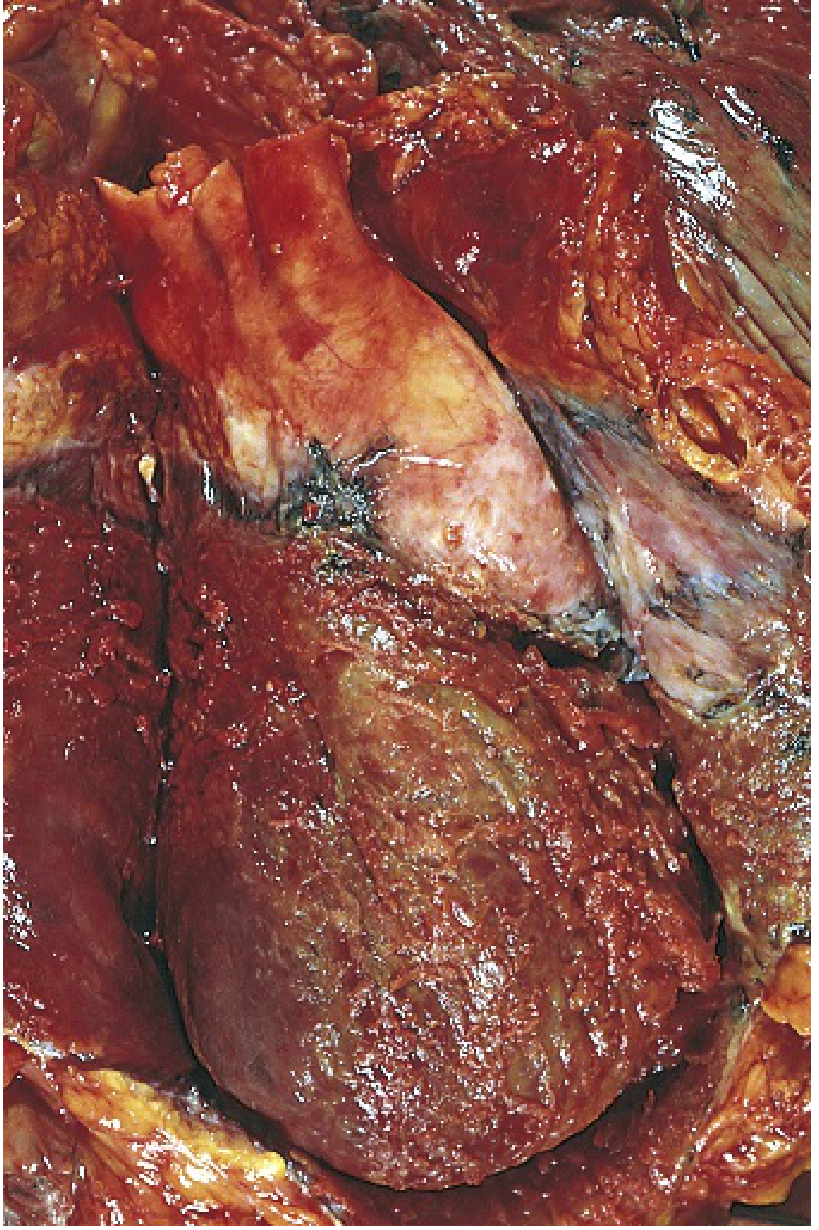
- Fibrinous (viral, uremic): irregular, shaggy "bread-and-butter" appearance
- Fibrinopurulent/suppurative (bacterial): pus accumulation
- Caseating (tuberculous)
- Serosanguineous/bloody (malignancy)
- Pericardial effusion may develop if exudate accumulates in the pericardial space
- Rapid or large accumulation of fluid → cardiac tamponade (compression of myocardium → ↓ stroke volume → ↓ cardiac output → shock)
- Healing with fibrosis → constrictive pericarditis (dense scar encases the heart, impairing diastolic filling)
Recent research has focused on distinguishing autoinflammatory vs. autoimmune pericarditis, which has therapeutic implications (particularly for IL-1 blockade in recurrent autoinflammatory pericarditis).
4. Clinical Manifestations
Symptoms
- Chest pain — the hallmark symptom; sharp, pleuritic in quality
- Worsened by: supine position, deep inspiration, swallowing, coughing
- Relieved by: sitting upright and leaning forward (classic position)
- Retrosternal location; may radiate to the trapezius ridge or back (highly specific for pericarditis), or present as isolated shoulder pain
- Fever and myalgias (common preceding history)
- Dyspnea — may have pleuritic component
- Fatigue, malaise
Signs
- Pericardial friction rub — pathognomonic physical finding
- Caused by friction between inflamed visceral and parietal pericardium
- Best heard: lower left sternal border, patient leaning forward in full expiration
- Has up to 3 components: ventricular systole, early ventricular diastole, atrial systole ("to-and-fro" or "creaking leather" quality)
- Intermittent and migratory — may disappear as effusion develops
- Tachycardia — may be the only finding in some patients
- If effusion develops: muffled heart sounds, distended neck veins, pulsus paradoxus
Signs of Complications
- Cardiac tamponade: Beck's triad — hypotension + distended neck veins + muffled heart sounds; pulsus paradoxus > 10 mmHg, tachycardia, tachypnea, hepatomegaly, lower extremity edema
- Constrictive pericarditis: right-sided heart failure (dyspnea, fatigue, weight gain, hepatomegaly, marked lower extremity edema, ascites), pericardial knock in early diastole
5. Diagnostic Criteria (Definitive Diagnosis)
ESC 2015 Diagnostic Criteria for Acute Pericarditis
Diagnosis requires ≥ 2 of the following 4 criteria:
| Criterion | Details |
|---|---|
| 1. Pericarditic chest pain | Sharp, pleuritic, improved sitting forward |
| 2. Pericardial friction rub | Scratching, scraping sound on auscultation |
| 3. ECG changes | New widespread ST elevation or PR depression |
| 4. Pericardial effusion | New or worsening on imaging |
Additional supporting findings: elevated CRP/ESR/WBC, evidence of pericardial inflammation on CT or MRI.
6. Diagnostic Investigations
ECG — Most Reliable Initial Tool
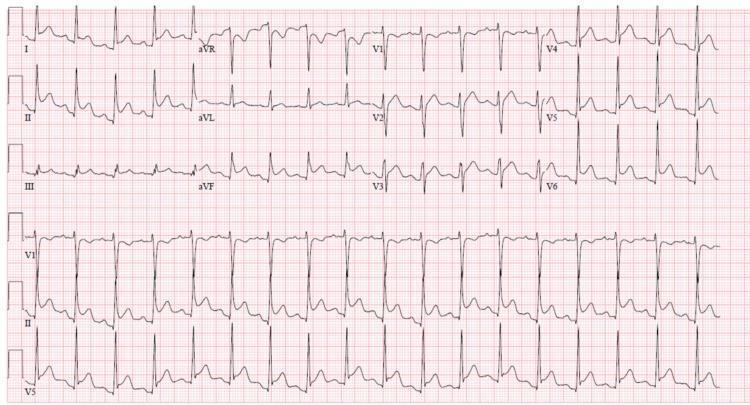
ECG evolves through 4 classic stages:
| Stage | Timing | ECG Findings |
|---|---|---|
| Stage 1 | Hours to days | Diffuse concave ("saddle-shaped") ST elevation in all leads except aVR and V1 (which show reciprocal ST depression); PR segment depression (most visible in lead II); Spodick's sign (downsloping TP segment) |
| Stage 2 | Days 1–2 weeks | ST and PR segments normalize; T waves flatten |
| Stage 3 | Weeks | Deep, symmetrical T wave inversions |
| Stage 4 | Weeks to months | ECG returns to normal (T-wave inversions may persist) |
Key distinction from STEMI: ST elevation in pericarditis is concave (not convex/tombstone), diffuse (not localized to one coronary territory), no reciprocal ST depression (except aVR/V1), no Q waves, no evolutionary progression of STEMI pattern.
Laboratory Studies
| Test | Finding / Purpose |
|---|---|
| CRP, ESR | Elevated (markers of inflammation; CRP guides treatment duration) |
| WBC | Leukocytosis (non-specific) |
| Troponin / CK-MB | Elevated if myopericarditis (concomitant myocardial involvement) |
| BUN/Creatinine | Rule out uremic pericarditis |
| ANA, anti-dsDNA | Rule out SLE |
| Rheumatoid factor | Rule out RA |
| Blood cultures | If bacterial pericarditis suspected |
| TSH | Rule out hypothyroidism |
| HIV testing | If at-risk patient |
Imaging
- Echocardiography (TTE/POCUS) — First-line imaging; detects pericardial effusion in up to 60% of patients; normal echo does NOT exclude pericarditis; assesses for tamponade
- Chest X-ray — May show enlarged cardiac silhouette ("water-bottle heart") with large effusion; may be normal; pericardial calcification suggests constrictive pericarditis
- Cardiac MRI — Gold standard for assessing pericardial inflammation: pericardial delayed gadolinium hyperenhancement confirms active inflammation; identifies myocarditis component; superior for constrictive vs. restrictive differentiation
- CT scan — Pericardial thickening (> 4 mm), calcification; useful for constrictive pericarditis
Pericardiocentesis / Pericardial Fluid Analysis
- Indicated when: tamponade, large effusion, suspicion of bacterial/tuberculous pericarditis, malignancy
- Fluid analysis: cell count, glucose, protein, LDH, culture, cytology, AFB stain, ADA (adenosine deaminase for TB)
- Note: routine fluid analysis is rarely diagnostically useful unless infection is specifically suspected; immune complexes, ANA, complement levels may be checked in autoimmune cases
High-Risk Features Requiring Hospitalization (ESC)
- Fever > 38°C
- Subacute onset
- Large effusion or tamponade
- Failure to respond to NSAIDs within 7 days
- Immunosuppression, trauma, anticoagulant therapy, myopericarditis
7. Management
Acute Idiopathic/Viral Pericarditis
First-line (both required together):
-
NSAIDs + Colchicine (Class I recommendation, ESC 2015)
- Ibuprofen 600 mg QID × 10 days, OR Aspirin 650 mg TID × 10 days (preferred post-MI), OR Indomethacin 25 mg TID
- Colchicine: 0.5 mg once daily (weight < 70 kg) or 0.5–0.6 mg twice daily (weight ≥ 70 kg) for 3–6 months
- Adding colchicine reduces persistent/recurrent pericarditis by ~50% (COPE and ICAP randomized trials)
-
Activity restriction: athletes should avoid competitive sports until complete resolution of symptoms and normalization of CRP, ECG, and echocardiogram
Second-line (if NSAIDs contraindicated, failed, or anticoagulant use):
- Low- to moderate-dose corticosteroids: Prednisone 0.2–0.5 mg/kg/day (lower dose has fewer recurrences and complications than 1.0 mg/kg/day)
- Steroids should be used sparingly — they increase recurrence risk and impair pericarditis resolution
- Post-MI: defer steroids ≥ 4 weeks (impair infarct healing, risk of ventricular aneurysm)
- Avoid heparin in active pericarditis (risk of pericardial hemorrhage)
Third-line / Recurrent/Refractory:
- IL-1 receptor antagonist: Anakinra (supported by the AIRTRIP randomized trial) — for recurrent idiopathic/autoinflammatory pericarditis
- Network meta-analysis (PMID 39705019, 2025) confirms colchicine + IL-1 antagonists are most effective for recurrent pericarditis
- Pericardiectomy: reserved for medically refractory cases or when constriction develops
Specific Etiologies
| Cause | Specific Treatment |
|---|---|
| Bacterial | IV antibiotics + early surgical drainage (survival ~50% combined vs. 30% antibiotics alone) |
| Tuberculous | Multidrug antitubercular therapy + pericardiocentesis; steroids not clearly beneficial |
| Uremic | Intensify dialysis; NSAIDs for pain |
| SLE/autoimmune | Treat underlying disease; NSAIDs/colchicine for symptoms |
| Post-MI (Dressler) | Aspirin preferred; ibuprofen/NSAIDs if needed; avoid in early post-MI period |
| Tamponade | Emergency pericardiocentesis |
| Constrictive | Pericardiectomy (treatment of choice; mortality ~10%) |
8. Prognosis
- Idiopathic/viral pericarditis: Self-limited in 70–90% of cases; excellent prognosis
- Recurrence rate: 15–30% with NSAIDs alone; reduced to ~7–15% with colchicine added
- Constrictive pericarditis: Develops in a minority; pericardiectomy has ~10% mortality
- Bacterial pericarditis: 30% survival with antibiotics alone; ~50% with antibiotics + drainage
- Cardiac tamponade: Life-threatening emergency; prompt pericardiocentesis is curative
- Poor prognostic indicators (require hospitalization):
- Fever > 38°C
- Large effusion or tamponade
- Subacute course
- Failure of NSAIDs within 1 week
- Immunosuppression
- Myopericarditis (concurrent myocardial involvement): generally favorable prognosis with appropriate management but requires troponin monitoring and cardiac MRI
9. Health Teachings (Patient Education)
Medications
- Take NSAIDs with food to prevent stomach upset; do not stop abruptly
- Colchicine must be taken for the full 3–6 months even after symptoms resolve — stopping early significantly increases recurrence
- Watch for colchicine side effects: diarrhea, nausea, abdominal cramping — report to provider; dose may be adjusted
- Do not take NSAIDs if you have kidney disease, peptic ulcer, or are pregnant without provider guidance
Activity Restrictions
- Avoid all strenuous physical activity, exercise, and competitive sports until pericarditis is fully resolved (symptoms gone + CRP normal + ECG/echo normalized)
- Rest as much as possible during the acute phase
- For athletes, this restriction can last weeks to months — premature return increases recurrence risk
Warning Signs — When to Return to Emergency Department Immediately
- Sudden worsening chest pain or pressure
- Difficulty breathing
- Rapid or irregular heartbeat
- Lightheadedness, dizziness, or fainting
- Swelling of the legs or abdomen (signs of constrictive pericarditis)
- High fever unresponsive to medication
Follow-up
- Regular follow-up appointments with cardiologist to confirm complete resolution
- Repeat CRP, ECG, and echocardiogram before returning to full activity
- Inform future healthcare providers about the episode of pericarditis (important for surgical planning, anticoagulation decisions)
Lifestyle
- Avoid alcohol during treatment — it can worsen inflammation and interact with medications
- Stay well hydrated, especially with colchicine use
- Reduce stress and ensure adequate rest
- Do not miss dialysis sessions if you are on dialysis (uremic pericarditis)
Understanding Recurrence
- Recurrence occurs in up to 30% of patients — this does NOT mean you did anything wrong
- Completing the full course of colchicine is the single most important step to prevent recurrence
- Report any recurrence of chest pain promptly — early treatment reduces complications
Infectious Precautions
- Most viral pericarditis follows upper respiratory infections; practice good hand hygiene
- Vaccinations (influenza, pneumococcal) reduce risk of viral/bacterial triggers
Summary Table
| Feature | Details |
|---|---|
| Most common cause | Idiopathic/viral (80–90% in Western countries) |
| Classic symptom | Sharp chest pain, worse supine, relieved leaning forward |
| Pathognomonic sign | Pericardial friction rub |
| Key ECG finding | Diffuse saddle-shaped ST elevation + PR depression |
| Definitive diagnosis | ≥ 2 of 4 ESC criteria |
| First-line treatment | NSAIDs + Colchicine (3–6 months) |
| Recurrence prevention | Colchicine reduces recurrence by ~50% |
| Dangerous complication | Cardiac tamponade (emergency pericardiocentesis) |
| Late complication | Constrictive pericarditis (pericardiectomy) |
Key sources:
- ROSEN's Emergency Medicine, 9th ed., Ch. 68
- Robbins & Kumar Basic Pathology, 10th ed., Ch. 9
- Mulholland & Greenfield's Surgery, 7th ed., Ch. on Pericardial Diseases
- Braunwald's Heart Disease, 12th ed.
- Washington Manual of Medical Therapeutics
- ESC 2015 Guidelines on Pericardial Diseases
- Desai D et al., Network Meta-Analysis, Panminerva Med 2025 [PMID: 39705019]
- Klein AL et al., JACC Cardiovasc Imaging 2024 [PMID: 39111992]
This is a shared conversation. Sign in to Orris to start your own chat.