
I and D of Perianal Abscess
Reading File
Finding Sources
Finding Sources
The best source is "Pfenninger and Fowler's Procedures for Primary Care" — it has a dedicated chapter on Perianal Abscess Incision and Drainage. Let me read it along with relevant sections from Roberts & Hedges' Emergency Clinical Procedures and Schwartz's Surgery.
Reading File
Reading File
Reading File
Reading File
Reading File
Loading Image
Searching Images
perianal abscess incision drainage technique anatomy
Loading Image
Loading Image
I now have comprehensive information from multiple authoritative textbooks. Here is a complete summary:
Incision & Drainage of Perianal Abscess
Pathophysiology & Classification
Most perianal abscesses originate from cryptoglandular infection at the dentate line — bacteria infect the anal crypts and spread through the path of least resistance into the perianal soft tissue spaces.
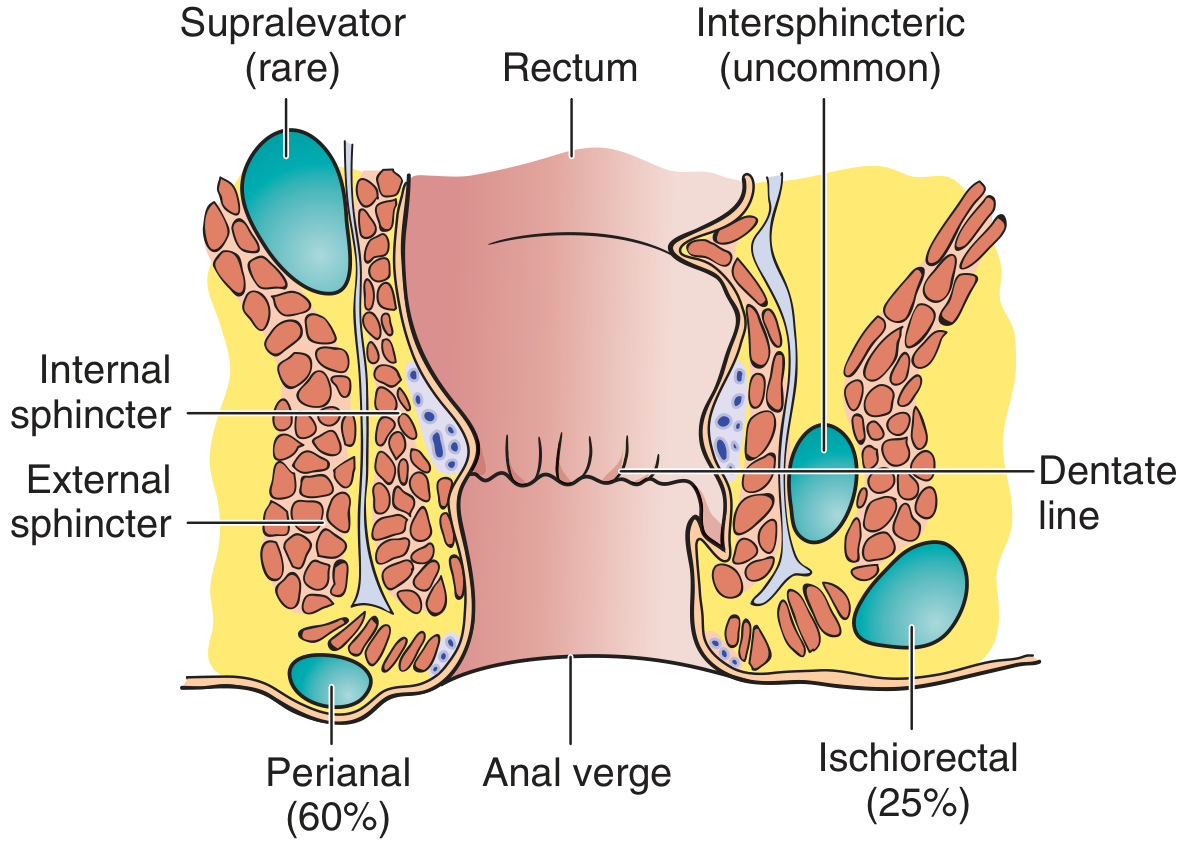
| Location | Incidence | Features |
|---|---|---|
| Perianal (adjacent to anal verge) | 60% | Most common; superficial; amenable to outpatient I&D |
| Ischiorectal (outside sphincters, 2–3 cm from verge) | 25% | Larger, may be bilateral ("horseshoe abscess") |
| Intersphincteric (between internal & external sphincters) | Uncommon | No external swelling; diagnosed on digital exam as fluctuant mass above anorectal ring |
| Supralevator / Pelvirectal | Rare | Must rule out intra-abdominal/pelvic source (appendicitis, diverticulitis, PID) |
Clinical Features
- Pain: Severe, throbbing, progressive perianal pain — worsened by sitting, coughing, sneezing, and straining
- Signs: Swelling, induration, erythema, tenderness near the anus
- Systemic: Fever and leukocytosis in more severe cases
- Microbiology: Mixed infection — anaerobes (B. fragilis), gram-negative enteric bacilli; consider MRSA in endemic areas
- WBC >10 × 10⁹/L in <50% of cases
Imaging: CT sensitivity is only ~77%; MRI is preferred when clinical suspicion is high but CT is non-diagnostic.
Indications for I&D
Nearly every perianal abscess requires I&D — this is the treatment of choice, not antibiotic therapy alone. The only exception is if spontaneous drainage has clearly provided adequate drainage (though loculations must still be assessed manually).
⚠️ Delaying I&D risks necrotizing fasciitis or perineal sepsis (pain + fever + inability to void). This is especially urgent in diabetic, immunocompromised, or steroid-dependent patients.
Contraindications / Special Cases
- Hematologic malignancy (leukemia, lymphoma, granulocytopenia): The infecting organisms differ; some authorities recommend conservative antibiotics ± local radiotherapy. If surgery is needed, do NOT attempt in an outpatient setting — refer.
- Only small, well-defined perianal abscesses without deeper extension are suitable for outpatient I&D. All others (ischiorectal, intersphincteric, supralevator) should be drained in the OR.
Equipment
- 2% lidocaine with epinephrine; 27- or 30-gauge needle
- Hemostats
- No. 11 scalpel blade
- 4×4 gauze
- Penrose drain or iodoform gauze packing (½-inch)
- Suction (for large abscesses)
- Surgical electrocautery (for hemostasis in hyperemic tissue)
- Ives slotted anoscope or Hill-Ferguson rectal retractors
Procedure — Step by Step
Before the Incision
- Anoscopy first (before I&D): With gentle pressure on the abscess, look for pus expressed from an internal opening at the dentate line — this confirms an associated anal fistula. The fistula-in-ano rate with perianal abscess is at least 50%.
- Anesthesia: Local anesthesia (2% lidocaine with epinephrine) is often only marginally effective because the acidic infected tissue resists local anesthetics. Spinal or general anesthesia may be required for larger abscesses.
Incision
- Make a radial incision over the most fluctuant area, directed radially toward the anal canal. This orientation allows easy extension for fistulotomy if a fistula is identified.
- Alternative: excise an ellipse of tissue large enough to admit a finger for cavity exploration and loculation breakdown.
- Another option: cruciate (cross) incision — preferred by some because a simple linear incision risks premature closure without adequate drainage.
- Express all purulence. Break down loculations with a gloved finger or hemostats. Cultures are obtained here if warranted (see below).
Irrigation & Drainage
- Irrigate the abscess cavity.
- Place a Penrose drain loosely in the cavity, sutured at the skin edge — remove at 24–48 hours (Penrose drain does not adhere, making removal painless).
- Alternative: pack with ½-inch iodoform gauze; replace at 48-hour intervals until granulation tissue appears (usually 4–6 days).
Temporizing Measure (if OR unavailable)
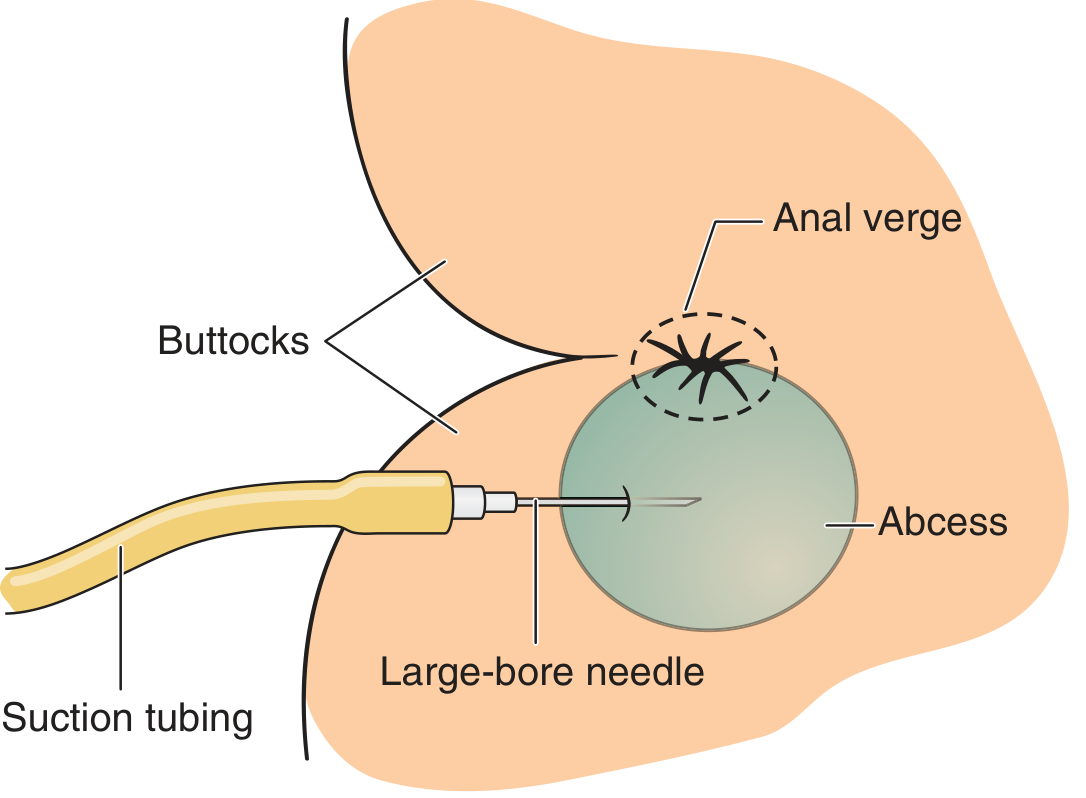
- A 16-gauge or larger needle + suction can temporarily decompress the abscess and provide dramatic pain relief. Disadvantage: makes fistula evaluation more difficult.
Clinical Photographs
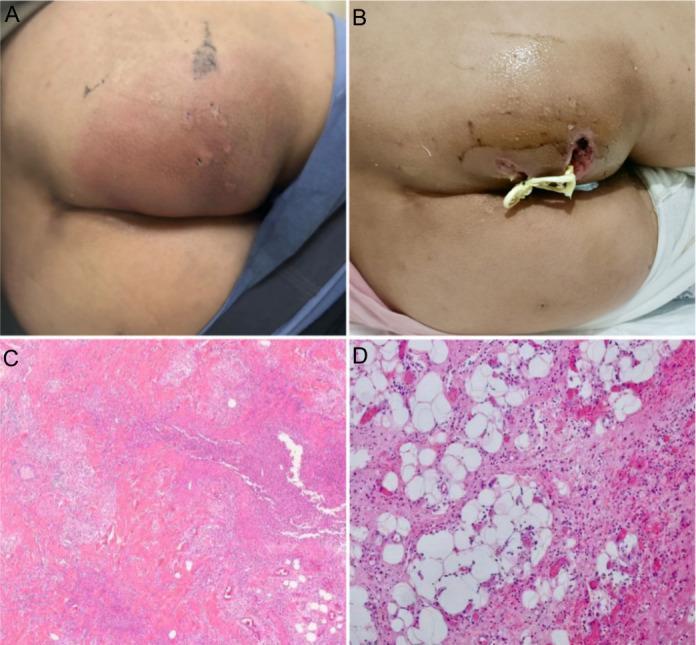
(A) Pre-op: tense, erythematous perianal mass. (B) Post-I&D with Penrose drain. (C–D) Histology: dense neutrophilic infiltrate, tissue necrosis confirming acute abscess.
Anesthesia Decision Guide
| Abscess Type | Setting | Anesthesia |
|---|---|---|
| Small, superficial perianal | Outpatient | Local (may be marginal) |
| Larger perianal / uncertain extent | ED or outpatient OR | Local + sedation or spinal |
| Ischiorectal / intersphincteric / supralevator | OR | Spinal or general |
Antibiotics
Postoperative antibiotics are generally NOT required after adequate I&D.
Consider antibiotics in:
- Immunocompromised patients
- Extensive surrounding cellulitis
- Sepsis
- Valvular heart disease
- Diabetes with systemic signs
- Patients on multiple prior antibiotic courses
Cultures: Not routinely needed. Useful in the above groups and to distinguish cryptoglandular abscess (colonic flora) from perianal skin abscess (staphylococcal).
Complications
| Complication | Notes |
|---|---|
| Recurrence (most common) | Usually due to unrecognized fistula-in-ano — evaluate all recurrences for fistula |
| Fistula-in-ano | Chronic sequela; patient should be referred for definitive fistulotomy |
| Crohn's disease | Consider in recurrent or atypical cases |
| Necrotizing fasciitis / Fournier's gangrene | If I&D is delayed; perirectal abscesses can serve as portal of entry |
| Bleeding | Uncommon |
| Sepsis / death | Associated with delay, inadequate drainage, and systemic disease |
Postprocedure Care
- Sitz baths 10–15 minutes, 2–4 times/day, starting 24 hours after surgery
- Wound must heal from inside out — prevent premature skin-edge closure
- Daily wound irrigations if no gauze packing is used
- Follow up to rule out fistula-in-ano, inflammatory bowel disease
Sources:
- Pfenninger and Fowler's Procedures for Primary Care, 3rd ed., Chapter 107
- Roberts and Hedges' Clinical Procedures in Emergency Medicine
- Mulholland and Greenfield's Surgery, 7th ed.
This is a shared conversation. Sign in to Orris to start your own chat.