Write a post graduate question on Strain replacement theory related to dental caries. you can take information from pubmed indexed articles and give me references

Reading File
Searching PubMed

strain replacement theory dental caries Streptococcus mutans

Searching PubMed

Streptococcus mutans replacement therapy dental caries prevention

Searching PubMed

bacterial strain replacement caries Streptococcus mutans

Finding Sources
Reading Article
Reading Article
Reading Article
Reading Article
Reading Article
I now have rich material to write a thorough postgraduate question. Here it is:

Postgraduate Question: Strain Replacement Therapy and Dental Caries


Long Essay Question (20 Marks)

"Strain replacement therapy represents a paradigm shift from conventional antimicrobial approaches to a biologically targeted strategy for dental caries prevention."
(a) Define strain replacement therapy and explain its theoretical basis in the context of oral ecology and the infectious nature of dental caries. (4 marks)
(b) Describe the construction and characteristics of the effector strain BCS3-L1 (and its subsequent modification A2JM), detailing the genetic modifications employed and the rationale behind each. (6 marks)
(c) Discuss the key properties that an ideal effector strain must possess to successfully colonize the oral cavity and displace wild-type cariogenic Streptococcus mutans. (4 marks)
(d) Critically evaluate the limitations, biosafety concerns, and ethical considerations associated with introducing a genetically engineered strain into the human oral microflora. (4 marks)
(e) How does bacterial replacement therapy compare with probiotic-based approaches (e.g., lactobacilli, S. salivarius) in the prevention of oral infectious disease? (2 marks)

Model Answer / Examiner's Key Points


(a) Definition and Theoretical Basis (4 marks)

Strain replacement therapy is a novel preventive strategy in which a harmless, genetically modified "effector" strain is permanently implanted within the host's indigenous oral microflora. Once established, this effector strain prevents the colonization or overgrowth of the virulent pathogen it was designed to displace.
The theoretical basis rests on three pillars:
  1. Infectious etiology of dental caries: Dental caries is a transmissible, bacterially mediated disease in which Streptococcus mutans is the primary etiological agent. Its acquisition follows a definable window of infectivity in early childhood.
  2. Ecological competition within biofilms: Members of the indigenous oral microflora actively compete for colonization sites and nutrients. Bacteria produce bacteriocins (e.g., mutacins) that inhibit competing strains - a phenomenon known as antibiosis. This natural antagonism can be exploited therapeutically.
  3. Colonization resistance: Once a strain occupies an ecological niche, it is difficult for a competing strain to displace it. A pre-established, benign effector strain can therefore block the subsequent establishment of pathogenic strains.
Hillman & Socransky (1987) first proposed this concept formally, describing replacement therapy as a biologically rational approach to preventing both dental caries and periodontal disease by exploiting interspecies bacterial antagonism. [PMID: 3326613]

(b) Construction of BCS3-L1 and A2JM (6 marks)

BCS3-L1 was derived from a clinical S. mutans isolate using recombinant DNA technology (Hillman, 2002):
ModificationGene TargetedRationale
Deletion of lactate dehydrogenase (LDH) geneldhCompletely abrogates lactic acid production, eliminating the primary mechanism of enamel demineralization. The strain retains the ability to colonize but cannot acidify the plaque environment.
Upregulation of mutacin 1140 productionMutacin structural genesMutacin 1140 is a novel lantibiotic peptide antibiotic. Elevated production gives BCS3-L1 a strong competitive advantage over wild-type S. mutans strains in the same niche.
BCS3-L1 was shown to be:
  • Genetically stable over prolonged colonization
  • Non-cariogenic in gnotobiotic rats (significantly less cariogenic than wild-type)
  • Capable of displacing indigenous S. mutans after a single topical application
A2JM - the clinically modified successor (Hillman et al., 2007) - introduced two additional mutations for human trial safety: [PMID: 17448156]
Additional ModificationGenePurpose
Deletion of d-alanine biosynthesis genedalCreates auxotrophy for d-alanine; the strain requires exogenous d-alanine to survive, allowing rapid eradication with chlorhexidine by depleting the oral bacterial reservoir if adverse effects occur.
Deletion of genetic transformation genecomEReduces horizontal gene transfer competence, limiting the possibility of the engineered genetic material spreading to other oral bacteria and increasing genetic containment.
A2JM retained the core features of BCS3-L1 and was found suitable for Phase I human clinical safety trials based on in vitro and animal model data.

(c) Properties of an Ideal Effector Strain (4 marks)

  1. Competitive colonization ability: The strain must be capable of establishing itself in the complex oral biofilm environment and persisting long-term after a single or limited application.
  2. Production of a potent, narrow-spectrum bacteriocin: It must produce an antibiotic (such as mutacin 1140) that specifically disadvantages the target pathogen (S. mutans) without broadly disrupting the commensal oral microbiome.
  3. Elimination of virulence factor(s): The cariogenic determinant (lactic acid production via LDH) must be deleted while retaining all colonization-related properties (adhesins, glucosyltransferases for biofilm formation).
  4. Genetic stability: The modifications must not revert to wild-type under in vivo selection pressures.
  5. Safety and containment: An ideal strain incorporates a "kill-switch" mechanism (auxotrophy, antibiotic sensitivity) that allows its eradication in the event of unexpected side effects, as exemplified by the dal deletion in A2JM.
  6. Lack of horizontal gene transfer: Reduced genetic transformability to prevent spread of engineered sequences to other oral microorganisms.
Gupta & Marwah (2010) succinctly captured the concept: relatively avirulent recombinant strains, once implanted, may either interfere with colonization of or compete with indigenous cariogenic mutans streptococci, offering a cost-effective, long-term host-tailored protection. [PMID: 27616834]

(d) Limitations, Biosafety, and Ethical Considerations (4 marks)

Biosafety concerns:
  • Although comE deletion reduces competence, horizontal gene transfer cannot be entirely excluded. Spread of mutacin 1140 overproduction genes to other oral streptococci could alter the oral microbiome unpredictably.
  • Auxotrophic strains can scavenge d-alanine from surrounding plaque bacteria, reducing the effectiveness of the kill-switch (demonstrated in the A2JM animal model).
  • Long-term colonization effects on the broader oral and systemic microbiome remain incompletely characterized.
Clinical and practical limitations:
  • The window of infectivity concept implies that treatment must be timed during early childhood, before indigenous S. mutans becomes established.
  • The current strain targets only S. mutans, but other mutans streptococci (e.g., S. sobrinus) also contribute to caries.
  • No large-scale human RCTs have been published to date confirming long-term safety or efficacy.
Ethical considerations:
  • Deliberate introduction of a live genetically modified organism (GMO) into the human oral cavity raises regulatory and bioethical questions regarding informed consent, especially in pediatric populations.
  • Long-term ecological consequences of permanently displacing wild-type strains in a community setting are unknown.
  • Public acceptance of "GMO bacteria" as a dental preventive measure may be limited.
Tagg & Dierksen (2003) cautioned that, despite the promise, increasing antimicrobial resistance and ecological unpredictability must be carefully weighed before wide deployment of any effector strain. [PMID: 12727383]

(e) Comparison with Probiotic-Based Approaches (2 marks)

FeatureStrain Replacement TherapyProbiotic Therapy
Organism typeGenetically engineered effector strainWild-type or naturally selected bacteria (e.g., Lactobacillus, S. salivarius)
PermanenceDesigned for permanent, single-application colonizationRequires repeated administration; transient colonization
SpecificityHighly specific (targets S. mutans niche via mutacin)Indirect competition; broad spectrum
Regulatory pathRequires GMO approval; stringent clinical trialsGenerally regarded as safe (GRAS); simpler approval
MechanismCompetitive displacement + bacteriocin productionCompetitive exclusion, immune modulation, lowered pH tolerance
Scope of diseaseDental caries specificallyCaries, periodontitis, and some systemic effects
Both strategies leverage the ecological framework of the oral microbiome. Tagg & Dierksen (2003) noted that bacterial replacement therapy shows particular promise for caries (via avirulent S. mutans), otitis media (via alpha-hemolytic streptococci), and pharyngitis (via S. salivarius BLIS producers). [PMID: 12727383]

References (PubMed Indexed)

  1. Hillman JD, Socransky SS. Replacement therapy of the prevention of dental disease. Adv Dent Res. 1987 Oct;1(1):119-25. PMID: 3326613
  2. Hillman JD. Genetically modified Streptococcus mutans for the prevention of dental caries. Antonie Van Leeuwenhoek. 2002 Aug;82(1-4):361-6. PMID: 12369203
  3. Tagg JR, Dierksen KP. Bacterial replacement therapy: adapting 'germ warfare' to infection prevention. Trends Biotechnol. 2003 May;21(5):217-23. PMID: 12727383
  4. Hillman JD, Mo J, McDonell E, Cvitkovitch D, Hillman CH. Modification of an effector strain for replacement therapy of dental caries to enable clinical safety trials. J Appl Microbiol. 2007 May;102(5):1209-19. PMID: 17448156
  5. Gupta S, Marwah N. 'Use a Thorn to Draw Thorn' Replacement Therapy for Prevention of Dental Caries. Int J Clin Pediatr Dent. 2010 Sep-Dec;3(3):157-62. PMC4993818. PMID: 27616834

Examiner's note: A candidate scoring full marks should demonstrate understanding that strain replacement therapy is an application of ecological competition principles (antibiosis, colonization resistance) to a specific infectious disease - dental caries - and should clearly distinguish the roles of each genetic modification in BCS3-L1/A2JM. Critical analysis of biosafety (GMO, kill-switch limitations, horizontal gene transfer) is expected for higher band marks.

write an answer for the exam

Here is a full model exam answer written in essay style, as a postgraduate student would write it under examination conditions:

EXAM ANSWER

"Strain Replacement Therapy as a Paradigm Shift in Dental Caries Prevention"


(a) Definition and Theoretical Basis

Strain replacement therapy is a novel, biologically targeted preventive strategy in which a genetically modified, avirulent "effector" strain of a cariogenic bacterium is deliberately implanted into the host's oral microflora. Once permanently established, this effector strain colonizes the same ecological niche as the pathogen and prevents the colonization or outgrowth of virulent disease-causing strains - most notably Streptococcus mutans.
The theoretical basis of this approach rests on the well-established understanding that dental caries is an infectious, transmissible disease. S. mutans is the primary etiological agent, producing lactic acid through fermentation of dietary carbohydrates, which drives enamel demineralization. Because caries follows a definable pattern of bacterial acquisition - typically from mother to child during a "window of infectivity" in early childhood - it is theoretically possible to interrupt this transmission by pre-establishing a competing, harmless strain before the virulent organism can colonize.
The underlying ecological principle is colonization resistance and interspecies antibiosis. Within the oral biofilm, bacteria compete aggressively for adhesion sites and nutrients. Many streptococci produce bacteriocins - proteinaceous antimicrobial peptides - that inhibit closely related competing strains. This natural antagonism provides the biological machinery for replacement therapy: if an effector strain already occupies the niche and produces a superior bacteriocin, incoming wild-type pathogenic strains are competitively excluded. Hillman and Socransky (1987) were the first to formally propose exploiting this phenomenon for the prevention of both dental caries and periodontal disease.

(b) Construction of BCS3-L1 and Its Clinical Modification A2JM

The first purpose-built effector strain, BCS3-L1, was derived from a clinical isolate of S. mutans using recombinant DNA technology by Hillman (2002). Two key genetic modifications were introduced:
1. Deletion of the lactate dehydrogenase (LDH) gene (ldh): The ldh gene encodes the enzyme responsible for converting pyruvate to lactic acid at the terminal step of anaerobic glycolysis. Complete deletion of this gene abolishes lactic acid production entirely. Consequently, BCS3-L1 retains all the colonization attributes of wild-type S. mutans - adhesins, glucosyltransferases for biofilm formation, acid tolerance - but cannot acidify the plaque environment. This single modification eliminates the primary virulence mechanism responsible for enamel destruction while leaving the organism's ability to compete for the oral niche intact.
2. Upregulation of mutacin 1140 production: Mutacin 1140 is a naturally occurring lantibiotic peptide antibiotic produced by certain strains of S. mutans. BCS3-L1 was engineered to produce elevated amounts of this mutacin. This confers a powerful competitive advantage: when BCS3-L1 is introduced into the oral cavity, the high mutacin output selectively inhibits wild-type S. mutans strains competing for the same niche. In animal and laboratory studies, BCS3-L1 demonstrated genetic stability, no apparent deleterious side effects during prolonged colonization, and strong displacement of indigenous S. mutans following a single topical application.
For translation to human clinical trials, Hillman et al. (2007) created the successor strain A2JM, incorporating two additional safety mutations:
3. Deletion of the d-alanine biosynthesis gene (dal): This mutation creates a nutritional auxotrophy: A2JM cannot synthesize d-alanine, an essential component of its cell wall peptidoglycan, without an exogenous supply. In the absence of dietary d-alanine supplementation, the strain can only survive by scavenging trace amounts from surrounding oral bacteria. This serves as a biological "kill-switch" - reducing the total oral bacterial load through chlorhexidine rinses depletes d-alanine availability, enabling virtually complete eradication of A2JM if adverse effects arise.
4. Deletion of the genetic transformation gene (comE): comE encodes a key regulatory component of the competence machinery through which S. mutans naturally takes up exogenous DNA from its environment. Deleting this gene reduces horizontal gene transfer competence, limiting the possibility that the engineered genetic elements (particularly mutacin overproduction sequences) could spread to other members of the oral microbiome. Although this deletion does not confer absolute containment, its very low reversion frequency provides an important additional safety layer.
A2JM thus satisfies both efficacy (LDH deletion + mutacin overproduction) and biosafety requirements (dal + comE deletions) for entry into Phase I human clinical trials.

(c) Properties of an Ideal Effector Strain

For replacement therapy to succeed clinically, the effector strain must satisfy several critical criteria:
i. Superior colonization capacity: The strain must out-compete wild-type S. mutans for adhesion to the tooth surface and integration into the dental biofilm. Since the oral niche is already occupied, the effector strain must possess at least equivalent, if not superior, adhesion and biofilm-forming properties. Strong initial implantation - ideally after a single application - ensures long-term residence without need for repeated dosing.
ii. Production of a potent, targeted bacteriocin: The effector strain must produce a bacteriocin (such as mutacin 1140) that specifically suppresses wild-type S. mutans strains without broadly disrupting the rest of the commensal oral microflora. Narrow-spectrum activity preserves the ecological balance of the oral cavity while targeting only the pathogen.
iii. Complete elimination of cariogenic virulence: Deletion of LDH activity must be total and stable. Any residual acid production would defeat the purpose of the therapy. The deletion must also be genetically stable under prolonged in vivo selection pressures to prevent reversion.
iv. Genetic stability: All introduced mutations must be maintained across generations of bacterial replication in the oral environment, without back-mutation or phenotypic drift.
v. Safety kill-switch: A mechanism for controlled eradication - such as auxotrophy (dal deletion) or heightened sensitivity to a specific antimicrobial agent - must be incorporated to allow rapid clearance of the strain in the event of unexpected adverse effects.
vi. Minimal horizontal gene transfer: Reduced competence (via comE deletion or similar) minimizes the risk of engineered sequences spreading to other oral bacteria, satisfying regulatory biosafety requirements.
vii. Immunological compatibility: The strain should not provoke an exaggerated immune response or induce systemic sensitization that would complicate long-term colonization.

(d) Limitations, Biosafety, and Ethical Considerations

Despite its biological elegance, strain replacement therapy faces significant challenges before widespread clinical adoption.
Biosafety concerns:
The most fundamental concern is the deliberate introduction of a live, genetically modified organism (GMO) into the human body. Even with comE deletion, horizontal gene transfer cannot be entirely excluded - bacteria possess multiple pathways for genetic exchange (conjugation, transduction), and complete containment is not guaranteed. Spread of mutacin overproduction genes to other oral streptococci could alter competitive dynamics in the oral microbiome in unpredictable ways.
The dal auxotrophy kill-switch, while conceptually sound, has shown partial limitations in practice. Hillman et al. (2007) demonstrated that A2JM can scavenge d-alanine from surrounding plaque bacteria and thus colonize rat oral cavities even without dietary supplementation. This reduces the reliability of the kill-switch and means that full eradication may require both chlorhexidine treatment (to deplete the bacterial d-alanine source) and cessation of dietary supplementation simultaneously.
Long-term ecological consequences of permanently displacing all wild-type S. mutans strains from an individual's oral cavity are unknown. While S. mutans is primarily associated with caries pathology, any permanent alteration of the human microbiome warrants longitudinal monitoring.
Practical limitations:
The therapy primarily targets S. mutans, but Streptococcus sobrinus and other mutans streptococci also contribute to caries development, particularly in certain geographic populations. A single-target effector strain may therefore provide incomplete protection.
Timing is a critical issue. The window of infectivity for S. mutans acquisition (typically 19-31 months of age in most studies) means that replacement therapy must be administered in early childhood before indigenous S. mutans becomes permanently established. In individuals already colonized, the superior colonization properties of BCS3-L1 or A2JM are still expected to achieve gradual displacement over time through mutacin-mediated competition, but this process is less predictable than prevention of initial colonization.
No large-scale randomized controlled human trials confirming long-term safety or efficacy have been published to date, representing a significant evidentiary gap.
Ethical considerations:
The use of recombinant DNA technology to create an organism for permanent implantation in children raises ethical questions that go beyond conventional drug administration. Informed consent in a pediatric population must be thoroughly structured. Parents must be clearly informed about the permanent nature of the colonization and the theoretical possibility of gene transfer events, even if remote.
Public perception of "GMO bacteria" as a dental preventive measure may present significant adoption barriers, irrespective of safety data. Regulatory approval pathways for live GMO therapeutics differ substantially from conventional drugs and require additional layers of review.

(e) Comparison with Probiotic-Based Approaches

Both strain replacement therapy and probiotic approaches share the same foundational principle - using beneficial bacteria to displace or inhibit pathogens - but differ substantially in mechanism, durability, and regulatory pathway.
Probiotic strategies (e.g., Lactobacillus rhamnosus, L. reuteri, Streptococcus salivarius BLIS producers) rely on natural wild-type organisms administered repeatedly. Their colonization of the oral cavity is typically transient, requiring ongoing administration to maintain any protective effect. Mechanism of action includes competitive exclusion, lowering local pH tolerance for pathogens, production of natural inhibitory substances (BLIS - bacteriocin-like inhibitory substances), and immunomodulation. These organisms are generally regarded as safe (GRAS status) and follow a simpler regulatory approval pathway.
Strain replacement therapy, by contrast, is designed for permanent single-application colonization through superior competitive displacement. Its highly engineered specificity (targeted LDH deletion + mutacin overproduction) represents a more powerful and durable strategy, but at the cost of regulatory complexity, biosafety scrutiny, and ethical deliberation.
Tagg and Dierksen (2003) noted that recent progress in bacterial replacement therapy has been most evident in three areas: avirulent S. mutans for dental caries control, alpha-hemolytic streptococci for reducing recurrent otitis media, and S. salivarius for preventing streptococcal pharyngitis - suggesting that the replacement therapy framework has broader applications beyond caries prevention.
In summary, replacement therapy offers a one-time, targeted, and potentially permanent solution to the infectious etiology of dental caries. Its realization in clinical practice depends on resolving the remaining biosafety, regulatory, and ethical challenges identified above.

References

  1. Hillman JD, Socransky SS. Replacement therapy of the prevention of dental disease. Adv Dent Res. 1987;1(1):119-25. PMID: 3326613
  2. Hillman JD. Genetically modified Streptococcus mutans for the prevention of dental caries. Antonie Van Leeuwenhoek. 2002;82(1-4):361-6. PMID: 12369203
  3. Tagg JR, Dierksen KP. Bacterial replacement therapy: adapting 'germ warfare' to infection prevention. Trends Biotechnol. 2003;21(5):217-23. PMID: 12727383
  4. Hillman JD, Mo J, McDonell E, Cvitkovitch D, Hillman CH. Modification of an effector strain for replacement therapy of dental caries to enable clinical safety trials. J Appl Microbiol. 2007;102(5):1209-19. PMID: 17448156
  5. Gupta S, Marwah N. 'Use a Thorn to Draw Thorn' Replacement Therapy for Prevention of Dental Caries. Int J Clin Pediatr Dent. 2010;3(3):157-62. PMID: 27616834

Word count guidance: A full answer of this depth in an exam setting would be approximately 1,200-1,500 words. Under time pressure, priority sections are (b) and (d), which carry the most marks and the highest examiner discrimination.

add a flowchart explaining the mechanism

Generating Image
Strain Replacement Therapy Flowchart

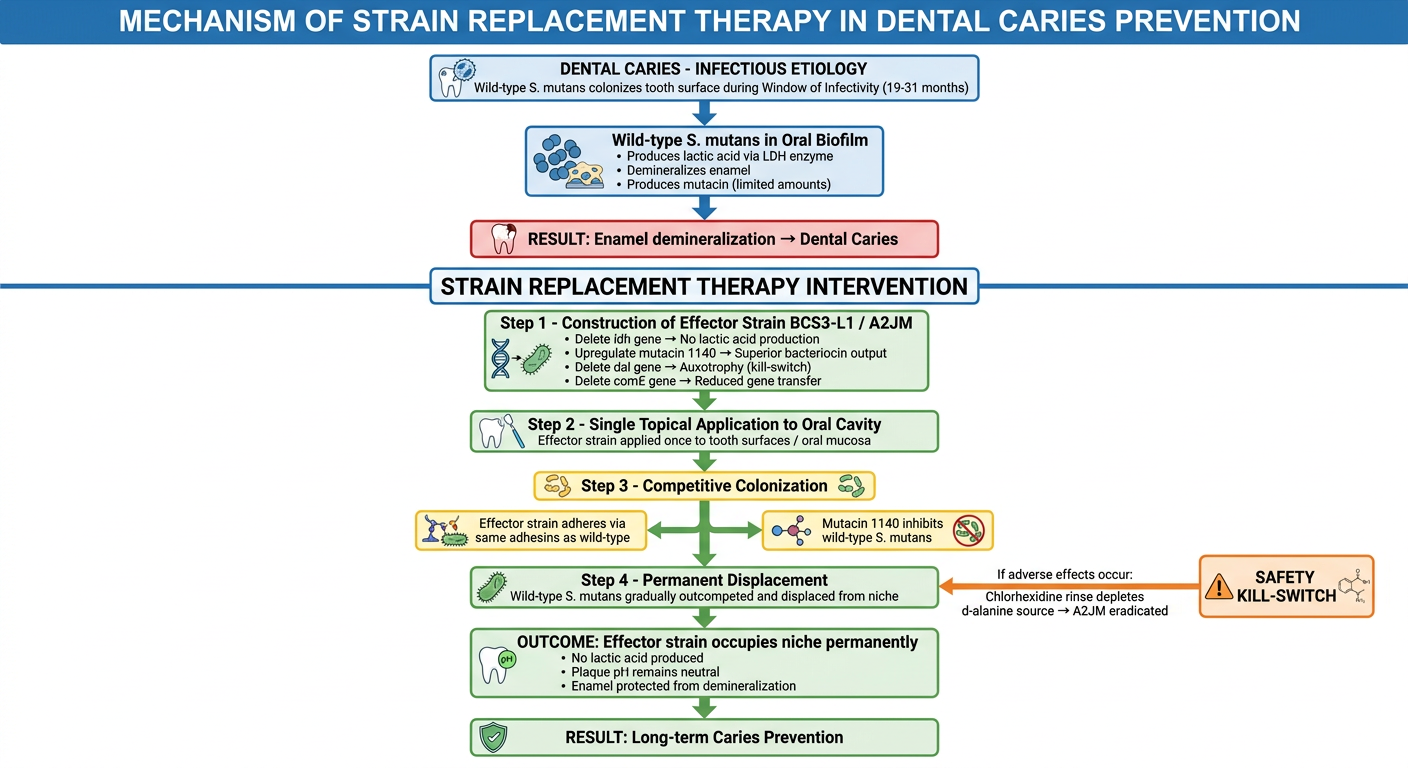
Here is the flowchart summarizing the complete mechanism of strain replacement therapy. The flow is organized in 5 conceptual phases:
  1. Disease context - Wild-type S. mutans establishes during the window of infectivity and produces lactic acid via LDH, driving enamel demineralization.
  2. Genetic engineering - BCS3-L1/A2JM is constructed with four key mutations: ldh deletion (no acid), mutacin 1140 upregulation (competitive weapon), dal deletion (kill-switch), and comE deletion (gene transfer block).
  3. Single application - The effector strain is applied topically once to the oral cavity.
  4. Competitive displacement - The effector strain colonizes the same niche using identical adhesion machinery, while mutacin 1140 suppresses wild-type S. mutans.
  5. Permanent protection - The niche is permanently occupied by a non-acidogenic strain, maintaining neutral plaque pH and preventing enamel demineralization. The orange safety kill-switch pathway shows how chlorhexidine can eradicate A2JM if needed by depleting its d-alanine source.
This is a shared conversation. Sign in to Orris to start your own chat.