
Vortex approach 10 marks answer
Asking for Preferences
Which subject/context is 'Vortex approach' from?
The Vortex approach is a cognitive aid and decision-making framework for managing the unanticipated difficult airway/failed intubation scenario. Let me pull detailed content from the medical library.
Searching sources...
Reading File
Finding Sources
Finding Sources
Searching the Web
Vortex approach difficult airway management 10 marks exam answer anaesthesia
Good - I found relevant sections in Miller's Anesthesia, Fishman's, and Cummings. Let me read them all in parallel.
Reading File
Reading File
Reading File
Reading Web Page
https://anaesthetics.ukzn.ac.za/Libraries/ab2/Vortex-approac…
I have enough information from multiple authoritative sources (Miller's Anesthesia, Fishman's, Cummings Otolaryngology, and the original Vortex document by Chrimes) to write a comprehensive 10-mark answer. Let me also fetch the Vortex diagram image mentioned in the Cummings textbook.
Finding Sources
Reading Web Page
https://rollcagemedic.com/resources/Archived_newsletters/the…
I have the Vortex diagram image URL. Let me fetch it and compile the full answer.
Loading Image
I now have all the content needed. Here is the complete 10-mark exam answer:
The Vortex Approach (10 Marks)
Definition and Origin
The Vortex approach is a cognitive aid and decision-making framework designed for the emergency management of the unanticipated Failed/Difficult Airway (FDA). It was conceived in 2008 by Nicholas Chrimes, an Australian anaesthetist, and formally published in 2016. Unlike traditional linear difficult airway algorithms (e.g. DAS, ASA), the Vortex does not prescribe specific techniques or devices - instead it is goal-oriented, focusing on key shared objectives across all team members involved in airway management. It is applicable across anaesthesia, emergency medicine, intensive care, and paramedical settings.
(Cummings Otolaryngology; Miller's Anesthesia 10e)
Why a New Approach Was Needed
Linear algorithms have several limitations in a real-time crisis:
- They can be difficult to recall under stress (cognitive overload)
- They do not account for human factors - communication breakdown, fixation errors, and failure of team situational awareness
- They are often technique-specific and less universally applicable
- Critical steps (e.g. basic face mask ventilation) are frequently overlooked in crisis settings
The Vortex addresses all of these by providing a simple visual cognitive aid that can be recalled during a crisis and shared by the whole team.
The Vortex Model - Core Structure
The Vortex is visualised as a funnel (vortex/cone shape):
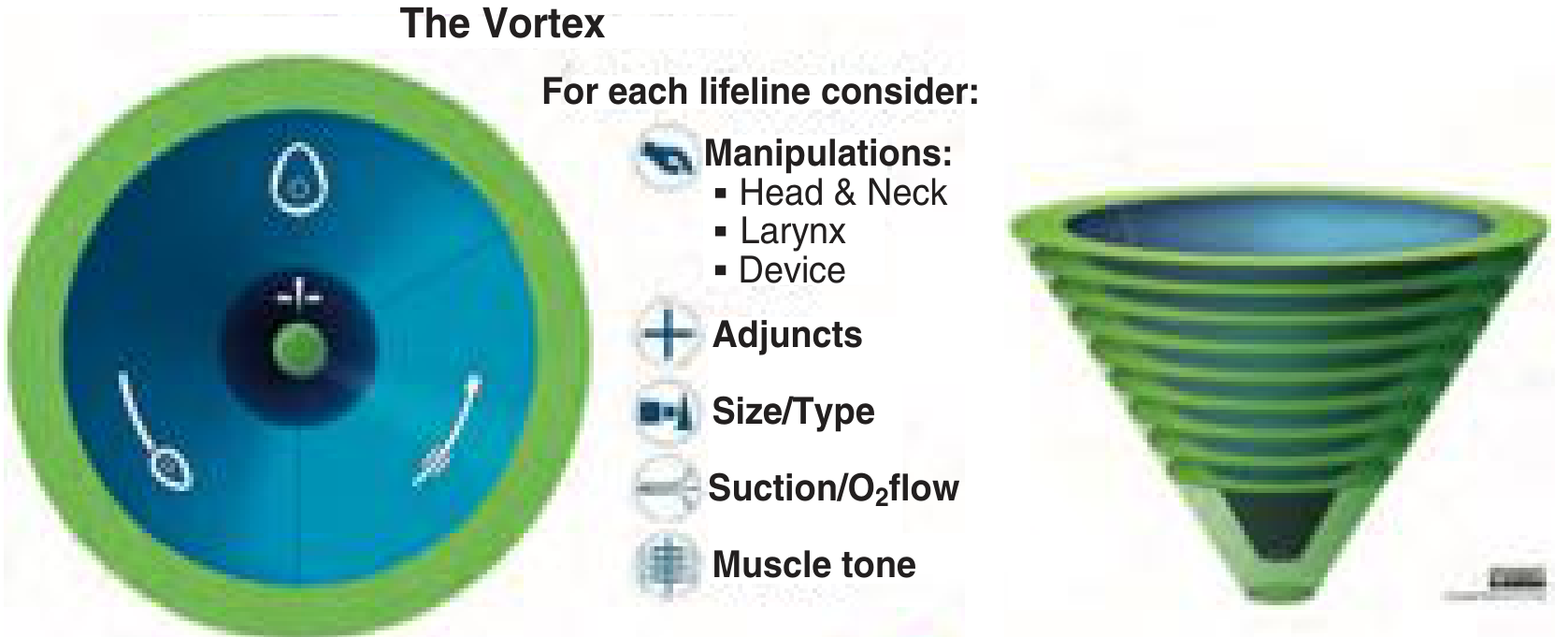
The funnel has a green outer zone (safety/non-crisis zone) and a dark central zone (representing CICO - Can't Intubate, Can't Oxygenate - the life-threatening endpoint). The team spirals inward toward the dark zone with each unsuccessful attempt, providing a visual metaphor for the deteriorating situation.
The Three "Lifelines" (Non-Surgical Airways - NSA)
The outer rim of the vortex is divided into three segments - the three non-surgical airway (NSA) lifelines:
| Lifeline | Device/Technique |
|---|---|
| 1. Face Mask Ventilation (FM) | Bag-mask ventilation |
| 2. Supraglottic Airway (SGA) | LMA / i-gel / other SGAs |
| 3. Tracheal Intubation (TI) | Direct/video laryngoscopy, fibreoptic, bougie-assisted |
Key Rule: Maximum 3 attempts at each lifeline
- At least one attempt at each lifeline must be made by the most experienced clinician available
- A "gamechanger" - a significant change in patient position, device size/type, technique, or operator - may justify an additional attempt beyond three
Optimisation Strategies for Each Lifeline
Before abandoning a lifeline and moving to the next, the operator should consider optimising the attempt using the following factors (acronym: MASS):
- Manipulations - Head & neck position, laryngeal manipulation, jaw thrust
- Adjuncts - Oropharyngeal/nasopharyngeal airway, stylet, bougie, introducer
- Size/Type - Different device size or type (e.g. switch from direct to video laryngoscopy)
- Suction/O2 flow / Muscle tone - Ensure adequate suction, apply apnoeic oxygenation, consider reversal of neuromuscular blockade if appropriate
(Miller's Anesthesia 10e; VortexApproach.org)
CICO Status and Escalation
- CICO (Can't Intubate, Can't Oxygenate) status is triggered when a "best effort" at ANY single lifeline fails. The team escalates CICO status with each unsuccessful best effort, reinforcing urgency.
- The model demands early recognition of CICO - ideally before SpO2 begins to fall - so that Emergency Surgical Airway (ESA) is not delayed.
- Evidence shows that morbidity and mortality in CICO scenarios are often not due to failure to perform the ESA itself, but due to delays in recognising the need for it.
Emergency Surgical Airway (ESA)
The dark central zone of the vortex represents the indication for an Emergency Surgical Airway (ESA):
- Cricothyroidotomy (surgical or needle) - the recommended technique
- "A surgical airway is NOT a failed airway" - it represents a lifesaving, proactive decision
- All team members should recognise when the "green zone" cannot be maintained and ESA must proceed
(Cummings Otolaryngology - DART Program)
Key Features and Advantages
| Feature | Detail |
|---|---|
| Goal-oriented | Focuses on achieving airway patency, not specific techniques |
| Universal | Applicable across anaesthesia, EM, ICU, pre-hospital settings |
| Addresses human factors | Promotes team communication, shared mental model, avoids fixation error |
| Visual simplicity | Can be recalled/used during a high-stress crisis |
| Non-prescriptive | Does not specify devices, allowing clinical flexibility |
| Team tool | Any team member can use it to communicate situation and escalate |
Integration with Guidelines
The Vortex approach is acknowledged by:
- The DAS 2015 Guidelines (Difficult Airway Society) - as a tool for "real-time" use during an emergency (unlike the DAS algorithm itself, which is for training/preparation)
- The 2018 DAS/ICS/FICM/RCoA guidelines for intubation of critically ill adults - explicitly incorporate the Vortex
- The ASA 2022 Practice Guidelines - cite the Vortex as a cognitive aid alongside the ASA Difficult Airway Algorithm infographic
- The DART (Difficult Airway Response Team) Program at Johns Hopkins - uses a combined ASA/Vortex approach as its standardised cognitive aid
(Miller's Anesthesia 10e; Fishman's Pulmonary Diseases; Cummings Otolaryngology)
Comparison with Linear Algorithms
| Aspect | Linear Algorithm (DAS/ASA) | Vortex Approach |
|---|---|---|
| Format | Step-by-step flowchart | Visual cognitive aid (funnel) |
| Best use | Pre-operative planning/training | Real-time crisis management |
| Technique specific | Yes | No (goal-oriented) |
| Human factors | Limited | Explicitly addressed |
| Universality | Speciality-specific | Cross-speciality |
Summary
The Vortex approach is a simple, goal-oriented cognitive aid for managing the unanticipated difficult airway. It organises the three non-surgical airway lifelines (face mask, SGA, tracheal tube) around a visual funnel, permitting a maximum of 3 optimised attempts at each before declaring CICO and proceeding to Emergency Surgical Airway. Its strength lies in its simplicity under stress, its applicability across clinical environments, and its focus on team situational awareness and early escalation - filling a critical gap left by traditional linear algorithms during real-time airway crises.
This is a shared conversation. Sign in to Orris to start your own chat.