
Give mbbs forensic medicine detailed easy to remember notes on coup injury and contrecoup injuries
coup and contrecoup brain injury diagram head trauma
contrecoup traumatic brain injury mechanism
Coup and Contrecoup Injuries — MBBS Forensic Medicine Notes
1. Quick Definitions (learn these two lines first)
| Term | Meaning | Location of brain damage |
|---|---|---|
| Coup (French = "blow") | Injury directly beneath the site of impact | Same side as the blow |
| Contrecoup (French = "counter-blow") | Injury opposite to the site of impact | Contralateral side (or against falx/tentorium) |
2. The Single Most Important Rule (exam favorite)
BLOW on a fixed/resting head → COUP injury predominates. FALL of a moving head onto a hard surface → CONTRECOUP injury predominates.
- Blow (weapon hits a head that is fixed, e.g., lying on ground) → coup contusion is bigger; contrecoup is small/absent.
- Fall (head is moving and strikes a hard, fixed surface like the ground) → contrecoup contusion is bigger; coup is small/absent.
3. Mechanism (why this happens)
- The skull decelerates suddenly, but the brain (a semi-jelly mass) keeps moving for a fraction of a second due to inertia.
- This differential movement produces shear strains - stretching/tearing of brain tissue and vessels - both at the impact site and, more severely, at the far pole.
Classic theories of contrecoup (easy recall - "SHRRR" - just pick 3-4 to remember well)
| Theory | Author | One-line idea |
|---|---|---|
| Struck Hoop theory | - | Skull flattens at impact → transiently becomes ovoid → opposite pole gets stretched/damaged |
| Theory of brain displacement | Russell | Brain (jelly-like) lags behind, moves toward impact site → creates a vacuum/potential space on the opposite side → vessels there tear |
| Pressure gradient theory | Gaggio | Impact side = high pressure; opposite side = negative pressure → vessels burst on the negative-pressure side |
| Shear strain / rotational force theory (most accepted) | Holbourn (1943) | Rotation of the head on impact causes shear strains that pull brain particles apart; rotational velocity change is greatest at the pole opposite the impact, so contrecoup damage is more extensive |
| Theory of bony irregularities | Rawling | Irregular bony ridges (orbital plate, cribriform plate, lesser wing of sphenoid, tentorial edge) contuse/lacerate the frontal and temporal lobe tips as the brain slides over them |
4. Practical/High-Yield Points (favorite viva/short-answer list)
- Sometimes only contrecoup lesion is present with no coup damage at all (common in falls).
- Skull fracture is NOT necessary for coup or contrecoup injury to occur - both can happen with an intact skull.
- Most common site for contrecoup = frontal lobes, especially the tips of the frontal poles (may be symmetrical after a fall on the occiput) and tips of temporal lobes.
- In temporal/parietal impact, contrecoup lesions usually appear on the diametrically opposite contralateral surface.
- In some temporal impacts, contrecoup damage occurs not on the contralateral hemisphere but on the opposite side of the same (ipsilateral) hemisphere, due to the brain striking the falx cerebri.
- It is virtually never seen that a fall on the frontal region produces an occipital contrecoup (occipital lobes are protected by the smooth, well-fitted tentorium/skull contour there).
- Severe frontal contrecoup (from an occipital fall) can be strong enough to fracture the thin bone of the anterior cranial fossa floor → cracks in the orbital roof → blood tracks into the orbit → "black eye" (periorbital ecchymosis) without any direct facial blow. (Classic medicolegal trap - don't mistake this for assault to the face!)
- Contrecoup contusions/lacerations are classically from a falling (moving) head, but can also occur when a blow strikes a fixed head - e.g., a person lying on the ground hit hard on the temporal/parietal region can get contrecoup injury in the contralateral cortex or against the falx.
- Contrecoup injuries are rare before age 3 (skull is more elastic/pliable in infants, absorbs energy differently) and also less marked in the very elderly with brain atrophy.
- Pathologically, contrecoup lesions present as cortical contusions or lacerations - often "fracture contusions" of the orbital and temporal pole surfaces where the brain grinds against bony ridges.
- A line joining the centers of the coup and contrecoup lesions indicates the direction of the impact force.
5. Medicolegal Significance (why this topic matters in exams and courtroom)
- Helps differentiate accidental fall vs. homicidal assault based on the pattern and severity of coup vs. contrecoup damage.
- Helps explain injuries in unexpected locations (e.g., frontal lobe damage when the actual blow was to the back of the head) - important so injuries aren't wrongly attributed to a second assailant or a second blow.
- Explains "black eye" without facial trauma (from anterior fossa fracture due to contrecoup) - avoids wrongful assumption of a punch to the face.
- Can help estimate number and direction of blows when correlating external wound sites with internal coup/contrecoup patterns.
Diagram
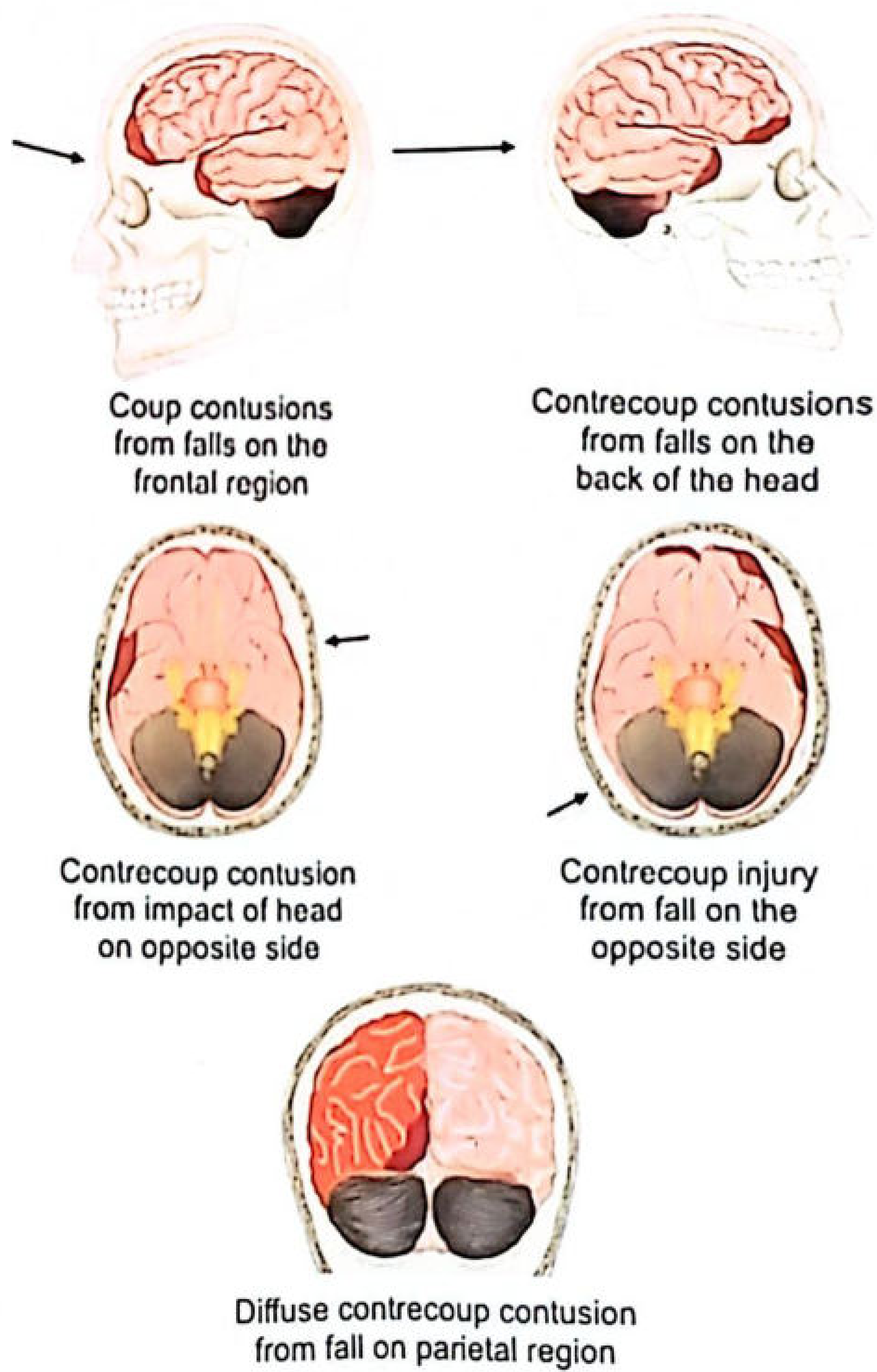
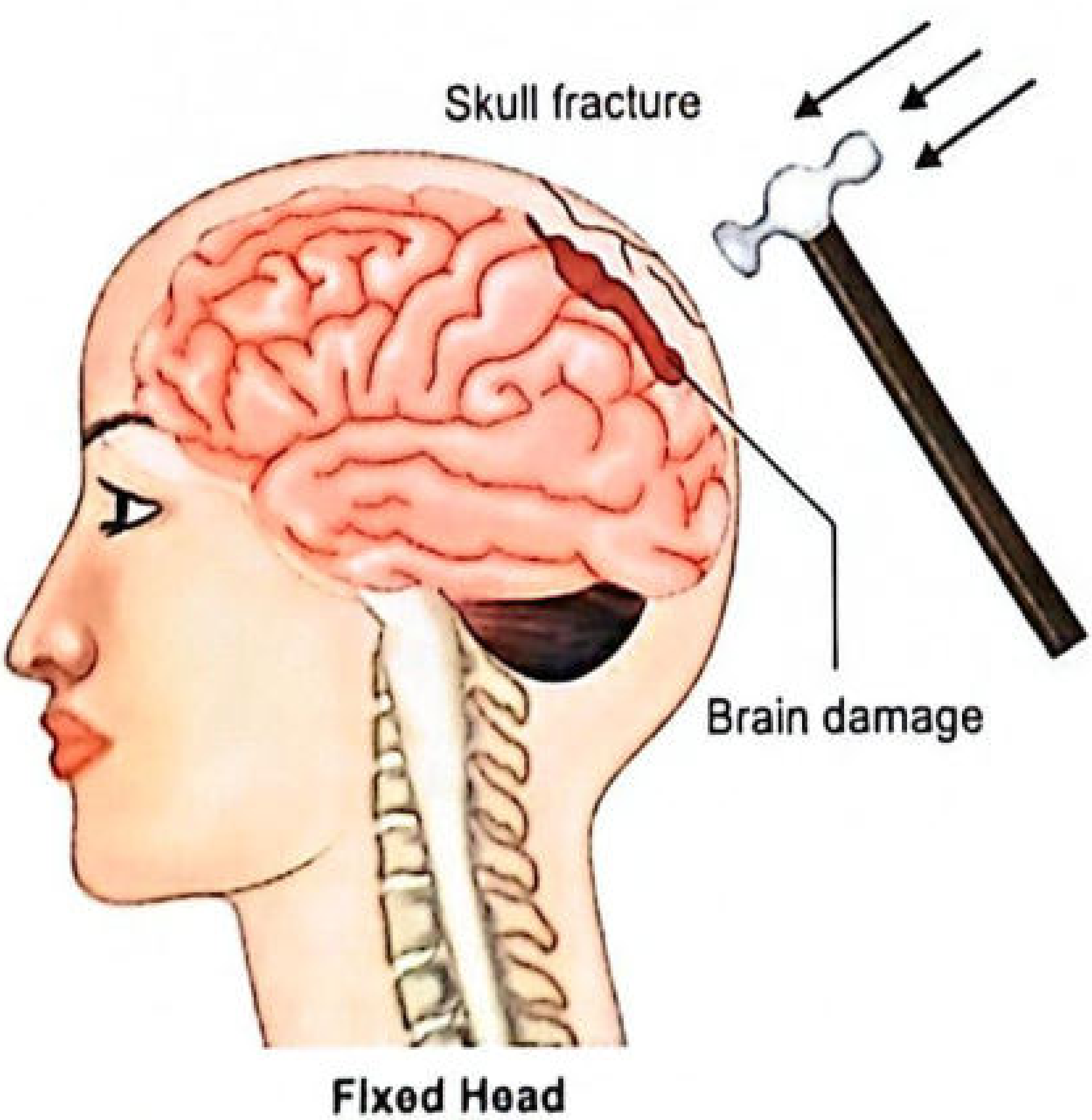
Include information from this tetLESIONS: Coup (blow; impact) means that the injury is located beneath the area of impact, and results directly by the impacting force. Contrecoup means that the lesion is present in an area opposite the side of impact Figs. (9-11, 9-14 and 9-16), Holbourn (Oxford physicist) in 1943, demonstrated that contrecoup lesions are chiefly due to local distortion of the skull, and sudden rotation of the head resulting from blow, which cause shear strains due to the pulling apart of the constituent particles of the brain. Holbourn defines shear strain as "a strain produced by applied forces which cause or tend to cause adjoining parts of the body to slide relatively to each other in a direction parallel to their planes of contact". A certain amount of shear may occur below the point of impact, particularly if the skull is fractured, which accounts for the coup, Fig. (9-16). A much greater shear strain develops as a result of the rotation of the skull, and because the changes in the rotational velocity are usually greater at the pole opposite to the point of impact, contrecoup injuries are more extensive. A line drawn between the centres of coup and contrecoup indicates. the direction of impact relative to the head. In some cases, there may be no coup damage at all, only contrecoup. Fracture of the skull may not occur, even in the presence of severe coup and cortrecoup injuries. Contrecoup injuries can also occur when a blow is struck on a fixed head Figs. (9-16 to 9-18). If a person is lying on the ground or against some other unyielding surface, a heavy blow on the upper temporal or parietal area, may cause typical contrecoup injuries either in the contralateral temporal or parietal cortex, or against the falx on the inner side of the ipisilateral lobe. There is often coup injury also. Mechanism: Contrecoup injury is caused when the moving head is suddenly decelerated by hitting a firm surface, e.g., striking the head on the ground during a fall, usually seen in traffic accidents. Subdural or subarachnoid haemorrhage may be caused as a contrecoup lesion. The sudden arrest of the head results in the brain which is still in motion, striking the arrested skull. A blow to the head causes the skull to move forward, but the brain lags behind for a brief period and the skull strikes the brain (acceleration injury). Another factor responsible for contrecoup injury is formation of a cavity or vacuum in the cranial cavity on the opposite side of impact, as the brain lags behind the moving skull. The vacuum exerts a suction effect which damages the brain Fig. (9-17). Brain Injuries: Occipital injuries produce severe and extensive contrecoup lesions in the frontal region. The irregular bony prominences, particularly of the orbital and cribriform plates, and the lesser wings of the sphenoid, contuse or lacerate the base and produce blood-filled cavitation in the deep cortex and underlying white matter of the frontal lobes and the tips of the temporal lobes, sometimes with fracture of orbital plates. A blow at the front of the head may very rarely damage the inner and lower parts of the back of the brain by contact with the edges of the tentorium. This can also injure the brainstem and produce pontine haemorrhage. Some authors are of the opinion that a fall on the frontal region will not produce occipital contrecoup injuries due to the relatively smooth internal surface of the posterior cranial fossa. A fall on to the side of the head may cause a fracture of that side and contusion of the opposite side of the brain. In temporal or parietal impacts, contrecoup injuries are likely to be diametrically opposite on the contralateral surface of the brain. A fall on the top of the head may produce contusion of the ventral surface of the cerebral hemisphere. Rarely, a contrecoup lesion may be seen on the opposite side of the same hemisphere, e.g., a blow on the left parietal area may cause contrecoup lesion on the medial side of the left cerebral hemisphere against the falx. M.L. Importance: A blow to the head produces coup contusions, while contrecoup contusions are either small or absent. A fall on the head produces contrecoup contusions while coup contusions are small or absent. Contrecoup injuries are rare before the age of three years. Contrecoup injury is seen in skull, brain, liver, heart and lungs.
Coup and Contrecoup Injuries — Updated Notes (with added mechanism detail)
1. Core Definitions
| Term | Meaning | Location |
|---|---|---|
| Coup | Injury directly beneath the area of impact, caused directly by the impacting force | Same side as blow |
| Contrecoup | Lesion present in an area opposite the side of impact | Contralateral side (or against falx/tentorium) |
2. Holbourn's Shear Strain Theory (1943) — the key accepted mechanism
- Local distortion of the skull and sudden rotation of the head on impact, producing shear strains — "a strain produced by applied forces which cause or tend to cause adjoining parts of the body to slide relatively to each other in a direction parallel to their planes of contact."
- A certain amount of shear occurs below the point of impact (especially if the skull fractures) → accounts for coup damage.
- A much greater shear strain develops from rotation of the skull, because the change in rotational velocity is greater at the pole opposite the impact → so contrecoup injuries are more extensive than coup.
- A line drawn between the centres of coup and contrecoup lesions indicates the direction of the impact relative to the head.
- Contrecoup can occur even on a fixed head: if a person lying on the ground/against an unyielding surface receives a heavy blow to the upper temporal or parietal area, typical contrecoup injury can appear in the contralateral temporal/parietal cortex, or against the falx on the inner side of the ipsilateral lobe — often with coup injury present too.
3. Two Additional Mechanisms (new detail from your text — easy to remember together as "Lag → Strike → Suck")
- When a blow hits the head, the skull moves forward, but the brain lags behind for a brief instant (inertia) — the moving skull then strikes the stationary/slower brain. This is called an acceleration injury.
- Conversely, in a fall, the skull decelerates suddenly on hitting a firm surface, but the brain, still in motion, strikes the now-arrested skull — producing contrecoup contusion/laceration, and can cause subdural or subarachnoid haemorrhage.
- As the brain lags behind the moving skull, a cavity or vacuum forms in the cranial cavity on the side opposite the impact.
- This vacuum exerts a suction effect that damages the brain tissue and vessels on that far side — a distinct contributing mechanism to contrecoup injury (separate from pure shear-strain rotation).
4. Site-Specific Patterns of Brain Injury (expanded)
| Impact site | Resulting pattern |
|---|---|
| Occipital blow/fall | Severe, extensive contrecoup in frontal region — bony ridges of orbital plate, cribriform plate, and lesser wing of sphenoid contuse/lacerate the frontal lobe base and temporal lobe tips, producing blood-filled cavitation in deep cortex/white matter; sometimes with orbital plate fracture |
| Frontal blow | Rarely damages the inner/lower back of the brain by contact with the tentorium edge; can injure the brainstem and cause pontine haemorrhage. Most authors hold that a fall on the front will not produce an occipital contrecoup, because the internal surface of the posterior cranial fossa is relatively smooth |
| Fall on the side of the head | Fracture on that side + contusion of the opposite side of the brain |
| Temporal/parietal impact | Contrecoup lesions typically diametrically opposite, on the contralateral brain surface |
| Fall on top of the head (vertex) | Contusion of the ventral surface of the cerebral hemispheres |
| Rare same-side (ipsilateral) pattern | e.g., a blow on the left parietal area can cause contrecoup on the medial side of the same (left) hemisphere, from impact against the falx cerebri, rather than the contralateral side |
5. Medicolegal Importance (final consolidated list)
- Blow to a fixed head → coup contusions prominent; contrecoup small/absent.
- Fall of a moving head → contrecoup contusions prominent; coup small/absent.
- Skull fracture is not required for either coup or contrecoup lesions to occur.
- Sometimes only contrecoup is present, no coup at all.
- Contrecoup injuries are rare before age 3 (more elastic, pliable skull in infants).
- Contrecoup injury is not limited to the brain — it is also seen in the skull, liver, heart, and lungs:
- In the chest, a blow/deceleration can cause a contrecoup contusion of the lung (classically described on the posterior lung surface, opposite the side of direct force).
- Cardiac and hepatic contrecoup-type contusions occur similarly with sudden deceleration (e.g., in falls or traffic accidents), useful when correlating external trauma with unexpected internal organ injury.
- Helps forensic pathologists distinguish fall vs. assault (blow) based on the relative severity of coup vs. contrecoup lesions.
- Explains findings like a "black eye" without facial trauma, when severe frontal contrecoup from an occipital fall fractures the thin anterior fossa floor, letting blood track into the orbit.
Diagrams (mechanism reference)
Include information from this text lesions: Coup (blow; impact) means that the injury is located beneath the area of impact, and results directly by the impacting force. Contrecoup means that the lesion is present in an area opposite the side of impact Figs. (9-11, 9-14 and 9-16), Holbourn (Oxford physicist) in 1943, demonstrated that contrecoup lesions are chiefly due to local distortion of the skull, and sudden rotation of the head resulting from blow, which cause shear strains due to the pulling apart of the constituent particles of the brain. Holbourn defines shear strain as "a strain produced by applied forces which cause or tend to cause adjoining parts of the body to slide relatively to each other in a direction parallel to their planes of contact". A certain amount of shear may occur below the point of impact, particularly if the skull is fractured, which accounts for the coup, Fig. (9-16). A much greater shear strain develops as a result of the rotation of the skull, and because the changes in the rotational velocity are usually greater at the pole opposite to the point of impact, contrecoup injuries are more extensive. A line drawn between the centres of coup and contrecoup indicates. the direction of impact relative to the head. In some cases, there may be no coup damage at all, only contrecoup. Fracture of the skull may not occur, even in the presence of severe coup and cortrecoup injuries. Contrecoup injuries can also occur when a blow is struck on a fixed head Figs. (9-16 to 9-18). If a person is lying on the ground or against some other unyielding surface, a heavy blow on the upper temporal or parietal area, may cause typical contrecoup injuries either in the contralateral temporal or parietal cortex, or against the falx on the inner side of the ipisilateral lobe. There is often coup injury also. Mechanism: Contrecoup injury is caused when the moving head is suddenly decelerated by hitting a firm surface, e.g., striking the head on the ground during a fall, usually seen in traffic accidents. Subdural or subarachnoid haemorrhage may be caused as a contrecoup lesion. The sudden arrest of the head results in the brain which is still in motion, striking the arrested skull. A blow to the head causes the skull to move forward, but the brain lags behind for a brief period and the skull strikes the brain (acceleration injury). Another factor responsible for contrecoup injury is formation of a cavity or vacuum in the cranial cavity on the opposite side of impact, as the brain lags behind the moving skull. The vacuum exerts a suction effect which damages the brain Fig. (9-17). Brain Injuries: Occipital injuries produce severe and extensive contrecoup lesions in the frontal region. The irregular bony prominences, particularly of the orbital and cribriform plates, and the lesser wings of the sphenoid, contuse or lacerate the base and produce blood-filled cavitation in the deep cortex and underlying white matter of the frontal lobes and the tips of the temporal lobes, sometimes with fracture of orbital plates. A blow at the front of the head may very rarely damage the inner and lower parts of the back of the brain by contact with the edges of the tentorium. This can also injure the brainstem and produce pontine haemorrhage. Some authors are of the opinion that a fall on the frontal region will not produce occipital contrecoup injuries due to the relatively smooth internal surface of the posterior cranial fossa. A fall on to the side of the head may cause a fracture of that side and contusion of the opposite side of the brain. In temporal or parietal impacts, contrecoup injuries are likely to be diametrically opposite on the contralateral surface of the brain. A fall on the top of the head may produce contusion of the ventral surface of the cerebral hemisphere. Rarely, a contrecoup lesion may be seen on the opposite side of the same hemisphere, e.g., a blow on the left parietal area may cause contrecoup lesion on the medial side of the left cerebral hemisphere against the falx. M.L. Importance: A blow to the head produces coup contusions, while contrecoup contusions are either small or absent. A fall on the head produces contrecoup contusions while coup contusions are small or absent. Contrecoup injuries are rare before the age of three years. Contrecoup injury is seen in skull, brain, liver, heart and lungs
Coup and Contrecoup Injuries — Final Consolidated Note
- Acceleration injury: skull moves forward on impact, brain lags briefly, skull then strikes the brain; in a fall, the reverse happens — skull arrests suddenly, brain still moving strikes the arrested skull → subdural/subarachnoid haemorrhage.
- Vacuum/cavitation: brain lagging behind the moving skull creates a cavity/vacuum on the side opposite impact; the suction effect damages that side.