
Human body cell
The human body cell is the basic structural and functional unit of life. Here's a quick overview:
Key facts:
- The human body contains roughly 37 trillion cells
- Cells range in size from ~1 micrometer (platelets) to ~1 meter (motor neurons)
- Over 200 distinct cell types exist in the human body
- Most cells share common organelles but are highly specialized
Searching sources...
Reading File
Searching the Web
human body cell structure organelles functions overview
Finding Sources
Loading Image
Finding Sources
Here is a complete overview of the Human Body Cell:
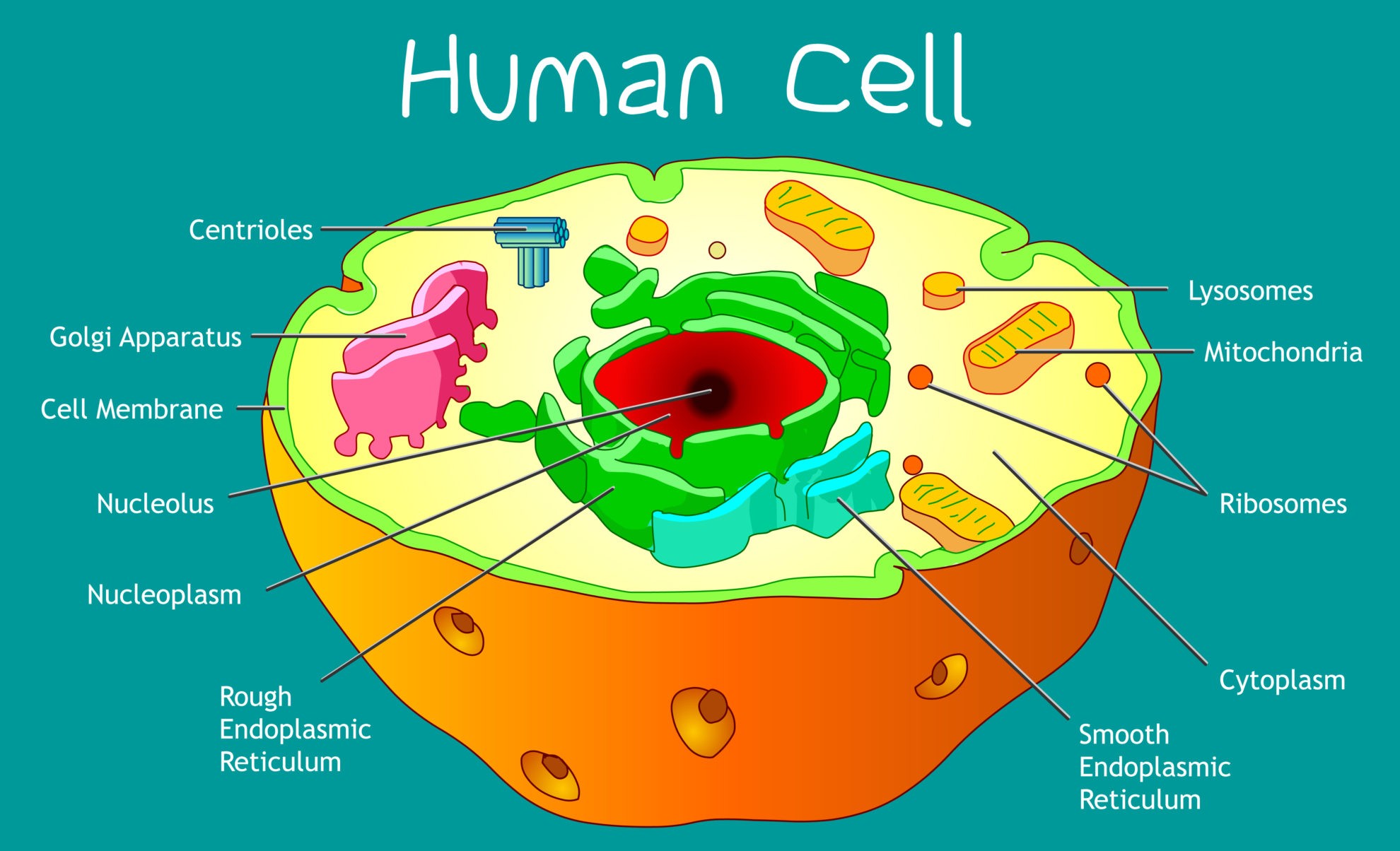
The Human Body Cell
The cell is the smallest living unit and the fundamental building block of the human body. There are approximately 37 trillion cells in the human body, spanning over 200 distinct cell types - each specialized for a particular job.
Main Parts of a Cell
A human (eukaryotic) cell has three major regions:
| Region | Description |
|---|---|
| Cell Membrane | Outer boundary; controls what enters/exits |
| Cytoplasm | Gel-like interior housing all organelles |
| Nucleus | Control center containing DNA |
Organelles and Their Functions
Membrane-Bound Organelles
| Organelle | Function |
|---|---|
| Nucleus | Stores DNA; controls gene expression and cell division |
| Nucleolus | Located inside the nucleus; produces ribosomal RNA (rRNA) |
| Mitochondria | Produces ATP (energy) via cellular respiration - the "powerhouse" |
| Rough ER | Studded with ribosomes; synthesizes and folds proteins |
| Smooth ER | Lipid and steroid synthesis; detoxification; calcium storage |
| Golgi Apparatus | Sorts, packages, and ships proteins/lipids to their destinations |
| Lysosomes | Contains digestive enzymes; breaks down waste and foreign material |
| Peroxisomes | Breaks down fatty acids and detoxifies hydrogen peroxide |
| Vacuoles | Storage; smaller than in plant cells |
Non-Membrane-Bound Organelles
| Organelle | Function |
|---|---|
| Ribosomes | Site of protein synthesis (reads mRNA) |
| Centrioles | Organize the mitotic spindle during cell division |
| Cytoskeleton | Structural support, cell shape, and intracellular transport |
The Cell Membrane
The plasma membrane is a phospholipid bilayer with embedded proteins. It is:
- Selectively permeable - allows some substances through and blocks others
- Home to receptor proteins that receive hormonal and chemical signals
- Involved in cell-to-cell communication and immune recognition
The Nucleus
- Contains the full human genome (~3 billion base pairs of DNA)
- DNA is organized into 46 chromosomes (23 pairs)
- Surrounded by a nuclear envelope with pores for molecule transport
- The nucleolus within it assembles ribosomes
Cell Division
Human cells replicate by two main processes:
- Mitosis - produces two identical daughter cells; used for growth and repair
- Meiosis - produces sex cells (gametes) with half the chromosomes; used in reproduction
Key Cell Types in the Human Body
| Cell Type | Location | Special Feature |
|---|---|---|
| Red blood cells | Blood | No nucleus; packed with hemoglobin |
| Neurons | Brain/nerves | Can extend over 1 meter long |
| Muscle cells | Muscles | Rich in mitochondria for energy |
| Epithelial cells | Skin/lining | Tightly packed; form protective barriers |
| Sperm cells | Male gonad | Has flagellum for motility |
| Egg cells | Female gonad | Largest cell in the human body (~120 µm) |
| Platelets | Blood | Tiny cell fragments; aid in clotting |
Fun Facts
- Shortest-lived cells: Intestinal lining cells (~2-4 days)
- Longest-lived cells: Neurons - some last your entire lifetime
- Smallest cells: Platelets (~2 µm)
- Largest cells: Egg cells (~120 µm visible to the naked eye)
- Mitochondria have their own DNA, supporting the theory they were once independent bacteria (endosymbiotic theory)
Want me to go deeper on any specific organelle, cell type, or process like protein synthesis, cell division, or the cell cycle?
This is a shared conversation. Sign in to Orris to start your own chat.